
You leave a wirehouse after years of building a book, sign a recruiting package with a new firm, and expect the deferred bonus on your old compensation statement to follow you. Then the former firm withholds the payout, calls a promissory note due, or points to a forfeiture clause you barely noticed. The money was “deferred,” but that never meant it was sitting in a protected account waiting for you.
So, what is deferred compensation? In the broadest sense, it's pay earned in one year but received later, often through a bonus arrangement, retirement accrual, executive plan, or other compensation program. The practical answer is more demanding. Your rights depend on the plan document, the deferral election, the payout schedule, the employer's financial condition, and the forum selected to resolve a dispute.
For financial advisors and brokers, deferred compensation is both a tax structure and a contract. Section 409A may determine when the government taxes the amount, but the written agreement often determines whether you receive it at all.
The Deferred Pay Promise Most Advisors Misunderstand
Consider a mid-career advisor who leaves a wirehouse after a long tenure. Her deferred balance is substantial, and the recruiting package from the new firm appears to replace what she believes she's giving up. She assumes the old balance will arrive according to the original schedule. Instead, the former firm says her resignation triggered forfeiture provisions, a disputed promissory note affects the account, and the payout schedule no longer operates as she expected.
That result surprises people because they treat deferred compensation like a delayed paycheck. It usually isn't. A deferred amount is a future payment right governed by a written plan, an election, and specified distribution terms. The plan may condition payment on continued service, define when a separation from service occurs, impose forfeiture after competition or solicitation, or authorize changes that affect administration.
Three assumptions that create expensive mistakes
Deferral equals accrual. Deferral means payment occurs later. It doesn't necessarily mean the participant has already earned an unconditional right to every dollar reflected on a statement.
Vesting means the money is protected. Vesting can remove one condition, but it doesn't turn an unfunded promise into segregated property. A vested benefit may remain exposed to plan language, employer solvency, and creditor claims.
Tax rules protect the payout. Section 409A controls important tax timing rules for nonqualified deferred compensation. It doesn't guarantee that an employer will honor a disputed contractual interpretation, and it doesn't eliminate a valid forfeiture provision.
Practical rule: Read the forfeiture clause before you negotiate the transition, not after the firm withholds the money.
The definitions matter more than the marketing label. Review separation from service, resignation, termination for cause, competition, solicitation, release requirements, change in control, and any provision addressing a promissory note. Determine whether the plan allows the employer to amend the arrangement, offset amounts, or alter the payment form.
Also identify the dispute-resolution forum. A mandatory FINRA arbitration provision, a JAMS clause, a court-selection provision, or an agreement with no clear forum can materially change how quickly and effectively you challenge a withheld payout. The strongest practical protection often comes from understanding those provisions before giving notice, accepting a recruiting package, or signing a separation agreement.
Qualified Plans and Nonqualified Arrangements Explained
An advisor can see a substantial balance on a compensation statement and still hold only an unsecured promise. The first question is whether the arrangement is qualified or nonqualified, because that label affects tax treatment, creditor protection, contribution limits, and the remedies available if a firm withholds payment.
A qualified plan, such as a 401(k) or defined-benefit plan, operates under federal tax and employee-benefit rules and commonly uses a trust structure. A nonqualified deferred compensation arrangement, or NQDC plan, is generally a contractual promise by the employer to pay compensation later outside the qualified-plan framework.
Section 409A governs much nonqualified deferred compensation, while qualified plans such as 401(k) arrangements follow a different regulatory framework. The distinction does not make an NQDC plan invalid or automatically unfavorable. It means the participant must assess a different combination of tax restrictions, employer solvency risk, and contractual remedies.
Common NQDC structures include elective bonus deferrals, employer contributions, supplemental executive retirement plans, phantom stock, and stock appreciation rights. Firms use them to retain selected employees and offer compensation beyond qualified-plan limits. The trade-off is direct: the participant usually receives a contractual promise, not ownership of assets held in a protected account.
A practical comparison
| Feature | Qualified Plan, such as a 401(k) | Nonqualified Plan, NQDC |
|---|---|---|
| Legal structure | Operates within qualified-plan and ERISA rules | Contractual compensation arrangement subject to applicable tax rules |
| Tax treatment | Favorable tax treatment when plan requirements are met | Tax deferral depends heavily on Section 409A compliance |
| Asset protection | Commonly supported by a trust and federal plan protections | Often an unfunded, unsecured obligation of the employer |
| Creditor exposure | Generally stronger participant protections | Participant may stand as a general unsecured creditor |
| Contribution limits | Qualified plans have statutory limits, including the $24,500 employee elective deferral limit for 2026 for 401(k) and profit-sharing plans, according to the IRS contribution-limit guidance | The plan may permit broader deferral opportunities, but its own terms control |
| Flexibility | Distribution, rollover, and loan rights depend on the plan | Payment dates and forms are usually fixed in advance |
| Dispute focus | Federal plan rights and administrative procedures may dominate | Contract language, forfeiture provisions, and arbitration clauses often dominate |
Governmental and tax-favored arrangements require separate analysis. The IRS describes a Section 457(b) plan as an arrangement that defers compensation through salary reduction or employer contributions. Its annual ceiling is the lesser of the applicable dollar amount or 100% of includible compensation, as stated in the IRS Section 457(b) requirements.
The practical question is where the plan fits and what follows after resignation. Check whether the benefit is held in trust or recorded only on the employer's books, then review payment conditions, forfeiture language, offsets, and dispute procedures. A focused employment agreement review can identify terms that change the value of the promised compensation before an advisor signs an employment or transition agreement.
Section 409A and the Tax Timing Trap
An advisor may leave a firm expecting deferred bonuses to be paid on a stated schedule, then learn that the firm will not release them without a signed release or a dispute over separation. Section 409A may affect the tax result, but it does not decide every contractual question. The plan's language, the election record, and the administrator's conduct determine whether the promised payment can be withheld and what tax exposure follows.
Section 409A governs much nonqualified deferred compensation. Congress added it to the Internal Revenue Code through the American Jobs Creation Act of 2004, enacted on October 22, 2004. The rules became effective for amounts deferred in taxable years beginning after December 31, 2004, as reflected in IRS Notice 2009-92.
The plan generally must identify when compensation may be deferred, when payment will occur, and which events permit distribution. A failure can make deferred amounts currently taxable, with an additional 20% tax and interest consequences. That exposure often leads administrators to take a conservative position when an advisor demands payment under disputed circumstances. It does not, by itself, validate a forfeiture provision or defeat a contract claim.
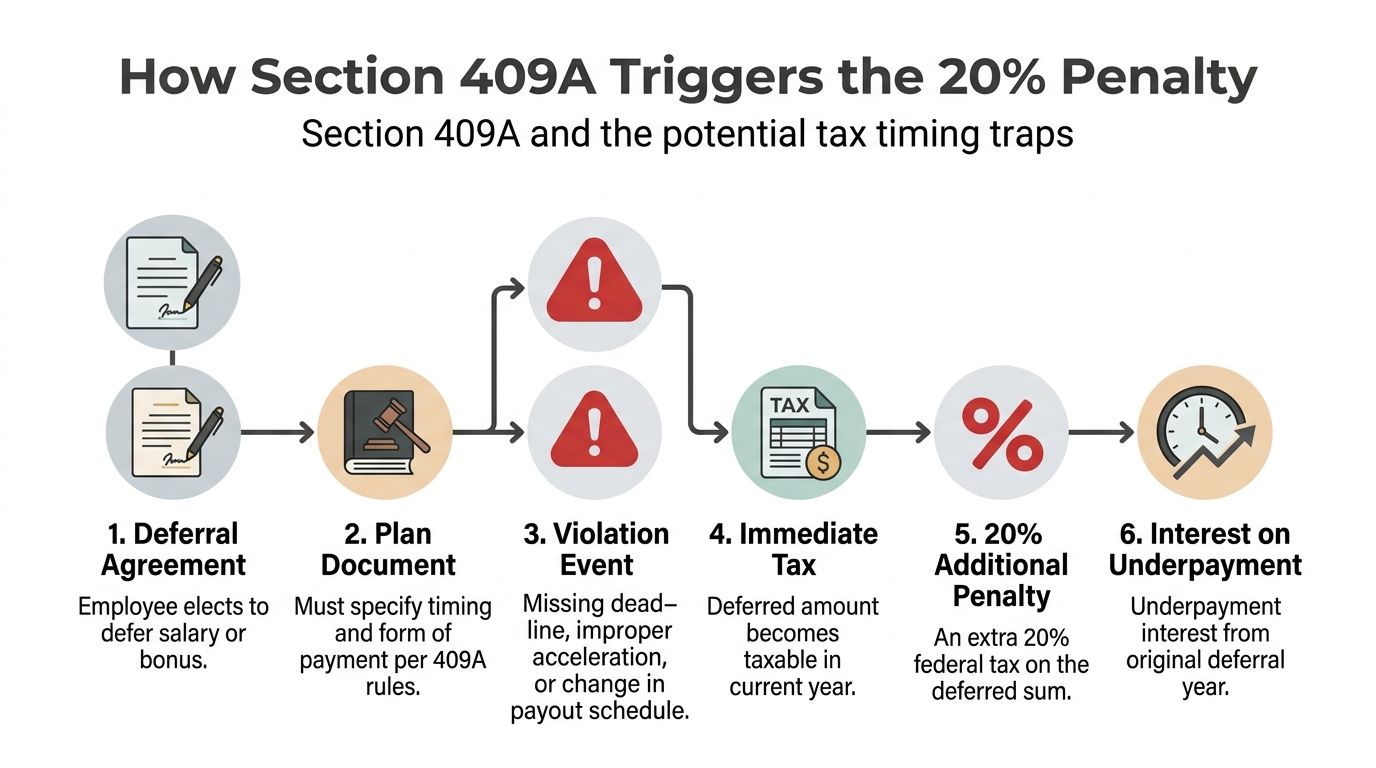
The timing rules advisors need to test
Election timing comes first. Section 409A generally requires an election during the year before the year in which services are performed. The payment timing and form generally must be set by that deadline, as explained in this Section 409A analysis from Gibson Dunn. A late salary or bonus election can defeat the intended deferral.
Payment acceleration is restricted. A participant usually cannot move a payment date forward because circumstances changed. Permitted events may include death, disability, an unforeseeable emergency, a qualifying change in control, separation from service, or a fixed schedule. The plan wording and the facts must satisfy the applicable rule.
Changes require patience. A later election generally must take effect only after at least 12 months. Most payment changes must delay payment by at least five additional years. A change tied to a fixed time or schedule generally must be made at least 12 months before the first scheduled payment, as described in IRS Notice 2009-92.
Operations matter as much as drafting. A compliant document can still produce a tax problem if the firm misses an election, handles payroll inconsistently, records the wrong separation date, or makes an unauthorized payment change. Preserve payroll records, election forms, plan amendments, and communications about the payout.
Public-company participants may face a six-month delay after separation from service if they qualify as specified employees. That delay affects timing, not necessarily entitlement. Review the plan and administration record together. In a payout dispute, tax compliance and the firm's contractual duty are related questions, not the same question.
Why Unfunded Top-Hat Plans Change the Power Balance
“Unfunded” doesn't mean the employer failed to keep a spreadsheet. It means the participant generally doesn't own a segregated pool of assets dedicated to satisfying the benefit. The firm may record the deferred balance on its books, but the participant's right commonly remains a contractual claim against the employer.
A select-management arrangement may qualify as an ERISA top-hat plan. That status can exempt the plan from ERISA's funding, vesting, and fiduciary requirements while leaving it subject to ERISA reporting and enforcement rules, as described in Pullcom's discussion of Section 409A and employment agreements.
What the participant actually owns
The participant may have a right to payment, but not a trust-account right. If the employer becomes insolvent, the participant may stand alongside other general unsecured creditors rather than ahead of them. The accounting entry doesn't create security, and a reference to investment returns doesn't necessarily mean assets were legally set aside.
A rabbi trust can provide administrative structure and may track assets associated with the plan, but it generally doesn't remove those assets from the employer's creditor pool. A secular trust can provide a different form of protection, but the exact structure and tax treatment require careful review. The label alone doesn't answer the question.
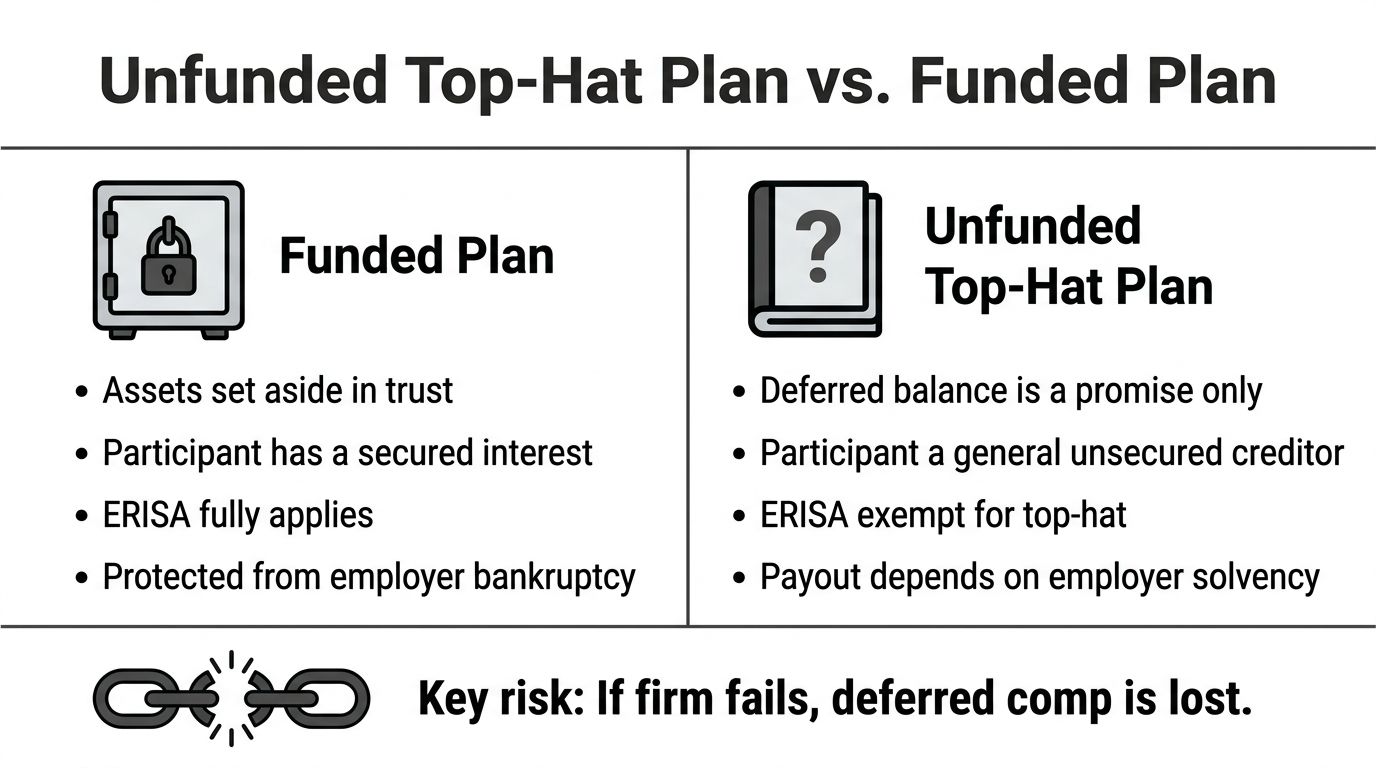
That power imbalance becomes sharper after termination. The employer controls the records, interprets the plan, and may possess the documents needed to calculate the benefit. The participant must often prove a contractual entitlement while responding to arguments about forfeiture, cause, competition, release conditions, or offsets.
Priority claims and attempts to pierce a corporate structure are fact-specific and uncommon remedies. They depend on bankruptcy law, the employer's conduct, the governing entity documents, and evidence of wrongdoing. An advisor shouldn't assume that a corporate guarantee exists because a parent company sponsors or administers the plan.
How Deferred Comp Disputes Start Between Firms
The dispute often begins with a transition that looks routine. An advisor accepts a recruiting package from a new firm, resigns from the old wirehouse, and expects the new compensation to replace the value of the old deferred balance. The former firm then invokes a resignation-based forfeiture clause, while the new firm says its package addressed recruiting costs or replacement compensation, not a guaranteed reimbursement of every withheld benefit.
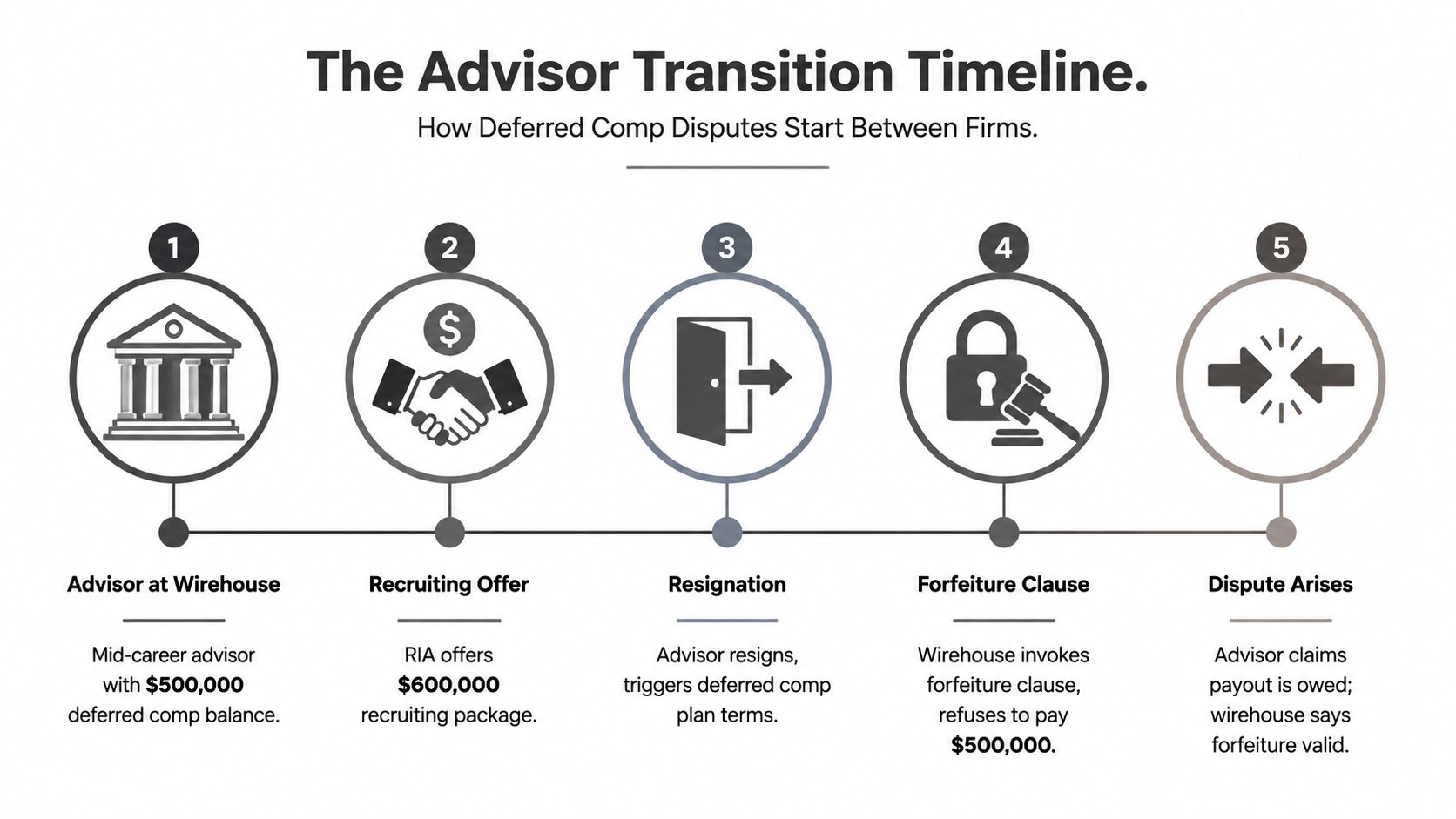
A forgivable loan or promissory note can make the situation worse. Voluntary resignation may accelerate repayment under the note, while the former firm withholds deferred compensation under the plan. The new firm may refuse to gross up the loss, and the advisor faces competing demands: one firm wants repayment, the other wants to avoid paying a disputed replacement amount, and the advisor wants the compensation originally promised.
Where the “double-dipping” argument enters
Recruiting packages are often drafted against a backdrop of compensation the advisor may forfeit by leaving. If the new firm pays a replacement amount and the old firm later pays the deferred balance, the former employer may argue that the advisor received duplicate compensation. If the old firm refuses to pay, the new firm may contend that its recruiting payment already covered the loss.
The argument isn't resolved by fairness alone. Decision-makers examine the recruiting agreement, the prior plan, payout statements, communications between firms, and the precise language describing offsets or replacement compensation. A promise made verbally by a recruiter may carry little weight if the signed agreement contains an integration clause or a contrary condition.
For broader context on structuring compensation around business growth, advisors and owners may find this resource on partner compensation for growth useful, particularly when comparing retention incentives with immediate compensation.
Before joining a new firm, ask the questions outlined in this broker transition review guide. The objective isn't to eliminate every risk. It's to identify which firm bears the risk if the old balance is forfeited, the note becomes due, or the payout schedule changes.
Recovering Withheld Payouts Through FINRA Arbitration
A withheld deferred-compensation payout requires a document-driven response. Start with the plan and the separation agreement, then locate the mandatory arbitration clause. A FINRA provision may send the dispute to FINRA arbitration, while another agreement may direct claims to JAMS or a court.
Before filing, send a focused demand letter when strategy supports it. Identify the payment obligation, the relevant payout date, the clause the firm relies on, and the relief requested. A demand that forces the employer to state its interpretation can narrow the dispute and expose whether the claimed forfeiture is contractual or an administrative position.
Evidence determines leverage
Preserve the complete record, not only the favorable emails. Keep plan booklets, amendments, enrollment confirmations, deferral elections, compensation statements, recruiting documents, promissory notes, resignation communications, termination notices, and any Form U5-related correspondence. Don't alter the files or rely on an online portal that may later change.
Common remedies include damages for breach of contract, an order requiring payment when available, and defenses or counterclaims involving a promissory note. The panel may also consider offsets, mitigation, release language, and whether the participant satisfied conditions attached to the benefit.
FINRA arbitration procedure and claim-filing considerations are addressed in this FINRA arbitration process guide. Forum selection affects the available discovery, the decision-maker, confidentiality, motion practice, and enforcement path.
Use this preliminary checklist:
- Contracts: Gather every agreement that mentions the benefit, resignation, repayment, or arbitration.
- Dates: Build a timeline of the election, vesting, resignation, scheduled payout, and demand for payment.
- Calculations: Reconcile statements with the plan formula and identify disputed offsets.
- Communications: Preserve recruiter promises and the firm's stated reason for withholding payment.
- Counterclaims: Review whether the promissory note can be challenged, reduced, or defended based on the firm's conduct.
Don't wait until records disappear or a filing deadline becomes the central issue. Counsel can assess the governing forum and limitations issues before the claim is framed.
Protecting Your Deferred Compensation Going Forward
The best time to evaluate deferred compensation is before signing the transition package. Start with the benefit itself, then trace every condition that can reduce or delay it. A projected payout has value only if the plan makes the right enforceable after the event that matters, usually resignation, retirement, termination, or a change in control.
A decision framework for advisors
Confirm the election. Verify when the deferral election must be made, what compensation it covers, and whether the selected payout schedule complies with Section 409A. Don't rely on a recruiter's summary or a prior year's election form.
Test the exit provisions. Read the definitions of resignation, termination for cause, separation from service, competition, solicitation, and release. Ask whether vesting accelerates, stops, or reverses when you leave.
Map the repayment risk. Compare the deferred-compensation terms with every forgivable loan and promissory note. Determine whether the firm can offset the deferred balance against amounts allegedly due, and whether a resignation triggers immediate repayment.
Put incentives in writing. If the new firm promises to replace forfeited compensation, identify the amount, payment dates, conditions, tax treatment, and what happens if the old firm later pays. Oral assurances are difficult to enforce when the final agreement says something else.
Choose the forum early. Mark every arbitration clause and governing-law provision. A state-law contract claim may remain important even when the dispute proceeds in a FINRA forum, but the pleading and remedy strategy must account for the arbitration agreement.
For a tax and planning perspective that complements legal review, the Allied Tax Advisors executive guide provides additional context on evaluating deferred compensation arrangements. Legal review should focus on a different question: what happens when the employment relationship breaks down?
Also examine any clawback provision before accepting a bonus or recruiting payment. Prevention usually costs hours. A payout dispute can consume years, especially when the employer controls the records and asserts a promissory-note counterclaim.
If a prior firm delays your payout or a new package contains aggressive forfeiture language, Kons Law can review the compensation documents, assess contract and arbitration issues, and advise financial professionals on withheld compensation and promissory-note disputes. To discuss your business law matter, contact Kons Law at (860) 920-5181 or visit Kons Law.
