
You're about to sign a vendor agreement, advisor contract, or partnership deal. The business terms look settled, everyone wants to move quickly, and the document appears to confirm what you already discussed. Months later, the vendor misses deadlines, the advisor disputes a repayment obligation, or both sides discover that “for cause” and “reasonable production” meant different things to each of them.
That outcome usually isn't caused by one dramatic mistake. It comes from assumptions that never became operative language. Contract drafting is the discipline that closes that gap. It turns a commercial understanding into rules that identify the parties, define performance, allocate risk, establish remedies, and create evidence of what the parties agreed to do. A useful starting point is this practical guide to writing a business contract, but the actual work begins before anyone opens a template.
Contract Drafting in Plain Language
So, what is contract drafting? It's the structured process of converting a business arrangement into precise, enforceable language. A well-drafted agreement should let a neutral reader determine:
- Who is bound: The legal names, roles, authority, and responsibilities of each party.
- What must happen: The services, goods, payments, approvals, disclosures, and other obligations.
- When it must happen: Deadlines, milestones, notice periods, renewal dates, and cure periods.
- How performance is measured: Deliverables, service levels, acceptance criteria, production formulas, or other objective standards.
- What happens if something goes wrong: Damages, indemnification, suspension, termination, repayment, arbitration, or other remedies.
A contract is therefore more than a record of mutual intent. It's the operating manual for the transaction. The scope of work tells a vendor what it must deliver. Payment provisions determine when cash leaves one party and reaches the other. Termination language controls how a relationship ends. A limitation of liability clause determines which losses remain with the party that suffers them and which losses can be shifted.
Drafting also requires translating commercial shorthand into legal mechanics. “The consultant will help with sales” isn't an actionable standard. A stronger provision might identify the accounts covered, the activities required, the reporting cadence, the approval process, and the conditions for earning compensation. “Payment is due promptly” leaves room for disagreement. A defined due date, invoice procedure, and consequence for late payment gives the parties something they can administer.
Practical rule: If a material business assumption matters to the deal, put it in a clause, a schedule, a calculation method, or an approval mechanism.
The best draft isn't necessarily the longest one. Extra language can create contradictions, increase negotiation friction, and obscure the terms that matter. The better test is whether the document expresses the negotiated deal clearly enough for people who weren't in the original conversation to apply it consistently.
Why Drafting Is an Economic Control Function
A supplier delivers late, an invoice is disputed, and the contract offers no clear way to calculate the adjustment. The business may have negotiated a discount or service commitment, yet the document does not make that value usable. Drafting determines whether agreed commercial outcomes survive contact with daily operations.
World Commerce & Contracting's 2023 benchmark research reported average contract-value erosion of 8.6% in 2023, referring to the difference between expected contractual value and actual outcomes such as missed savings, uncontrolled costs, revenue leakage, and weak risk allocation (World Commerce & Contracting benchmark report). The figure does not mean every agreement loses the same amount. It shows why signing a contract does not, by itself, secure the economics of the deal.
The financial effect often sits in specific provisions:
- Price adjustment language controls whether rates can change, the permitted grounds for an increase, and the required notice.
- Service levels set measurable performance standards and may connect missed targets to credits, corrective work, or termination rights.
- Payment provisions govern invoice content, disputed amounts, withholding rights, and the timing of cash flow.
- Renewal mechanics can extend an arrangement unless notice deadlines and pricing changes are stated clearly.
- Indemnification assigns specified third-party claims, losses, or expenses to one party.
- Limitation of liability sets a ceiling or excludes categories of damages, changing exposure when the transaction fails.
- Termination rights determine whether a party may exit for convenience, breach, insolvency, regulatory concerns, or prolonged delay.
A vague provision creates operational cost before anyone files a claim. It may delay payment, reduce bargaining power during renegotiation, block recovery for a loss, or keep an unprofitable relationship in place. Precise drafting makes duties, calculations, deadlines, and remedies workable for the people administering the agreement.
The same benchmark research indicates that organizations in technology and software may achieve improvements equivalent to 5–7% of contract value through cost reduction, cost avoidance, or revenue enhancement when contract-management practices are stronger. Drafting alone does not produce that outcome. It supplies the terms that contract-management processes must track, apply, and enforce.
A practical review therefore starts with one question: Which clause controls the money or risk that matters most in this transaction? The answer directs attention toward pricing, delivery, payment, exit, and exposure rather than page count or familiar boilerplate.
The Four Stages of the Drafting Process
Drafting works best as a sequence rather than a writing exercise performed in isolation. The drafter first identifies the deal, then converts it into clauses, tests the language through negotiation, and makes the allocation of risk explicit.
Stage one identifies the commercial terms
Start with the transaction, not the template. For a small services engagement, the initial term sheet might identify the parties, the services, the project fee, delivery milestones, client approvals, ownership of work product, and the intended end date.
That list should also capture facts that people often leave implicit:
- Who supplies materials or access?
- Who has authority to approve deliverables?
- What happens if the client delays a decision?
- Can the provider use subcontractors?
- What evidence establishes completion?
- Does the fee change when the scope changes?
The drafter converts those answers into operative facts. If the parties agreed on a project fee payable after acceptance, the draft needs an acceptance process, a response deadline, and a procedure for rejected work. Without those details, the payment term may not function as intended.
Stage two converts terms into clauses
The next stage is requirements engineering. Each material fact becomes a covenant, condition, definition, representation, schedule, or remedy.
A price term might become a payment clause with invoice requirements and a due date. A deadline might become a milestone tied to a deliverable and an approval process. A statement that the provider will meet “industry standards” might need a defined technical standard, testing method, or service-level schedule.
Definitions do real work here. They prevent the drafter from using “Services,” “Deliverables,” and “Work Product” as if those terms were interchangeable when they carry different consequences. An order-of-precedence clause can determine whether the signed agreement, statement of work, purchase order, or online terms control when documents conflict.
Stage three tests the language through negotiation
Negotiation isn't merely a contest over redlines. It's a test of whether each side understands the economic and operational effect of the language.
A vendor may accept a performance commitment but resist a service credit. A customer may accept a liability cap but require exceptions for confidentiality breaches, intellectual-property infringement, or intentional misconduct. Each proposed change should be evaluated against the underlying deal rather than accepted or rejected as boilerplate.
Stage four allocates risk deliberately
Risk allocation becomes visible through indemnities, insurance requirements, liability caps, exclusions, dispute mechanisms, and termination rights. The parties should know which losses each side will absorb, which losses can be transferred, and what evidence will trigger a remedy.
A liability cap that doesn't match the actual exposure can make a carefully negotiated indemnity largely theoretical.
The final draft should connect the risk provision to the operational terms. If a provider handles sensitive information, confidentiality and data-use restrictions should align with the services. If a representative owes repayment under a promissory note, the agreement should identify the triggering event, calculation method, notice process, and available challenge.
Common Clauses and What They Actually Control
Clause names can make agreements seem familiar while concealing important differences. The business question behind each provision matters more than its label. A useful overview of commercial contract clauses helps orient a reader, but the drafter still has to decide what each clause should control in the particular transaction.
The opening provisions establish the deal's identity
The parties block identifies the legal entities and the people signing for them. A wrong entity name, missing affiliate, or unauthorized signatory can create enforcement problems before anyone reaches the substantive terms.
Recitals provide context, but the operative provisions create the obligations. Definitions establish the vocabulary used throughout the document. If “Confidential Information,” “Cause,” “Net Revenue,” or “Production Credit” carries financial or termination consequences, the definition needs to be tested against real examples.
Scope and payment control delivery and cash flow
The scope of work describes what the provider must deliver and what the customer must provide. It should address exclusions as well as inclusions. A statement of work that says a vendor will provide “ongoing support” without identifying response times, support channels, or excluded work leaves the parties to negotiate the meaning after a problem arises.
Payment terms control invoices, due dates, taxes, expenses, disputed amounts, late charges, offsets, and conditions to payment. For goods transactions, quantity deserves particular care. UCC § 2-201 generally requires a signed writing indicating a sale for goods priced at $500 or more, and enforcement is limited to the quantity identified in the writing (UCC § 2-201).
Risk provisions determine who bears the loss
Representations and warranties allocate responsibility for facts and conditions existing at signing or performance. Indemnification addresses specified losses, often third-party claims, while limitation of liability controls the extent of recoverable damages. These provisions must work together. A broad indemnity paired with a broad cap may produce a result neither party expected unless the agreement expressly addresses exceptions.
Confidentiality controls permitted use, disclosure, security measures, compelled disclosure, and return or destruction. Intellectual-property language determines who owns preexisting materials, newly created work product, modifications, licenses, and residual know-how.
Exit and dispute provisions shape leverage
Term and termination clauses identify the duration of the relationship and the events that permit or require an exit. Notice, cure, transition assistance, payment of accrued amounts, and post-termination restrictions often matter more than the phrase “termination for cause.”
Governing law selects the legal framework. Dispute-resolution language selects the forum, procedure, location, and sometimes the available discovery and appeal rights. In advisor agreements and transition documents, arbitration forum selection can materially affect the practical cost and strategy of a dispute.
Financial-services agreements require additional precision. Production-credit calculations should identify eligible revenue, exclusions, timing, adjustments, and audit rights. Deferred-compensation provisions should state vesting, forfeiture, payment dates, and triggering events. Promissory-note repayment language should address acceleration, credits, offsets, termination, and the evidence used to calculate the balance. Restrictive covenants need defined activities, customers, territories, and duration rather than broad labels that invite disagreement.
Drafting Pitfalls That Drive Disputes
Many contract disputes begin with a sentence that sounded clear during a meeting. The problem appears later, when the parties apply the sentence to facts neither side discussed.
Interpretive certainty provides a practical test. A neutral decision-maker should be able to determine from the agreement what each party must do, when performance is due, how compliance is measured, and what happens after nonperformance. Language that reasonably supports more than one interpretation creates room for litigation or arbitration over meaning instead of performance.
Vague standards need an anchor
“Reasonable,” “promptly,” “material,” and “for cause” can be useful terms, but they shouldn't carry the entire provision by themselves. The drafter can anchor them to objective criteria, examples, notice requirements, cure periods, decision-makers, or calculation methods.
In a financial-services transition, “for cause” should identify the triggering conduct or refer to a defined standard. “All amounts owed” should identify whether it includes advances, unvested compensation, expenses, interest, chargebacks, or other amounts. A clause that depends on a calculation should explain who performs it, what records control, and how the other party can challenge the result.
Inconsistent language creates avoidable ambiguity
Defined terms should be used consistently. If the agreement defines “Customer Data,” switching later to “Client Information” can create an argument about whether the terms mean the same thing. Unexplained synonyms are especially dangerous in documents that distinguish between conditions, covenants, representations, and remedies.
Long sentences can hide multiple obligations and make it unclear whether one event triggers all of them. Numbered subsections help separate duties, exceptions, approvals, and consequences. An order-of-precedence clause should resolve conflicts among a master agreement, statement of work, purchase order, and incorporated online terms.
Notice and cure mechanics must function in practice
A termination right should state how notice is delivered, when it becomes effective, whether the recipient gets an opportunity to cure, and what happens while the cure period runs. If the agreement requires written notice, it should identify permitted delivery methods and addresses. If a party can suspend services, the draft should address the scope and duration of the suspension.
A useful quality-control exercise is to give the draft to a reader unfamiliar with the transaction and ask that person to explain what a disputed provision requires. An insider's knowledge can fill gaps unconsciously. An outside reader exposes the assumptions the document failed to express.
How Drafting Plays Out in Real Transactions
A small business hires a vendor to manage a recurring operational function. The business expects defined deliverables, timely responses, and predictable charges. A workable agreement identifies the services, excludes tasks outside scope, sets service levels, explains how the vendor reports completion, and states when invoices become payable. The liability provision then addresses the actual exposure rather than applying an arbitrary cap to every possible loss. Confidentiality and intellectual-property terms distinguish the customer's information from the vendor's tools and preexisting materials.
The trade-off is between flexibility and control. A highly detailed scope reduces disputes but requires updates when the business changes. A broad scope adapts more easily but shifts the disagreement to what the fee includes. Drafting should place flexibility where the parties want it, then create a change-order process so flexibility doesn't become unpaid work.
A different transaction involves an advisor moving between firms. The documents may need to coordinate production-credit calculations, deferred compensation, a promissory-note repayment obligation, restrictive covenants, and arbitration. The central drafting task is to connect each financial consequence to a defined event. If repayment accelerates after termination, the agreement should identify the type of termination, calculation date, credits, notice, and dispute process.
Neither transaction is solved by adding more boilerplate. The drafter has to understand the business mechanics well enough to decide which facts belong in the operative provisions and which risks require a negotiated backstop.
AI, Templates, and the Limits of Self-Help
A template can turn a blank page into a workable first draft. An AI tool can organize language, compare versions, and surface omissions. Neither one decides whether the document matches the deal or who bears the resulting cost. The controlling question is who is accountable if a clause conflicts with the transaction, fails under governing law, or creates an unauthorized commitment.
The World Commerce & Contracting 2025 benchmark reported that 40% of respondents were already using AI in an approved form and another 23% had use under review. The benchmark identified drafting, summaries, review, and obligation extraction as growing use cases. It also reported that 70.8% expected AI-driven transformation in contract management within three years, while 65.3% anticipated impact on drafting and template generation. Adoption is growing, but adoption does not transfer responsibility for the final language.
Tools perform well on bounded work:
- Formatting: Applying consistent numbering, headings, cross-references, and approved standard language.
- Comparison: Showing changes between versions and presenting alternative clauses for review.
- Issue spotting: Finding missing defined terms, inconsistent dates, and deviations from an approved playbook.
- Routine documents: Supporting predictable NDAs, simple service agreements, and internal memoranda built from vetted terms.
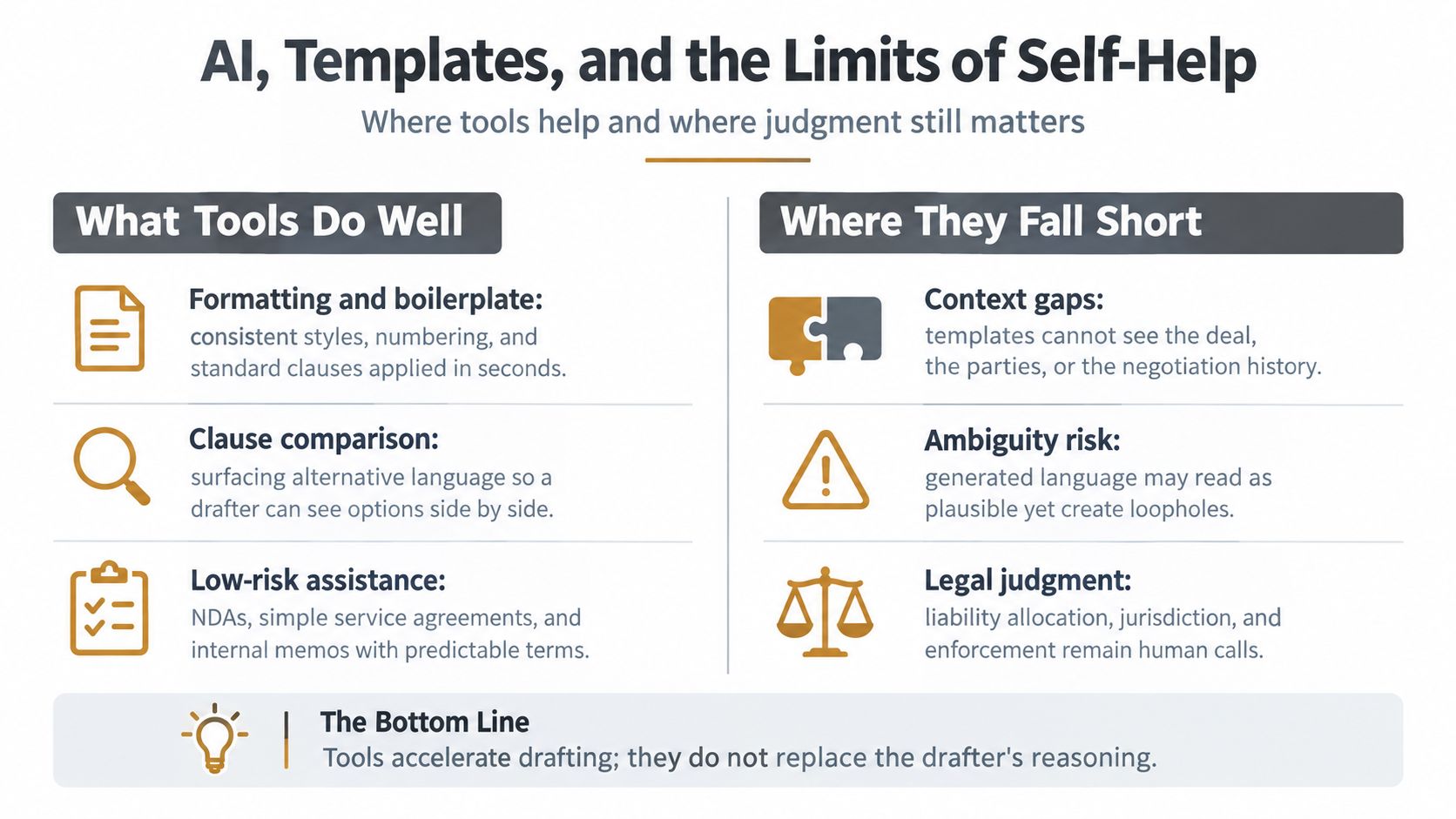
Context changes the risk. Indemnities, liability caps, restrictive covenants, compensation formulas, arbitration provisions, regulatory cooperation, and termination rights determine who pays, how much, and when. A polished generated clause can shift a loss to the wrong party or make payment depend on an event the business cannot control.
An intelligent document builder overview can support first-pass drafting, provided the workflow preserves human review:
- Use approved sources: Start with current templates and documented fallback positions.
- Protect confidential information: Redact sensitive deal data unless approved controls permit its use.
- Track versions: Preserve prompts, source language, revisions, and the final document.
- Validate clauses: Test each material provision against the transaction and governing law.
- Document sign-off: Identify the qualified person who reviewed and approved the language.
A small-business contract template resource can save time for repeatable arrangements. The savings disappear when users treat a template as a conclusion rather than a starting point. A template may omit a payment trigger, assume the wrong entity structure, or allocate liability that the business never intended to accept. Use self-help tools for controlled drafting work, then assess the clauses that govern money, authority, performance, and exit.
When to Draft Yourself and When to Engage Counsel
Use a vetted template for low-stakes, repeatable arrangements such as straightforward NDAs, routine vendor orders, or standard service letters. Seek attorney review for multi-party deals, customized compensation, and engagements touching regulatory obligations. Have counsel lead high-stakes, regulated, or jurisdictionally complex matters, including securities-industry transitions, acquisitions, and disputes. For terminology questions, these master legal writing distinctions can prevent avoidable confusion, while a small-business contract lawyer can help pressure-test a document before signature.
If you want to discuss your business law matter, contact Kons Law at (860) 920-5181. Kons Law can help draft, review, and negotiate commercial agreements, advisor arrangements, compensation provisions, and other contracts where wording affects payment, risk, and exit rights. Visit Kons Law to start a conversation about the transaction in front of you.
