
Yes. FINRA selling away occurs when a registered representative participates in any private securities transaction outside the member firm without prior written notice and approval. FINRA's 2018 review found that approximately 40% of responding member firms had received at least one Rule 3280 notice during the preceding five years, while approximately 89% maintained policies limiting or prohibiting compensated private securities transactions.
An advisor might agree to help a longtime client invest in a friend's startup, believing the role is limited to offering informal guidance. The advisor may never receive a commission, never execute a trade, and never describe the opportunity as a product of the brokerage firm. Even so, recommending the investment, helping complete subscription documents, handling customer funds, or taking another active role can create a Rule 3280 issue.
The practical question isn't just whether money changed hands. It's whether the registered person participated in a private securities transaction outside the regular course or scope of the member firm's business, and whether the firm received the required notice before participation began.
What Is FINRA Selling Away and Why It Matters
FINRA Rule 3280 governs a registered person's participation in a private securities transaction outside the regular course or scope of employment with a member firm. The rule reaches more than traditional commission-based selling. It can apply when an advisor recommends a private offering, assists with an investor's paperwork, introduces a customer to an issuer, or performs another meaningful role in the transaction.

The advisor in the startup example may think the absence of a commission ends the analysis. It doesn't. FINRA's framework focuses on participation and disclosure. Before participating, the associated person must provide the firm with written notice describing the proposed transaction, the person's role, and whether the person has received or may receive selling compensation. If compensation is involved, the firm must decide in writing whether to approve the participation. An approved transaction must be recorded on the firm's books and records and supervised as if it had been executed through the firm. FINRA Rule 3280
Why the distinction matters
The line between an outside business activity and a private securities transaction can be difficult to identify in practice. A registered representative may hold a board position with a startup, conduct due diligence for an issuer, or make introductions without calling the activity a sale. Those labels don't control. The person's actual conduct does.
The firm also faces exposure. If the transaction wasn't disclosed, the broker-dealer had no opportunity to evaluate conflicts, review the offering, impose conditions, record the transaction, or supervise the representative's conduct. Customers may likewise lose the protections associated with the firm's normal review and recordkeeping processes.
Practical rule: Treat any proposed involvement with a private investment as reportable until the firm's compliance department determines otherwise in writing.
Rule 3280 includes unregistered securities offerings, although it excludes specified categories, including certain transactions covered by Rule 3210 and certain uncompensated immediate-family transactions. Those exclusions require careful analysis rather than assumptions based on the transaction's informal nature.
Advisors should also distinguish this issue from the related outside-business-activity requirements discussed in FINRA Rule 3270 and outside business activities. A private investment may raise both questions, and a firm's internal policy may require disclosure even when the advisor believes Rule 3280 doesn't apply.
Understanding FINRA Rule 3280 Requirements
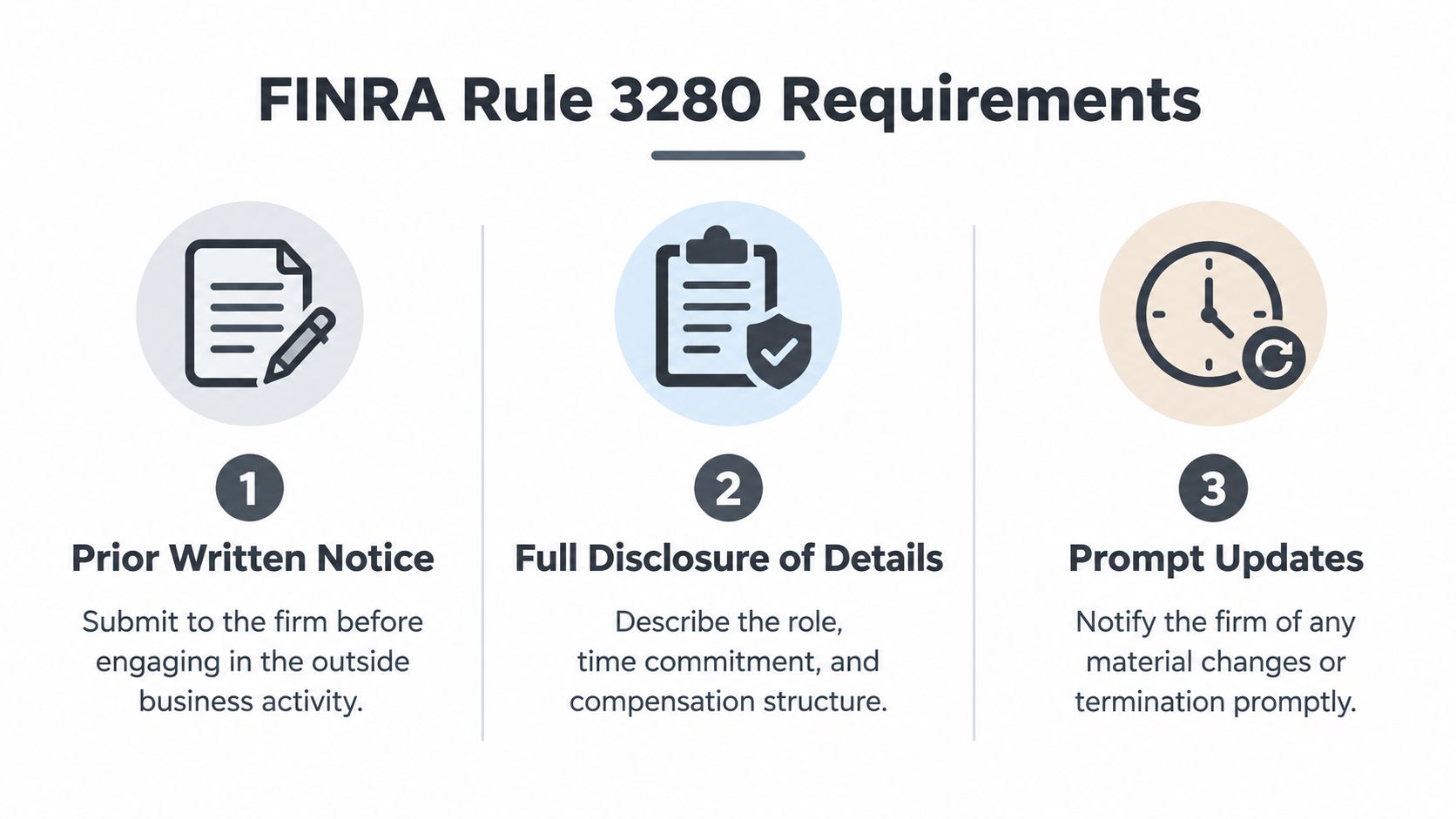
Rule 3280 works as a sequence, not an after-the-fact reporting mechanism. The associated person must notify the firm before participating, give the firm enough information to evaluate the activity, and comply with the firm's written decision.
The three core requirements
Prior written notice should identify the private securities transaction and provide it to the firm before the representative participates. A later disclosure doesn't convert an undisclosed transaction into a compliant one.
Role disclosure should explain what the representative will do. “Investor” may be incomplete if the person also introduces customers, reviews offering materials, negotiates terms, communicates with investors, or helps process subscriptions.
Compensation disclosure must address whether the representative has received or may receive selling compensation. That includes arrangements that aren't labeled commissions. Referral payments, carried interests, ownership benefits, bonuses, or other financial benefits may affect the firm's analysis.
If compensation is involved, the firm must make a written approval decision. If the firm approves the transaction, it must record the transaction on its books and records and supervise it as though the transaction had occurred through the firm.
The rule's operational demands explain why a casual email to a customer or a disclosure made after closing is inadequate. The relevant decision belongs with the member firm, and the firm needs advance information to make that decision.
What the industry data shows
FINRA's review of outside business activity and private securities transaction practices found that approximately 40% of responding member firms had received at least one written notice under Rule 3280 during the preceding five years. Within those firms, approximately 19% of associated persons had provided written notices. Approximately 89% of respondents maintained internal policies limiting or prohibiting private securities transactions for compensation. FINRA Regulatory Notice 18-08
Those figures don't establish that the reported transactions were violations or that every transaction was approved. They show that firms regularly encounter these activities and commonly impose restrictive controls.
For advisors, the safest workflow is straightforward:
- Identify the activity early: Ask compliance about the proposed transaction before making an introduction or recommendation.
- Describe the actual role: Include advisory, referral, board, diligence, negotiation, subscription, and funds-handling responsibilities.
- Disclose every benefit: Report compensation, ownership, potential compensation, and indirect financial interests.
- Wait for the written decision: Don't rely on verbal approval or a supervisor's informal comfort.
- Update the firm: Report material changes, additional investors, new compensation, or a changed role.
Additional guidance on the distinction between firm-approved offerings and outside private transactions appears in private securities transactions.
How FINRA Assesses Selling Away Violations
FINRA doesn't use a single transaction-size threshold to determine the seriousness of a selling-away matter. Its sanction guidance applies an extent-of-conduct framework, examining the surrounding facts and the scale of the representative's activity. A modest individual transaction can become more serious when the conduct involves repeated solicitation, multiple customers, undisclosed ownership, or apparent firm sponsorship.
The factors that change the risk
| Factor | What FINRA Examines | Impact on Sanctions |
|---|---|---|
| Dollar volume | The amount of securities sold | Greater volume can indicate broader conduct and greater customer exposure |
| Number of customers | How many customers participated | More affected customers can increase supervisory and investor-protection concerns |
| Duration | How long the activity continued | Prolonged conduct may suggest repeated disregard of firm controls |
| Product compliance | Whether the product violated securities or SRO rules | Additional product violations can aggravate the matter |
| Issuer interest | The representative's ownership or beneficial interest | Undisclosed financial alignment can create conflict concerns |
| Firm sponsorship | Whether the representative used the firm's name or facilities | Apparent sponsorship can make customers believe the firm approved or offered the investment |
These factors work together. A representative who makes one undisclosed introduction is presenting a different enforcement picture from someone who repeatedly solicits several customers, owns part of the issuer, uses firm facilities, and receives compensation. The individual transaction may look small in isolation, but the combined conduct can demonstrate a systematic failure to disclose and obtain supervision.
The best defense record is created before the regulator asks for it.
Preserve customer lists, communications, offering materials, compensation records, issuer-affiliation disclosures, and every record showing what the member firm knew. Keep written evidence of whether the firm approved, rejected, conditioned, recorded, or supervised the activity. Do not edit or selectively preserve messages after an inquiry begins.
The difference between a defensible explanation and an adverse inference often turns on chronology. A clear notice sent before participation, followed by a written firm decision, tells a different story from a reconstructed account assembled after customer complaints or a regulatory request.
FINRA's archived sanction guidance provides the framework for evaluating these aggravating factors in activity away from the associated person's member firm. Advisors dealing with an inquiry should also understand how FINRA disciplinary actions can affect registration, employment, and future disclosures.
Common Examples of Selling Away Violations
The obvious example is a representative who receives a commission for selling an unapproved private placement. The harder cases involve conduct that feels advisory, administrative, or personal rather than sales-oriented.
Consider a representative who tells a customer about a private fund operated by a close business contact. The representative doesn't receive a referral fee but recommends the fund and explains why the customer should consider it. That recommendation may constitute participation because the representative helped move the customer into the transaction outside the firm's regular business.
Indirect participation still counts
A representative may also participate by helping the customer complete a subscription agreement. The person might review missing information, explain where the customer should sign, transmit the completed document, or coordinate the closing. FINRA treats recommending a private placement, helping complete the customer's subscription agreement, or handling customer funds as participation, even when the representative isn't the named salesperson. FINRA's private securities transaction materials
Other common situations include:
- Referral arrangements: The representative introduces customers to an issuer and expects a future referral payment, ownership benefit, or other compensation.
- Informal advisory roles: The representative advises a private company about fundraising, investor communications, or offering strategy.
- Board or director service: The representative joins an issuer's board and helps identify or communicate with prospective investors.
- Due diligence assistance: The representative reviews a private offering and communicates favorable conclusions to customers.
- Funds handling: The representative directs customer money, collects checks, or coordinates transfers to an issuer or third party.
- Personal investment activity: The representative invests in a private company away from the member firm and takes an active role in bringing other investors into the opportunity.
The buying-away issue
FINRA's proposed framework highlights a point many professionals miss: a personal securities investment away from the employing member can itself raise a Rule 3280 issue when it isn't covered by Rule 3210. The analysis may therefore involve buying away, not only selling away.
That doesn't mean every passive personal investment is automatically prohibited. It means the representative shouldn't assume that personal ownership ends the inquiry. Ownership, issuer affiliation, communications with customers, introductions, and participation in the transaction can change the analysis.
The 2025 proposal confirms that the relevant questions include the transaction, the person's role, prior written notice, and whether the person receives or may receive selling compensation. A commission-free activity can still require advance disclosure.
Current Rules Versus Proposed Changes
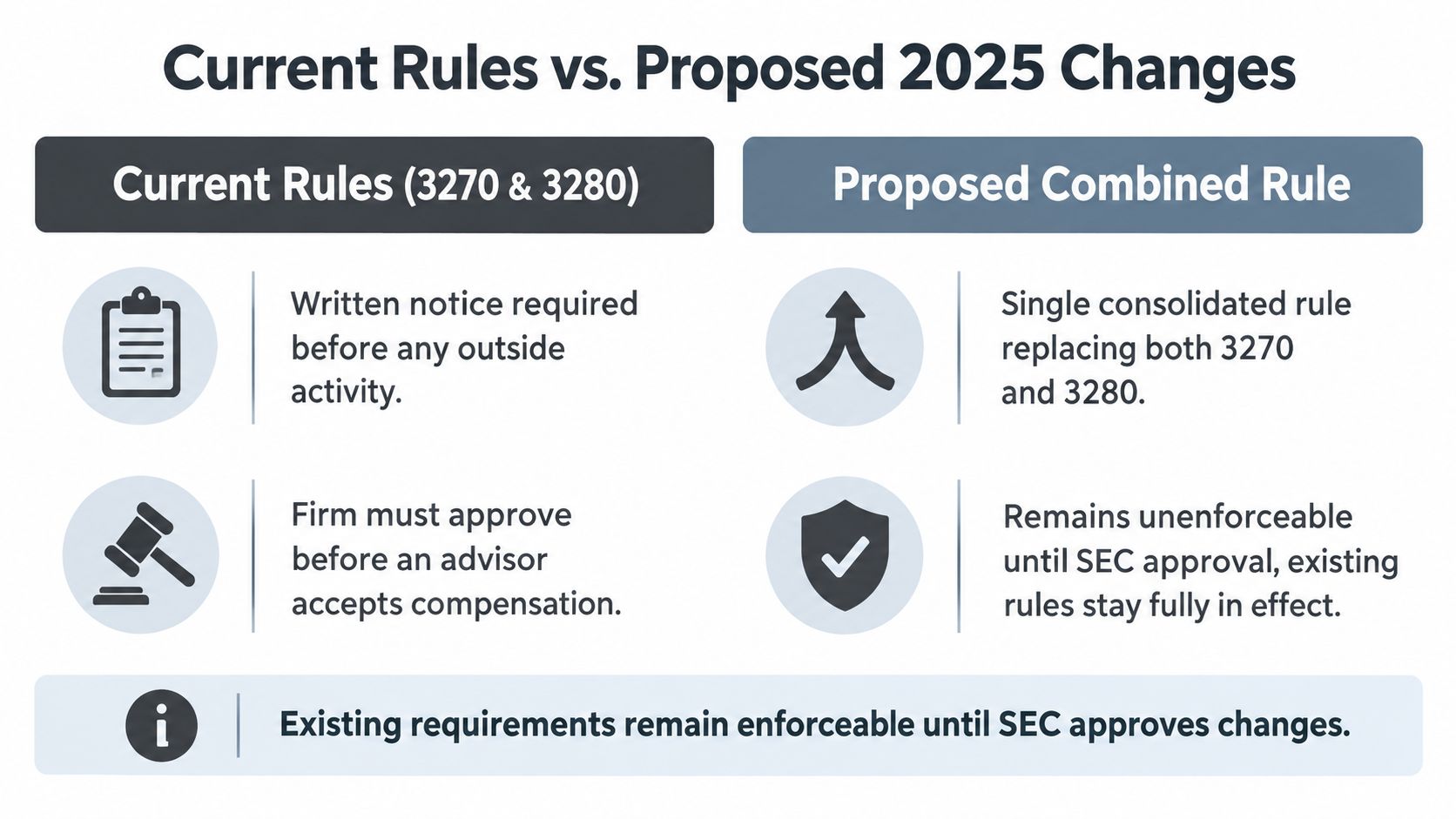
FINRA's proposed replacement of Rules 3270 and 3280 has created a practical compliance hazard. Some summaries describe the proposal as though it already changed the governing rules. It hasn't. FINRA states that the existing requirements continue until the SEC approves the changes and they become effective. FINRA Regulatory Notice 25-05
What applies now
Under the current framework, advisors should continue to obtain prior written notice and comply with the existing Rule 3280 requirements for private securities transactions. Firms must assess compensation and make the required written decision when compensation is involved. Approved transactions must be recorded and supervised through the firm's books and records.
A firm may also apply broader internal standards. Its policies can limit or prohibit activities that might otherwise qualify for an exclusion, and representatives must follow those policies.
What the proposal may change
The proposal would preserve prior written notice for outside activities and private securities transactions while introducing targeted exclusions. It would also allow firms to allocate monitoring responsibilities when an associated person is connected to multiple members.
That approach may matter to dual registrants, employee-investors, representatives involved with private funds or startups, and professionals changing firms. A person working with multiple member firms may need a clear allocation of responsibility rather than duplicate or conflicting monitoring processes.
The transition creates a simple rule for present conduct:
- Current obligations remain active: Don't treat the proposal as a safe harbor.
- Proposed exclusions aren't operative: Don't structure conduct around an exclusion that hasn't taken effect.
- Advance disclosure still controls: Send notice before participating.
- Keep records through the transition: Preserve notices, firm responses, role descriptions, and compensation disclosures.
The proposal may reduce unnecessary burdens while retaining supervision and investor protections. Until an approved effective rule says otherwise, compliance teams should design around the current requirements.
Compliance Steps to Protect Your Career
A strong compliance process makes the right action easier before an opportunity becomes a customer problem. The process should identify private securities activity early, route it to the right reviewer, and preserve a record that explains what happened.
Build a repeatable workflow
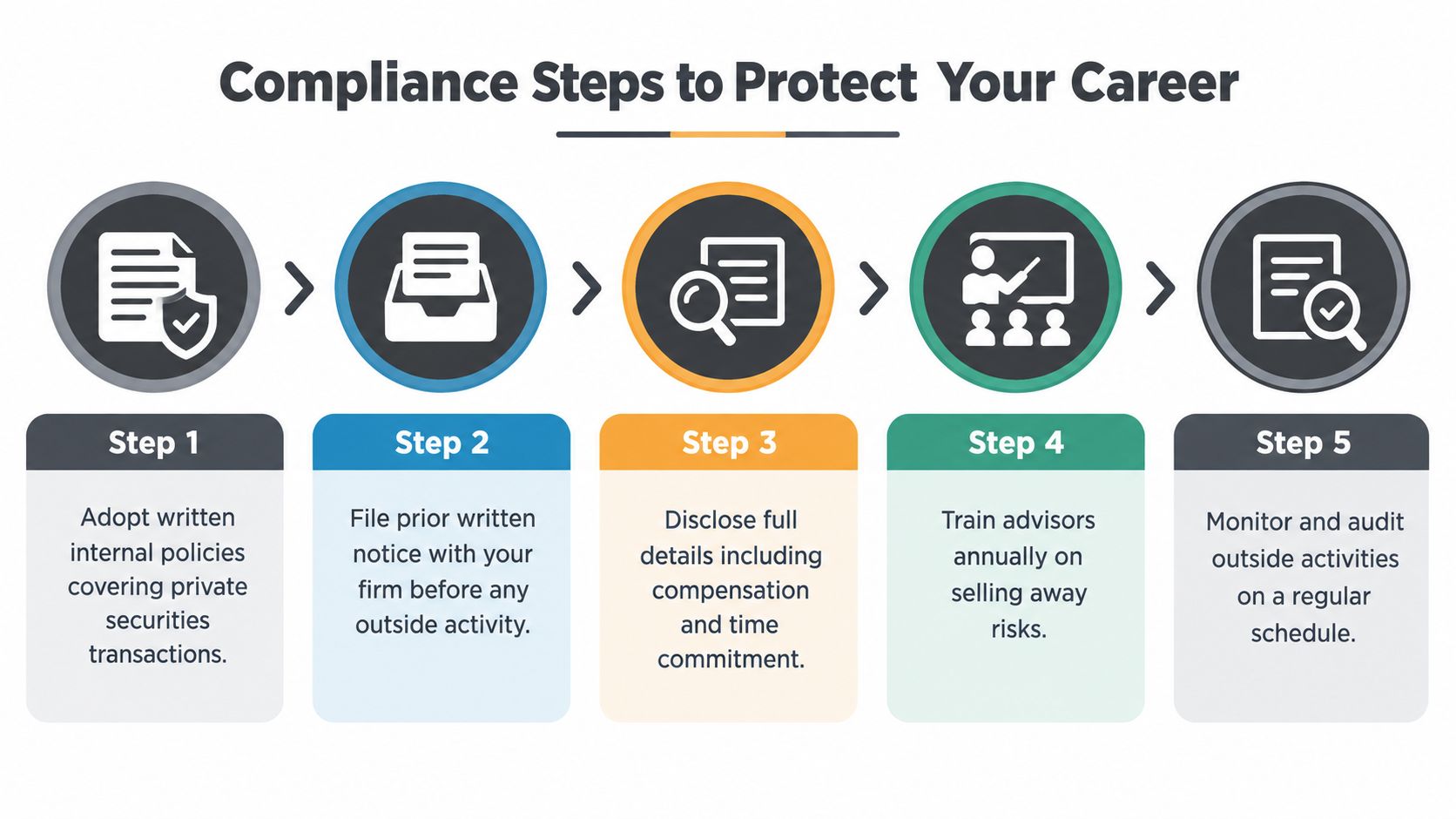
Start with written internal policies covering private securities transactions and outside business activities. The policy should identify who receives notices, what information representatives must provide, how compliance reviews compensation, and where the final decision is stored.
The notice itself should be specific. Identify the issuer, the type of security, the expected customer involvement, the representative's role, the time commitment, ownership interests, compensation, and any use of firm resources. A vague description deprives the firm of the information it needs to supervise.
Use a documented approval workflow. A compliance officer's informal statement that an activity “should be fine” isn't a substitute for the written decision required by the rule where compensation is involved.
Audit the mechanics
FINRA's interpretation reaches practical conduct, not just signed sales agreements. Recommending a private placement, helping complete a subscription agreement, or handling customer funds can qualify as participation. Advisors should therefore review their email, messaging, referral, and document-handling practices, not only their commission records.
A workable control program should include:
- Policy ownership: Assign responsibility for maintaining the firm's written standards.
- Advance intake: Require notice before introductions, recommendations, diligence, or investor communications.
- Conflict review: Compare issuer affiliations, personal investments, compensation, and customer relationships.
- Record retention: Preserve notices, approvals, offering documents, messages, customer lists, and compensation records.
- Periodic testing: Review outside activities and private investments on a regular schedule.
- Training: Teach representatives that no commission doesn't automatically remove the Rule 3280 question.
The records should allow a reviewer to reconstruct the timeline without relying on memory. Keep the original notice, the firm's response, later updates, and evidence of supervision together.
For advisors who face employment or registration consequences after a compliance dispute, guidance concerning Form U5 and FINRA issues may also be relevant. A Form U5 explanation can affect how future firms and regulators understand the departure and the underlying conduct.
When to Seek Legal Counsel
Legal counsel becomes important when a compliance question has turned into an investigation, customer complaint, arbitration claim, or employment dispute. A representative who receives a FINRA request should preserve relevant records, avoid destroying or altering messages, and obtain advice before making assumptions about the scope of the response.
That is especially true when the matter involves a Rule 8210 request, disputed customer communications, personal ownership in an issuer, compensation questions, or a possible Form U5 filing. Counsel can help organize document production, protect applicable rights, develop a consistent factual presentation, and address related employment or arbitration issues.
Confidentiality also matters. Advisors should understand the mechanics of keeping confidential exchanges legally protected before discussing sensitive facts through informal channels or personal accounts.
A legal review is useful before an inquiry escalates as well. Counsel can evaluate whether notice was sufficient, whether the activity was within an exclusion, whether the firm's records accurately reflect approval and supervision, and whether the representative's conduct differed from the firm's description.
If you want to discuss your business law matter, contact Kons Law at (860) 920-5181.
Kons Law advises financial professionals and investors involved in private securities transactions, FINRA investigations, selling-away disputes, and related arbitration matters. To discuss the facts, records, and compliance decisions in your matter, visit Kons Law or call (860) 920-5181.
