
A solo advisor can spend years building a trusted practice and still have no workable answer to one urgent question: What happens if you can't come into the office tomorrow? Clients may need immediate service, staff may lack access to essential systems, and a broker-dealer or custodian may need clear instructions before anyone can act. Retirement may be years away, but incapacity, death, disability, termination, or a sudden ownership dispute can force a transition without notice.
Succession planning for financial advisors therefore has two jobs. It must support an orderly retirement exit, and it must preserve client service and enterprise value during an emergency. The legal documents, regulatory procedures, valuation method, successor preparation, and client communications need to work together.
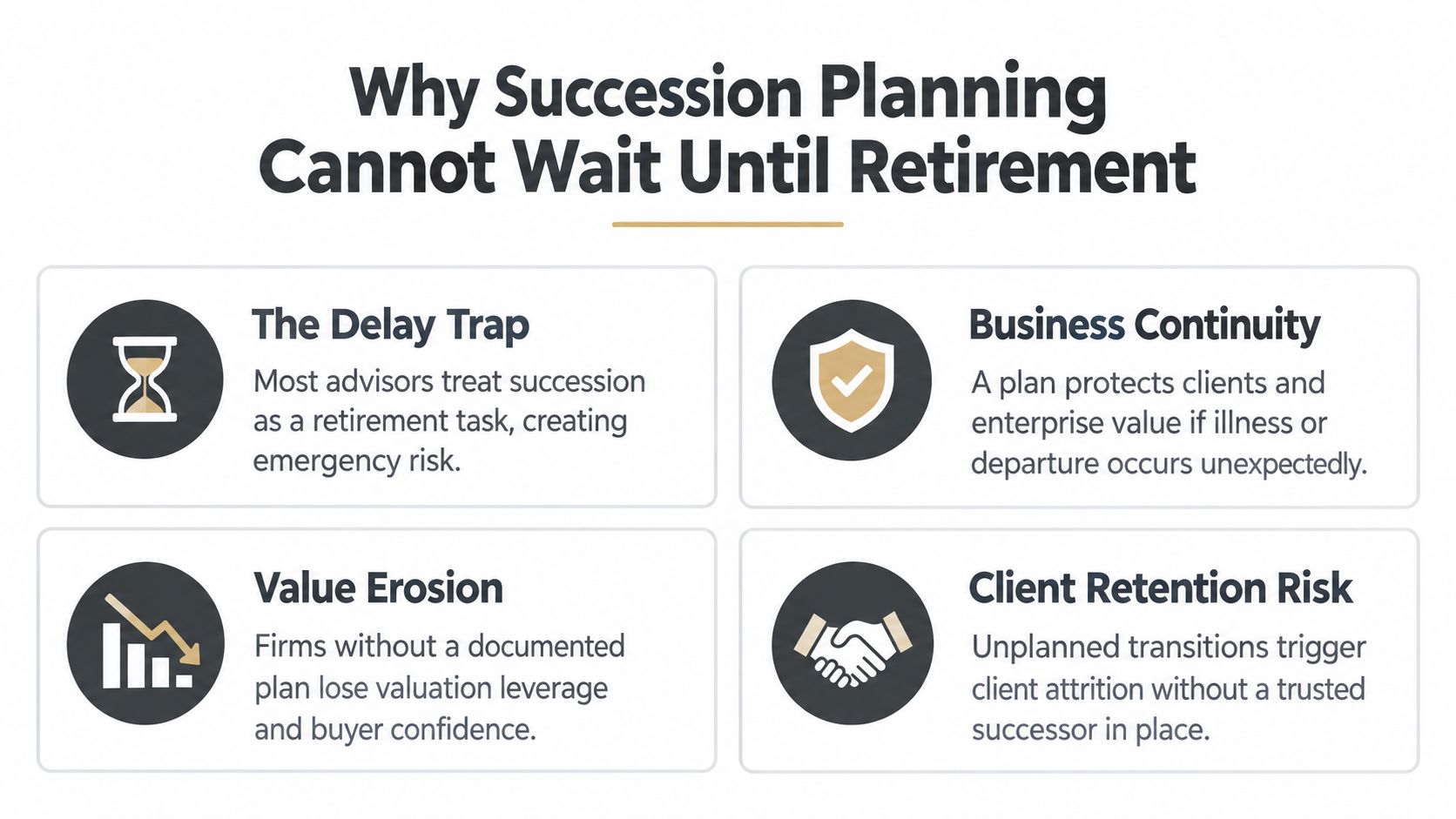
Why Succession Planning Cannot Wait Until Retirement
Consider a familiar scenario. A solo advisor has a profitable practice, a capable client-service employee, and a general understanding that a neighboring firm might acquire the book someday. The advisor's spouse knows the office exists, but not how to access the custodian portal. The employee knows the clients, but has no authority to manage accounts. The operating agreement contains no transfer mechanism, and the firm has never selected a temporary successor.
If illness or an accident removes the advisor from daily operations, goodwill doesn't solve those problems. A buyer may hesitate because the business depends heavily on one person. Clients may receive inconsistent answers. Staff may spend time locating contracts and passwords instead of serving households. The absence of a documented plan can reduce both practical continuity and negotiating strength.
A financial advisor book of business for sale also raises questions that a retirement conversation often leaves unanswered. Who can approach clients? Which accounts require consent or repapering? How will the purchase price be calculated? What happens if the proposed buyer can't complete the transaction?
The industry problem is larger than one practice
The scale of the transition risk is substantial. Cerulli estimates that 105,887 advisors plan to retire over the next decade, representing 37.4% of industry headcount, controlling 41.4% of total assets, or approximately $10.4 trillion in advisory assets. Cerulli also reports that 26% of advisors expecting to retire within the next 10 years remain unsure about their retirement plans, with that figure reaching 30% among independent RIA-affiliated advisors. Those figures appear in Cerulli's analysis of RIA acquisition opportunities and succession.
The planning gap has persisted for years. A foundational Financial Planning Association study found that only 27% of financial advisors had a formal succession plan, while 41% had some type of succession plan. At firms with less than $50 million in assets under administration, only 13% had a formal plan, compared with 60% at firms with $500 million or more. The same study found formal planning among 40% of advisors within five years of retirement, versus 34% of those five to ten years away, as reported by PLANADVISER.
Practical rule: A retirement plan answers how ownership will change. An emergency continuity plan answers who can protect clients before that ownership change is complete.
Succession is not the same as business continuity
A business continuity plan may identify backup systems, alternate work locations, communication procedures, and vendor contacts. A succession plan adds ownership, valuation, successor authority, client relationships, employment arrangements, and transfer economics.
Both are necessary. A continuity plan without a successor may keep the lights on but leave no long-term owner. A succession agreement without emergency authority may identify a future buyer but fail during the period when clients need immediate help. The strongest plan connects the two and gets tested before a crisis exposes the gaps.
When to Start and What to Put in Place First
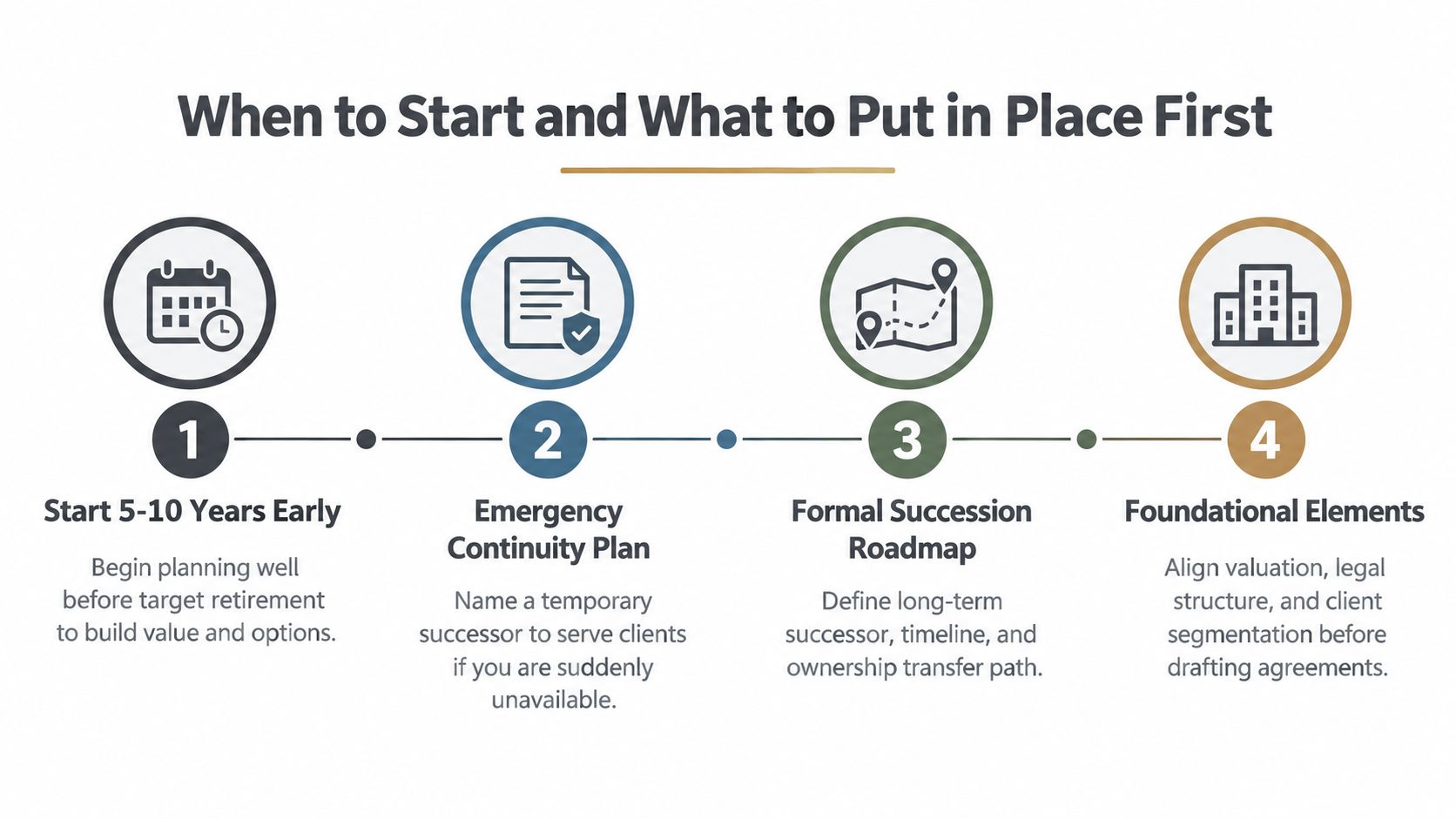
The best time to begin is five to ten years before a planned exit, while the owner still has time to develop candidates, transfer relationships, improve documentation, and adjust the business model. That timeline also gives the advisor room to choose among an internal transition, an external sale, a merger, a partial transfer, or a staged arrangement rather than accepting the only available offer.
Start sooner if a partner is approaching retirement, the firm depends on one rainmaker, a key employment agreement is expiring, or a health event changes the owner's availability. Don't wait for a valuation conversation to reveal that the business has no clear authority structure.
A useful early distinction is between temporary authority and permanent ownership. The emergency designation should identify the person or firm that can step in if the advisor dies, becomes disabled, or is otherwise unavailable. The long-term plan should determine who ultimately owns the entity, book, contracts, intellectual property, and client relationships.
Build the planning team
Counsel should coordinate the legal architecture, but the owner also needs the CPA, compliance professionals, the broker-dealer or custodian, and potential successors involved early. Each sees a different risk:
- Counsel: Reviews entity documents, operating agreements, employment contracts, buy-sell provisions, restrictive covenants, and transfer restrictions.
- CPA: Models cash flow, purchase-price allocation, installment payments, tax consequences, and the owner's after-tax proceeds.
- Compliance professionals: Confirm registration, supervision, books and records, privacy, client-consent, and reporting requirements.
- Broker-dealer or custodian: Identifies account-transfer procedures, platform restrictions, forms, and approval requirements.
- Successor candidates: Test whether they understand the economics, responsibilities, culture, and client-service expectations of the proposed role.
For a plain-language overview of the broader concept, Business Loan Warrior's succession planning resource can help frame the business issues before the advisor moves into financial-services-specific documentation.
Assemble the operating inventory
Begin with an inventory, not a contract. Document the entity structure, ownership percentages, governing documents, advisory agreements, employment arrangements, insurance policies, leases, technology systems, vendor contacts, custodial relationships, and regulatory records. Identify who has access to each system and whether that access survives the owner's absence.
Then segment the client base by service complexity, relationship sensitivity, account type, and successor fit. The successor must know which households require joint meetings, which accounts require affirmative consent, and which relationships may be vulnerable during a handoff.
Finally, write down the decision criteria for the transition path. An internal successor may preserve culture and trust but require seller financing or a gradual equity transfer. An external buyer may provide stronger immediate liquidity but create greater client-retention and cultural risk. A merger may supply operational depth while reducing the owner's control. The right answer depends on the owner's objectives, not on a generic industry template.
Valuing Your Practice and Structuring the Buy Sell Agreement
A valuation is useful only when the parties understand what is being valued and how the price will be determined. An RIA's enterprise value may reflect recurring revenue, profitability, client concentration, retention, staff depth, compliance history, technology, growth prospects, and the degree to which relationships depend on the founder. A hybrid practice may require separate analysis of advisory revenue, brokerage relationships, commissions, contracts, and regulatory restrictions.
Common approaches include a revenue multiple, an EBITDA multiple, and a discounted cash flow analysis. A revenue approach is comparatively simple and may work where recurring revenue is stable, but it can overlook expense discipline and the cost of replacing the owner. EBITDA analysis better reflects operating profitability, yet it depends on consistent normalization of compensation and one-time expenses. Discounted cash flow can capture expected future performance, but it requires assumptions that may become disputed when markets, client retention, or staffing changes.
| Valuation Method | How It Works | Best Fit | Watch Out For |
|---|---|---|---|
| Revenue multiple | Applies an agreed multiple to qualifying revenue | Practices with predictable recurring revenue | Revenue quality, client concentration, and owner dependence |
| EBITDA multiple | Applies a multiple to normalized operating earnings | Firms with reliable profitability and clean financials | Disputes over add-backs, compensation, and unusual expenses |
| Discounted cash flow | Estimates the present value of projected future cash flow | Practices with a credible forecast and changing operations | Sensitive assumptions about growth, discount rates, and retention |
| Independent appraisal | A qualified appraiser determines value periodically or after a trigger | Partners seeking a neutral process | Cost, timing, and disagreements over the appraiser's scope |
Choose the pricing mechanism before the conflict
A buy-sell agreement should establish the valuation method before death, disability, retirement, involuntary termination, deadlock, or divorce creates pressure. The parties can use a fixed formula, periodic independent appraisal, or a hybrid approach. A fixed formula offers predictability, but it may become stale. An appraisal can better reflect current conditions, but it creates timing and methodology disputes. A hybrid can balance both, provided the agreement explains when each method applies.
The agreement also needs more than a price. It should state the trigger, notice procedure, closing mechanics, payment schedule, security, default remedies, insurance funding, voting rights during the transition, and limits on competing activity. Seller financing may make an internal purchase possible, while an earnout can align payment with client retention. Those structures also shift collection risk to the seller, so the agreement should address reporting, offsets, security interests, and what happens if the successor leaves.
For a practical explanation of the document's role, see what a buy-sell agreement does. Owners comparing drafting issues across jurisdictions may also find this discussion of a buy-sell agreement for Texas owners useful as general background, although Connecticut counsel must tailor the documents to the entity, contracts, and applicable law.
Regulatory Continuity and Form U5 Considerations
A succession plan can fail even when the business terms are sound. The advisor may have a buyer and a price, but the transition still requires coordination with the broker-dealer, RIA, custodian, regulators, employment agreements, and client-account procedures.
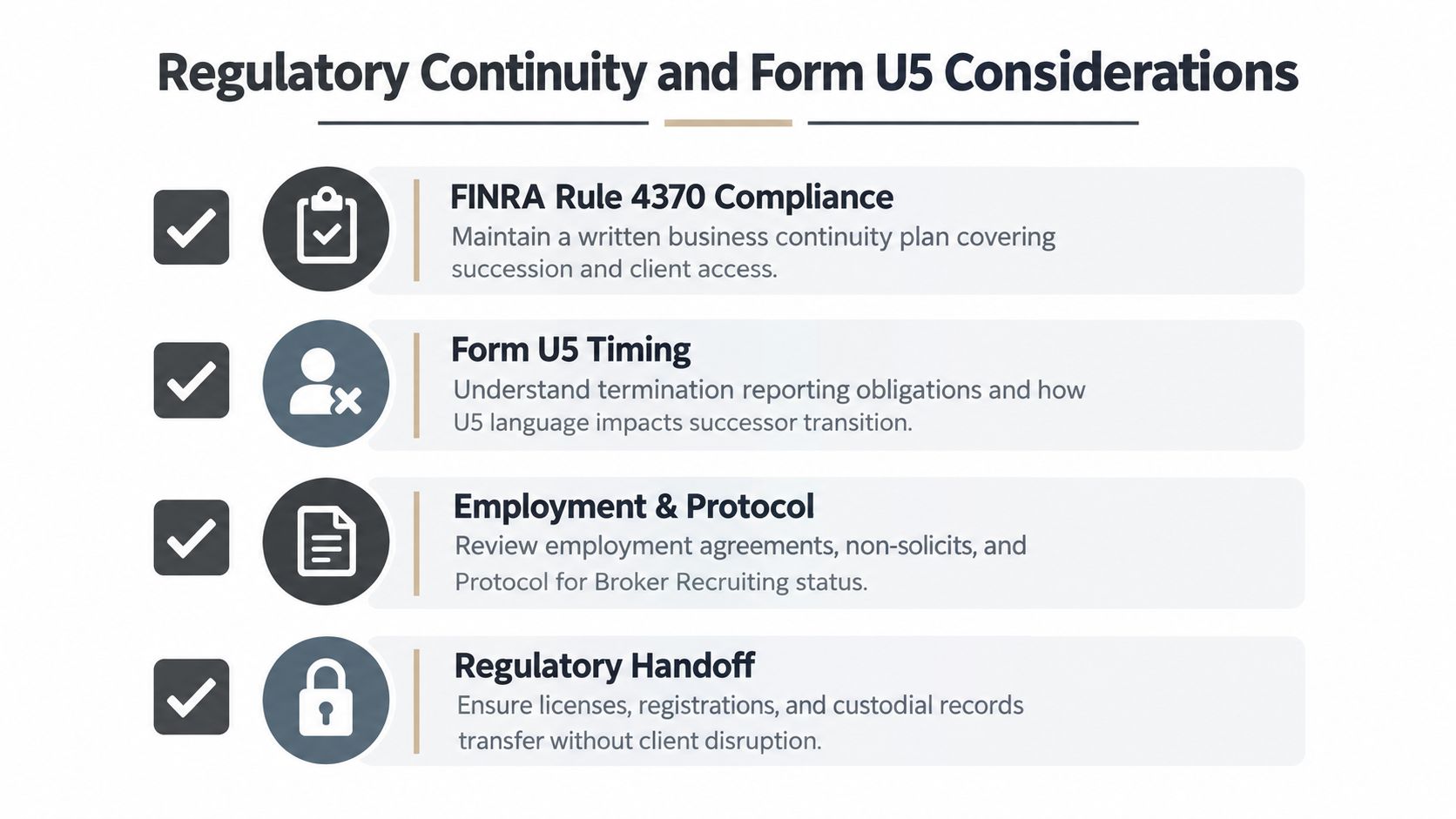
FINRA doesn't require a separate succession plan for every firm or representative. Member firms must, however, maintain a written business continuity plan under FINRA Rule 4370, review it at least annually, and update it after a material change. FINRA Regulatory Notice 22-23 encourages firms to use succession planning for death, disability, retirement, and other disruptions. The legal discussion of these obligations is summarized in guidance on succession plans for financial advisers.
Document operational authority
The continuity plan should identify who can communicate with clients, access records, coordinate with vendors, and work with the custodian if the owner is unavailable. It should specify where records are stored, who maintains credentials, and how the firm will preserve privacy and supervision. Avoid putting sensitive passwords in an unsecured agreement. Instead, use a controlled access process and document who has authority to retrieve the information.
Review the plan after changes to ownership, technology, personnel, office location, custodial relationships, or business structure. An annual review is the regulatory minimum for the FINRA business continuity plan, but a practice should update its operational materials whenever a material change occurs.
Treat Form U5 as a separate risk issue
Form U5 reporting requires careful attention when a registered representative leaves a broker-dealer. The reason for termination, disclosure language, timing, and supporting records can affect the departing advisor's future employment, regulatory profile, and ability to transition client relationships. The firm should coordinate internally before submitting language that is inaccurate, incomplete, retaliatory, or inconsistent with the underlying record.
Review employment agreements for notice, confidentiality, non-solicitation, non-compete, intellectual-property, garden-leave, and promissory-note provisions. Determine whether the Broker Protocol applies, whether the firms are signatories, and whether the proposed conduct fits its requirements. Protocol status isn't a substitute for client consent, firm approval, or compliance review.
A focused review of Form U5 and FINRA obligations should occur before announcing a departure. The broker-dealer, RIA, custodian, successor, and counsel need a coordinated timeline so regulatory reporting doesn't undermine the client handoff.
Transitioning Clients Compensation and Tax Without Losing Trust
Clients don't experience succession as a transaction. They experience it as a change in the person they trust with personal financial decisions. A successor who is legally authorized but unfamiliar to the household may still struggle to retain the relationship. The handoff must transfer judgment and confidence, not merely account data.
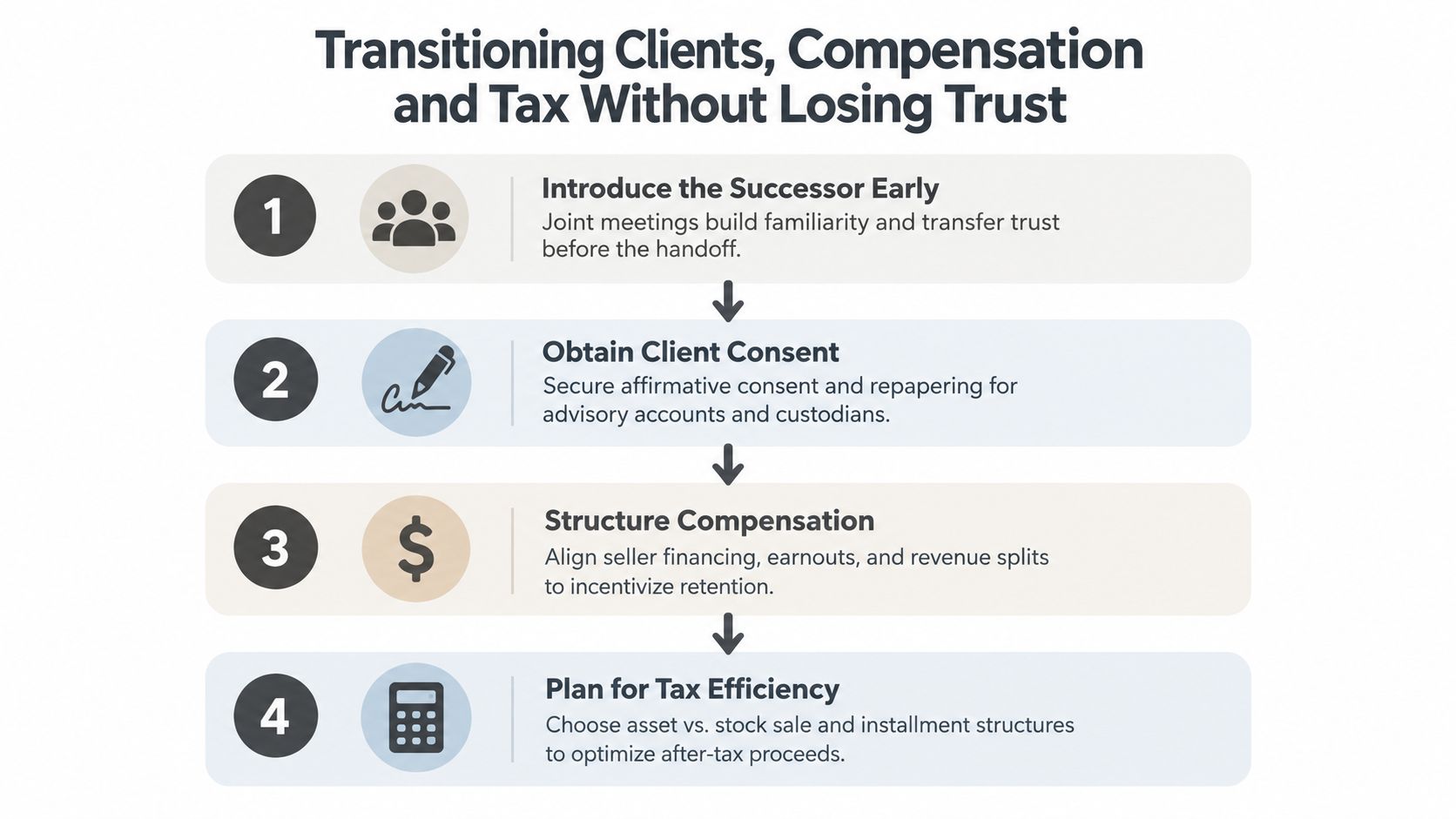
Introduce the successor while the retiring advisor remains active. Joint meetings let clients observe how the successor thinks, answers difficult questions, and handles market stress. The retiring advisor should gradually give the successor responsibility for meeting preparation, follow-up, planning discussions, and service decisions. A name on an agreement isn't evidence of readiness.
The client should meet the successor before the successor has to ask for the client's trust.
Use a deliberate client sequence
Start with the most relationship-sensitive households and those whose accounts require careful repapering. Explain why the transition is occurring, what will remain unchanged, what the successor will handle, and whom the client can contact with questions. Avoid promising that every detail will remain identical. Clients respond better to clear explanations than to vague assurances.
The sequence typically includes:
- Prepare the successor: Review client history, planning philosophy, service commitments, open issues, and likely objections.
- Hold joint meetings: Let the retiring advisor demonstrate confidence in the successor and give the successor meaningful speaking responsibility.
- Obtain required consent: Determine which advisory agreements, custodial accounts, beneficiary instructions, powers of attorney, or privacy authorizations require affirmative action.
- Repaper and track: Maintain a closing checklist for signatures, account changes, registrations, fee arrangements, and incomplete items.
- Phase the founder out: Reduce involvement gradually, while retaining a defined role for escalated matters during the agreed transition period.
Client consent isn't a formality. The practice should identify the governing agreement and custodian process for each account category, then document the outreach and response.
Align compensation with retention and service
Compensation determines whether the successor has a reason to protect the relationship and whether the seller has a reason to support a genuine handoff. Revenue splits, salary plus incentive compensation, earnouts, seller financing, and staged equity transfers can all work, but each creates different incentives.
An earnout can connect payment to retained revenue or transferred relationships, but the agreement must define measurement, exclusions, reporting, and disputes. Seller financing can make the purchase affordable, but the seller becomes a creditor and needs payment protections. A revenue split may ease the transition, yet it can create ambiguity if the successor performs the work while the seller continues receiving compensation.
Tax treatment also depends on structure. An asset sale, equity sale, deferred payment, and promissory note can produce different tax outcomes for the buyer and seller. The CPA should model purchase-price allocation, basis, timing of income, interest, withholding, and installment treatment before the parties sign. Legal counsel can document the arrangement, but tax counsel or the CPA should determine the tax position.
Implementation Checklist and How to Avoid Costly Disputes
A succession plan becomes useful when someone else can execute it without guessing. Put the documents in one controlled location, identify the responsible person for each action, and test the emergency process with the compliance team and custodian.
Use this implementation checklist:
- Confirm authority: Name the temporary emergency contact and define what that person can do.
- Update governance documents: Align the operating agreement, shareholder agreement, trust documents, employment agreements, and buy-sell provisions.
- Lock in valuation mechanics: State the formula, appraisal process, valuation date, notice requirements, and treatment of disputed items.
- Plan funding: Identify insurance, cash reserves, seller financing, outside financing, or staged payments.
- Prepare the successor: Require joint meetings, operational training, compliance review, and documented responsibility transfers.
- Coordinate reporting: Review Form U5 issues, registrations, licenses, custodial requirements, privacy, and client-consent procedures.
- Test continuity: Confirm access to records, vendors, technology, contracts, and communication channels.
- Schedule review: Revisit the plan after material changes and at least annually where FINRA Rule 4370 applies.
Disputes usually begin with ambiguity. A formula that doesn't define revenue, an earnout that doesn't explain retention, or an equity provision that doesn't establish timing can turn a cooperative transition into litigation. The same problem arises when the successor is named but hasn't received a clear compensation structure or a realistic ownership path.
Build a dispute process before the relationship deteriorates
The agreement should address negotiation, mediation, arbitration, venue, governing law, confidentiality, fees, and emergency relief. Mediation can preserve relationships when the parties still need to work together. Arbitration before FINRA, AAA, or JAMS may provide a defined forum, but the clause must fit the parties, claims, and regulatory requirements. Court access may remain necessary for injunctions, records, or enforcement, so the agreement should not use generic dispute language without considering the actual business structure.
Examples of how disputes develop and how parties can manage them are collected in business dispute resolution examples. The practical objective is simple: decide the process while the owner and successor still trust each other, not after a missed payment, disputed client list, or damaging Form U5 allegation.
The strongest succession plan is specific enough to operate during a crisis and flexible enough to accommodate a planned retirement. It names people, sets authority, establishes value, protects clients, and gives the successor a credible path to earn trust and ownership.
If you want to discuss your business law matter, contact Kons Law at (860) 920-5181. The firm can help structure buy-sell agreements, regulatory transition documents, client handoffs, and dispute protections for financial advisory practices. Visit Kons Law to begin a conversation about your succession plan.
