You’re often dealing with the issue before anyone says the words “non-compete.” A salesperson gives notice and plans to join a rival. A manager wants a stronger offer letter. A consultant gets access to customer lists and pricing. Or an employee is handed an agreement and wants to know whether signing it will block the next job.
That’s where connecticut non compete agreements become a practical business problem, not just a legal topic. In Connecticut, enforceability still turns first on judge-made law, but recent and proposed legislation shows a steady move toward tighter limits, especially for lower-paid workers and, notably, for some independent contractors. If you use old templates or assume a court will automatically rewrite an overbroad restriction, you’re taking on avoidable risk.
A workable Connecticut strategy starts with two questions. First, does this business need a non-compete, or would narrower protections do the job better? Second, if a non-compete is used, is it drafted narrowly enough to survive a serious challenge under Connecticut law as it exists now and as it may change next?
Understanding Connecticut's Five-Factor Test for Non-Competes
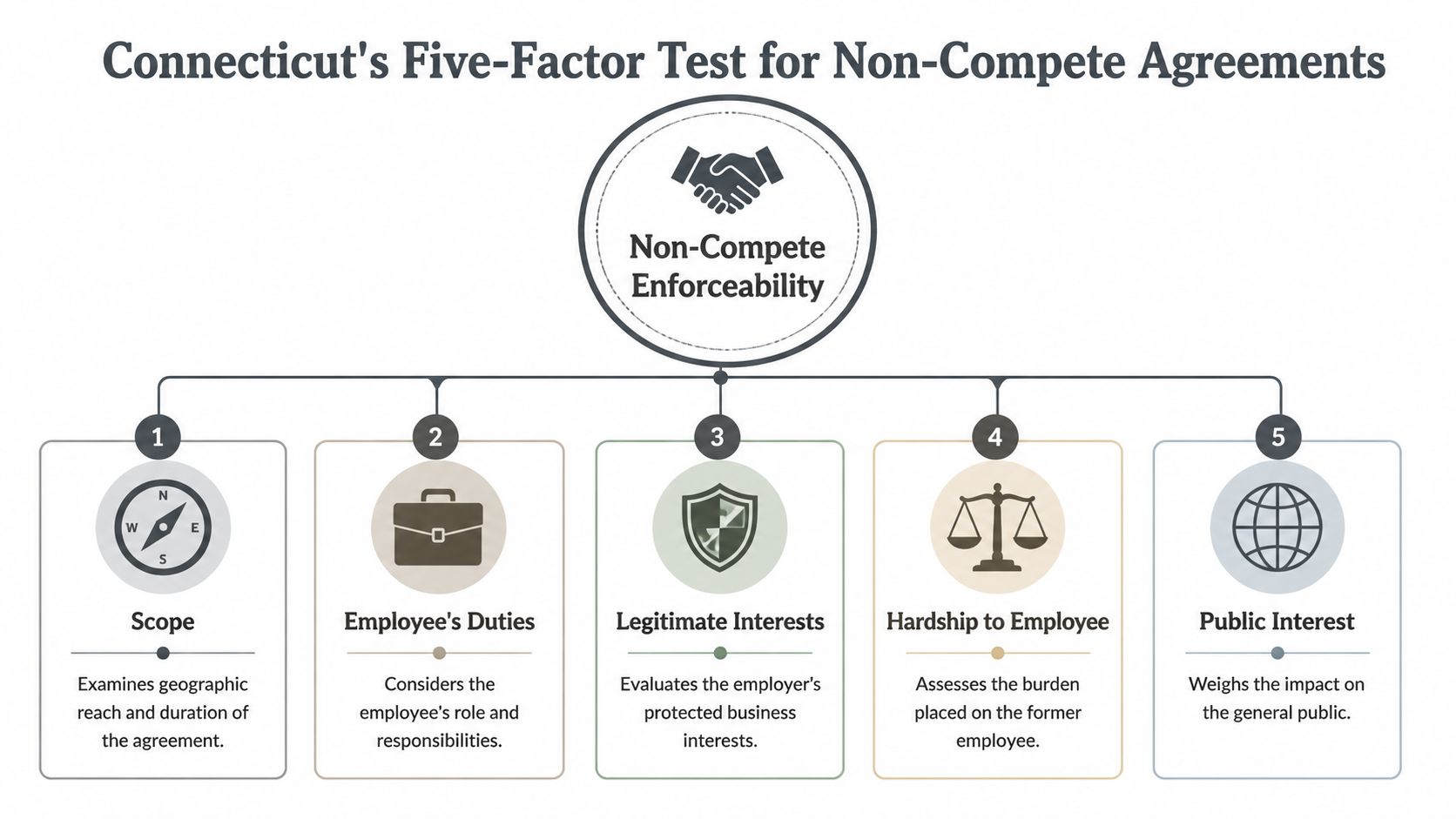
A non-compete is a contract term that limits where, when, or for whom a worker can compete after the relationship ends. In Connecticut, these agreements are governed primarily by common law, and courts apply a strict five-factor reasonableness test: temporal scope, geographic scope, the employer’s legitimate business interests, the employee’s ability to earn a livelihood, and the public interest. That framework matters in a country where nearly one in five U.S. workers are bound by such agreements, according to the Economic Innovation Group’s Connecticut non-compete overview.
The easiest way to think about the test is as a fence. A business can build a fence around what it legitimately owns or needs to protect. It can’t build that fence so wide that it blocks an employee from making a living or interferes with the public.
Start with time and place
The first two factors are usually where businesses overreach. Duration asks how long the restriction lasts. Geography asks where it applies.
Connecticut courts commonly scrutinize these two issues closely. A local business with customers in a limited service area should usually draft a limited post-employment restriction that matches that footprint. A restriction that reaches far beyond the area where the employee worked invites trouble.
A few practical examples help:
- Local service business: A bakery or home-service company may have a strong argument for a narrow local radius tied to where the employee worked and built customer relationships.
- Statewide account manager: A broader territory may be defensible if the employee serviced accounts across that area.
- Remote knowledge worker: A broad territorial restriction can be harder to justify if the primary concern is misuse of information, not physical competition in a mapped region.
Practical rule: If the map in the agreement is broader than the employee’s real market, the covenant is already vulnerable.
The business interest must be real
A Connecticut court won’t enforce a non-compete merely because an employer prefers less competition. The restraint has to protect a legitimate business interest, such as trade secrets, confidential strategies, or customer relationships the employee developed on the employer’s behalf.
That sounds straightforward, but boilerplate often fails in these instances. If the employee didn’t have meaningful access to sensitive information, or didn’t control key relationships, a broad non-compete looks less like protection and more like an unfair advantage.
This is also why many employers are better served by pairing narrower covenants with confidentiality and non-solicitation language. If the actual concern is misuse of data or poaching clients, the agreement should say so with precision.
For a closer discussion of enforceability issues under Connecticut law, see this analysis of when a non-compete agreement may be enforceable.
Courts weigh hardship and the public
The last two factors keep the analysis grounded in reality. A court looks at whether the restriction leaves the worker with a fair ability to earn a livelihood, and whether enforcement would harm the public.
If a covenant effectively bars someone from working in the only field they know, that’s a serious problem. If the restriction limits access to services the public needs, that matters too.
Consider the contrast:
- A narrow restriction preventing a departing executive from soliciting a defined customer base may be easier to defend.
- A broad restriction that blocks a specialized employee from working anywhere in the industry may be much harder to justify.
A Connecticut non-compete has to protect the business without choking off the worker’s future.
The five-factor test isn’t mechanical. Judges look at the whole setting, including the employee’s role, what the company is protecting, and whether the restriction fits that purpose. But the core lesson is simple. Reasonableness isn’t a drafting slogan in Connecticut. It’s the standard that decides whether the covenant stands or falls.
Navigating 2026 Legislative Changes and Proposals
Connecticut has long relied on common law for most non-compete disputes, but that’s no longer the whole story. The trend line is toward more statutory guardrails, especially for lower-wage workers and arrangements that function like non-competes even if they’re labeled differently.
That trend matters because many businesses still use agreements drafted for an older legal climate. Those forms often assume broad coverage, broad geography, and broad discretion. Connecticut is moving in the other direction.
What the recent proposals signal
In the 2026 legislative session, H.B. 5492 proposed banning non-competes for employees earning less than two times the state minimum wage, which the reporting summarized as about $62,400 annually for full-time work, and it followed prior attempts to limit or prohibit non-competes for broader groups of workers. The same reporting also noted Connecticut’s 2019 prohibition on non-competes for homemaker, companion, or home health workers, reflecting a clear trend toward protecting lower-wage workers, as discussed in Jackson Lewis’s review of four Connecticut bills in 2026.
This doesn’t mean every non-compete is dead in Connecticut. It means the state’s policy direction is increasingly skeptical of using restrictive covenants as a default employment term.
Three business consequences follow from that shift:
- Older templates age badly. A covenant drafted to be as broad as possible is more likely to conflict with newer policy choices.
- Compensation level matters more. Employers need to know not just the role, but where the worker falls under proposed wage-based lines.
- Labels won’t save bad drafting. If a clause functions like a non-compete or exclusivity restriction, it may draw the same scrutiny.
The practical meaning of reform pressure
A lot of companies ask whether they should wait for a bill to pass before changing their documents. Usually, that’s the wrong move. If Connecticut lawmakers repeatedly target low-wage restrictions, broad reform provisions, and anti-worker exclusivity terms, that tells you how courts and opponents will frame the issue even before any single bill becomes the final rule.
If your current agreement would look harsh to a legislator, expect it to look risky in a courtroom and expensive in a dispute.
A prudent response is to review agreements by category, not one by one in a panic after a departure. That means separating executives from rank-and-file employees, employees from contractors, and customer-facing workers from employees whose real risk lies in information access.
Many employers will also benefit from a parallel compliance review. Restrictive covenants rarely live alone. They sit inside onboarding systems, handbooks, offer packages, commission plans, and separation documents. A broader small business compliance checklist can help spot where outdated language keeps reappearing.
The state is no longer purely common law in practice
Connecticut still depends heavily on judicial reasonableness review, but the legislative pattern changes how smart employers should behave. The old model was, “Draft broad, enforce what you can.” That approach is weak in Connecticut.
A better model is narrower and role-specific. Ask what must be protected. Then decide whether a non-compete is necessary at all, or whether the actual problem is client solicitation, misuse of confidential information, or exclusivity during the engagement. Businesses that adapt now will be in a better position whether future proposals pass, fail, or return in revised form.
Who Is Covered and Who Is Exempt in Connecticut
The hardest question is often the simplest one. Who can be subject to a Connecticut non-compete? The answer depends on worker classification, industry, compensation, and the exact contract date or proposal at issue.
For some workers, Connecticut already has specific statutory treatment. For others, the answer still comes from common law. And for independent contractors, the analysis has become much more important than many businesses realize.
Worker categories that need separate analysis
A useful way to approach coverage is to sort your workforce into legal buckets before drafting anything.
| Worker Type | Applicable Non-Compete Rules | Governing Authority |
|---|---|---|
| General employees | Typically evaluated under Connecticut’s common-law reasonableness framework unless a specific statute or enacted reform applies | Common law |
| Employees covered by proposed wage-threshold reforms | Proposed legislation would restrict enforceability based on earnings level | H.B. 5269 proposal |
| Independent contractors | Proposed legislation would apply a higher earnings threshold and also address exclusivity restrictions | H.B. 5269 proposal |
| Physicians | Non-competes are subject to specific statutory limits of one year and 15 miles from the primary practice site | Conn. Gen. Stat. Ann. § 20-14p |
| Broadcast employees | Industry-specific statutory treatment applies | Conn. Gen. Stat. Ann. § 31-50b |
| Homemaker, companion, or home health workers | Non-competes are prohibited under the sector-specific 2019 change | 2019 state budget measure |
Employees and contractors aren't in the same lane
One of the most important recent developments is the focus on independent contractors. Under HB 5269, for agreements entered, amended, extended, or renewed on or after July 1, 2024, enforceability may require employees to earn at least three times the state minimum wage, approximately $30 per hour, and independent contractors to earn at least five times the state minimum wage, approximately $75 per hour, as reflected in the Connecticut General Assembly bill analysis for HB 5269.
That proposed split is easy to miss, and it matters. Many businesses assume contractors can be restricted more aggressively because they aren’t employees. The proposal points the other way. It treats contractor restrictions as serious restraints that may require an even higher compensation threshold.
The same proposal is also notable because it addresses exclusivity agreements, not just classic post-employment non-competes. If your contract bars a consultant from working for others during the engagement, that clause deserves its own review.
For businesses using freelancers, referral partners, and project-based consultants, many forms show their greatest weakness. A generic “independent contractor agreement” often contains restrictive language borrowed from employee contracts, with little attention to how the contractor works or how compensation is measured.
For a broader look at classification and contract issues, this discussion of contractor and employment law considerations is a useful starting point.
Special industries already have their own rules
Some sectors never fit neatly into the general common-law model. Connecticut physicians are the clearest example. Their statutory framework limits non-competes to one year and 15 miles from the primary practice site, which is much more concrete than the usual case-by-case analysis.
Broadcast employees also have specific statutory treatment. And homemaker, companion, and home health workers are already protected by a sector-specific ban.
A worker’s title doesn’t decide the issue by itself. Industry, compensation, contract structure, and the type of restraint all matter.
That’s why a single company may need multiple covenant templates. One version for senior employees. Another for sales roles. A separate contractor form. Possibly no non-compete at all for categories where confidentiality and non-solicitation terms are the better fit.
A Drafting Checklist for Connecticut Employers
Most bad Connecticut non-competes don’t fail because the employer had no protectable interest. They fail because the document says too much, covers too much, or tries to solve every risk with one clause.
Good drafting starts with restraint. If the agreement reads like it was written to frighten departures rather than protect a legitimate business interest, it’s already off course.

Build the agreement from the role outward
The strongest approach is role-first drafting. Start with the employee’s actual duties, customer exposure, access to confidential information, and market footprint. Then draft only what that role requires.
Use this checklist before you ask anyone to sign:
- Define the specific risk: Identify whether the concern is customer diversion, misuse of confidential information, employee raiding, or direct competition. Different risks call for different clauses.
- Match the scope to the job: A covenant for a regional sales employee should not look like one for a back-office analyst.
- Limit the restricted activities: Don’t prohibit all work in an industry if the specific concern is solicitation of a narrow customer group.
- Draft the geography from facts: Tie the territory to where the employee performed duties or where the business has a significant competitive presence.
- Set a defensible duration: In Connecticut, shorter and role-justified usually works better than aggressive duration for its own sake.
- Describe protected information carefully: Avoid vague references to “all company information.” Be specific about what is confidential and why.
Pay attention to when and how the agreement is signed
Process matters. A covenant handed to a worker after employment begins raises different issues than one included in the offer package. Connecticut case law includes a 1993 ruling holding that reducing a non-compete term from two years to one year provided sufficient consideration for post-employment signing, which shows that post-hire agreements can be enforceable when handled properly. But relying on after-the-fact fixes is rarely the best plan.
Businesses should also review notice and rollout procedures, particularly if future legislation or revised policy expectations continue to move toward advance disclosure and narrower use. In practice, surprise agreements create disputes even before a court reaches the merits.
A useful discipline is to run every covenant through an internal review with HR and legal before onboarding begins. The agreement should be approved for that specific job family, not pulled from a folder because it was used last year.
For employers reviewing forms and offer documents, an employment agreement review can reveal where the problem is not a single clause, but the entire process around it.
What to remove from a template immediately
Some language almost always weakens Connecticut non compete agreements.
Overbreadth doesn’t make a covenant stronger. It makes enforcement less predictable.
Clauses to revisit include:
- Nationwide bans without a nationwide role
- Restrictions on “any business similar to” the employer
- Prohibitions untethered to the employee’s actual services
- Definitions of confidential information that sweep in public or ordinary know-how
- One-size-fits-all forms used for both employees and contractors
The most effective Connecticut drafting is disciplined, not dramatic. A covenant should read like a careful tool built for one job. Not a weapon aimed at every possible future dispute.
Employee Rights and Defenses Against Overbroad Covenants
Employees often assume a signed non-compete is automatically enforceable. In Connecticut, that assumption can put you at a disadvantage. A covenant may look intimidating on paper and still be vulnerable in court.
One of the most important features of Connecticut law is that a single unreasonable part of the agreement can sink the whole thing. Courts do not generally rescue sloppy drafting by rewriting it into something narrower.
One bad factor can undo the covenant
Connecticut courts do not favor blue-penciling overbroad non-competes. If one of the five reasonableness factors is unreasonable, the entire agreement is typically unenforceable, as explained in CT Mirror’s discussion of Connecticut non-compete law.
That changes how employees should evaluate a covenant. You do not need to prove that every line is invalid. You need to identify where the employer reached too far.
A few common pressure points come up again and again:
- The territory exceeds the actual job market: If you worked with a local client base, a much broader geographic restriction may not fit the business interest.
- The duration is longer than needed: If the employer can protect customer transition and confidential information with a shorter period, a longer one becomes harder to justify.
- The role-based ban is too broad: A clause that bars work in an entire field, instead of limiting specific competitive activities, may be excessive.
- The employer’s stated interest is generic: Courts tend to care more about actual client relationships and confidential business information than abstract claims about competition.
- The restriction cuts off your livelihood: If the covenant effectively forces a career change rather than preventing unfair competition, that fact matters.
Employees should challenge the fit, not just the existence
The most effective defense is usually practical, not rhetorical. Focus on mismatch.
Ask questions like these:
- What exactly did I do for the company?
- Which clients or markets did I serve?
- What confidential information did I access?
- What jobs is this clause now blocking me from taking?
- Could a narrower covenant have protected the same interests?
Those questions expose whether the agreement was specifically designed or copied. In Connecticut, copied restrictions are dangerous for employers because the court’s analysis is intensely fact-specific.
A non-compete that ignores the employee’s actual work history often tells the court it was never tailored in the first place.
A threat letter isn't the end of the matter
Many disputes never reach a final hearing. They start with a cease-and-desist letter, a demand to the new employer, or a motion for injunctive relief. At that stage, speed matters, but so does framing.
Employees and new employers should gather the agreement, job descriptions, compensation terms, customer account history, communications about signing, and any later amendments. The objective is to show why the covenant is broader than the business need. A fast, well-supported response often changes the negotiation.
That’s especially true where the former employer is relying on fear of litigation rather than a carefully drafted and role-specific agreement. In Connecticut, overbreadth is not a small drafting defect. It’s often the central defense.
Strategic Alternatives to Non-Compete Agreements
A lot of businesses use non-competes because they want protection, not because a non-compete is the best tool. Those are not the same thing. In many Connecticut disputes, a narrower agreement would have protected the company more effectively and created less enforcement risk.
The first alternative is a strong confidentiality agreement. If the primary concern involves pricing, customer data, internal strategy, product roadmaps, or proprietary methods, the agreement should target disclosure and misuse directly. Courts are generally more receptive to precise confidentiality language than to broad restraints on future employment.
The second is a non-solicitation covenant. That tool focuses on customer relationships, referral sources, or employee raiding. It’s often a better fit for sales, recruiting, and client-facing roles because it addresses the actual harm without barring someone from working at a competitor in every capacity.
A third option is a carefully designed exclusivity clause during the relationship, where appropriate and legally supportable. But businesses should be careful here, especially given Connecticut’s recent attention to exclusivity restrictions in the contractor context. If the clause is doing the work of a non-compete, it should be reviewed with the same skepticism.
Some companies also consider garden leave structures or notice-period arrangements for senior personnel. The idea is straightforward. Instead of imposing a broad post-employment ban with uncertain enforceability, the business creates a controlled separation period with clearer obligations and business continuity.
The best protection package is often layered:
- Confidentiality for trade secrets and sensitive information
- Non-solicitation for clients, customers, or employees
- IP assignment for work product and inventions
- Return-of-property provisions for devices, records, and access credentials
- Role-specific offboarding procedures to lock down data and relationships
The smarter question isn’t “How broad can this non-compete be?” It’s “What is the narrowest restriction that protects the business if tested tomorrow?”
That shift in mindset usually produces better contracts. It also produces better litigation positions, because a judge can see the employer tried to protect legitimate interests without overreaching.
Enforcing or Contesting Your Agreement in Connecticut
When a non-compete dispute turns active, the timeline compresses quickly. Employers may seek an injunction to stop a former employee from joining a competitor or soliciting accounts. Employees and new employers may need to respond before business momentum is lost.
The strongest side is usually the one that prepared before the dispute began. For employers, that means precise drafting, documented business interests, and role-specific restrictions. For employees, it means understanding where the agreement exceeds the work performed and where the restraint blocks a fair livelihood.
Connecticut is not a forgiving state for sloppy restrictive covenants. Courts expect tailoring. They expect legitimate business reasons. And they expect the agreement to fit the worker, the market, and the actual risk.
That makes strategy more important than force. A broad form agreement can create confidence inside the company and still collapse under pressure. A narrow, disciplined covenant often does the opposite. It looks modest, but it gives the employer a far better chance of real enforcement.
If you’re evaluating connecticut non compete agreements in 2026, the safest assumption is that old boilerplate is not enough. Every agreement should be reviewed with current law, current legislative trends, and the worker’s actual role in mind.
If you want to discuss your business law matter, contact Kons Law at (860) 920-5181.
