
Whether a non-compete agreement is enforceable is rarely a simple yes-or-no question. Its real power depends entirely on state laws, the specific demands it makes on you, and your role at the company. If an agreement is written too broadly or lacks a legitimate business reason, it likely won't stand up in court.
Decoding Your Non-Compete Agreement

Staring at a non-compete can feel paralyzing. Is it an ironclad contract meant to box in your career, or is it more of a scare tactic with little legal weight? The truth is, its actual power isn't black and white. To figure out if a non-compete is truly enforceable, you have to look at it not as a single document but as a structure that needs several key supports to remain standing.
Think of enforceability like a three-legged stool. For the agreement to be stable and upheld by a court, all three legs must be solid:
- A Legitimate Business Reason: The employer must have a valid interest to protect, like trade secrets or confidential client lists—not just a desire to stamp out competition.
- Reasonable Terms: The restrictions on time, geography, and the scope of work you're barred from must be narrowly defined and not overly burdensome.
- Compliance with State Law: The agreement has to follow the specific statutes and legal precedents in the state where it applies. These laws vary dramatically across the country.
If any one of these legs is weak or missing, the entire agreement can collapse. An employer can't just prevent you from earning a living in your chosen field without meeting these strict legal standards.
This guide will walk you through each of these critical factors, giving you a clear framework to assess your own situation. Navigating these complex issues often requires a deep understanding of Connecticut's specific rules, and you can learn more about the broader scope of business law to see how these agreements fit into the bigger picture. By the end, you'll have a much better sense of the real power—or lack thereof—behind the paper you signed.
Protecting Business Secrets vs. Stifling Competition
When a court looks at a non-compete agreement, it boils everything down to one question: Is this agreement genuinely protecting the business, or is it just trying to crush fair competition? That single distinction is the bedrock of non-compete law. Courts aren't in the business of helping companies stop former employees from making a living or cornering the market on skilled talent.
Instead, the law treats these restrictive agreements as a special exception, allowed only when they serve a clear, protective purpose. An employer has to prove they have a real, tangible asset on the line—something that justifies limiting where an employee can work next. If they can't, the agreement is usually seen as an unfair restraint on trade and won't hold up.
What Is a Legitimate Business Interest?
A "legitimate business interest" isn't just a vague concept; it's something concrete and valuable that a company has the right to shield from competitors. Think of it as the company's "crown jewels"—the unique assets that give it an edge. This isn't about the general skills an employee picks up on the job. It’s about the proprietary resources the employer gave them access to.
Here’s what courts most often recognize as legitimate interests worth protecting:
- Trade Secrets and Confidential Information: This is the most straightforward category. We're talking about things like the secret formula for Coca-Cola, proprietary software code, unique manufacturing methods, or confidential expansion plans. If an employee was privy to these kinds of secrets, an employer has a very strong case for needing a non-compete.
- Substantial Customer Relationships: When an employee’s main job is to build deep, lasting relationships with clients on the company's behalf, a non-compete can be valid. The goal here is to protect the customer goodwill and client list that the employer spent time and money developing. This is especially true for roles in sales, account management, or client services.
- Specialized Training or Investment: In some rare cases, if a company pours an extraordinary amount of money into an employee's training—far beyond what’s considered normal professional development—it might be considered a protectable interest. The training has to be truly unique and give the employee a major leg up in the industry.
The core idea is that a non-compete should stop an ex-employee from using the employer's assets (like its secret code or client list) against it. It should never prevent them from using their own skills and general industry know-how.
Distinguishing Protection from Punishment
So, where's the line? Imagine a brilliant software engineer at a fintech firm. A non-compete that stops her from taking the company's proprietary trading algorithm to a direct competitor is almost certainly protecting a legitimate interest. But a non-compete that blocks her from working as a developer for any company, including a hospital or a retail brand, would be seen as far too broad and purely punitive.
Despite these legal lines in the sand, non-competes are everywhere. Their widespread use, even when legally shaky, often works as a scare tactic. Roughly 49.4% of U.S. businesses make at least some of their employees sign them—a figure that’s still shockingly high even in states like California (45.1%), where most non-competes are banned. This creates a "chilling effect," where employees, afraid of a lawsuit, simply don't pursue better jobs. It's a huge drag on their career mobility and wage growth. You can discover more insights about the prevalence of non-compete clauses and their impact on the workforce from the Economic Policy Institute.
Understanding this difference is the first step in figuring out where you stand with your own agreement. If you want to discuss your business law matter, contact Kons Law at (860) 920-5181.
The Three Tests of a Reasonable Non-Compete
Even if a company has a solid reason for a non-compete, the agreement is worthless if its demands are unreasonable. Courts are naturally skeptical of contracts that stop people from earning a living, and for good reason. To figure out if a non-compete agreement is enforceable, judges use a strict “reasonableness test,” which is the heart of any legal challenge.
This test is like a three-point inspection for the contract. It closely examines the specific restrictions placed on the former employee. If the agreement fails on even one of these points, a court will likely toss it out. The whole idea is to strike a fair balance between protecting the employer’s business and preserving an individual’s right to work.
Test 1: The Duration of the Restriction
The first thing a court looks at—and often the most scrutinized—is time. How long does the agreement try to keep you out of your field? The answer has to be a period no longer than what's truly necessary for the employer to protect its legitimate business interests.
Think of it this way: an employer needs a little time to hand off a departing employee's clients, lock down its confidential data, and get a new person up to speed. The non-compete's duration should realistically reflect that transition period.
A restriction lasting six months to one year is usually seen as reasonable for most professional roles. But a non-compete that tries to stretch for three, five, or even ten years? That’s almost always going to be viewed as punitive and unenforceable. Durations that long go way beyond simple protection and start to look like an attempt to just eliminate a competitor.
Test 2: The Geographic Area
Next up, the court examines the geographic scope. Where, exactly, does this agreement prevent you from working? The rule here is simple: the restricted area has to be directly tied to where the employer actually does business and, more importantly, where the employee actually worked.
For instance, a non-compete that stops a salesperson from working for a competitor within the specific sales territory they managed is probably reasonable. It's narrowly designed to protect the very customer relationships the employer helped them build in that specific area.
On the other hand, a clause that prohibits a local bakery employee in Hartford from working in any bakery across the entire United States would be laughed out of court. The scope has to be limited to what’s necessary. A nationwide ban is incredibly rare and is typically only upheld for top-level executives at massive corporations with a genuinely global footprint.
A reasonable non-compete acts like a targeted shield, protecting a specific business asset in a defined area for a limited time. An unreasonable one acts like a cage, locking an employee out of their profession without a justifiable cause.
Test 3: The Scope of Prohibited Activities
Finally, the agreement must be reasonable in what it prohibits you from doing. What specific jobs or roles are you actually barred from taking? This is where vague, overly broad language can kill an otherwise valid agreement.
The restriction should only prevent an employee from doing a similar job for a direct competitor. It's one thing for a clause to stop a software developer from working for another fintech firm that uses the same kind of technology. It's another thing entirely to prevent them from taking any software development job anywhere—including at a non-profit, a hospital, or a car manufacturer. That's just too broad.

The key is function. The agreement needs to focus on the specific role and duties the employee performed, not on wiping out their ability to work in an entire industry. For business owners, getting this part right is crucial. You can find helpful guidance on creating clear, legally sound agreements by reviewing a well-structured small business contract template.
Reasonable vs. Unreasonable Non-Compete Restrictions
To really see how this plays out, it helps to put reasonable and unreasonable restrictions side-by-side. The table below shows how the same concepts apply to different job roles and how a small change can push a clause from enforceable to unenforceable.
| Restriction Type | Job Role Example | Generally Considered Reasonable | Generally Considered Unreasonable |
|---|---|---|---|
| Duration | Senior Sales Executive | 6-12 months post-employment, allowing the company to transition key accounts. | 3+ years, effectively locking the person out of the industry long-term. |
| Geography | Local HVAC Technician | The specific county or 25-mile radius where the majority of their service calls were. | The entire state of Connecticut or the entire East Coast. |
| Scope of Work | Marketing Manager at a SaaS company | Prohibits working as a marketing manager for a direct SaaS competitor in the same niche. | Prohibits working in any marketing role at any tech company whatsoever. |
As you can see, the difference is all in the details. The goal of a non-compete should be precision, not punishment.
If you believe your agreement is unreasonable in its time, geography, or scope, it might not be enforceable. If you want to discuss your business law matter, contact Kons Law at (860) 920-5181.
How State Laws Can Invalidate Your Agreement
You can have a non-compete that seems perfectly fair—reasonable time, limited geography, narrow scope—but it can be instantly torpedoed by one thing: state law. Where you live and work is, without a doubt, the single most important factor in whether a non compete agreement is enforceable. There’s no single federal rulebook here. Instead, the U.S. is a patchwork quilt of state laws, making the legal reality completely different from one state border to the next.
This isn't about small differences in legal interpretation. Some states have drawn a hard line in the sand, treating these agreements as illegal restraints on trade that hurt workers and kill economic growth. Others have carved out specific protections for certain employees, while many still operate on traditional common law, leaving it up to a judge to decide what’s fair on a case-by-case basis.
The Spectrum of State Non-Compete Laws
State laws on non-competes fall into three general buckets, from total prohibition to widespread acceptance. Figuring out which bucket your state is in is the first and most crucial step.
- States with Outright Bans: A small but growing number of states have banned non-competes for almost everyone. California is the most famous example, with laws that declare these agreements void for nearly all employees. North Dakota and Oklahoma have similar stances, arguing they unfairly trap employees and keep wages down.
- States with Specific Restrictions: Many states haven't banned non-competes entirely but have put serious guardrails in place. These laws often shield vulnerable workers. For instance, states like Massachusetts, Illinois, and Washington have passed laws making non-competes unenforceable against employees earning below a certain salary. Colorado, on the other hand, voids them for workers who are laid off.
- Common Law States: This is where the majority of states land. They don't have detailed statutes for every non-compete scenario. Instead, they lean on decades of court decisions (what we call common law) to apply that "reasonableness" test we talked about earlier. In these states, a judge has a lot more room to decide if an agreement is fair based on the unique facts of the case.
The bottom line is that an agreement that’s perfectly legal in Florida could be worthless just one state over. You simply can't use a one-size-fits-all contract for a national workforce.
Global Trends and Where We're Headed
This isn't just an American debate. How enforceable these agreements are varies wildly across the globe, shaped by deep-seated legal traditions and modern reforms. Internationally, the picture is even more fractured. In the UK, proposals on the table in 2024 would cap post-employment non-competes at just three months, which follows a broader European trend toward reining them in. You can get a sense of the international legal landscape by checking out this overview of global non-compete clause regulations.
Why Geographic Location Is Everything
Let's play this out. Imagine a company headquartered in Texas, a state that generally enforces reasonable non-competes. They hire a fully remote employee who lives and works in California. When that employee quits, the Texas company tries to enforce its standard non-compete.
What happens? A California court will almost certainly throw it out. They will apply California’s strict ban, invalidating the clause entirely. The employee's physical location—and the laws that govern it—usually win the day.
This is exactly why "choice of law" clauses in contracts are so fiercely debated. An employer might write in that any dispute will be handled under Texas law, but a California judge can—and often will—decide that their state's public policy against non-competes is more important and refuse to honor it.
The legal ground is always shifting, with more states introducing bills to limit or ban these agreements every year. Staying on top of the current laws in your specific state isn't just a good idea; it's essential.
If you want to discuss your business law matter, contact Kons Law at (860) 920-5181.
Common Ways to Challenge a Non-Compete Agreement
Signing a non-compete agreement can feel like the final word, but it's often just the start of the conversation. Think of it less like an unbreakable chain and more like a contract that has to clear some pretty high legal hurdles to be considered valid. If your former employer fumbled any of those requirements, you have several powerful arguments to challenge whether the non-compete agreement is enforceable.
Understanding these common weak points gives you a road map for finding the cracks in your own agreement. It completely shifts the power dynamic. Instead of just accepting the terms as they're written, you can start questioning their legal foundation. Plenty of employees have successfully pushed back against overreaching restrictions by zeroing in on one of these key vulnerabilities.
Arguing a Lack of Consideration
One of the strongest arguments you can make, especially if you're a long-term employee, is a lack of consideration. In the world of contract law, consideration is a two-way street—both sides have to get something of value. When you sign a non-compete as part of a new job offer, the job itself is the "value" you receive.
But what if your boss slides a non-compete across your desk years after you started working there? In that case, they typically have to provide new consideration to make it stick.
This could look like:
- A promotion or a meaningful raise.
- A cash bonus just for signing.
- Access to new, valuable training or legitimate trade secrets.
If you were simply told to sign a new non-compete to keep the job you already had, that agreement might be dead in the water. An employer can't just slap new, restrictive terms on you without offering something valuable in return. It’s a critical point that can invalidate an agreement right from the get-go.
This concept is absolutely fundamental in any contract dispute and is central to many types of commercial litigation.
The Employer Breached the Contract First
Another potent defense is pointing out that the employer committed a material breach of the employment contract first. A non-compete doesn't exist in a vacuum; it’s part of your overall employment relationship. If the company fails to hold up its end of the bargain, you may be released from your obligation to comply with the non-compete.
A classic example is wrongful termination. If you were fired in a way that violated the law or your employment agreement, courts are often reluctant to then turn around and reward the employer by enforcing the non-compete. Other breaches could be an employer failing to pay you commissions you earned or creating a hostile work environment that essentially forced you to quit.
The logic here is simple: An employer can't benefit from a contract that it has already broken. If they didn't honor their commitments to you, they lose the right to enforce yours to them.
Blue Penciling vs. All or Nothing
When a court decides a non-compete is unreasonable—maybe the time frame is way too long or the geographic area is absurdly wide—it generally has two ways it can respond. And this is where the state you're in really matters.
-
The Blue Pencil Doctrine: In some states, a judge can take a "blue pencil" to the contract. This means they can cross out the unreasonable parts and enforce what’s left. For instance, if a five-year restriction is deemed excessive, a court might strike that and change it to one year.
-
The "All or Nothing" Rule: Other states are much stricter. If any part of the non-compete is found to be unreasonable, the entire agreement is tossed out. This approach is designed to stop employers from drafting overly broad agreements in the first place, hoping a court will just clean up their mess later.
The infographic below does a great job of showing how different states handle this, from outright bans to a case-by-case analysis.
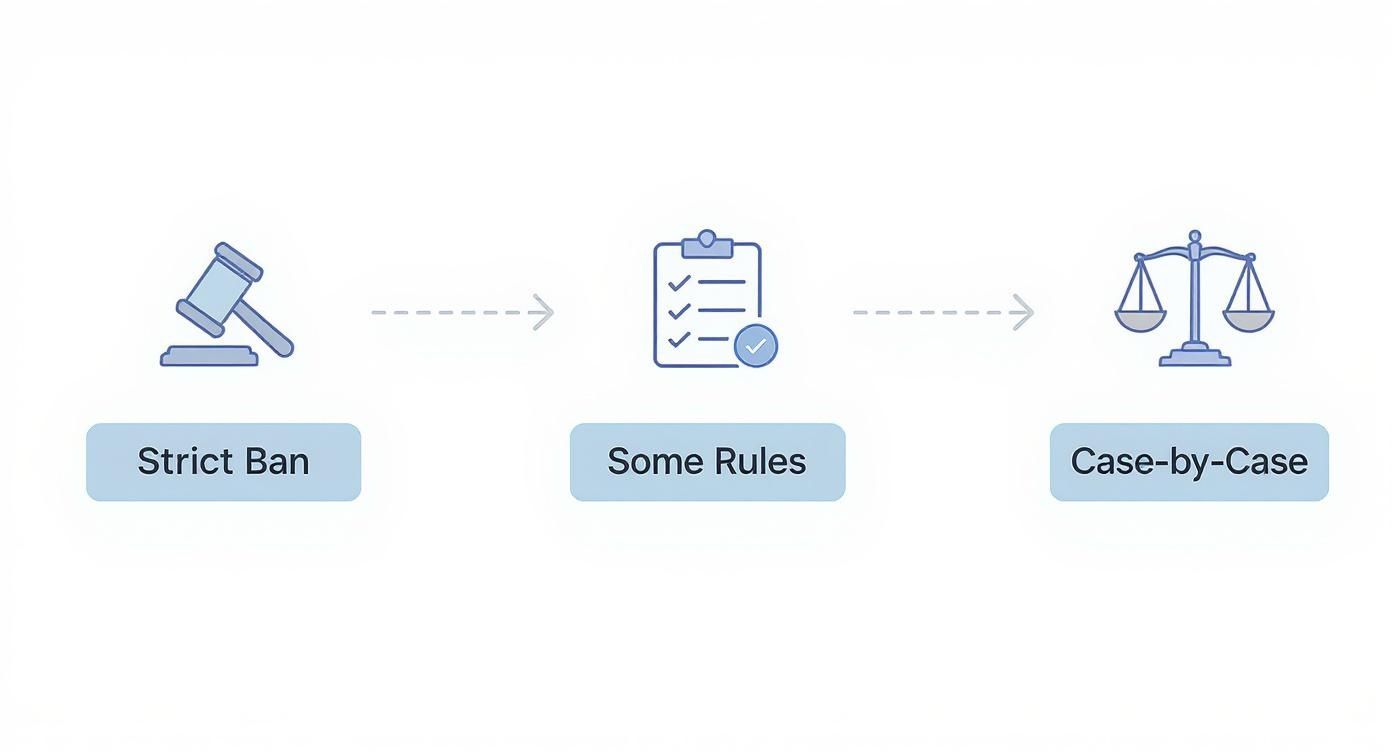
This visual really drives home how crucial your location is. The local legal framework can either give you a clear path to getting an agreement thrown out or leave it entirely up to a judge's interpretation.
What to Do When Facing a Non-Compete
Finding yourself up against a non-compete agreement is a high-stakes situation where making assumptions can be a costly mistake. Whether a non-compete agreement is enforceable isn't a simple yes or no question; it depends on a tricky mix of what's considered reasonable, the company's legitimate business needs, and the specific laws of your state.
The single most important step you can take is to avoid making decisions based on fear or wishful thinking. Don't just assume the agreement is an unbreakable ironclad contract, and definitely don't ignore it and hope for the best.
The biggest mistake you can make is trying to interpret a complex legal document on your own. A small detail in the contract or a recent change in state law could completely alter your situation.
Instead, get professional guidance. An experienced attorney can break down the specific language of your contract and measure it against the laws in your jurisdiction. This process gives you a clear-eyed assessment of your rights, the risks you're facing, and your strategic options moving forward.
A lawyer can spot weaknesses in the agreement that you might miss, like restrictions on time or geography that are far too broad, or a lack of valid consideration to make the contract stick. They can also walk you through the potential outcomes, from negotiating a clean release with your former employer to challenging the agreement in court. Understanding what a business lawyer does clarifies how they protect your interests in these exact situations. Ultimately, getting professional advice is what turns uncertainty into a clear, actionable plan.
If you want to discuss your business law matter, contact Kons Law at (860) 920-5181 for personalized legal advice.
Frequently Asked Questions About Non-Competes
When you’re dealing with a non-compete, the big, overarching rules are one thing, but the real-world situations are what keep people up at night. The stakes are incredibly high, and the answers can make or break a career move or leave a business exposed.
This is where the rubber meets the road. General ideas about "reasonableness" get put to the test when things like layoffs or mid-stream contract changes happen. Let’s tackle some of the most common questions that come up.
What Happens if I Was Laid Off?
This is probably one of the most frequent questions I hear: "My company laid me off, do I still have to follow the non-compete?" It’s a great question, because it feels fundamentally unfair to be let go and then have your former employer block you from finding new work.
The answer really comes down to your state's laws. A growing number of states agree with that sense of unfairness. In places like Colorado, for example, the law is clear—if an employer lays you off, the non-compete is void.
But don't assume that's the rule everywhere. In many other states, a layoff doesn't automatically kill the agreement. A court might still enforce it if the employer can make a convincing argument that they need to protect critical trade secrets, even though they were the one to end the employment. It often turns into a courtroom battle over what's fair under the circumstances.
Can I Be Forced to Sign After Starting a Job?
Here’s another classic scenario. You’ve been working at a company for months, maybe even years, and suddenly HR puts a non-compete agreement on your desk and tells you to sign it. Can they do that?
Yes, an employer can ask you to sign one at any point. But for that signature to hold up in court, they almost always need to give you something new in return. This is a legal concept called "consideration." In many states, just letting you keep the job you already have isn't considered enough.
A non-compete that’s introduced well after you’ve started a job needs to be supported by a real, tangible benefit. Without that fresh exchange of value, the agreement is often built on a shaky legal foundation and can be challenged.
So, what counts as valid consideration?
- A promotion that comes with new duties and a pay raise.
- A meaningful, one-time bonus for signing.
- A new grant of stock options or other company equity.
If they just slide the paper across the desk and expect a signature to keep your existing job—with nothing new offered—that non-compete might not be worth the paper it's printed on.
Are Non-Competes Enforceable for Contractors?
Lately, more companies are trying to use non-competes with their independent contractors. But this is a much tougher sell in court. The entire point of being an independent contractor is the freedom to work with multiple clients. Trying to restrict that freedom goes against the very nature of the relationship.
Courts look at these agreements with a very skeptical eye. Enforceability almost always comes down to just how deep the contractor's access to sensitive information was.
For instance, if a company hired a freelance developer to build its core proprietary software and gave them the keys to the kingdom—the entire source code—a court might uphold a very narrowly written non-compete. On the other hand, if a freelance marketing consultant is asked to sign a broad non-compete, it's far less likely to stick. The business has to prove an exceptionally strong and specific reason for limiting a contractor's ability to work.
If you want to discuss your business law matter, contact Kons Law at (860) 920-5181.
