
A solid small business contract template is your first line of defense. Think of it as a clear, written agreement that defines expectations from the outset, heading off costly misunderstandings before they can even start. It’s far more than a formality; it’s a foundational tool that outlines the scope of work, payment terms, and responsibilities for everyone involved, giving you crucial legal protection.
Why a Generic Template Is Not Enough
Grabbing the first free template you find online might feel like a quick win, but this approach often creates more problems than it solves. A generic document can't possibly understand your business, your industry, or the specific nuances of the project you're about to undertake. It's a one-size-fits-all solution for a problem that demands a custom fit.
Without a careful eye and customization, you might be agreeing to terms that are unfavorable, unclear, or even legally unenforceable in your state. The language is often vague, leaving critical details open to interpretation—and that’s exactly where most business disputes are born.
The Dangers of Vague Agreements
Imagine you hire a web developer using a basic online template. The contract just says they will "build a new website." What does that actually mean?
- Does it cover copywriting and pulling together images?
- How many rounds of revisions are you allowed?
- Is ongoing maintenance part of the deal or a separate cost?
If these points aren't explicitly spelled out, you're setting yourself up for a classic "he said, she said" scenario. This can lead to project delays, unexpected costs, or a final product that falls short of what you envisioned. A well-structured contract template eliminates this ambiguity right from the start.
Core Components of a Reliable Contract
A truly reliable small business contract template must contain several non-negotiable elements to be effective. These are the building blocks that ensure clarity and provide the framework for a successful professional relationship.
A contract is a tool for setting expectations. Its primary job isn't to win a lawsuit; it's to prevent one by making sure everyone is on the same page from day one.
Before you even think about customizing clauses, make sure your starting template includes clear sections for these fundamentals. For a deeper dive into different agreement types, our collection of articles on business contracts offers valuable insights. A strong foundation is everything.
- Identification of Parties: The contract must clearly state the full legal names and contact information for all individuals or businesses involved. It should specify whether a party is an individual, an LLC, or a corporation.
- Scope of Work: This is arguably the most critical section. It needs to detail the exact services to be provided or products to be delivered. The more specific you are here, the better.
- Payment Terms: This part outlines how, when, and how much will be paid. Be sure it includes due dates, accepted payment methods, and any penalties for late payments.
- Timeline and Deliverables: The agreement needs to set firm deadlines for key milestones and the final project completion. Vague timelines just invite delays and frustration.
- Confidentiality and Ownership: Who owns the final product or any intellectual property created during the project? This section defines ownership rights and outlines any confidentiality obligations.
These elements transform a simple piece of paper into a powerful business tool. Starting with a template that properly addresses these core areas gives you a solid base to build upon, ensuring your final agreement truly protects your interests.
If you want to discuss your business law matter, contact Kons Law at (860) 920-5181.
Choosing The Right Contract Template For The Job
Using a generic, one-size-fits-all contract for your business is a disaster waiting to happen. Think about it: the agreement you need for a freelance graphic designer is completely different from the one you'd use for a long-term software developer or a critical parts supplier. Picking the right template from the start is the only way to build a document that actually protects you.
The reality is, not all agreements are created equal. Each type is built for a specific job, outlining unique obligations and protections that match the work being done. If you grab the wrong one, you could be left wide open to scope creep, intellectual property theft, or worse.
This need for specialized, solid contracts has kicked off a huge industry. The global market for contract drafting services was valued at around USD 9.57 billion and is expected to explode to USD 44.95 billion by 2033. It’s a clear sign that small businesses are getting serious about managing their risks with legally sound agreements.
Matching The Template To The Task
To sidestep the most common mistakes, you need to know what the most common contracts are actually for. Let's walk through three essential templates that pretty much every small business will need sooner or later.
Common Small Business Contract Types
Here's a quick breakdown of the essential contract templates you'll likely encounter, what they're used for, and the non-negotiable clauses you should always look for.
| Contract Type | Primary Use Case | Must-Have Clauses |
|---|---|---|
| Service Agreement | Hiring a business for a specific, time-bound project (e.g., a marketing campaign, tax prep). | Scope of Services, Payment Milestones, Project Timeline, Deliverables. |
| Independent Contractor Agreement | Engaging a self-employed individual (e.g., freelance writer, contract developer). | Independent Contractor Status, IP Ownership, Confidentiality, Termination. |
| Statement of Work (SOW) | Detailing a complex, multi-phase project, often as part of a larger agreement. | Exhaustive Scope of Work, Deliverables List, Acceptance Criteria, Timelines. |
Understanding these distinctions is the first step toward ensuring your agreements provide the protection your business needs for any given engagement.
The Service Agreement
A Service Agreement is your workhorse for hiring another business or an individual to perform a specific service. It’s perfect for projects with a clear beginning, middle, and end.
You'd pull this out when hiring a marketing agency for a six-month campaign, a consultant for a market analysis report, or an accounting firm to handle your year-end taxes. The key here is that you're paying for a defined outcome or a specific package of services. Make sure it has detailed sections on the scope of services, payment milestones tied to deliverables, and a firm project timeline.
The Independent Contractor Agreement
This one is absolutely critical. An Independent Contractor Agreement is specifically for engaging self-employed individuals, not employees. It’s the document that legally defines the working relationship and protects your business from getting into hot water with the IRS over misclassification.
This is the right choice when you bring on a freelance writer, a contract-based web developer, or a temporary project manager. It makes it crystal clear that the contractor controls how the work gets done and is responsible for their own taxes and benefits. It absolutely must include language explicitly stating their independent contractor status, along with clauses covering intellectual property ownership, confidentiality, and how either party can end the contract.
Before you even get to a formal contract, many deals start with a less formal document to get everyone on the same page. You can learn more about what a letter of intent is and see how it can fit into your negotiation process.
The Statement of Work (SOW)
A Statement of Work, or SOW, is often an add-on to a larger master service agreement, but it can also stand on its own for project-based work. This is where you get hyper-specific. The SOW drills down into the "who, what, when, and where" of a particular project in painstaking detail.
An SOW is perfect for complex projects with multiple phases, deliverables, and strict performance standards. For example, building a custom software application or managing a multi-stage construction project would be impossible without a detailed SOW. It should include an exhaustive scope of work, a specific list of deliverables, clear acceptance criteria, a project timeline with all milestones, and an unambiguous payment schedule.
This decision tree gives you a simple visual for making sure your contract's core elements are ready to go.
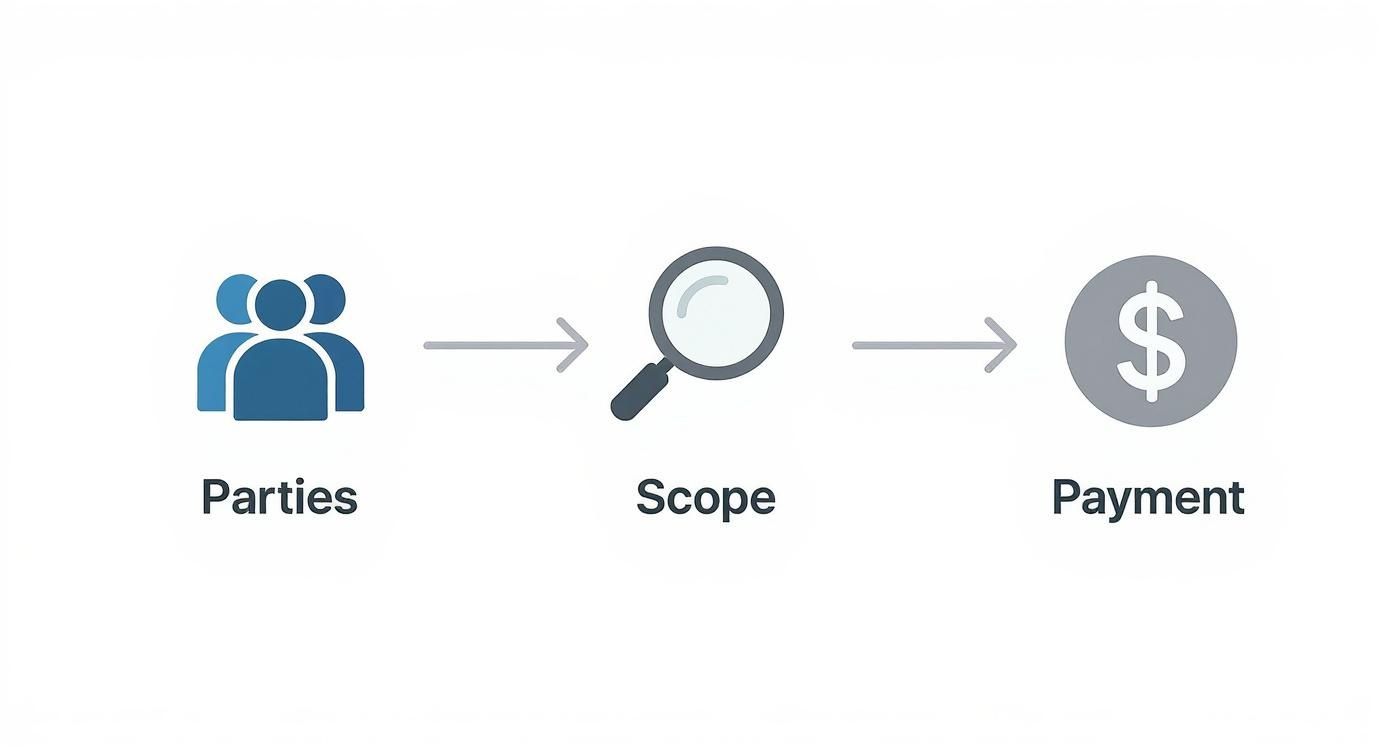
No matter what template you start with, getting the parties, scope, and payment terms right is the foundation of any solid agreement.
How To Customize Critical Contract Clauses
A small business contract template is a fantastic starting point, but it's just that—a start. The real legal protection comes from tailoring that blueprint to fit the unique specs of your project. This is where you turn a generic document into a precise tool that shields your business from costly misunderstandings.
Vague language is the number one cause of contract disputes. Phrases like "provide marketing services" or "design a new logo" are just invitations for trouble. The goal of customization is to replace these ambiguities with specific, measurable, and crystal-clear terms that leave zero room for interpretation.
Think of it like building a house from a set of architectural plans. You still have to choose the materials, define the exact dimensions, and make sure every last detail is accounted for. The clauses below are the load-bearing walls of your agreement; getting them right is non-negotiable.
Defining The Scope Of Work
The Scope of Work (SOW) is where most contracts either stand strong or fall apart. A weak SOW is a breeding ground for scope creep, project delays, and budget overruns. Your mission here is to be painstakingly specific.
Instead of a fuzzy description, break the project down into concrete deliverables. What exactly will be produced? What are the key milestones? What specific tasks are included, and just as importantly, what is explicitly excluded?
- Weak Wording: "The contractor will develop a social media strategy."
- Strong Wording: "The contractor will deliver a comprehensive social media strategy document for Q3. This document will include a content calendar for three platforms (Facebook, Instagram, LinkedIn), five sample posts per platform, and a list of recommended performance metrics. This does not include ad spend management or community engagement, which will be billed separately."
That level of detail ensures both you and your contractor know exactly what to expect. It creates a clear benchmark for what "done" really looks like, heading off disagreements before they can even start.
Nailing Down Payment Schedules
Clarity on payment terms is every bit as critical as the work itself. Any ambiguity here can strain the working relationship and throw your cash flow into chaos. A solid payment clause outlines not just how much, but also the when and the how.
Your customized clause should specify the exact payment structure. Is it a fixed fee? An hourly rate? Based on milestones? If it's milestone-based, you need to tie each payment directly to the completion of a specific deliverable you already defined in the Scope of Work.
A well-drafted payment clause acts as a project roadmap. By linking payments to tangible progress, you incentivize timely completion and maintain control over the project's financial flow.
Be sure to cover these details for a rock-solid payment clause:
- Payment Amounts and Dates: List the exact dollar amount for each payment and the specific trigger (e.g., "Upon signing," "Upon delivery of draft one").
- Invoice Submission: How should invoices be sent? To whom? What information must be included?
- Late Fee Policy: What's the consequence for a late payment? Specify a reasonable late fee or interest rate to encourage everyone to stay on schedule.
- Payment Methods: Clearly state the accepted forms of payment, whether it's bank transfer, credit card, or a check.

Protecting Your Intellectual Property
If your project involves creating something new—like software, a brand identity, or original content—the Intellectual Property (IP) clause is absolutely paramount. This section spells out who owns the final work product and any related materials.
A common mistake is assuming ownership automatically transfers to you, the client. Without an explicit clause, the creator might actually retain the rights, leaving you with a product you can't fully use or modify as you see fit. Your template needs to be adapted to clearly state that all rights, title, and interest in the work created under the agreement transfer to your company upon final payment.
This is especially crucial when working with independent contractors. The language should be unambiguous, often called a "work for hire" provision, to ensure the IP legally belongs to you.
Clarifying Termination Conditions
Nobody goes into an agreement expecting it to fail, but you always have to plan for the possibility. A termination clause provides a clean exit strategy, defining how and why the contract can be ended by either party. This prevents a messy, indefinite limbo if the relationship goes south.
Customize this clause to outline the specific conditions for termination.
- Termination for Cause: This covers situations where one party fails to hold up their end of the bargain—like missing major deadlines, delivering substandard work, or not making payments.
- Termination for Convenience: This allows either party to end the contract for any reason, usually with a certain amount of written notice (e.g., 30 days). This adds flexibility but should also clarify any final payments owed for work completed up to the termination date.
A strong termination clause protects both sides by setting clear rules for disengagement, helping you avoid a long and expensive legal fight. If you want to discuss your business law matter, contact Kons Law at (860) 920-5181.
Bringing Your Contracts Into Daily Operations
A signed contract is a powerful starting point, but its real value comes from active management. An agreement gathering dust in a digital folder offers no practical protection. To turn your customized small business contract template from a static document into a dynamic tool, you have to integrate it into your daily workflow.
This means treating your contracts as living documents. They should guide project execution, track milestones, and ensure obligations are met on time. When a contract is actively managed, it becomes a roadmap for the entire business relationship, helping to prevent misunderstandings and keep projects on track.
Systems for Managing Contracts
For a small business, managing contracts doesn't have to be complicated. The goal is to create a simple, repeatable system that ensures nothing falls through the cracks. It all starts with organization—creating a central, secure place where all your signed agreements are stored and easily accessible.
From there, the key is tracking. What are the major deadlines? When are payments due? When does the contract expire or come up for renewal? Manually tracking these dates in a spreadsheet can work for a while, but it quickly becomes unwieldy as your business grows.
A disorganized contract system is a huge liability. A missed renewal date or forgotten deliverable can cost you a key client or supplier relationship, directly impacting your bottom line.
This is why many businesses turn to technology for help. Even simple tools can make a world of difference in keeping your commitments organized and visible.
The Rise of Contract Management Software
Modern businesses are increasingly relying on specialized software to handle their agreements. Contract management software has become a critical tool, with the global market valued at around USD 2.8 billion and projected to grow significantly. The legal function alone holds about 30% of this market, which just goes to show how important legally sound agreements are in managing business operations efficiently. You can explore more about the growth of contract management tools on gminsights.com.
This kind of software automates many of the tedious tasks involved in contract oversight. For a small business, this can include:
- Automated Reminders: Get alerts for upcoming payment deadlines, renewal dates, and project milestones.
- Centralized Repository: Store all your contracts in one secure, searchable database.
- Version Control: Keep track of changes and ensure everyone is working from the most current version of the agreement.
- Compliance Tracking: Monitor obligations to ensure both parties are fulfilling their duties as outlined in the contract.
Even basic project management tools or a well-organized cloud storage system can serve as a starting point. The specific tool is less important than the commitment to a proactive management process.
Making Compliance a Part of Your Workflow
Integrating contract management into your daily operations is also a key part of your overall business health. A well-managed contract system ensures you are not just signing agreements, but also adhering to their terms—a core component of legal compliance.
Building a workflow around your contracts helps make this process natural. For instance, when you sign a new client agreement, your process should immediately trigger actions like adding key dates to a shared calendar and assigning responsibility for tracking deliverables to a team member. This proactive approach ensures that compliance isn't an afterthought but a fundamental part of how you do business.
To build a stronger framework for your business operations, consider reviewing a small business compliance checklist to identify other key areas that need systematic oversight. Making contract adherence a habit turns your agreements into active tools that support secure, scalable growth. It transforms them from legal paperwork into a reliable framework for building strong and lasting business relationships.
If you want to discuss your business law matter, contact Kons Law at (860) 920-5181.
Managing Your Supplier And Vendor Agreements
Your relationships with suppliers are the backbone of your business. A delay in materials, a dip in quality, or a sudden price hike from a vendor can bring your entire operation to a screeching halt. This is why your supplier agreements are so critical. A solid small business contract template for vendors isn't just for placing orders; it’s about building a supply chain you can actually rely on.
These agreements are fundamental for setting clear expectations and heading off potential disasters. Without one, you're running on handshakes and hope—a huge gamble when your ability to deliver to your own customers is on the line. A proper vendor contract brings clarity to the entire partnership, from quality control all the way to payment terms.
Key Clauses You Cannot Ignore
When you're tailoring a template for a supplier, some clauses need extra attention. These are the parts that directly hit your bottom line, your product quality, and your ability to operate smoothly. Getting them right is non-negotiable for a healthy, long-term partnership.
- Quality Standards and Acceptance Criteria: Don't be vague here. Be painfully specific about what you consider acceptable. Define quality with measurable metrics, material specs, or industry standards. The contract also needs to spell out how you'll inspect goods upon arrival and exactly what happens if a delivery doesn't meet the standard.
- Delivery Schedules and Logistics: "Delivery in Q3" just won't cut it. Your agreement needs exact delivery dates or tight windows, shipping methods, and a clear statement on who covers shipping costs and insurance (often referred to as FOB terms). This prevents endless arguments over lost or late shipments.
- Pricing and Payment Terms: Lock in your pricing for a set period. This protects you from out-of-the-blue increases that can wreck your budget. The contract should also clearly state the payment schedule—is it net 30, net 60, or payment on receipt? And be sure it defines the consequences for late payments on your part and, just as importantly, late deliveries on theirs.
A great vendor agreement is a roadmap for mutual success. It protects you from supply chain headaches while giving your supplier the clear, predictable framework they need to do their best work.
Building Stronger Partnerships Through Clear Agreements
A good contract does more than just shield you from risk—it builds trust. When everyone knows their rights and responsibilities, the relationship can focus on growth and collaboration instead of constantly putting out fires. This is especially true when it comes to clauses that define what happens when things inevitably go wrong.
A strong template will include sections that cover breach of contract, termination rights, and how you'll resolve disputes. For instance, what happens if a supplier consistently misses deadlines? The contract should outline the remedies, which could be anything from financial penalties to your right to walk away from the deal after a certain number of strikes.
The Role of Modern Platforms in Vendor Management
Managing these vital relationships has become a major focus for businesses everywhere. In fact, the market for supplier contract management is expected to grow from USD 1.85 billion to nearly USD 3.96 billion by 2035. Today, cloud-based platforms hold a massive 58% of the market, giving small businesses the kind of scalable and secure tools they need to professionalize their procurement.
While big companies still drive most of the demand, platforms designed for small and medium-sized businesses are catching up fast. You can dig deeper into these trends in supplier contract management on futuremarketinsights.com.
These platforms offer affordable templates and tools that help small businesses handle vendor relationships far more effectively. By starting with a properly customized small business contract template, you're laying the groundwork for partnerships that aren't just transactional, but truly collaborative.
If you want to discuss your business law matter, contact Kons Law at (860) 920-5181.
When To Call A Lawyer Instead Of Using A Template
Templates are fantastic tools. I use them myself for routine, low-stakes agreements. They’re great for streamlining simple deals and saving precious time.
But let's be honest—templates have their limits. When a deal starts to get complicated or strays into unfamiliar territory, a generic document just won't cut it. That's when you need an expert eye to protect your business.
Think of it this way: a template can handle the basics like scope and payment terms. What it can’t do is anticipate the unique risks that come with more complex transactions.
So, when should you pick up the phone and call an attorney? Here are a few red flags I always tell my clients to watch out for:
- High-Stakes Deals: Anything involving the sale of major assets, mergers, or significant equity investments.
- Complicated Intellectual Property: If ownership and licensing rights need to be spelled out with surgical precision, a template is a recipe for disaster.
- International Agreements: You're dealing with multiple sets of laws, regulations, and potential jurisdictional conflicts.
- Unusual Liability Requests: A client is demanding bespoke indemnity clauses or incredibly broad warranties.
The moment a contract could expose your business to unpredictable, high-impact risks, it's time to get professional guidance. It's that simple.
Common Complex Scenarios
I see these situations all the time. A founder is negotiating a term sheet with an investor, and the funding conditions are a tangled mess of preferences and anti-dilution clauses. Or, two companies are forming a joint venture with partners in different countries.
These aren't your everyday agreements. They almost always involve specific local laws, tax implications, and regulatory hurdles that a one-size-fits-all template completely ignores.
You should seriously consider legal help when:
- The transaction value climbs over $100,000 and involves multiple stakeholders.
- The deal creates potential for revenue-sharing disputes over intellectual property rights or licensing.
- The contract contains vague performance standards, confusing penalty clauses, or unclear exit terms.
If you want to understand more about how a lawyer can help in these situations, our guide on What Does a Business Lawyer Do is a great place to start.
A quick legal review can easily save you thousands—or even tens of thousands—down the line.
- An attorney can perform a custom risk assessment to spot hidden landmines.
- You'll walk into negotiations with much stronger leverage because you understand the risk parameters.
- Getting a formal review of complex clauses is your best defense against future disputes.
Bringing in counsel early can head off litigation before it ever starts and ensures you walk away with clear, enforceable terms that actually match your goals.
Templates are a great starting point, but knowing their boundaries is key to protecting your interests.
If you want to discuss your business law matter, contact Kons Law at (860) 920-5181.
Common Questions About Contract Templates
When you're running a small business, legal questions pop up all the time. Here are some of the most common ones I hear from clients about using contract templates. Let's clear up the confusion so you can move forward with confidence.
Are Online Contract Templates Legally Binding?
Yes, a contract built from a template can be legally binding, but it's not automatic. For any contract to hold up, it needs a few key ingredients: a clear offer, acceptance of that offer, consideration (meaning both sides are giving up something of value), and a mutual understanding that you're entering a formal agreement.
The real test, though, is in the details. If the template's language is vague, conflicts with Connecticut state law, or hasn't been properly adjusted for your specific deal, a court might not enforce it. The goal is to make sure the final document is specific, clear, and fully compliant with local laws.
What Is The Best Way To Handle Digital Signatures?
In the U.S., digital signatures are widely accepted and carry the same legal weight as a wet-ink signature, thanks to the E-SIGN Act. For almost any business agreement, using a trusted e-signature service is the most secure and efficient way to go.
Platforms like DocuSign or Adobe Sign create a verifiable audit trail, showing exactly who signed and when. This adds a crucial layer of security that you just don't get with other methods. Just make sure both parties agree to sign electronically, which is usually a standard part of the process on these platforms.
A common mistake I see is someone just typing their name into a PDF or pasting a scanned image of their signature. While it might seem convenient, these methods lack the security and legal traceability of a dedicated e-signature platform, making them much easier to challenge down the road.
How Do I Modify A Contract After It's Signed?
Life happens, and sometimes deals need to change. If you have to alter an agreement after everyone has signed, you can't just cross things out or add notes in the margin. The only legally sound way to do this is with a formal amendment.
An amendment is a separate, new document that clearly identifies the original contract (by title and date) and spells out the exact changes. Are you adding a clause? Removing one? Changing a deadline? It all goes in the amendment.
Crucially, both parties must sign the amendment for it to be valid. Skipping this step is a recipe for a future dispute.
If you want to discuss your business law matter, contact Kons Law at (860) 920-5181.
