A Connecticut business owner usually doesn't set out to mislead anyone. The problem starts with ordinary decisions. A sales page promises "no surprise charges," but a processing fee appears at checkout. A distributor says inventory is "available now," but the product won't ship for weeks. A contract buries a limitation that changes the deal's real value.
Those situations don't feel like classic fraud. They still can create exposure for deceptive and unfair trade practices claims.
For Connecticut companies, that risk sits at the intersection of federal consumer-protection standards and state law, especially CUTPA. The practical issue isn't just whether a statement is technically false. It's whether your pricing, disclosures, contract terms, sales process, and post-sale conduct create a misleading overall impression or impose harm that a court or regulator could view as unfair. That analysis also reaches farther than many owners expect, including disputes between businesses.
Understanding Your Legal Obligations in Fair Trade
A common version of the problem looks like this. A Connecticut retailer adopts a new pricing strategy to stay competitive online. The advertised price tracks what competitors show in search results, but mandatory charges appear late in the checkout flow. Internally, the team may view that as standard e-commerce practice. A customer, regulator, or competitor may view it very differently.
The same thing happens in distribution channels. A manufacturer wants consistency across dealers and starts tightening price-related rules, promotional language, and online listing requirements. Some of that can be lawful and commercially sensible. Some of it can become risky if the implementation creates confusion, selective enforcement, or misleading representations about price or availability. If you're working through channel-pricing issues, a practical guide to implementing MAP pricing can help frame the business side of the problem before legal review.
The line is broader than most owners expect
Connecticut businesses often assume these laws only target scams, counterfeit goods, or outright lies. That's too narrow. Risk can arise from:
- Incomplete disclosures that leave out a limitation a buyer would care about
- Sales scripts that overstate timing, performance, or exclusivity
- Contract terms that are technically present but hidden in a way that distorts consent
- Customer-service practices that make cancellation, refunds, or warranty use harder than the marketing suggested
A business can create liability through the total impression of a transaction, not just one bad sentence in an ad.
Operational discipline is critical. Marketing has to match fulfillment. Pricing has to match checkout. Sales promises have to match the contract. If those pieces don't align, the legal issue usually appears after a customer complaint, a demand letter, or a threatened CUTPA claim.
Defining Deceptive and Unfair Practices
The federal framework matters because it gives businesses a workable way to think about exposure before a dispute lands on someone's desk. The two labels, deceptive and unfair, overlap, but they aren't the same.
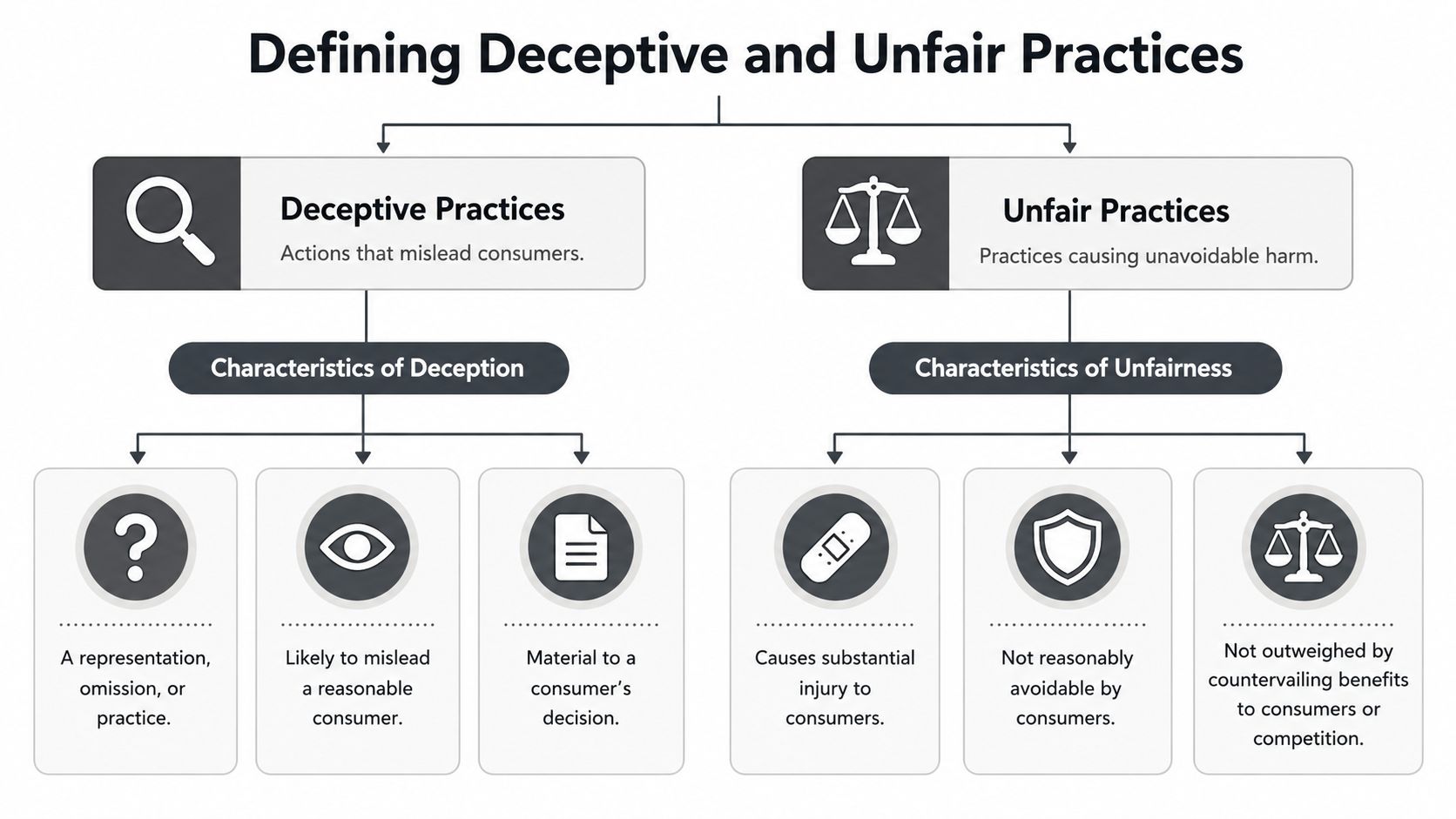
What makes a practice deceptive
A deceptive practice usually involves a representation, omission, or overall course of conduct that is likely to mislead a reasonable consumer in a way that matters to the decision to buy, cancel, renew, or pay. In plain terms, if the detail would influence the deal, hiding it or clouding it creates risk.
That doesn't only mean fake claims. It can also mean partial truths. "Free trial" language paired with a difficult cancellation path is an example of where businesses get into trouble. So is "limited inventory" language used as pressure when the seller can't support the urgency claim.
For a contract-focused example, disputes over what was promised versus what was delivered often overlap with misrepresentation issues. This is one reason businesses should understand how courts analyze misrepresentation in a contract before relying on aggressive sales language.
What makes a practice unfair
The unfairness standard is more specific. Under the FTC Act, the legal question is tied to consumer injury, not whether the conduct feels sharp or unpleasant.
Under the FTC Act, a practice is legally unfair only if it causes or is likely to cause substantial injury to consumers, the injury is not reasonably avoidable by consumers, and the injury is not outweighed by countervailing benefits to consumers or competition, according to the FTC's description of its enforcement authority for unfair practices.
That test matters because many businesses focus too much on disclosure formalities. A disclosure doesn't always solve the problem if the transaction still imposes a harmful net effect. Hidden fees, bait-and-switch setups, omitted limitations, and false availability claims are risky for that reason.
Why digital conduct creates extra exposure
Online sales compress the timeline for consumer decisions. Buyers move from ad to cart to payment quickly, often on a phone, which makes omissions more dangerous. If you want a non-legal way to think about how users evaluate trust before transacting online, resources that help people spot scams and avoid malware are useful because they highlight the same practical issue: people react to incomplete, inconsistent, or suspicious signals fast.
Connecticut businesses should also know that state law analysis often tracks federal concepts even when the claim is pleaded under state law. That makes federal standards more than background reading. They often shape how local risk gets evaluated.
The Legal Framework The FTC Act and CUTPA
The federal and Connecticut systems do different jobs, but they work in the same orbit. The FTC sets the national baseline for policing misleading conduct. The FTC states that enforcing laws against "deceptive and unfair business practices" remains the central statutory standard for policing misleading conduct in the U.S. economy, and that framework has expanded to pricing, data use, and contract transparency through the agency's consumer-protection enforcement role.
For a Connecticut company, that matters because many modern disputes don't start with a false billboard. They start with subscription terms, checkout design, data-driven marketing, renewal practices, lead-generation funnels, or inconsistent contract disclosures. Federal standards help explain why those practices draw attention.
How CUTPA fits
CUTPA is Connecticut's principal state-law tool for policing unfair and deceptive conduct in trade or commerce. Its reach is broad by design. That's why businesses can't safely approach compliance as a checklist of forbidden phrases.
In practice, CUTPA asks a more demanding question. Did the business act in a way that a court could view as unfair, deceptive, unethical, oppressive, or contrary to accepted commercial standards? That flexibility is what makes the statute useful to plaintiffs and dangerous to companies that rely on technicalities.
A good starting point for broader state-level operating risks is this overview of Connecticut business laws, because deceptive and unfair trade practices rarely exist in isolation. They usually overlap with contract formation, governance, advertising review, collections, and vendor management.
Why the FTC and CUTPA should be read together
Federal law offers structure. CUTPA gives Connecticut plaintiffs and enforcement authorities a broad state-law vehicle. For business owners, the practical takeaway is simple:
- Don't separate marketing from legal review. The claim language and the transaction flow need to match.
- Don't separate contracts from sales behavior. A strong clause won't rescue a sales process that created a misleading impression.
- Don't assume state law is narrower. In many disputes, state-law claims are the immediate pressure point.
The safest approach is to treat fairness as an operating standard, not a litigation defense.
That mindset helps when the business model changes. New products, AI-assisted marketing, revised billing logic, and channel restructuring all create exposure faster than most templates keep up.
Common Examples in Business and Consumer Transactions
The fastest way to understand deceptive and unfair trade practices is to look at the conduct that triggers real disputes. Most business owners recognize the obvious examples. The harder cases involve routine practices that look normal inside the company but appear misleading from the outside.
B2C patterns that create trouble
A home-services company advertises a low service price to get calls. Once the technician arrives, the quoted option is treated as unavailable, and the customer is pushed to a much higher-priced package. That's the classic bait-and-switch pattern.
An online seller promotes a product with a bold discount claim. The discount is real only if the buyer accepts auto-renewal terms, a nonrefundable add-on, or a final-step fee that wasn't clear earlier. The issue isn't just the fee itself. It's the path the customer took to reach the payment page.
A software provider offers a free trial, but the cancellation method is hidden behind multiple account screens and delayed support responses. Even if the subscription language exists somewhere in the terms, the overall process may still create serious exposure.
B2B risk is often underestimated
Many companies assume these claims belong only to retail buyers. That's a mistake. Many state UDAP statutes can support claims in B2B contexts involving one-sided contract terms, high-pressure sales tactics, and conduct that distorts the market, as described in this discussion of unfair trade practices and business conduct.
Here are the commercial versions I see businesses overlook:
- Specification inflation. A supplier represents that a component meets a required standard, knowing the buyer is relying on that representation for its own downstream obligations.
- Pressure through timing. A larger counterparty pushes a smaller business to sign quickly while minimizing material limitations that only appear after signature.
- Channel distortion. A company tells distributors that inventory, exclusivity, or promotional support will be handled one way, then uses a different system that undermines some channel partners.
B2C and B2B scenarios compared
| Business-to-Consumer (B2C) Examples | Business-to-Business (B2B) Examples |
|---|---|
| Advertising a low price that excludes mandatory charges until checkout | Quoting favorable supply terms while hiding operational limits that defeat the deal's value |
| Promoting a free trial without clear cancellation mechanics | Using one-sided renewal or termination terms against a smaller commercial partner |
| Claiming a product is in stock when fulfillment is materially delayed | Representing production capacity or technical specifications the seller can't meet |
| Highlighting benefits while downplaying key restrictions | Making sales promises that conflict with the written distribution or service agreement |
Some of the strongest claims arise when the written contract says one thing, the sales process communicates another, and performance reflects neither.
That last pattern matters in Connecticut because a business can be the claimant as well as the target. If a competitor, supplier, platform partner, or service vendor used misleading or oppressive conduct to win business or force terms, a deceptive and unfair trade practices analysis may belong in the case evaluation.
Navigating Enforcement Actions and Litigation
Once a problem surfaces, the question shifts from compliance to response. At that point, businesses need to think on two tracks at once. One track is regulatory exposure. The other is private litigation from consumers, customers, or commercial counterparties.
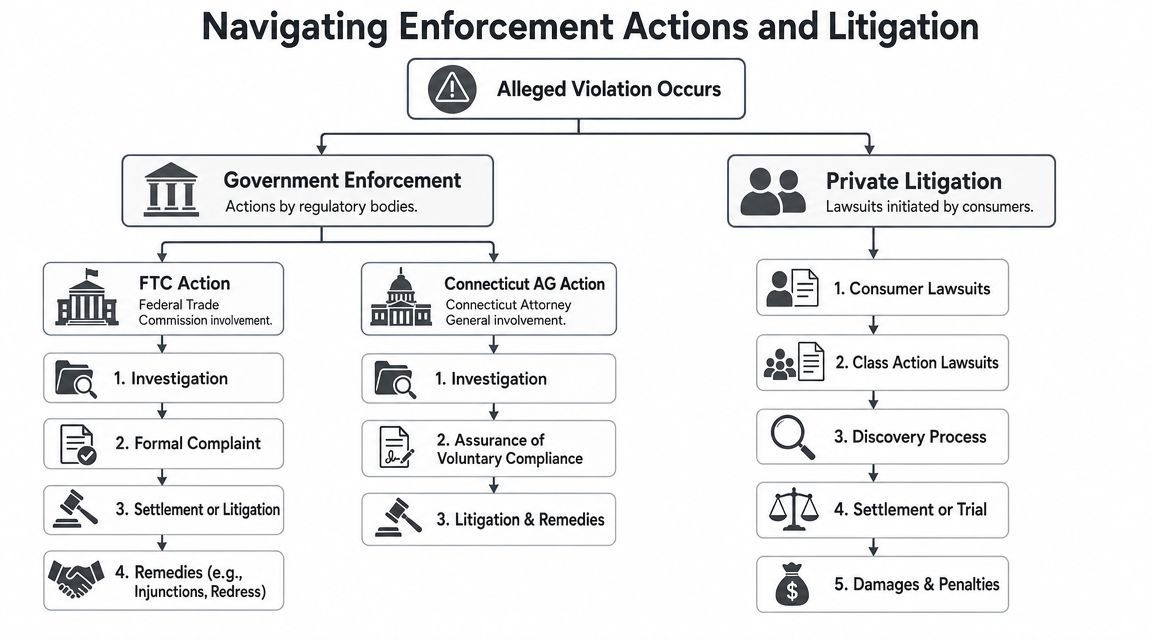
Government enforcement pressure
A regulator usually focuses first on the practice itself. What was represented, what was omitted, who was affected, and whether the company continued after complaints or warnings. The business response in those early stages matters. Sloppy internal explanations and inconsistent records often make a manageable issue look intentional.
Government action may involve an investigation, demands for documents, negotiations over corrective measures, and litigation if the matter doesn't resolve. Operational remedies can matter as much as money. A company may be forced to change ads, revise forms, alter sales scripts, update cancellation procedures, or stop using a disputed pricing format.
Private claims and class exposure
Private litigation creates a different kind of pressure because the plaintiff's lawyer isn't only looking at the challenged transaction. Counsel is also looking for scale. If the same script, form agreement, checkout design, or renewal practice affected a larger group, class allegations may follow.
The path to a remedy can include individual litigation, class actions, and regulatory complaints, and the best route often depends on state law and contract terms such as arbitration clauses or class-action waivers, as discussed in this analysis of unfair trade practice remedy paths.
That makes contract drafting a real risk-management tool, but not a cure-all. Arbitration clauses can narrow forum risk in some cases. They don't automatically fix a bad sales practice, and they don't always prevent coordinated claims.
For businesses weighing forum strategy, this overview of alternative dispute resolution vs litigation is useful because the best defense posture often depends on the contract, the number of affected parties, and whether the challenged practice is still ongoing.
What works in an early response
When a complaint arrives, these steps usually help:
- Freeze the facts. Preserve the ad copy, web pages, order flow, sales script, customer messages, and contract version used.
- Stop improvising. Front-line employees shouldn't send explanatory emails that create new admissions.
- Check for repeat use. One dispute may reveal a systemwide issue in templates, product pages, or channel instructions.
- Separate legal and business fixes. Refunding one customer may solve a relationship problem while leaving the larger exposure untouched.
Early containment beats late argument. If the practice is still live, fix it first, then fight about characterization.
Proactive Compliance and Risk Reduction for CT Businesses
Most deceptive and unfair trade practices problems are preventable. They happen when a business scales faster than its controls. A new landing page goes live without legal review. A sales manager rewrites a script. A software update changes how fees appear. A distributor gets one version of the policy and customers get another.
UDAP statutes exist in all 50 states and the District of Columbia, making compliance a nationwide baseline rather than a local option, according to the National Consumer Law Center's 50-state UDAP survey. For Connecticut companies that sell across state lines, that means one weak sales process can create problems in multiple jurisdictions.
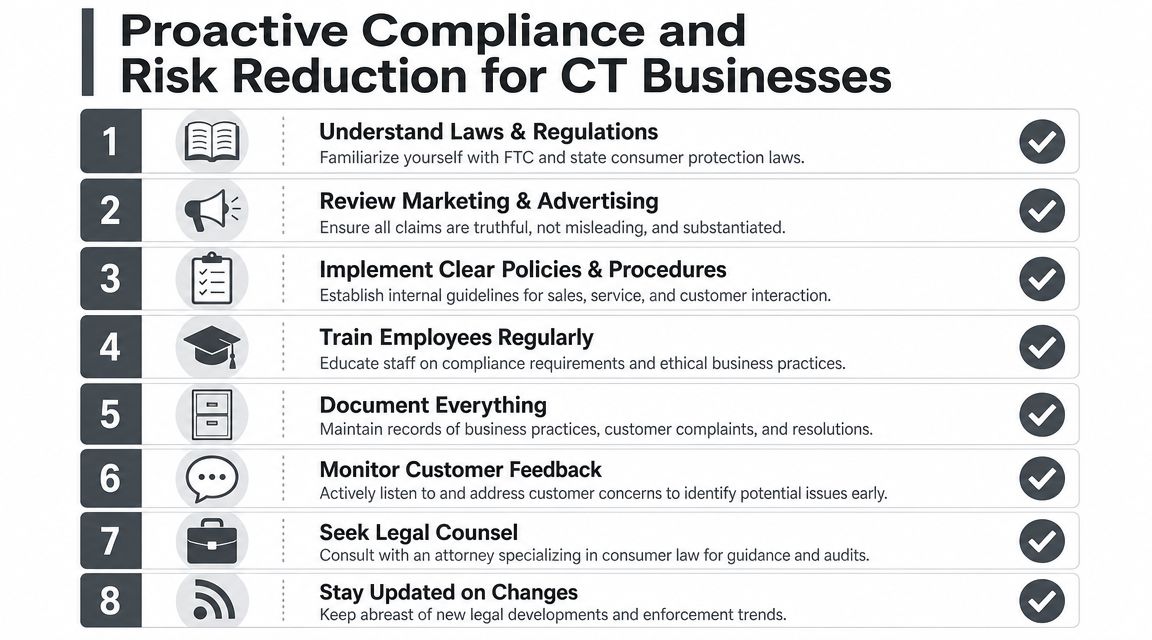
A workable compliance checklist
A practical system doesn't need to be fancy. It needs to be consistent.
- Review claims before launch. Marketing statements about price, availability, savings, quality, or exclusivity should be checked for support and context.
- Test the full customer journey. Read the ad, click the offer, go through checkout, review the confirmation, and try cancellation or return steps.
- Align sales with contracts. If your team explains the deal differently than the agreement reads, fix one of them.
- Track complaints by theme. Repeated confusion about one fee, term, or process usually means the disclosure isn't working.
- Audit partner communications. Distributors, affiliates, and outside sales reps can create liability with scripts and listings you never approved.
Where Connecticut businesses usually slip
The weak points are rarely exotic. They're usually ordinary operating habits:
- Version control failures across proposals, order forms, and website terms
- AI-generated copy that sounds polished but overstates what the product does
- Renewal and cancellation workflows designed by software teams without legal review
- Customer-service shortcuts that contradict advertised guarantees
A broader small business compliance checklist can help organize these controls, but the key is to assign ownership. Someone must be responsible for claim review, complaint escalation, and periodic audits.
Practical rule: If a buyer would feel surprised after reading the contract and seeing the invoice, your process needs work even if the language is technically there somewhere.
Protecting Your Business with Strategic Legal Counsel
Deceptive and unfair trade practices law rewards businesses that think early. Not businesses that scramble after a demand letter arrives. The companies that handle this well don't treat compliance as a marketing obstacle. They treat it as a discipline that protects revenue, reputation, and advantage in negotiations.
That matters even more now because risk doesn't stay confined to consumer advertising. It reaches vendor agreements, distributor relations, renewal terms, digital checkout flows, and AI-assisted content. A business can create exposure without a single obviously false sentence if the overall transaction is misleading or unfair in operation.
The smartest legal work in this area often happens before a launch, before a contract rollout, and before a response email goes out to an angry customer. That kind of review is less dramatic than litigation, but it's usually where the most value sits. Businesses dealing with broader governance and control issues may also benefit from related compliance resources, including this financial crime and compliance guide, because the common thread is the same: internal controls matter most before a regulator or plaintiff starts asking questions.
If you want to discuss your business law matter, contact Kons Law at (860) 920-5181.
