An employee non-disclosure agreement, or NDA, is a legally binding contract. It creates a confidential relationship between you, the employer, and your employee. The main goal? To stop employees from sharing your company’s sensitive information with anyone who shouldn't have it.
Think of it as a formal promise to keep your business’s secrets under lock and key, both while they work for you and long after they've left.
Understanding the Core Purpose of an Employee NDA
At its heart, an employee NDA acts as a shield for your company's most valuable, non-public assets: its information. Imagine you’ve poured years and resources into developing a one-of-a-kind manufacturing process, a proprietary software code, or a hard-won client list. This is the stuff that gives you an edge over the competition, and if it got out, the damage could be devastating.
The NDA is the legal instrument that formally labels this information as confidential and legally obligates your employee to protect it. It draws clear lines in the sand right from the start, usually as part of the initial hiring paperwork.
Why Are NDAs So Common?
You see NDAs everywhere these days for a reason. It's estimated that somewhere between 33% and 57% of U.S. workers are bound by an NDA or a similar confidentiality clause. They're so widespread because they solve a fundamental business problem: how to protect intellectual property and stay competitive in a world that moves incredibly fast.
And it’s not just for tech startups with secret algorithms. NDAs are critical tools across almost every industry. Before we dig deeper, let's look at the kinds of information these agreements are designed to protect.
Key Information Protected by Employee NDAs
| Information Category | Examples |
|---|---|
| Trade Secrets | Proprietary formulas (like a recipe), unique manufacturing processes, software source code, business methods. |
| Client & Customer Data | Customer lists, contact information, purchasing history, contractual terms, pricing agreements. |
| Financial Information | Internal profit/loss statements, revenue figures, pricing structures, budgets, investor details. |
| Business Strategy & Operations | Upcoming product launch plans, marketing campaigns, R&D projects, internal processes, M&A discussions. |
| Intellectual Property | Unpublished patent applications, copyrighted materials, designs, and other creative works in development. |
Each of these categories represents a potential vulnerability. An NDA works to close those gaps by making the employee's duty of confidentiality crystal clear.
The Foundational Promise of Secrecy
The NDA essentially creates a "cone of silence" around specific company information. It’s a formal acknowledgment from the employee that they are being trusted with valuable secrets and that they accept the legal responsibility that comes with that trust. This agreement helps build a framework of security, but more importantly, it gives you legal recourse if that trust is ever broken.
Without an NDA, proving an ex-employee had a clear duty to keep certain information secret can be a tough, uphill battle. The contract makes that obligation explicit, removing any doubt and strengthening your legal position if a dispute ever arises. Understanding these agreements is a crucial part of any sound corporate and business law strategy.
If you want to discuss your business law matter, contact Kons Law at (860) 920-5181.
The Anatomy of an Effective Employee NDA
A solid employee NDA isn't some generic template you pull off the internet. It’s a carefully crafted legal instrument where every single clause has a specific job to do. Think of it as a blueprint for a house—if the foundation is weak, the whole structure can come crumbling down under legal pressure.
To build an agreement that will actually hold up in court, you have to understand its core components. This isn't just about knowing definitions; it's about appreciating why each part matters and how they all lock together to shield your business. Let’s break down the critical pieces that give your NDA real teeth.
Defining Confidential Information Clearly
The absolute heart of any employee NDA is the definition of "Confidential Information." This clause is the bedrock of the entire agreement. If it’s vague or overly broad, a judge could toss the whole thing out.
Your goal here is to be specific enough to be clear, but not so narrow that you accidentally leave a critical asset unprotected. You need to explicitly list the categories of information you're protecting.
Good examples to include are:
- Trade Secrets: This is the "secret sauce"—proprietary formulas, unique processes, or business methods that give you an edge over the competition.
- Financial Data: Be specific. Think revenue reports, profit margins, pricing models, and sensitive investor information.
- Customer and Client Information: This covers everything from your client lists and contact details to contract terms and their buying habits.
- Business Operations and Strategy: This can include your marketing playbook, future product roadmaps, and internal procedures that make your business run smoothly.
The more precise you are, the harder it is for a former employee to argue they "didn't realize" that information was supposed to be kept under wraps. This clarity is your first and best line of defense.
This flowchart shows the key pillars of information an employee NDA is designed to protect.
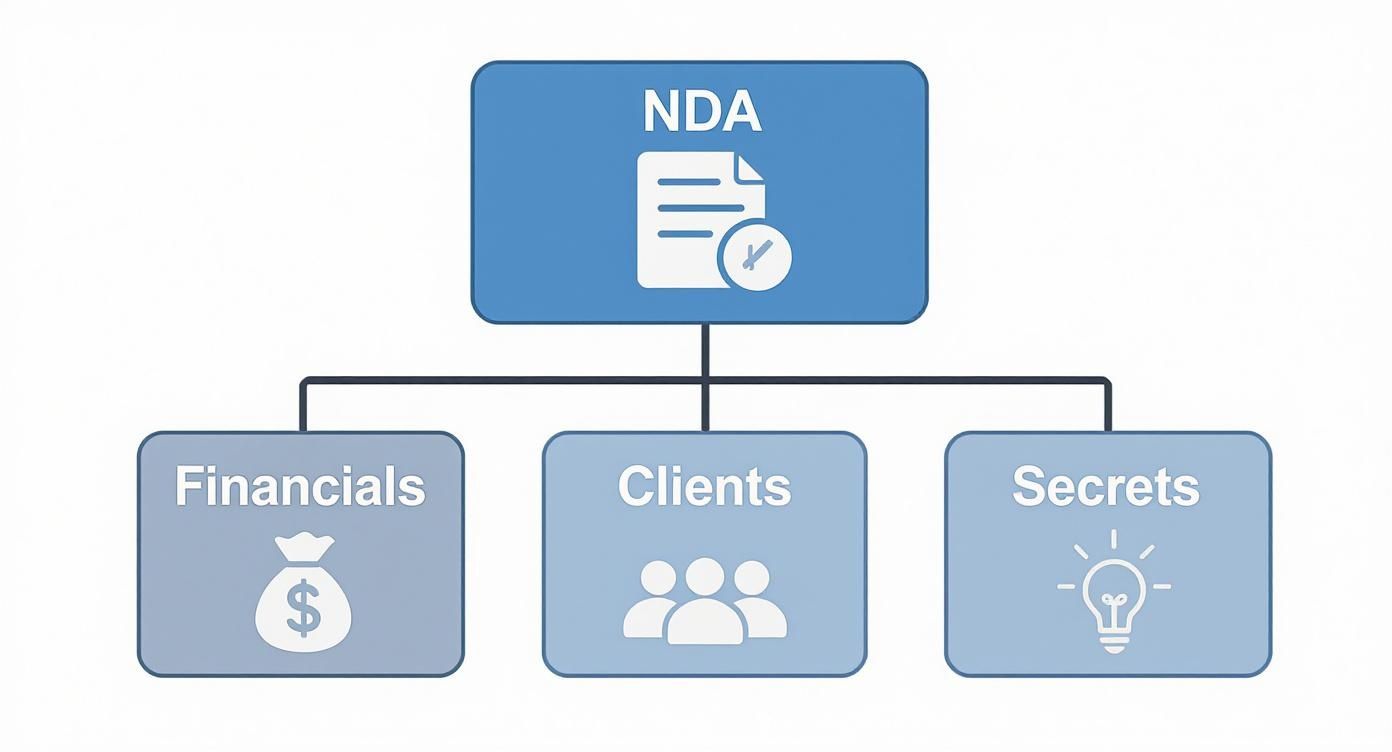
As you can see, a single agreement casts a wide net, protecting everything from your financial health and client relationships to your core intellectual property.
Specifying Scope and Duration
Once you’ve defined what is confidential, you have to nail down the how and how long. An NDA that tries to last forever or covers information that isn't really a secret won't survive a legal challenge.
Key Takeaway: Courts are always looking for what’s reasonable. An agreement that effectively prevents someone from ever working in their field again will almost certainly be seen as an unfair restraint of trade and thrown out.
The duration—how long the obligation to keep quiet lasts—is critical. For most general business information, a period of one to five years after the employee leaves is often considered reasonable. But for true trade secrets, that obligation can and should last as long as the information remains a secret.
The scope defines exactly what the employee can and cannot do. This clause needs to be crystal clear, stating that the employee is prohibited from:
- Disclosing the information to any outside party.
- Using the information for their own gain or for a new employer.
- Copying, downloading, or walking out the door with confidential documents.
A well-written scope clause leaves zero room for interpretation. If you’re looking to build solid legal documents from the ground up, reviewing a professionally vetted small business contract template can provide some excellent structural guidance.
Outlining Consequences of a Breach
Finally, any effective NDA must clearly spell out what happens if someone breaks the rules. This "breach" clause isn't just a formality; it’s a powerful deterrent and sets the stage for what you can do legally if your trust is violated.
This section should specify the remedies your company can pursue, which typically include:
- Injunctive Relief: This is an emergency court order to immediately stop the person from continuing to leak or use your information.
- Monetary Damages: This gives you the right to sue for any financial harm your business suffered because of the breach.
- Attorney's Fees: A crucial provision, this can require the person who breached the contract to pay your legal costs for having to enforce it.
By laying out these consequences from the start, you send a clear message about how seriously you take the protection of your confidential information.
If you want to discuss your business law matter, contact Kons Law at (860) 920-5181.
Ensuring Your NDA Is Legally Enforceable
An employee NDA is more than just a piece of paper; it’s a legal tool. But like any tool, it’s only useful if it’s built correctly. An agreement that won’t hold up in court is worthless, leaving your most valuable business secrets exposed right when you need protection the most.
Too many employers fall into the trap of drafting NDAs that are overly aggressive or frustratingly vague. A court's job isn't just to enforce contracts; it's to balance your right to protect your business with an individual's right to earn a living. If your agreement pushes that balance too far in your favor, it risks being thrown out entirely.
Understanding these legal guardrails is non-negotiable. Let's break down the key factors that determine whether your employee NDA will stand firm under legal pressure or crumble when challenged.
The Critical Test of Reasonableness
When a judge looks at an employee NDA, the central question always comes down to one thing: reasonableness. They need to decide if the contract fairly protects a legitimate business interest without unfairly handcuffing a former employee from finding new work.
This isn't a simple yes-or-no question. It’s a multi-faceted evaluation of the agreement's core restrictions.
A court will closely scrutinize these key areas:
- Scope of Information: Is the NDA protecting specific, genuinely confidential information, or is it trying to lock down general knowledge and skills the employee already had or would learn in any similar job? Trying to claim ownership of public information or an employee's inherent expertise is a fast track to getting your NDA invalidated.
- Duration of the Obligation: How long does the confidentiality last? A term of one to five years is often considered reasonable for most business information. But if you're trying to impose a permanent, indefinite obligation on information that isn't a true trade secret, that's a major red flag for any court.
- Geographic Limitations: While you see this more often in non-compete clauses, geography can still be a factor if the NDA is written so broadly that it effectively limits where an employee can work. An unreasonable geographic scope can easily be seen as an unfair restraint on trade.
A court will always look for a logical link between what you are protecting and the restrictions you impose. The goal is protection, not punishment. If the terms look like they were designed to stifle competition rather than safeguard actual secrets, the entire agreement is in serious jeopardy.
Avoiding Common Enforceability Pitfalls
Several common drafting mistakes can instantly make an employee NDA useless. One of the most frequent is being overly broad. An agreement that defines "confidential information" as "any and all information related to the business" is almost guaranteed to be struck down for being too vague.
Another huge pitfall is a lack of consideration. Every contract requires an exchange of value. If an NDA is signed at the very beginning of employment, the job offer itself counts as consideration. But if you ask a current employee to sign one, you have to offer something new in return—think a bonus, a raise, or a promotion.
The legal landscape is also constantly shifting, with a clear trend toward protecting employees from unethical agreements. In the United Kingdom, for instance, major reforms now require that NDAs are written in plain English and that employees get independent legal advice before signing. This is specifically designed to stop them from being used to silence victims of workplace misconduct.
The Rise of Whistleblower Protections
Finally, it's absolutely critical to understand that no employee NDA can legally stop someone from reporting illegal activities. Federal and state whistleblower laws give ironclad protection to employees who report violations of the law to a government or law enforcement agency.
Trying to use an NDA to create a culture of silence around harassment, discrimination, or other illegal conduct is not only wrong, it’s legally invalid. Any clause that tries to forbid this kind of reporting will be voided by a court, and its very presence could cast a shadow of doubt over your entire agreement.
If you want to discuss your business law matter, contact Kons Law at (860) 920-5181.
Drafting and Implementing Your NDA Strategy
A well-drafted employee NDA is a powerful asset, but its true strength comes from a thoughtful rollout strategy. Just downloading a generic template and asking everyone to sign it is a recipe for low morale and potential legal headaches. A successful approach involves careful tailoring, clear communication, and a process that respects your employees.
This isn’t about building a wall of legal jargon; it’s about creating a framework of trust and clarity. By handling the drafting and implementation process with care, you can protect your company’s most sensitive assets while reinforcing a professional work environment. A strong process ensures your non-disclosure agreement is not just a piece of paper, but an effective, enforceable tool.

Customization Is Non-Negotiable
The biggest mistake I see companies make is using a one-size-fits-all NDA. Your senior software architect with access to proprietary source code needs a different confidentiality agreement than a junior sales associate who only sees public-facing client lists. A single, overly broad agreement for both is legally weak and easy to challenge.
Effective drafting means tailoring the agreement to the specific role. Before you even start writing, ask yourself these questions for each position:
- What specific confidential information will this employee access? You need to be precise.
- How long does that information need protection after they leave? A product roadmap might be old news in two years, but a trade secret formula needs protection indefinitely.
- What are the biggest risks tied to this role? Focus the restrictions on preventing the most likely and damaging kinds of disclosures.
By customizing your agreements, you show a court that you have a legitimate and narrowly tailored business interest to protect—a cornerstone of enforceability.
The Logistics of a Smooth Rollout
How and when you present an NDA matters just as much as what's in it. Ambushing an employee or pressuring them to sign on the spot breeds distrust and could even be used against you in a legal dispute. A fair, transparent process is your best defense.
Best Practice: Always give employees enough time to review the document—at least seven days is a strong standard. This allows them to read it thoroughly and, if they choose, consult with their own legal counsel.
For new hires, the best time to present the NDA is right alongside the official job offer. This makes it a clear and upfront condition of employment.
For current employees, introducing an NDA requires more finesse. You have to provide new "consideration"—something of value in exchange for their signature. This could be a bonus, a pay raise, a promotion, or even continued employment, depending on what your state’s laws allow.
To help guide your process, here is a quick overview of what to focus on—and what to avoid.
NDA Drafting Do's and Don'ts
| Do | Don't |
|---|---|
| Tailor the scope to the specific employee's role and access level. | Use a generic, one-size-fits-all template for every employee. |
| Clearly define what constitutes "Confidential Information" with specific examples. | Be vague or overly broad in your definitions, which can make the NDA unenforceable. |
| Specify a reasonable duration for the confidentiality obligations. | Set an indefinite or unreasonably long time frame for non-trade secret information. |
| Provide new "consideration" when asking current employees to sign. | Pressure existing employees to sign without offering anything in return. |
| Give employees ample time to review the agreement and seek legal advice. | Demand an on-the-spot signature or create a high-pressure environment. |
| Include clear carve-outs for legally protected disclosures (e.g., whistleblowing). | Create an agreement that appears to silence legally protected speech. |
Following these guidelines will put you in a much stronger position if you ever need to enforce the agreement.
Securely Managing Signed Documents
Once the NDA is signed, your job isn't finished. These are critical legal documents that must be managed properly. Keep the original signed copies in a secure, access-controlled location, whether that's a locked file cabinet or an encrypted digital repository.
Proper management ensures you can quickly find the agreement if a breach occurs. It also signals that you take your own confidentiality protocols seriously, which strengthens your legal position. A sloppy storage process can undermine the very seriousness the NDA is meant to represent.
Finally, remember that the legal landscape for these agreements is always shifting. An NDA that was enforceable last year may not be today. Regularly reviewing and updating your templates with experienced legal counsel is essential to maintaining robust protection for your business.
If you want to discuss your business law matter, contact Kons Law at (860) 920-5181.
That sinking feeling when you realize an employee might have violated their NDA is something no business owner wants to experience. Your first instinct might be to react with anger or even panic, but the best thing you can do is take a deep breath and respond strategically. Flying off the handle can backfire, but a deliberate, measured plan lets you control the damage and enforce the agreement your non disclosure agreement employees signed.
The moment you even suspect a breach, the clock is ticking. Your top priority is to plug the leak and start gathering the evidence you’ll need to make your case. This calls for a quick, but careful, investigation to confirm what happened and figure out how bad the damage is.

First Steps When You Suspect a Breach
Before you even think about legal action, you need to be sure a breach actually happened. That means launching a quiet, internal investigation to get your facts straight. Jumping to conclusions without proof will only make a messy situation worse.
Your investigation should zero in on a few key things:
- Find Hard Evidence: Start collecting any emails, text messages, documents, or firsthand accounts that point to the unauthorized share. You might even need digital forensics to trace where data went or who accessed certain files.
- Document Everything: Create a detailed timeline. Write down when you first suspected the breach, exactly what information you think was leaked, and who you believe is responsible. Meticulous records are your best friend in any legal fight.
- Assess the Fallout: Figure out the immediate and long-term hit to your business. Did a competitor get their hands on your client list? Was a trade secret posted online? You have to understand the harm to decide what to do next.
Once you have solid evidence, the standard next step is to have your attorney send a formal cease and desist letter. This isn't just a strongly worded email—it’s a legal notice telling the former employee to immediately stop using or sharing your confidential information. Think of it as the final warning before things get serious.
Taking Legal Action
If the cease and desist letter is ignored or the damage is already severe, it’s time to take it to the next level. Your main goal here is to stop the bleeding and get compensated for any losses your business has taken.
Your legal strategy will depend on the specifics of the breach, but the objective is always the same: mitigate the harm and hold the breaching party accountable. This is where a well-drafted NDA proves its worth.
One of the most powerful tools in your arsenal is an injunction. This is a court order that forces the former employee to stop what they're doing right now. An injunction can prevent a competitor from using your stolen secrets or stop your private client data from spreading further while the full lawsuit plays out.
Beyond just stopping the immediate damage, you can also sue for monetary damages to recover your financial losses. This can get complicated—it could include lost profits, harm to your business’s reputation, or the money you spent cleaning up the mess. Proving these financial hits is a crucial part of making your business whole again.
The legal system can be slow and complex. It’s smart to weigh all your options, which is why understanding the differences between a full-blown lawsuit and other approaches is so important. Getting familiar with concepts like alternative dispute resolution vs litigation can give you a clearer picture as you decide on your next move.
If you want to discuss your business law matter, contact Kons Law at (860) 920-5181.
Need Help With Your Business Law Matter?
Putting together an NDA for your employees isn't as simple as downloading a template and hitting "print." You're navigating a tricky landscape of state and federal law, where one wrong move or a poorly worded clause could make the whole agreement fall apart—usually at the worst possible time.
To truly protect your business, you need more than a generic document. You need a legal strategy that's built for your specific needs and holds up under current Connecticut law. Getting guidance from an experienced attorney is the best way to ensure your NDA is solid, compliant, and actually enforceable when you need it most.
If you want to discuss your business law matter, contact Kons Law at (860) 920-5181.
Your Top Questions About Employee NDAs, Answered
Non-disclosure agreements often bring up a lot of questions for both sides of the table. These documents are incredibly common in the workplace, but they're also frequently misunderstood. Let's clear the air and provide straightforward answers to some of the most common queries we hear.
Getting clear on the basics is the best way to prevent future disputes. Whether you're an employer putting these agreements in place or an employee asked to sign one, understanding your rights and obligations is absolutely critical.
Are NDAs Still Valid After an Employee Leaves The Company?
Yes, absolutely. In fact, that's the whole point. A properly drafted NDA is designed specifically to remain in effect long after an employee has moved on.
This is usually handled by a "survival clause," which explicitly states that the duty of confidentiality continues for a set period of time post-employment. The main goal is to protect the company's sensitive information—like client lists or trade secrets—from walking out the door and ending up with a competitor.
Can an NDA Stop Me from Reporting Illegal Activity?
No, it cannot. An employee NDA is legally powerless to prevent you from reporting illegal conduct to government or law enforcement agencies. Federal and state whistleblower protection laws will almost always override the confidentiality terms of a private contract like an NDA.
Any attempt by an employer to use an NDA to silence an employee from reporting harassment, fraud, or safety violations is completely unenforceable. These protections exist for a reason: to ensure public safety and hold companies accountable.
What Is the Difference Between an NDA and a Non-Compete?
This is a very common point of confusion, but the distinction is critical. Think of it this way: an NDA protects information, while a non-compete restricts actions.
- An NDA (Non-Disclosure Agreement) is all about secrecy. It stops an employee from sharing specific confidential company information.
- A Non-Compete Agreement is about competition. It prevents an employee from going to work for a direct competitor for a certain time and within a specific geographic area after they leave.
While you often see them used together, they serve two very different legal functions. One protects your secrets, and the other protects your business from direct competition.
Should I Have a Lawyer Review an NDA Before Signing?
While it's not a legal requirement, it is highly recommended. An NDA is a legally binding contract, and it can have a real impact on your future career. Having an attorney review the document is the best way to ensure you understand every single obligation you're agreeing to.
An experienced lawyer can quickly spot terms that are too broad, unreasonable, or just plain unenforceable. This review protects your interests and makes sure the agreement is fair before you put your name on the dotted line.
These agreements are more common than you might think. Research involving nearly 2,000 workers found that about 45% are bound by non-disclosure agreements with their employers. This statistic really highlights how widespread these clauses have become. You can learn more about these findings on workplace agreements to see the bigger picture.
A non-disclosure agreement is fundamentally about trust, but it's formalized through a legal framework. For that framework to be effective, it must be clear, reasonable, and legally sound from the very beginning for everyone involved.
By understanding the answers to these common questions, both employers and employees can approach the NDA process with much greater confidence and clarity.
If you want to discuss your business law matter, contact Kons Law at (860) 920-5181.
