You're often forced to answer this question before the business has even opened its doors. You're filling out LLC paperwork, talking with a co-founder, or bringing in an investor, and someone asks: who's going to be the managing member, and who's just an owner?
That decision isn't cosmetic. In an LLC, titles affect authority, control, signing power, and the way third parties deal with the company. If you get it wrong, the problem usually doesn't show up on day one. It shows up when someone signs a lease, hires a vendor, opens a credit account, or makes a promise the rest of the ownership group says they never approved.
For Connecticut businesses, the practical question behind managing member vs owner is simple. Who has the legal power to act for the company, and how clearly have you documented it? The answer can shape internal disputes, outside contract risk, and the strength of the company's liability protections.
Structuring Your Business for Success
A lot of founders assume every owner automatically has equal authority. That's often how small businesses begin in practice. Everyone does a bit of everything, nobody wants formality, and the paperwork gets treated like an afterthought.
That works until the company needs structure. Once money, contracts, employees, lenders, landlords, or outside investors enter the picture, the difference between ownership and management stops being theoretical. It becomes operational.

The decision that affects control
When you form an LLC, you're not just choosing a tax and liability structure. You're also deciding how authority will be allocated inside the company. Some businesses want all owners actively involved. Others need a cleaner split, where one person runs operations and another keeps an economic stake without day-to-day responsibility.
That's why this issue comes up so early. The management model influences:
- Who signs contracts: Vendors, banks, and landlords want to know whose signature binds the LLC.
- Who makes routine decisions: Hiring, purchasing, pricing, and workflow decisions need a clear decision-maker.
- How disputes are handled: Ambiguity creates friction fast when the business hits pressure.
- How investors participate: Some owners want upside without operational involvement.
If you're still comparing entity options generally, this overview of how to choose a business structure helps frame where LLC governance fits in the larger formation process.
Practical planning before you file
Before naming anyone a managing member, decide what the business needs. A two-owner Connecticut service business usually needs a different structure than a real estate holding company with passive capital, or a professional firm where one person runs operations.
For founders building a professional services business, practical startup resources can also help identify where management decisions intersect with operations. For example, Cloudvara's firm startup guide is useful because it highlights the non-legal setup issues that often force owners to define responsibility early.
Practical rule: If you can't answer who may sign, hire, borrow, and commit the company, your LLC isn't fully organized, even if the filing is complete.
Defining the Roles of Member and Managing Member
In LLC language, owner usually means member. A member holds an ownership interest in the company. That interest typically includes economic rights, such as a share of profits, losses, and distributions, along with whatever voting or information rights the governing documents provide.
A managing member is different. That person is both an owner and part of management. The role combines equity with actual operating authority.
What an owner is
A member can be highly involved in the business, or almost entirely passive. The title alone doesn't tell you whether that person may act for the company in day-to-day affairs. That's where many business owners get tripped up.
The LLC structure is designed to separate those roles when needed. As Wolters Kluwer explains in its discussion of LLC members and managers, in a manager-managed LLC, members remain owners while appointed managers handle day-to-day management, and members often have limited voting power. The same source also notes that a managing member is an owner who participates in management, while an owner who is not a managing member keeps equity rights but lacks executive authority.
What a managing member does
A managing member usually has authority to run operations, make routine decisions, and interact with third parties on behalf of the business. Whether that authority is broad or narrow depends on the operating agreement. In a well-drafted LLC, the title should never stand alone. The documents should say exactly what the managing member may do.
That distinction matters because many disputes start with assumptions. One owner thinks ownership equals control. Another assumes the person “running things” can make all decisions. The law and the operating agreement may say otherwise.
If you want a deeper baseline definition of LLC ownership itself, this explanation of what a member is in an LLC is a useful starting point.
A person can own part of an LLC and still have no authority to bind it.
For readers who also work with partnership-style entities, it can help to contrast LLC terminology with the salaried member LLP definition. The terms sound similar, but the legal and tax implications are not interchangeable.
Choosing Your Governance Model
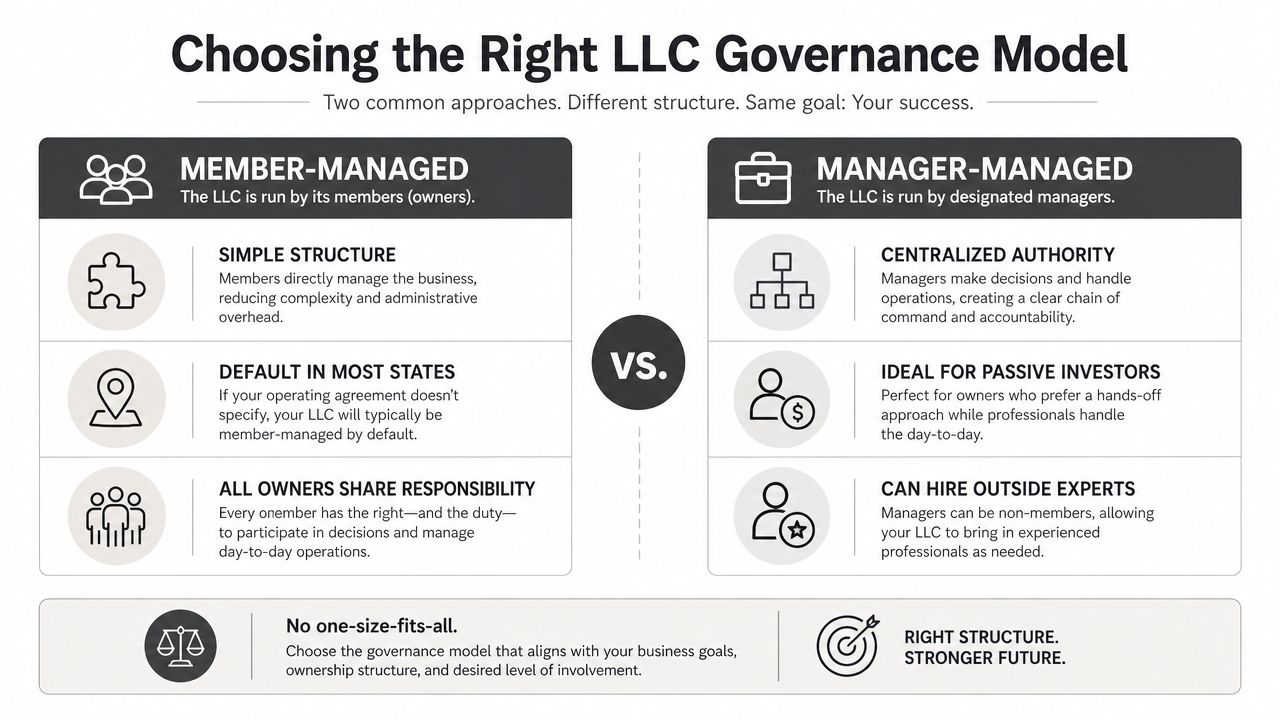
The specific answer to managing member vs owner depends on the governance model you choose. LLCs generally operate under one of two structures. They are either member-managed or manager-managed.
That choice affects who has default authority and who does not.
When member-managed works
A member-managed LLC is usually the better fit when the owners are all active in the business and want shared control. This structure tends to work well for small companies where the owners trust each other, communicate regularly, and expect to stay involved in operations.
It's straightforward. If everyone is actively participating, there's less need to create a formal wall between ownership and control.
That said, simplicity can become a weakness if the business grows or the owners' roles start to diverge. Shared authority sounds efficient until one owner moves into a passive role but still expects equal operational input.
When manager-managed works
A manager-managed LLC centralizes authority. That can be a major advantage when not every owner should be acting for the company.
As Torres Business Law notes in its discussion of member versus manager LLCs, the most common reason for choosing manager management is when some members want to be passive investors. The same source explains that in this structure, members are generally not agents of the business and usually cannot bind the company, while the designated manager or board of managers can.
That isn't just cleaner on paper. It solves real operating problems.
- Passive investment: One or more owners contribute capital but don't want day-to-day duties.
- Specialized operations: The business needs a focused operator with industry knowledge.
- Faster decision-making: Routine decisions can be handled without chasing every owner for approval.
- Authority control: Outside parties have a clearer path to confirm who may act.
If you're looking specifically at the governance side of this issue, this discussion of member-managed limited liability companies gives useful context for how the default model compares with more centralized control.
What usually fails in practice
What doesn't work is a hybrid arrangement that exists only in conversation. A lot of businesses say one owner “handles the business” but never update the certificate, operating agreement, banking resolutions, or signature rules to match. That gap creates avoidable risk.
If your company runs as manager-managed in reality but your documents still read like every member has equal authority, you've created the conditions for a future dispute.
In practice, the right structure is the one that matches how decisions will be made six months from now, not how the founders feel on formation day.
Comparing Key Rights and Responsibilities
The fastest way to understand managing member vs owner is to compare what each role can do. The distinction isn't abstract. It affects daily operations, internal accountability, and outside relationships.
| Attribute | Managing Member | Owner (Non-Managing Member) |
|---|---|---|
| Ownership interest | Has an ownership stake in the LLC | Has an ownership stake in the LLC |
| Day-to-day management | Participates in running the business | Usually does not run daily operations |
| Authority to bind the company | Often yes, if the governing documents grant that power | Often no, especially if the LLC is manager-managed |
| Contract signing role | Commonly authorized to sign routine business agreements | Should not assume signing authority without express authorization |
| Hiring and vendor decisions | Often involved directly | Usually limited or indirect involvement |
| Voting rights | May have management and ownership voting rights | May retain ownership voting rights but not operational control |
| Economic rights | Shares in profits, losses, and distributions based on ownership terms | Shares in profits, losses, and distributions based on ownership terms |
| Information access | Typically broad operational access | Usually entitled to at least the access provided by the operating agreement and applicable law |
| Fiduciary exposure | More likely to face scrutiny for management conduct | Less direct management exposure if not acting for the company |
| Risk of overstepping | Risk comes from acting beyond granted authority | Risk comes from acting as if ownership alone creates agency power |
Authority is the real dividing line
The key difference is authority. A non-managing owner may have substantial financial rights and still have no power to sign a lease, hire an employee, settle a dispute, or open a line of credit for the company.
That's the point many businesses miss. Equity and agency are not the same thing.
A managing member, by contrast, usually operates as part of the company's control group. That person's actions can affect the company directly. If the authority is broad, the managing member may handle routine contracts, banking, staff supervision, and vendor relationships without seeking a vote every time.
Duties rise with power
With management power comes greater responsibility. A managing member is more likely to be accused of overreaching, self-dealing, withholding information, or making decisions outside the agreed scope of authority. Even where the business is informal, other owners often expect the person in charge to act consistently, document major decisions, and avoid treating company assets as personal assets.
A non-managing owner has a different set of concerns. That owner usually wants visibility into the business without carrying operational burden. Problems arise when a passive owner tries to step back in selectively, often during conflict, and claims rights that were never preserved clearly in the operating agreement.
Where disputes usually start
Most internal LLC disputes don't start with dramatic misconduct. They start with ordinary business moments:
- A contract gets signed by someone who thought they had authority.
- A manager makes a hire that another owner says required consent.
- A lender requests guaranties and the owners discover they never defined approval thresholds.
- A member speaks for the company in negotiations without actual authority.
Client-side takeaway: If one owner runs the business and another only shares in profits, your documents should say that plainly and repeatedly.
The table above is useful, but real protection comes from matching titles to written authority. Titles without process don't resolve conflict. They invite it.
Drafting Your Operating Agreement
If the certificate forms the LLC, the operating agreement defines how it functions. This agreement makes the managing member vs owner distinction concrete. Without a written agreement, people fill gaps with assumptions, email threads, and memory. That's a poor substitute for governance.
The operating agreement should say who manages, what powers they have, what they can't do alone, and when member approval is required.

Clauses that deserve real attention
The strongest operating agreements are specific. They don't just label someone the managing member and stop there. They map authority in practical terms.
Focus on these areas:
- Signing authority: State who may sign contracts, checks, loan documents, leases, and settlement agreements.
- Ordinary course decisions: Clarify what the managing member may do without a vote.
- Reserved matters: Identify decisions that require owner approval, such as admitting a new member, taking on major debt, selling key assets, or amending the agreement.
- Removal and replacement: Set a process for replacing a managing member if performance fails or trust breaks down.
- Information rights: Define what non-managing owners may inspect and how often reporting must occur.
If you need a primer on the document itself, this explanation of what an operating agreement is is a helpful companion.
Sample language style that works better
The goal isn't ornate drafting. It's clarity. Good clauses are concrete and readable.
Examples of the kind of language that usually works better:
- Management designation: “The Company shall be manager-managed. Only the Managing Member may conduct the day-to-day business and affairs of the Company, except as otherwise expressly provided in this Agreement.”
- Contract authority: “The Managing Member may enter into agreements in the ordinary course of business on behalf of the Company.”
- Approval threshold: “Member approval shall be required before the Company incurs indebtedness outside the ordinary course of business, admits a new member, or sells substantially all of its assets.”
- Limit on unilateral action: “No non-managing Member has authority to bind the Company solely by reason of being a Member.”
Those are examples of drafting style, not one-size-fits-all provisions. The right language depends on the business model, ownership mix, and risk tolerance.
Review process matters too
Many LLC disputes come from documents nobody reread after formation. Businesses evolve. Roles shift. Passive owners become active, or the reverse. A manager leaves. A spouse or trust gets added as a member. The agreement needs to keep up.
For preliminary issue-spotting during review, tools such as a legal contract analyzer can help flag inconsistencies or missing terms before counsel does a full legal pass. That kind of tool is useful for organization, but it shouldn't replace attorney review on governance language.
Write the agreement for the moment when people stop agreeing.
Connecticut-Specific Legal Considerations
Connecticut LLCs don't operate in a vacuum. State law supplies default rules, and those defaults can control when the company's documents are vague or silent. That's why Connecticut businesses should treat governance as both an internal planning issue and an external risk issue.
The most important practical question in Connecticut is often not who the owners intended to be in charge. It's whether the company documented that intention clearly enough that a court, creditor, landlord, or counterparty can recognize it.
Authority problems often look ordinary at first
A Connecticut business might think it has a clean internal understanding. One person runs operations. Another is just an investor. Then a lease gets signed, or a vendor agreement is disputed, and everyone realizes the documents don't line up with the business reality.
That is where authority questions become expensive. If the LLC's structure is unclear, a third party may argue it reasonably relied on the signer's apparent authority. Even if the company eventually prevails, the ambiguity creates an advantage for the other side.
As Northwest Registered Agent notes in its discussion of member-managed LLCs, manager-managed structures can improve separation between ownership and administration, which may matter in veil-piercing arguments and in clarifying authority for third parties like creditors or landlords who need to confirm a signer's power to bind the company.
What Connecticut businesses should do
For Connecticut companies, the practical takeaway is discipline. The certificate of organization, operating agreement, resolutions, bank records, and contract execution practices should tell the same story.
Use a consistent process:
- Match the filings to the structure: If the company is manager-managed, make sure the public-facing records and internal documents reflect that choice.
- Control signature practices: Don't let inactive owners sign documents casually just because they helped start the business.
- Document major approvals: Written consents and meeting records still matter, even in closely held LLCs.
- Train the business side: Staff should know who may approve deals, engage counsel, hire key personnel, or negotiate with lenders.
Clear governance doesn't just help the owners. It helps every outsider who needs to know whether the company is actually bound.
Connecticut courts generally won't rescue a business from sloppy internal governance. If you want the liability shield and the flexibility of an LLC, you need to respect the formal distinctions that structure allows.
Frequently Asked Questions About LLC Management
Can a non-member serve as manager of an LLC
Yes. In a manager-managed LLC, the manager doesn't have to be an owner. That can make sense when the owners want outside expertise or want to remain passive while a professional operator handles the business.
The key is documentation. The operating agreement should define the manager's authority, limits, compensation, and reporting obligations.
How do you switch from member-managed to manager-managed
Usually, the company must amend its operating agreement and follow whatever approval process the current documents require. Depending on the structure and public filings, the company may also need to update its formation records to reflect the change accurately.
This shouldn't be handled informally. If the business has already signed contracts or opened accounts under one model, the transition should be documented carefully so third parties know who has current authority.
Does a managing member automatically get paid
Not automatically. A managing member may receive compensation for management services, but the LLC should state the arrangement clearly in writing. Otherwise, owners often end up fighting over whether the managing member was supposed to receive salary-like compensation, distributions only, or some combination.
Is a managing member more exposed to legal risk than a passive owner
Potentially, yes. The person exercising management authority is more likely to be scrutinized when there's a dispute over contracts, internal decisions, company funds, or dealings with third parties. That doesn't eliminate LLC liability protection, but it does increase the importance of acting within written authority and keeping good records.
Choosing the right structure early is easier than repairing a bad one during a dispute. If you want to discuss your business law matter and make sure your LLC is set up properly, contact Kons Law at (860) 920-5181.
If you want to discuss your business law matter, contact Kons Law at (860) 920-5181.
