An operating agreement template for an LLC is the foundational document that maps out your business's ownership and how it's run. Think of it as a custom-made rulebook for your company, clearly defining member roles, financial contributions, and what happens during critical moments. It’s what keeps your business running smoothly and protects everyone involved.
Why an Operating Agreement Is Non-Negotiable
Let’s be crystal clear: for any Limited Liability Company (LLC), the operating agreement is the single most important internal document you'll create. While many states, including Connecticut, don't technically require you to have one, flying without it is a huge risk no serious entrepreneur should take. It’s the framework that governs your entire business from the inside out.
This agreement turns all those verbal agreements and handshake deals—the very things that often spark legal nightmares down the road—into a formal, written contract. It’s your business’s best defense against internal blow-ups over money, management power, or member duties. It gives you a clear, mutually agreed-upon roadmap for navigating conflict and big decisions.
The Myth of the Single-Member LLC Exception
There's a common misconception that single-member LLCs don't need an operating agreement. This is a dangerously flawed assumption. If you're a solo entrepreneur, this document is absolutely critical for establishing the legal separation between you and your business.
It’s one of the strongest pieces of evidence you can present to protect your personal assets—like your home or savings—from business debts and lawsuits. Without it, a court might see you and your LLC as one and the same. To understand just how serious that is, you can read our guide on piercing the corporate veil. This mistake could leave your personal finances completely exposed if your business runs into legal trouble.
An operating agreement proves to banks, investors, and courts that your LLC is a legitimate, separate entity with its own formal procedures. It reinforces the liability protection that is the primary benefit of forming an LLC in the first place.
A Foundation for Stability and Growth
Ultimately, an operating agreement stops your business from being governed by your state’s default LLC laws, which probably don't match what you and your partners have in mind. It lets you set your own rules for the things that matter most.
The business world is catching on. The adoption of operating agreement templates for LLCs has skyrocketed, with downloads from major online platforms jumping by over 150% between 2015 and 2023. In 2023 alone, more than 1.2 million templates were downloaded globally, a clear sign that startups are embracing accessible legal tools. You can dig into these trends in this LLC operating agreements report from eForms.
A solid agreement should lay out procedures for plausible—but often unexpected—events, such as:
- A member wanting to leave the business
- The death or disability of a member
- The process for dissolving the company if it comes to that
Starting with a template is a smart first step, but it's the customization that builds the solid legal foundation your business needs to thrive. If you want to discuss your business law matter, contact Kons Law at (860) 920-5181.
Decoding the Critical Clauses in Your Agreement
Think of your LLC's operating agreement as the actual blueprint for your business. A template gives you the basic framing, sure, but it's understanding what each clause does that lets you build a company that can withstand real-world pressures. These clauses aren’t just legalese; they are the non-negotiable building blocks defining how your business runs, how money flows, and how you'll handle disagreements.
This visual map shows how all the pieces connect. A solid operating agreement acts as the central rulebook for your LLC, linking together member roles, financial rules, and legal protections.
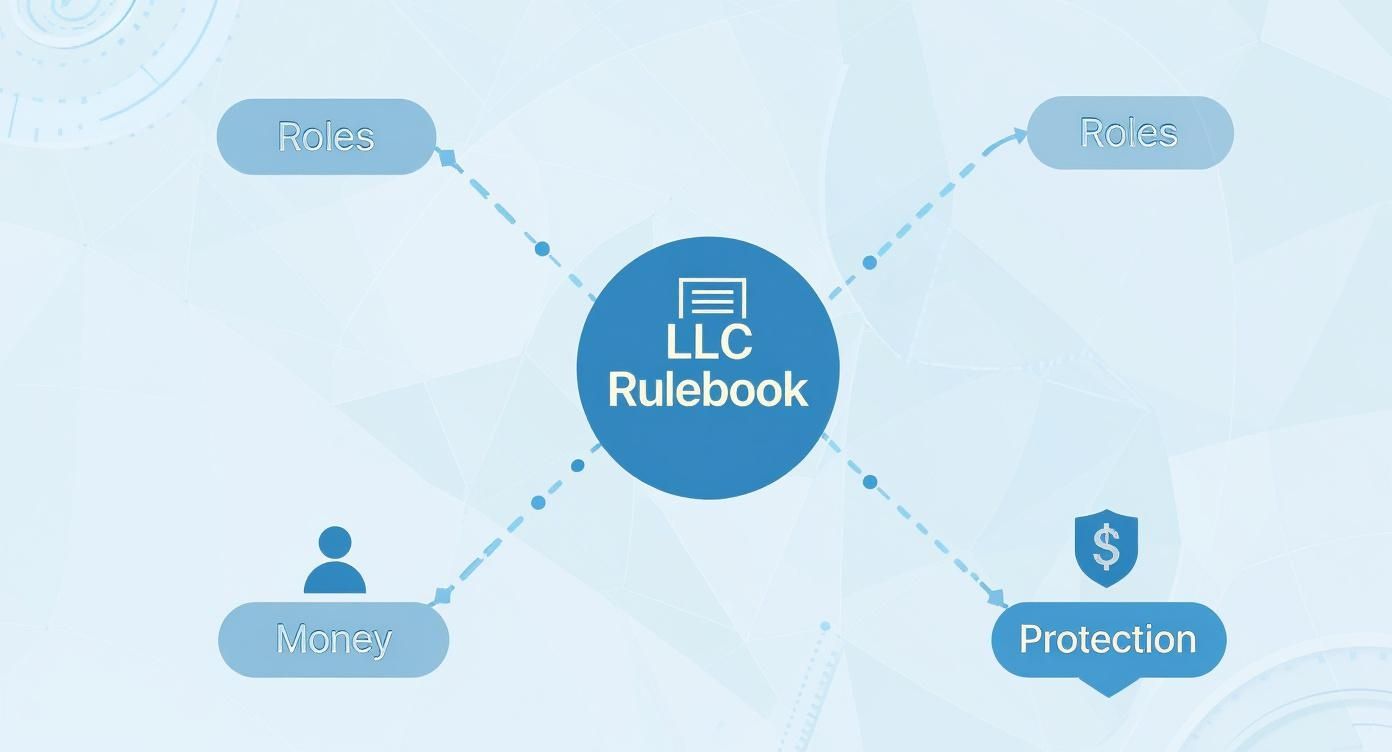
As you can see, it’s not just a flat document. It’s an interconnected system. A decision about who runs the company directly impacts the finances, and both are wrapped in the legal protections you establish from day one.
Critical Clauses for Your LLC Operating Agreement
To help you get started, I've put together a quick-reference table that breaks down the absolute must-have clauses. Think of this as your high-level checklist before you dive into the finer details.
| Clause | Purpose | Key Consideration |
|---|---|---|
| Ownership & Contributions | Defines who owns what percentage of the LLC and what they put in to get it. | Be crystal clear about the value of non-cash contributions (property, services). |
| Management & Voting | Specifies if the LLC is run by members or appointed managers and how decisions are made. | Don't be vague. Define which decisions need a majority vote vs. a unanimous one. |
| Profit & Loss Distributions | Outlines how and when profits (and losses) are divided among members. | Distributions don't have to match ownership percentages, but you must state that explicitly. |
| Buy-Sell Provisions | Creates a clear exit strategy for when a member leaves, dies, or is forced out. | This is your business prenup. It prevents chaos and costly legal battles down the road. |
Getting these four areas right from the start is the key to a stable and predictable business structure. Now, let's unpack what each one really means for your company.
Ownership Percentages and Capital Contributions
First things first: who owns what? This is where you explicitly list every member and their ownership stake, often called their "membership interest." Usually, this percentage is directly tied to what each person put into the business at the very beginning.
A capital contribution is simply the cash, property, or services a member invests to get the business off the ground. Your agreement needs to be painstakingly specific here:
- Initial Contributions: Detail the exact cash amount or the agreed-upon fair market value of any property or services from each member.
- Future Contributions: Lay out the rules for "capital calls"—when the business needs more money. Are they mandatory? Optional? How will a new investment change the ownership percentages?
Getting this right prevents so many arguments down the road about who really owns how much of the company. It's the foundational financial record of your partnership.
Management Structure and Voting Rights
Next up, you have to decide how the LLC will actually be run. There are two main ways to go, and your operating agreement must clearly state which path you're taking.
- Member-Managed LLC: This is the most common setup for smaller businesses where all the owners want to be hands-on with daily operations and decision-making. Everyone has a say.
- Manager-Managed LLC: In this structure, the members appoint one or more managers to run the show. A manager can be one of the members or an outsider hired for their expertise. It’s a great fit for LLCs with passive investors.
Once you've defined the structure, you have to detail the voting rights. This is all about how decisions get made. Will a simple majority vote work for day-to-day choices, while massive decisions like selling the company require a unanimous "yes"? Vague language here is a recipe for total gridlock.
Profit and Loss Distributions
This clause is all about the money—specifically, how you'll slice the pie. It needs to spell out precisely how the LLC’s profits (and losses) will be distributed to the members. Most people assume distributions have to be proportional to ownership, but they don't. Your agreement can set up any custom arrangement, as long as everyone agrees to it upfront.
Your agreement must answer these key questions:
- When do we get paid? Will distributions happen annually, quarterly, or just whenever the manager decides?
- Are payouts mandatory? Can the company hold back profits to reinvest in growth, and who gets to make that call?
- How are losses handled? Losses also get allocated among members, which has important implications for everyone's taxes.
Putting this in black and white prevents some of the most bitter and common disputes between business partners. For more tips on making your business documents ironclad, check out our guide on what to include in a small business contract template.
Member Disassociation and Buy-Sell Provisions
What happens when a member wants out, passes away, goes through a divorce, or has to be fired? This is arguably one of the most critical sections in the entire document, yet it's the one most often glossed over in generic templates. These buy-sell provisions are your pre-planned exit strategy.
This section needs to meticulously outline the procedure for any "triggering event," such as:
- Voluntary resignation
- Death or long-term disability
- Personal bankruptcy
- A divorce settlement that could transfer ownership
- Expulsion for a specific cause (which you should also define!)
The provision has to detail how the departing member's share will be valued—will you use a predetermined formula, bring in an appraiser, or just go by book value? It also must specify if the LLC or the remaining members have the first right to buy that share. Without this, you could wake up one day and find yourself in business with your former partner's ex-spouse.
A well-crafted operating agreement provides a clear, fair process for navigating these tough transitions, protecting the business and every member from chaos and expensive litigation. If you want to discuss your business law matter, contact Kons Law at (860) 920-5181.
Customizing Your Template for Your Business
A generic operating agreement template is a starting point, nothing more. Its real value comes when you shape that standard document into a shield forged specifically for your company. This is where you move beyond the boilerplate and adapt the language to handle the messy, unpredictable, and entirely human situations that pop up when people go into business together.

Think of it like buying a suit off the rack versus getting one tailored. The generic version might technically cover you, but it won’t fit right and will be uncomfortable in a pinch. The customized version, however, is built for you, letting you operate with confidence. This process is all about looking down the road, anticipating future challenges, and building the solutions right into your company’s DNA from day one.
Planning for the Unexpected Departure
One of the most critical areas you'll customize is the buy-sell provisions. This is the section that answers the tough question: "What happens when a member wants out?" Without a clear plan, a member’s departure—whether it’s voluntary or due to something unforeseen like death or disability—can throw your entire business into chaos.
Here’s a real-world scenario. Imagine a two-member LLC where one partner, holding 50% of the company, suddenly leaves to start a competing business. Without a buy-sell clause, you’re facing a few nightmare possibilities. Can they sell their stake to just anyone, including your newest competitor? Are you forced to buy them out at a price you can’t possibly afford?
A well-drafted buy-sell provision acts as a business prenup. It pre-negotiates the terms of a separation while everyone is still on good terms, which is the key to preventing costly court battles and protecting the company’s stability later.
To sidestep that disaster, your agreement needs to meticulously outline a few key things:
- Triggering Events: Define exactly what kicks off the buyout process. This could be a resignation, death, disability, bankruptcy, or even a serious ethical breach.
- Right of First Refusal: This is crucial. It gives the LLC or the remaining members the first shot at buying the departing member's interest before it can be offered to an outsider.
- Valuation Method: Decide ahead of time how the departing member's share will be valued. Will you use a set formula, hire an independent appraiser, or go by the company's book value? This stops arguments over price when emotions are already running high.
- Payment Terms: Detail how the buyout will be funded. Is it a lump sum payment, or will it be paid out over several years with interest?
A Clear Roadmap for Dissolution
Nobody launches a business planning for it to fail, but having a clear roadmap for dissolution is just smart planning. This clause provides an orderly, structured process for winding things down if the members decide it’s time to close up shop. It prevents a messy free-for-all when it's time to sell assets and pay off debts.
Without this provision, you’re stuck with the state’s default rules, which might not be what you had in mind. Your custom dissolution clause should specify the exact voting requirements needed (e.g., a two-thirds majority or a unanimous vote) and lay out the step-by-step process for liquidating assets and paying creditors before distributing what’s left to the members.
Mandating Mediation to Avoid Lawsuits
Disagreements in business are inevitable. Partners will argue over spending, hiring decisions, or the company's direction. A dispute resolution clause is your proactive plan to handle these conflicts constructively, stopping them from escalating into expensive, relationship-destroying lawsuits.
A powerful customization is to mandate mediation as the first step. In mediation, a neutral third party helps the members find common ground. It's far less adversarial and significantly cheaper than going to court.
Your clause can state that before any member files a lawsuit, all parties must first try to resolve the issue through mediation for a set period, like 30 or 60 days. This simple addition can save thousands in legal fees and keep working relationships intact.
State-Specific Considerations for Connecticut
It’s vital to remember that your LLC is governed by state law. If your operating agreement is silent on an issue, Connecticut's default LLC statutes will fill in the blanks—and those default rules might not work for you. For a deeper dive, check out our guide on starting a business in CT.
For example, Connecticut law might require profits to be distributed based purely on ownership percentage. But what if one member contributed less cash but brings priceless industry connections? You might want to give them a larger profit share. Your operating agreement is the only place to legally define that custom arrangement and override the state’s one-size-fits-all approach.
Transforming a basic template into a tailored document isn't just a good idea; it's an essential step in building a resilient company. If you want to discuss your business law matter, contact Kons Law at (860) 920-5181.
Executing and Maintaining Your Agreement
You’ve put in the hard work and customized an operating agreement for your LLC. That's a huge step, but the document is just a plan on paper until it's properly signed and put into practice. This final part is what turns your carefully crafted draft into the legally binding rulebook for your company. It’s what ensures every member is truly on the same page and keeps the agreement relevant as your business grows and changes.

Before anyone signs, a thorough review is non-negotiable. Every single member needs to read and—more importantly—understand the entire document. This isn't the time to skim. I always encourage clients to ask questions and talk through any confusing parts before a single signature hits the page.
The Formal Signing Process
Once everyone has reviewed the agreement and given their verbal "yes," it's time to make it official. The signing process is what validates the agreement, confirming that everyone consents to be bound by its terms.
Every member of the LLC must sign. In today's business world, digital signatures are widely accepted and are just as legally valid as a wet-ink signature. This is incredibly convenient, especially if you have remote members. Platforms like DocuSign or Adobe Sign provide a secure and verifiable way to handle this.
After it's all signed, make sure each member gets a complete, executed copy for their records. The original signed document should be stored in a safe, central place alongside your other critical company paperwork, like your formation documents and business licenses.
An operating agreement is an internal document. Unlike your articles of organization, you do not file it with the Connecticut Secretary of State. Its real power comes from its role as a private contract among the members.
Keeping Your Agreement a Living Document
Your business isn't static, and your operating agreement shouldn't be either. A document that’s signed and then shoved in a drawer quickly loses its value. It should be a living guide, which means you need to review it—I recommend annually—and amend it whenever significant changes happen.
What kind of changes trigger an amendment? Here are a few common ones:
- Adding or Removing a Member: When someone joins or leaves the LLC, the agreement must be updated to reflect the new ownership structure.
- Changing Profit Splits: If you decide to adjust how profits and losses are distributed, a formal amendment is a must.
- Altering Management Structure: Shifting from member-managed to manager-managed (or the other way around) is a fundamental change that needs to be documented.
- Taking on Significant Debt: Major financial decisions, like securing a large business loan, might require an amendment to spell out the new obligations.
Your agreement should already have a clause detailing how to amend it, which usually requires a majority or unanimous vote. Any changes must be made in writing, signed by all members, and attached to the original agreement. This careful record-keeping is just as crucial as your other compliance tasks. To stay on top of all requirements, you can learn more about key business responsibilities like understanding the State of Connecticut annual report filing.
If you want to discuss your business law matter, contact Kons Law at (860) 920-5181.
Common Template Mistakes to Avoid
Using an LLC operating agreement template is a great start, but treating it like a simple fill-in-the-blank form is a huge misstep. Think of a template as the foundation, not the finished house. Overlooking this opens you up to nasty internal disputes, legal vulnerabilities, and the real possibility of your agreement being useless when you actually need it.
These documents are meant to save you time, but they absolutely do not replace careful, strategic thinking. Let’s walk through the common traps people fall into so you can make sure your LLC is built on solid ground.
Using a One-Size-Fits-All Generic Template
One of the biggest blunders is grabbing the first free template you find online without a second thought. A generic agreement written for a California tech startup is going to be wildly inappropriate for a Connecticut construction company. State laws are not all the same, and a cookie-cutter document almost always fails to address critical, state-specific rules.
For example, Connecticut has default laws for how an LLC must operate if your agreement is silent on certain issues. If you rely on a generic template, you could be unknowingly agreeing to these state rules—which might be the exact opposite of what you and your partners intended.
Key Takeaway: Always find a template that is either specific to your state or clearly designed for heavy customization. Never assume a generic document gives you the protection you need; its vague language can create more problems than it solves.
Neglecting Essential Customization
Failing to tailor the template to your actual business is another major pitfall. A template can't possibly know the unique dynamics between you and your partners, the specific risks of your industry, or your vision for the future. It provides the skeleton, but you have to add the muscle.
Imagine this scenario: two partners launch a marketing agency. They use a basic template that doesn't include a non-compete clause. A year later, one partner leaves and immediately starts a rival firm, poaching several key clients. Because their agreement was generic, the remaining partner has very little they can do. A few custom sentences could have prevented this entire disaster.
Adopting Vague or Ambiguous Language
When it comes to legal documents, precision is everything. Templates often use broad terms like "reasonable efforts" or "major decisions" that are wide open to interpretation. That’s a recipe for conflict.
What does a "major decision" really mean?
- Hiring a new employee?
- Spending over $1,000?
- Changing the company logo?
Without crystal-clear definitions, members can easily end up in a deadlock. Your agreement needs to spell things out. For instance, define a major decision as "any expenditure exceeding $5,000 or any action that fundamentally changes the company's business model." That removes all the guesswork.
Here's a quick look at some common template traps and how to get around them.
Common Operating Agreement Template Pitfalls and Solutions
| Common Mistake | Potential Consequence | How to Avoid It |
|---|---|---|
| Using a Non-State-Specific Template | Accidentally adopting unfavorable state default rules or missing mandatory provisions. | Source a template specifically for your state (e.g., Connecticut) or one designed for easy state-specific customization. |
| Skipping Custom Clauses | The agreement fails to address key business realities like non-compete rules, intellectual property, or specific member roles. | Brainstorm "what-if" scenarios with your partners and add clauses for buyouts, non-competition, and dispute resolution. |
| Leaving Language Vague | Members disagree on the meaning of terms like "major decision," leading to operational paralysis or disputes. | Define all key terms with specific numbers and thresholds. Instead of "significant expense," write "any expense over $2,500." |
| Forgetting to Execute Properly | The agreement is legally unenforceable because not all members signed it. | Hold a formal signing meeting. Ensure every single member signs and receives a copy. Digitize the signed document for safekeeping. |
| Not Amending the Agreement | The document becomes outdated as the business grows, creating a mismatch between the agreement and how the company actually runs. | Schedule an annual review of the operating agreement. Formally amend and sign it any time a major change occurs (e.g., a new member joins). |
Thinking through these points upfront will save you from major headaches down the road.
Forgetting Signatures or Proper Execution
It sounds obvious, but you’d be surprised how often it happens: an unsigned agreement is completely worthless. Every single member of the LLC must sign the operating agreement for it to become a legally binding contract. Without all the signatures, a member could later claim they never agreed to its terms.
Likewise, you can't just sign it and forget it. If you add a new member, change profit distributions, or shift management duties, you need a formal, signed amendment. Your agreement has to evolve with your business to stay relevant.
While only a few states legally mandate an operating agreement, the smart money is on having one. Over 85% of multi-member LLCs now use one, because they understand the risk of not having one. A recent survey from the U.S. Chamber of Commerce drove this home, finding that a staggering 78% of LLCs that had internal disputes had no written operating agreement in place. The data is clear: a well-executed agreement is one of your most powerful tools for preventing conflict.
If you want to discuss your business law matter, contact Kons Law at (860) 920-5181.
Frequently Asked Questions
When it comes to LLC operating agreements, a few questions pop up time and time again. Even after you've got the basics down, you might still be wondering about a few specific details. Let's clear up some of the most common uncertainties business owners face.
Do I Need an Operating Agreement for a Single-Member LLC?
Yes, absolutely. It's a common misconception that solo owners can skip this step, but that's a risky move. An operating agreement for a single-member LLC is one of your best tools for protecting your personal assets.
Think of it as the ultimate proof that your business is a separate legal entity. If your business ever faces a lawsuit or you need to secure a bank loan, this document is what separates your personal finances from your company's obligations. It also doubles as a simple succession plan, spelling out what happens to the company if you're ever unable to run it yourself.
Where Should I File My Operating Agreement?
Here’s a point that trips up a lot of new business owners: you don't file it anywhere. An LLC operating agreement is a strictly internal document. It's not sent to the Connecticut Secretary of State or any other government agency.
Keep the signed original with your other official company records. You'll need it for internal reference, bank meetings, or if legal issues arise, but its contents remain private among the members.
The fact that an operating agreement is internal is a huge advantage. It lets you set specific, private rules for how your business runs without putting all those details on the public record.
Can We Change the Operating Agreement Later?
You can, and you should. A good operating agreement is never "set it and forget it." It’s a living document that needs to evolve as your business does. Companies grow, add partners, take on investment, and shift direction—your agreement must be updated to reflect those changes.
Your agreement should include a clause that clearly defines the process for making amendments. Usually, it requires a formal vote, and any changes must be put in writing and signed by all members to be legally binding.
What Happens If We Don’t Have an Operating Agreement?
If you don't have a signed operating agreement, your LLC isn't operating in a vacuum. It's automatically governed by Connecticut's default LLC laws, and these one-size-fits-all rules might not be what you want for your business.
For instance, state law might require profits to be split exactly according to ownership percentage, even if one partner does 90% of the work. Or it could allow any single member to sign a contract that binds the entire company. Relying on these default rules can lead to serious arguments over money and control that you and your partners never saw coming.
If you want to discuss your business law matter, contact Kons Law at (860) 920-5181.
When to Call a Connecticut Business Law Attorney
While a solid operating agreement template is a fantastic starting point, it's just that—a start. Think of it as a quality blueprint, but every business is built on a unique plot of land with its own set of challenges. A generic document simply can't anticipate your specific industry risks, the unique dynamics between partners, or your ambitious long-term growth plans.
This is where professional legal advice becomes invaluable. An experienced attorney can spot potential pitfalls you might not see coming and help you customize those critical clauses to ensure your agreement fully protects your interests under Connecticut law.
If you’re facing a complex situation or just want the peace of mind that comes from getting it right, we’re here to help. Contact the business law attorneys at Kons Law at (860) 920-5181 for guidance tailored to your specific needs.
