When you form an LLC, you're usually thinking about flexibility and liability protection. But as your business grows, that simple, flexible structure can start to feel a little too loose. This is where creating officer roles comes in handy.
LLC officers are individuals you appoint to handle the day-to-day business, with familiar titles like President, Secretary, or Treasurer. While not every state requires them, these roles bring a dose of corporate-style structure that clarifies who's in charge of what. It’s a move that signals a commitment to clear leadership and operational discipline.
Do You Really Need LLC Officers?
Think of your LLC as a ship. The members are the owners. If you have a manager, they're the captain, setting the course. So, where do officers fit in? They are the specialized crew—the chief engineer running the engine room, the navigator charting the path, the quartermaster managing supplies. Each one has a specific job to keep the ship running smoothly.
This structure becomes invaluable when you start dealing with outside parties. Banks, vendors, and potential partners want to know who they're talking to. They're looking for a CEO or President—someone with the clear authority to sign a contract or make a binding decision. Appointing officers gets rid of that guesswork and makes those interactions much cleaner.
How Your Management Structure Changes Things
Whether you need officers often comes down to how your LLC is managed. In a member-managed LLC, where all the owners are involved in the daily grind, you might not need formal officers right away. Everyone is already hands-on.
But in a manager-managed LLC, where a specific manager or board of managers is calling the shots, creating officer roles is the logical next step. The managers handle the big-picture strategy, and the officers are tasked with executing it.
The hierarchy below shows how these roles typically fit together, with officers handling the execution of the managers' strategic vision.
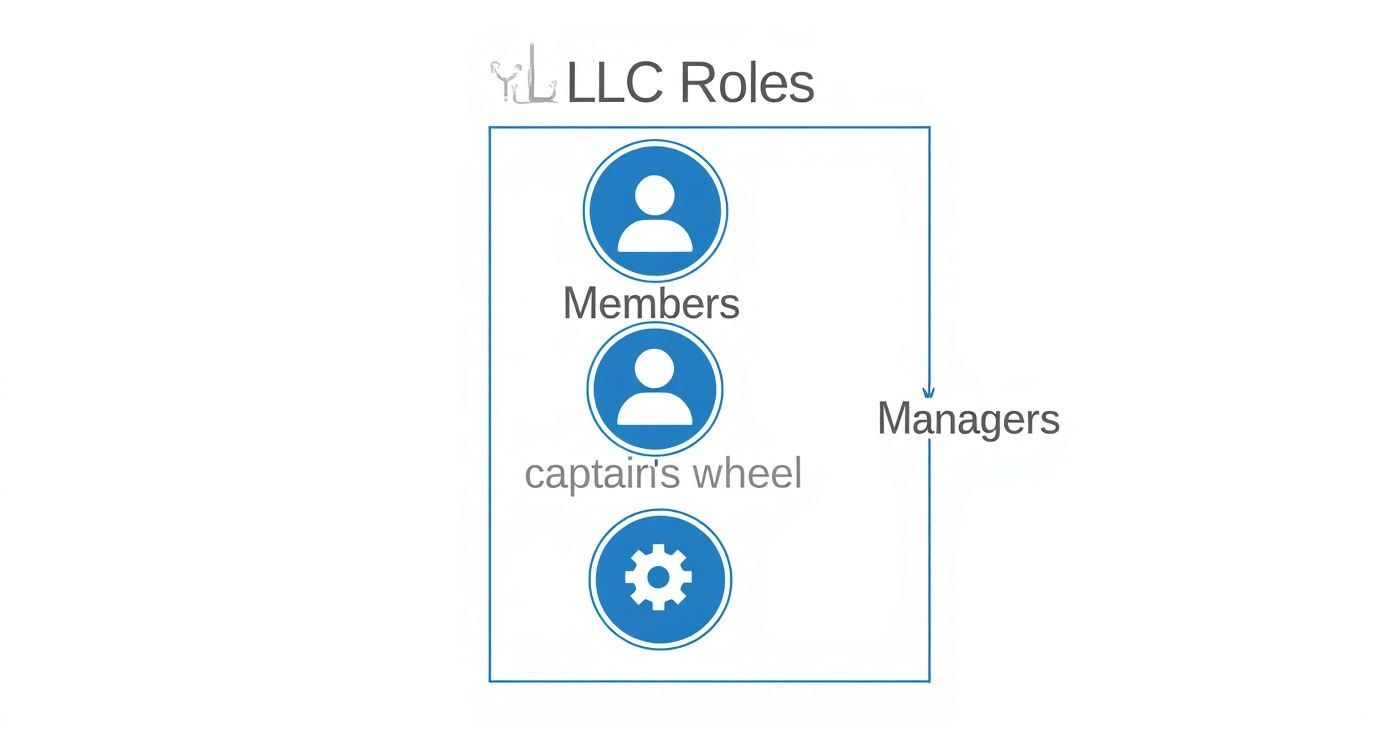
This visual makes it clear: members have the ownership stake, managers direct the strategy, and officers are on the ground making it happen.
To break it down even further, here’s a quick comparison of the different roles you’ll find in a more structured LLC.
LLC Roles at a Glance
| Role | Primary Function | Source of Authority | Typical Involvement |
|---|---|---|---|
| Members | Own the company and vote on major decisions (e.g., selling the business, amending the operating agreement). | Operating Agreement & State Law | High-level; strategic oversight, not daily tasks. |
| Managers | Oversee the business strategy and major operational decisions, as delegated by the members. | Operating Agreement | Strategic; directs the company's course. |
| Officers | Manage the daily business operations within their specific area (e.g., finance, administration). | Appointed by Members/Managers | Day-to-day; tactical execution. |
This table clarifies that while ownership and management set the direction, officers are the ones with their hands on the wheel, steering the company's daily activities.
Ultimately, appointing officers is a strategic decision. By defining these roles in your operating agreement, you eliminate internal confusion and establish clear lines of authority. It’s a proactive step that helps you manage growth and prepares your company for whatever comes next.
If you want to discuss your business law matter, contact Kons Law at (860) 920-5181.
The Evolving Demands on LLC Officers
The days when an LLC officer’s job was a straightforward, functional role focused on day-to-day operations are long gone. Modern business is a complex web of digital systems, global supply chains, and constantly shifting regulations. These forces have fundamentally reshaped what officers are expected to do, demanding a much higher level of strategic thinking and foresight.
Today, officers find themselves on the front lines, navigating intricate challenges that used to be the exclusive domain of massive corporations. This shift elevates their importance, transforming them from managers into vital strategic leaders. They have to be agile and ready to steer the company through uncertainty at a moment's notice.
Navigating a Tougher Regulatory Landscape
Compliance has become one of the heaviest lifts for LLC officers. The business world is under more scrutiny than ever, with mounting pressure from local, state, and federal agencies. This reality requires officers to have a deep, practical understanding of governance and risk management to protect the company from legal and financial threats.
A recent survey from the Association of Corporate Counsel drives this point home. After polling 772 chief legal officers across 48 countries, it found that legal leaders and officers are grappling with an increasingly complex regulatory world shaped by global turmoil, economic volatility, and political uncertainty. The study confirms that officers are taking on broader strategic duties far beyond their traditional tasks, with a sharp focus on compliance, risk, and governance. You can dig into the details and discover more insights about these evolving C-suite pressures in the full ACC survey.
So what does this look like in practice? A Chief Financial Officer isn't just balancing the books anymore. They are also on the hook for ensuring the company complies with intricate financial reporting standards and tax laws that can change with little warning. In the same vein, a Chief Operating Officer has to manage supply chain risks that span continents and navigate a maze of international trade regulations.
The Impact of Technology and Digital Transformation
Technology hasn't just added new tools; it's added entirely new layers of responsibility. Digital transformation isn't about buying new software—it’s about fundamentally rethinking how a business operates, serves its customers, and, critically, protects its data.
An officer's role today is as much about managing digital risk as it is about managing people and processes. From cybersecurity threats to data privacy regulations, the technological landscape presents constant challenges that require sophisticated oversight.
This means officers must be fluent in areas that were once siloed in the IT department. They are now expected to lead critical initiatives related to:
- Cybersecurity Protocols: Implementing robust systems to shield sensitive company and customer data from breaches.
- Data Privacy Compliance: Making sure the company adheres to regulations like GDPR or the CCPA, which come with steep penalties for getting it wrong.
- Digital Infrastructure: Overseeing the integration of new technologies, like AI and cloud computing, to boost efficiency and stay competitive.
A Greater Focus on Strategic Governance
Beyond the nuts and bolts of compliance and tech, there's a growing expectation for officers to contribute to the company's long-term vision. This includes a much sharper focus on Environmental, Social, and Governance (ESG) factors. Stakeholders—from investors and customers to employees—are demanding that companies operate ethically and sustainably.
This expectation puts officers in the hot seat, where they must balance profitability with broader social responsibilities. They are now instrumental in shaping and implementing policies that reflect the company's core values, which directly impacts brand reputation and long-term success. The modern LLC officer, in short, is a multifaceted leader whose expertise has never been more critical.
If you want to discuss your business law matter, contact Kons Law at (860) 920-5181.
Defining Common Officer Roles and Duties
Putting LLC officers in place is a smart way to build a clear leadership team. While you can technically create any officer title you want, most LLCs find it practical to stick with the traditional roles you’d see in the corporate world. There's a good reason for this: everyone gets it. This familiarity helps clarify who's responsible for what internally, and it makes life much easier when dealing with outside parties like banks, vendors, and partners who need to know who has the authority to sign on the dotted line.
These roles aren’t just about fancy titles; they're about creating a functional division of labor. By assigning specific, critical functions to qualified people, an LLC can make sure every key area of the business is handled properly—from big-picture strategy all the way down to the nitty-gritty of record-keeping. This kind of structure stops important tasks from falling through the cracks and establishes clear lines of accountability.

The President or Chief Executive Officer (CEO)
The President, often called the Chief Executive Officer (CEO), is the top leader of the LLC. Think of this person as the public face of the company and the final decision-maker on most day-to-day matters. Their primary job is to take the strategic vision set by the members or managers and turn it into reality.
A President’s duties are broad and directly tied to the company's overall health and direction. Their core responsibilities usually include:
- Strategic Execution: Turning high-level goals from the board or members into actionable business plans.
- Major Contracts and Agreements: Serving as the main signatory for significant legal and financial commitments.
- Leadership and Management: Overseeing other officers and key employees to ensure the entire team is pulling in the same direction.
- External Relations: Representing the company in high-stakes negotiations with key partners, investors, and clients.
For instance, the members might decide to expand into a new market. It's the President who then has to create the operational plan, line up the resources, and lead the charge to make it happen.
The Vice President or Chief Operating Officer (COO)
The Vice President (VP) or Chief Operating Officer (COO) is the second-in-command. This officer typically manages the company’s internal operations, making sure the business runs like a well-oiled machine. If the President is focused on the "what" and "why," the VP is often all about the "how."
This role is incredibly flexible and can be customized to fit what the business actually needs. Some LLCs even have multiple VPs, each heading a specific department, like a VP of Sales or a VP of Marketing. Above all, their main duty is to support the President and be ready to step in if needed.
A well-defined officer structure ensures that every core business function has a designated leader. This distribution of responsibility not only improves efficiency but also strengthens internal controls and accountability across the organization.
The Secretary
The Secretary is the official guardian of the LLC's corporate governance and records. This role is far more than just administrative support; it's about compliance and legal formality. The Secretary makes sure the company follows the rules laid out in its operating agreement and under state law.
Key duties of the Secretary often involve:
- Record-Keeping: Maintaining mission-critical documents, including the operating agreement, meeting minutes, member resolutions, and official state filings.
- Meeting Management: Organizing official member or manager meetings, sending proper notice, and taking detailed minutes of what happens.
- Compliance: Making sure the LLC files its annual reports and meets other legal deadlines to stay in good standing with the state.
A diligent Secretary is crucial for protecting the company’s liability shield. By keeping a clean, official record of all major decisions, they help prove the LLC is a legitimate, separate legal entity.
The Treasurer or Chief Financial Officer (CFO)
The Treasurer, also known as the Chief Financial Officer (CFO), is in charge of the company's financial health. This officer oversees everything to do with money, from high-level financial planning to daily cash flow management.
A Treasurer’s responsibilities are fundamental to the company's stability and growth. They are tasked with:
- Financial Reporting: Preparing and presenting accurate financial statements to members and managers.
- Budgeting and Forecasting: Creating the financial plans and models that guide the company's strategic moves.
- Cash Management: Overseeing bank accounts, managing liquidity, and making sure the company can pay its bills.
- Tax Compliance: Working with accountants to ensure all tax filings are accurate and get submitted on time.
By appointing these key limited liability company officers, an LLC can build a strong leadership team where every essential function is clearly defined and managed by someone with the right expertise.
If you want to discuss your business law matter, contact Kons Law at (860) 920-5181.
How to Appoint and Remove LLC Officers
Handling leadership changes is one of the most critical, and yet most neglected, parts of running a successful LLC. Without a clear game plan for appointing and removing officers, a company can easily get stuck in internal squabbles, opening the door to legal risk and operational chaos.
The secret is to put these procedures in place long before you ever need them, right inside your LLC’s foundational document.
It all comes down to your operating agreement. This is the official rulebook for your company, and it’s the best place to define exactly how officers get their roles and how they can be let go. Ambiguity is your worst enemy here; a well-written agreement eliminates confusion when a leadership change becomes necessary.
The Blueprint for Appointing Officers
The appointment process should be a straightforward, documented event. Typically, the power to appoint officers belongs to either the members or the managers, depending on how your LLC is structured. Your operating agreement needs to explicitly state who holds this power.
To keep the process clear and legally solid, think about including these key provisions:
- Designation of Authority: Clearly state whether the members (by a majority or supermajority vote) or the managers have the sole power to appoint officers.
- Appointment Process: Lay out the specific steps, like a nomination, a formal vote, and the percentage needed for approval.
- Term of Office: Define how long an officer serves (e.g., one year, or until a successor is named). This avoids indefinite terms that could turn into a problem down the line.
- Documentation: Require all appointments to be recorded in writing, usually through a formal resolution.
A strong operating agreement is absolutely essential for managing these details. If you're creating or updating your company's core governance, our guide on crafting an operating agreement template for your LLC provides valuable insights into structuring these crucial sections.
The Mechanics of Officer Removal
Just as important as appointing officers is having a clear path for removing them. This can be a touchy subject, so a pre-defined, formal procedure is vital for handling it professionally and legally. The power to remove an officer almost always rests with the same group that appointed them in the first place.
Your operating agreement should spell out the grounds and steps for removal, which usually involves a vote by the members or managers. It’s also smart to differentiate between removals "for cause" and "without cause."
A "for cause" removal is triggered by specific misconduct, like fraud, gross negligence, or a major breach of duty. A removal "without cause" lets you make a leadership change for strategic reasons, without having to prove any wrongdoing. Having both options gives you maximum flexibility.
No matter the reason, the process has to be formally documented. This is typically done with a written resolution signed by the authorized members or managers. This paper trail becomes part of the LLC's official records and serves as legal proof that the removal was done correctly, protecting the company from potential wrongful termination claims.
The Importance of Formal Resolutions
Whether you’re appointing or removing an officer, a formal resolution is the instrument that makes it official. Think of it as the legal gavel that finalizes the decision. This written document offers undeniable proof of the action taken, the date it happened, and who authorized it.
A standard resolution for an appointment or removal should include:
- The Name of the LLC: Clearly identify the company.
- Date of the Resolution: Establish a precise timeline.
- Statement of Action: State exactly what is happening (e.g., "Jane Doe is hereby appointed as Treasurer" or "John Smith is hereby removed as President").
- Authority: Reference the section of the operating agreement that grants the power to take this action.
- Signatures: The resolution must be signed by the members or managers with the authority to make the decision.
Meticulous record-keeping isn’t just good practice; it’s a critical defense. These documents clarify leadership roles and protect the business by showing that all changes were made by the book.
If you want to discuss your business law matter, contact Kons Law at (860) 920-5181.
Managing Officer Liability and Insurance
Stepping into an LLC officer role gives you significant authority, but it also means putting your personal assets on the line. Officers have a legal obligation—a fiduciary duty—to act in the company's best interest. If you breach that duty, even unintentionally, you could face a lawsuit that comes after your personal finances.
That's a scary thought. A lawsuit for mismanagement or a bad business decision could be financially devastating, even if you win. Fortunately, an LLC can put two powerful safeguards in place to protect its leadership team from that kind of personal risk.

Indemnification: A Shield Against Legal Costs
The first line of defense is something called indemnification. This is basically a promise from the LLC, written into the operating agreement, to cover an officer's legal bills, settlements, and court judgments if they get sued for something they did as part of their job.
Think of it as the company having your back financially. But it’s not a free pass for bad behavior. This protection typically only applies if the officer:
- Acted in good faith.
- Genuinely believed their actions were in the best interests of the LLC.
- Wasn't involved in willful misconduct or illegal activity.
The goal here is to give officers the confidence to make tough calls without being paralyzed by the fear of a lawsuit wiping them out personally.
Directors and Officers (D&O) Liability Insurance
Indemnification is great, but it has one big weakness: it’s only as strong as the company's bank account. If a lawsuit is big enough to bankrupt the LLC, that promise to cover your legal fees is suddenly worthless.
That's where Directors and Officers (D&O) liability insurance comes in as a critical second layer of protection. This is a specific type of insurance policy that covers the personal assets of company leaders if they're accused of wrongful acts in their role. It’s a safety net for both the officers and the company itself.
In today's business world, D&O insurance isn't just for huge corporations anymore. It's a must-have for LLCs of all sizes that want to properly manage risk and give their leaders peace of mind.
This kind of insurance has become increasingly important as business risks evolve. Global trends show high demand for D&O coverage to guard against new threats, from regulatory crackdowns to financial instability. For a deeper dive, you can discover more about these D&O liability market trends and see how the risk landscape is changing.
It's also crucial to remember that these protections work best when you maintain a clear line between the business and its owners. If those lines get blurred, a court could ignore the LLC's liability shield altogether. You can learn more by reading our guide on what is piercing the corporate veil and why it's so important.
By combining strong indemnification clauses with a solid D&O insurance policy, an LLC can attract and keep top talent. These protections allow leaders to focus on what they do best—growing the business—without worrying about losing everything.
If you want to discuss your business law matter, contact Kons Law at (860) 920-5181.
An Essential Governance Checklist for LLC Officers
Think of strong governance and meticulous records as the bedrock of your LLC’s liability shield. For limited liability company officers, following these formalities isn’t just about paperwork—it’s about proving your business operates as a legitimate entity, separate from its owners.
This proactive approach to record-keeping protects everyone involved and brings clarity during high-stakes moments like audits, legal disputes, or investor due diligence. Adopting a consistent documentation process today can prevent minor oversights from snowballing into major legal headaches down the road.
Key Governance Action Items
To keep your LLC compliant and well-organized, officers should get into a rhythm of regularly reviewing and maintaining a few key documents. This checklist provides a simple but effective framework for sound governance.
-
Maintain an Updated Officer List: Keep a formal, current list of all appointed officers, their titles, and their terms. This isn't something to jot on a sticky note; it should be stored with your core company records and updated immediately after any leadership change.
-
Formally Document Appointments and Removals: A handshake won't cut it. Every appointment, resignation, or removal must be documented with a formal written resolution signed by the authorized members or managers.
-
Ensure Meeting Minutes Reflect Key Decisions: When members or managers meet, the minutes need to a clearly record any major decisions made by or about officers. This includes approving a significant contract an officer signed or delegating new authority to them.
Regular Reviews and Compliance
Good governance is a marathon, not a sprint. It’s an ongoing process, and setting a schedule for regular reviews ensures your company's foundational documents and practices evolve right alongside the business.
A huge part of this process involves grasping the broader principles of corporate management. You can learn more about how these structures protect your business in our detailed guide on what is corporate governance.
Regularly reviewing and updating your LLC’s governance documents is like performing routine maintenance on a valuable asset. It prevents breakdowns, ensures peak performance, and protects your investment for the long term.
Finally, make it a habit to periodically review the operating agreement itself. Business needs change. The provisions defining officer roles, duties, and authority should be updated to reflect your company’s current reality, not what it looked like on day one. This simple step keeps your foundational rulebook relevant and effective.
If you want to discuss your business law matter, contact Kons Law at (860) 920-5181.
Discuss Your Business Law Questions
Trying to sort out LLC management and corporate governance on your own can feel like wading through legal quicksand. It demands careful planning and a real-world grasp of Connecticut law. If you're wrestling with questions about how to structure your business, what your officers should be doing, or any other business law matter, getting professional guidance is the best way to find clarity and protect what you've built.
Understanding what a business lawyer does is the first step in seeing how the right advice can put your company on solid legal ground from day one.
To talk through your specific situation and get the answers you need, contact Kons Law at (860) 920-5181.
