
A security deposit dispute usually starts with a small number on paper and turns into a much bigger problem. A tenant moves out expecting a check. A landlord sees repairs, unpaid charges, or a unit that wasn't left in acceptable condition. Both sides think they're being reasonable. Both sides often walk into the dispute with incomplete records.
That problem is especially common in Connecticut because the rules are technical. Missing a deadline, using the wrong account, failing to document damage, or mishandling interest can change a routine turnover into a legal claim. For residential landlords, the statute is strict. For tenants, the law gives real remedies. For small business landlords and commercial owners, the challenge gets harder because most online guidance is written only for residential tenants.
A lot of the available help with security deposits in ct focuses on tenant aid programs. Far less addresses the practical concerns of small business landlords and commercial property owners, even though that gap is real and noted in discussion of the market at the National Low Income Housing Coalition page discussing the lack of specific guidance for commercial owners.org/node/95021). That leaves landlords, property managers, and mixed-use owners trying to apply residential concepts to business problems that don't fit neatly.
This guide is built for both sides. If you're a tenant, you need to know how to protect your money and press a valid claim without making avoidable mistakes. If you're a landlord, especially a smaller operator or someone managing mixed-use property, you need a workflow that stands up in court and reduces dispute risk before it starts.
Navigating CTs Complex Security Deposit Landscape
Most security deposit fights aren't really about a single repair bill. They're about process.
A landlord may believe the deductions are justified, but if the deposit wasn't handled correctly from day one, that landlord may be at a disadvantage. A tenant may know something feels wrong, but without the right documents, the tenant can struggle to prove what happened. Connecticut law doesn't leave much room for casual handling.
Why these disputes get expensive fast
Security deposits sit at the intersection of contract law, property condition, recordkeeping, and timing. That's why people get tripped up. The legal issue isn't only whether a carpet needed replacement or whether rent remained unpaid. The issue is often whether the landlord followed the required method from collection through return.
For landlords, the trade-off is straightforward. A loose, informal process may feel easier during leasing, but it creates avoidable exposure later. For tenants, waiting until move-out to start gathering evidence is usually too late.
Practical rule: The strongest security deposit position is built at move-in, not after the dispute begins.
The residential and commercial disconnect
Residential deposits in Connecticut are governed by a specific statutory framework. Commercial leasing is different. Commercial parties often have more room to define deposit terms by contract, but that does not mean owners should improvise or assume a residential practice automatically carries over cleanly to a business lease.
That matters for:
- Mixed-use properties where one building has both residential and business tenants
- Small commercial landlords who use the same internal process for every lease
- Creditors and lenders reviewing lease files where deposit treatment affects claims and recoveries
- Business tenants who signed deposit clauses without clear default, offset, or bankruptcy language
What works in practice is disciplined documentation, clear lease drafting, and a written turnover process. What doesn't work is relying on memory, text messages, or a property manager's informal notes after possession changes hands.
The real objective
The goal isn't to win a dispute. It's to avoid one that never needed to happen.
Tenants want their money back promptly. Landlords want to preserve legitimate claims for rent, damage, and lease breaches. Both sides benefit when the file is complete, the timeline is clear, and the expectations are written down before the first key changes hands.
Connecticut Security Deposit Fundamentals Explained
A deposit problem usually starts with an ordinary leasing decision. A residential landlord uses the same form for every applicant and collects two months' rent from a tenant who qualifies for the age-based cap. Or a business owner signs a commercial lease that calls a payment a "security deposit" without saying whether the landlord can apply it to future rent, operating charges, or default damages. By the time the tenancy ends, both sides are arguing about money that should have been handled correctly on day one.

The amount a landlord can collect
For residential tenancies, Connecticut sets the deposit cap by statute. Under Connecticut General Statutes § 47a-21, a landlord generally may collect no more than two months' rent, but only one month's rent from a tenant who is age 62 or older.
That rule deserves careful attention because it creates liability at the moment of collection, not just at move-out. A landlord who over-collects has a compliance problem immediately. A tenant who pays without checking the cap may spend months trying to recover money that should not have been demanded in the first place.
Commercial leasing is different. Connecticut's residential cap does not transfer into the business setting. In most commercial deals, the lease language controls the amount, use, and return of the deposit, which is why retail, office, and industrial landlords should avoid recycling residential forms for business tenants.
Where the money must go
For residential property, the deposit must be kept in a separate escrow account. It is not operating income, and it should never be treated as a reserve the landlord can dip into during the tenancy.
That point matters in litigation. Judges and housing courts often focus on records. If the deposit was deposited properly, tracked consistently, and tied to the right tenancy, the landlord starts from a stronger position. If the money was mixed with general funds, the dispute gets harder to defend and more expensive to resolve.
Commercial landlords should apply the same discipline even when the statute does not impose the same residential framework. Segregated handling, clear ledgers, and written application terms reduce fights over offsets, defaults, and end-of-lease reconciliations.
Interest is part of the obligation
Connecticut also requires residential landlords to account for interest on security deposits as required by law. The applicable rate changes over time, so landlords should confirm the current rate from the responsible state source rather than relying on an old form, a prior year's worksheet, or a property manager's memory.
Owners with properties in multiple states often get tripped up here. Connecticut is more procedural than some jurisdictions, and a habit picked up elsewhere may not fit local law. For a useful comparison, this practical guide to security deposit laws in Texas shows how much deposit rules can vary from one state to another.
The basic framework at a glance
| Issue | Connecticut rule |
|---|---|
| Maximum deposit for tenant under 62 | Two months' rent |
| Maximum deposit for tenant 62 or older | One month's rent |
| Account requirement for residential deposits | Separate escrow account |
| Interest obligation | Applies under Connecticut law at the current rate in effect |
One more point for both landlords and tenants. Deposit disputes often overlap with older claims for rent, property damage, contract breaches, or holdover issues. If the file involves events from months or years ago, review the applicable filing deadlines under Connecticut statutes of limitations.
What this means in practice
Residential landlords should treat deposit compliance as a repeatable legal process. Business landlords should draft deposit clauses with the same level of care they would give default remedies or personal guaranties. Tenants, whether residential or commercial, should read the deposit provision before paying and keep proof of every payment, notice, and move-in condition report.
That is how deposit disputes are prevented. And when prevention fails, that is how they are won.
A Landlords Guide to Compliant Security Deposit Handling
A common Connecticut dispute starts the same way. The tenancy ends, the unit needs work, the landlord believes the deductions are justified, and the tenant believes the deposit was mishandled long before move-out. By the time lawyers get involved, the problem is often not the damage claim. It is the paper trail.
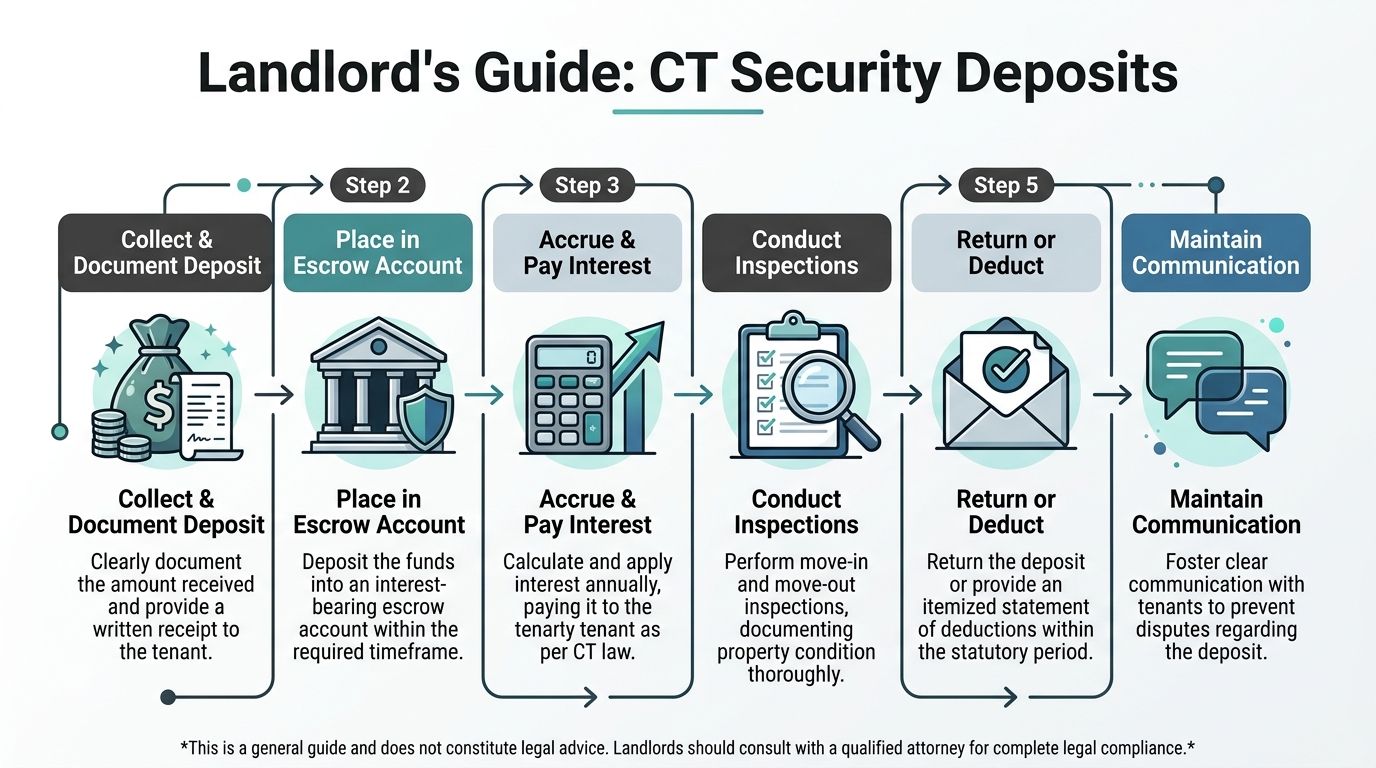
Start the file correctly
Landlords should treat deposit handling as an accounting process tied to statutory deadlines. Commercial landlords should approach it with the same discipline, even though commercial deposits usually turn on the lease language rather than the residential escrow and interest rules. Tenants on both sides should insist on written proof at the outset, because missing records usually hurt the party who had control of the money.
At the start of the tenancy, build a file that can be read by a judge or opposing counsel without explanation. That means clear records of the amount collected, the lease term, the date of receipt, and where the funds were placed. Residential owners also need records showing compliance with Connecticut's escrow and notice requirements.
A workable opening file includes:
- The signed lease with the exact deposit terms
- Proof of payment such as a check image, ledger entry, or receipt
- A written receipt given at the time funds are accepted
- Bank and escrow records that match the tenant and unit
- Any required written notice about where the deposit is held
Landlords who manage multiple units should standardize this process. Tenants should ask for these records early, not after relations have broken down.
For readers who want a general explanation of a deposit's function before getting into Connecticut procedure, this overview of what is security deposit used for is a useful starting point.
Document condition before the dispute starts
The strongest deduction case is built at move-in, not after surrender.
In practice, many residential landlords lose good claims because they cannot prove the unit's starting condition. Commercial landlords face the same problem in a different form. The dispute may involve tenant improvements, restoration obligations, fixtures, or deferred maintenance under the lease. In both settings, the rule is the same. If the file does not show condition at possession and condition at return, the deduction becomes harder to defend.
Use a move-in package that includes:
- Dated room-by-room photos
- A written condition checklist
- Notes on preexisting defects
- Tenant acknowledgment, preferably signed
- A matching move-out inspection form using the same categories
Photos matter. So do invoices, vendor estimates, and maintenance logs. A landlord who claims damage but cannot connect the charge to a specific condition, date, and repair cost invites a challenge.
If the claimed loss exceeds the deposit, send a clear written demand that explains the basis of the claim and encloses supporting documents. This article on what is a demand letter explains how to structure that notice.
Track the money, not just the unit
Security deposit disputes are often won or lost on timing and bookkeeping.
Residential landlords tend to focus on cleaning, repairs, and unpaid rent. The safer approach is to audit the file before move-out even happens. Confirm the deposit amount, confirm where it is held, confirm whether interest must be paid or credited, and confirm that internal records match the lease. A landlord with a legitimate damages claim can still face exposure if the money was handled incorrectly.
Commercial landlords have a different set of risks. Many business owners use one broad "security" clause and assume it covers every default. It often does not. A better lease specifies whether the deposit can be applied to rent, operating expenses, repair costs, attorneys' fees, restoration work, or post-termination holdover damages. Tenants should read that clause carefully before signing. Broad discretion for the landlord may be enforceable in commercial leasing if the language is clear.
Close the tenancy on a calendar, not by instinct
At move-out, dates control the result.
For residential property, Connecticut law imposes a deadline to return the balance of the deposit with any required interest or to send a written statement of deductions. Missing the deadline creates avoidable risk, even where some charges are valid. For commercial property, the lease usually controls timing, but delay still creates practical problems. It suggests disorganization, hinders settlement negotiations, and can complicate collection.
A disciplined closeout process looks like this:
| Stage | Landlord action |
|---|---|
| Surrender | Confirm the vacancy date and get the forwarding address in writing |
| Inspection | Compare move-out condition to the move-in record |
| Review | Separate unpaid rent, physical damage, and other lease-based charges |
| Accounting | Apply the deposit only to items supported by the lease and the file |
| Mailing | Send the refund or itemized statement within the required time |
| Retention | Keep copies of the full file, including proof of mailing |
Tenants should do their own closeout file as well. Keep photos, keep the lease, keep payment records, and keep the forwarding address notice. That advice helps residential tenants trying to recover a statutory deposit and commercial tenants disputing a landlord's broader damage claim.
Practices that hold up under scrutiny
The landlords who avoid deposit litigation usually do the same ordinary things every time. They use the same forms, the same inspection method, and the same closeout checklist. The landlords who get sued often rely on memory, informal texts, and repair numbers pulled together after the dispute starts.
Practices that usually help
- Consistent forms for receipt, inspection, and closeout
- Dated photographs stored in one place
- Detailed itemization tied to actual invoices or repair estimates
- Proof of mailing for refund checks and deduction statements
- Lease clauses that clearly describe deposit use, especially in commercial tenancies
Practices that create risk
- Commingling funds
- Late notices or late refund mailings
- Vague charges such as "repairs" or "cleaning" with no backup
- Condition reports prepared only at move-out
- Commercial leases with deposit language too thin to support the claimed offsets
Good procedure protects both sides. It helps landlords preserve valid deductions and helps tenants identify when a deposit claim is overstated or legally defective.
Allowable Deductions and Interest Payments Decoded
Most deposit disputes come down to two arguments. Was the deduction proper, and was the money handled correctly while it was being held?

What a security deposit can cover
Connecticut allows deductions for unpaid rent, damage beyond normal wear and tear, and other lease breaches. The hard part is applying those categories to real facts.
A useful general primer on the purpose of a deposit appears in this article on what is security deposit used for. In Connecticut practice, the distinction that matters most is between ordinary aging of the property and tenant-caused loss that exceeds ordinary use.
Here is the practical difference:
| Condition | Likely treatment |
|---|---|
| Minor scuffs on painted walls | Often ordinary wear |
| Large holes or unauthorized alterations | More likely chargeable damage |
| Worn carpet from normal traffic | Often ordinary wear |
| Heavy staining, burns, or unusual destruction | More likely chargeable damage |
| Loose handles or aging fixtures | Often maintenance |
| Broken fixtures caused by misuse | More likely chargeable damage |
The label isn't enough. A landlord should be able to show what the condition was at move-in, what it was at move-out, and why the tenant caused the difference.
Deductions that usually trigger fights
Three categories create recurring conflict.
- Cleaning charges often fail when the landlord has no proof that the unit was left beyond ordinary turnover condition.
- Painting charges are vulnerable when the walls show routine use rather than unusual damage.
- Replacement claims become harder when the item was already old or visibly worn at move-in.
Tenants should ask a simple question when reviewing a deduction. Is this a charge for restoring damage, or is it a charge for ownership costs the landlord was already going to bear?
If the deduction reads like deferred maintenance dressed up as tenant damage, expect a dispute.
Interest should not be an afterthought
Interest sounds minor until it becomes the basis for a larger compliance argument.
The safer landlord practice is to maintain a written method for calculating annual credits and to preserve that record in the tenant's file. The safer tenant practice is to request a full accounting that includes the deposit principal, any deductions, and any interest due.
Sloppiness can give a party an advantage. A landlord who carefully documented wall damage but ignored the financial handling of the deposit may still face a serious challenge. A tenant who disputes every deduction without separating legitimate charges from questionable ones may weaken an otherwise strong claim.
Practical judgment beats inflated positions
The strongest deduction position is usually the narrow one. Landlords who claim every possible dollar invite scrutiny. Tenants who deny obvious damage lose credibility.
The more defensible approach is selective and evidence-based. Claim what can be shown. Challenge what lacks proof. That is usually what moves a dispute toward resolution instead of litigation.
A Tenants Step-by-Step Guide to Recovering Your Deposit
Tenants who recover deposits successfully usually do the boring work early. They keep records, they communicate in writing, and they don't wait until a deadline has passed to get organized.
Build your file before move-out
Start with the basics. Gather the lease, proof of deposit payment, any move-in checklist, photos from the first day of occupancy, and copies of repair requests or landlord communications.
Then create a move-out record that is just as clear.
A useful tenant file includes:
- Move-in photos that show the original condition
- Move-out photos taken after cleaning and before key return
- Messages about repairs that show when problems were reported
- Proof of rent payments if unpaid rent is being claimed
- A copy of your forwarding address notice sent in writing
If the apartment had pre-existing issues, don't assume the landlord remembers them. Put those issues in the file.
Leave the unit like someone will inspect it carefully
A tenant doesn't need to renovate a unit before leaving. But a tenant should remove personal items, clean the space reasonably, and fix small issues that can be corrected without creating new damage.
Before surrendering possession:
- Photograph every room, including appliances, floors, walls, bathrooms, and inside closets.
- Record the date the keys were returned or the lease ended.
- Send your forwarding address in writing so there is no later argument about where the deposit should have gone.
- Keep copies of everything you send.
Ask for specifics, not conclusions
When a landlord withholds money, ask for the itemized basis. General statements like "excessive damage" aren't enough to evaluate the claim meaningfully.
A focused written request works better than an emotional one. Ask for:
- the amount withheld,
- the reason for each deduction,
- supporting documentation if available,
- and confirmation of how the final balance was calculated.
That approach matters if the dispute later becomes a legal case. Judges tend to care about the written record and whether each side acted reasonably.
Send the kind of message you'd be comfortable attaching as an exhibit.
Use a demand letter when informal requests fail
If the landlord doesn't respond or the response is plainly inadequate, send a formal demand letter. Keep it direct. State the tenancy dates, the deposit amount, the date you surrendered possession, that you provided a forwarding address, and why you believe the withholding is improper. Request payment by a specific date and keep the tone professional.
A basic tenant demand letter can follow this structure:
I rented the premises under our lease and paid a security deposit at the start of the tenancy. I vacated the premises and provided my forwarding address in writing. I dispute the withholding of my deposit because the deductions are not supported by the condition of the unit or by adequate documentation. Please remit the balance due promptly and provide a full written accounting if you contend additional sums are justified.
That letter doesn't need dramatic language. It needs dates, facts, and a clear request.
If the matter moves beyond informal resolution, tenants often benefit from understanding the broader mechanics of contract-based claims and court filings. This overview of how to sue for breach of contract is helpful for thinking through the next step.
When tenants hurt their own case
Some tenants make good claims harder by overreaching.
Common self-inflicted problems include:
- Throwing away records after move-out
- Failing to provide a forwarding address in writing
- Sending hostile messages instead of clear requests
- Ignoring obvious damage that should have been addressed.
- Waiting too long to gather evidence
A tenant doesn't need to prove perfection. A tenant needs to prove what happened, what was paid, and why the withholding wasn't justified.
Resolving Disputes Through Legal Action in Connecticut
A typical lawsuit starts the same way. The tenant says the deposit was withheld without a valid reason. The landlord says the money covered real damage, unpaid rent, or another lease default. In court, the side with the clearer records usually has the advantage.

What is actually at stake in court
Connecticut security deposit cases can become more expensive than the amount originally disputed. A landlord who mishandles the timing, accounting, or holding of the deposit can face statutory exposure beyond the deposit itself. A tenant who files without organized proof can spend time and filing fees and still lose.
That is why both sides need to assess the case early. The legal question is rarely just whether damage existed. The court may also examine whether the deposit was handled the way Connecticut law and the lease required.
For commercial landlords, the analysis can widen fast. A security deposit dispute may overlap with claims for unpaid additional rent, restoration costs, holdover damages, or broader default remedies under the lease. Tenants in business premises often miss that point and focus only on the deposit balance. Landlords sometimes make the opposite mistake and assume every lease charge can be offset against the deposit without a record the court can follow.
The evidence judges usually care about
Judges want a timeline supported by documents. They do not want a long narrative that fills gaps with assumptions.
The most useful proof often includes:
- The signed lease and any amendments
- Proof the deposit was paid
- Ledger entries, escrow records, or bank records, where relevant
- Move-in and move-out photographs
- Inspection reports, punch lists, or maintenance notes
- Repair invoices, estimates, and proof the work was done
- Written communications about condition, access, surrender, or deductions
- The itemized statement sent after move-out
- Proof of the tenant's forwarding address and the date it was provided
A landlord should be prepared to connect each deduction to a specific lease provision, a specific condition, and a specific dollar amount. A tenant should be prepared to show timely surrender, the condition of the premises, and any gap between what the landlord claimed and what the documents support.
Invoices matter. So does context. An estimate may help explain a claim, but a paid invoice or other proof of actual loss usually carries more weight.
Choosing between small claims, settlement, and a full civil case
Many residential deposit disputes fit in small claims court. Some do not, especially when the case includes counterclaims, multiple lease issues, or a commercial tenancy with larger damage allegations.
Before filing or digging in, ask three practical questions:
| Question | Why it matters |
|---|---|
| What does the lease or statute actually require? | A party can have a good factual story and still lose on a technical legal requirement |
| Can the claim be proved with documents? | Unsupported accusations usually weaken settlement position and trial position |
| What will it cost to pursue or defend the case? | Time, witness preparation, business interruption, and legal fees can outweigh the amount in dispute |
Settlement is not a sign of weakness. It is often the better business decision, particularly where the documents are mixed, the amount is modest, or both sides face some risk. For parties weighing forum and cost, this explanation of alternative dispute resolution versus litigation options gives a useful framework.
Commercial and mixed-use disputes need closer lease analysis
Commercial and mixed-use properties create issues that tenant-focused guides usually skip. The lease may allow the landlord to apply the deposit to rent arrears, taxes, common charges, utilities, attorney's fees, repair obligations, or post-termination losses. Some leases also require replenishment of the deposit after a draw, which creates a separate breach issue.
Those clauses help only if they were drafted clearly and administered consistently. I often see files where the landlord had a valid business claim but weakened it with poor accounting, informal offsets, or inconsistent notices. I also see commercial tenants overlook defenses based on waiver, mitigation, incomplete repair proof, or charges that fall outside the lease language.
A court will not reconstruct the file for either side. The judge will read the lease, review the chronology, and ask whether the numbers and documents line up.
A practical legal point for both sides
Security deposit cases are won with discipline. Landlords should present a clean damages package with lease support and accounting support. Tenants should isolate each deduction, admit what is fairly chargeable, and challenge only what the landlord cannot prove.
That approach improves settlement prospects and makes the court presentation stronger if the case has to be decided.
Assistance Programs and Final Considerations
A deposit dispute does not always start at move-out. In many Connecticut files, the first problem is getting into the property without enough cash for a full security deposit.
Connecticut's Security Deposit Guarantee Program can help eligible households secure rental housing by giving a landlord a state-backed guarantee for certain losses, including unpaid rent and damage beyond normal wear and tear, as described by the Connecticut Department of Housing Security Deposit Guarantee Program.
The takeaway for tenants
Tenants who need help with security deposits in ct should separate two issues. First, getting into housing. Second, protecting the right to a refund at the end of the tenancy.
For the front end, check whether you qualify for the state guarantee program before signing a lease you cannot fund. For the back end, treat the deposit file like evidence. Send the forwarding address in writing, keep photos, save texts and emails, and ask for an itemized explanation if money is withheld. A tenant who can prove dates, condition, and communications usually has a stronger position for settlement and a cleaner court presentation.
The takeaway for landlords and business owners
Landlords should treat deposit handling as an accounting and risk-control process, not just a move-out task. Problems usually come from preventable mistakes: taking the wrong amount, poor records, weak condition documentation, or issuing deductions that are hard to prove.
Commercial and mixed-use owners need even more discipline. Residential habits do not always fit a business lease. The lease may expand what can be charged against the deposit, but those rights hold up only when the file is organized and the charges match the contract language.
The practical test is simple. Could a judge, property manager, buyer, or successor counsel read the file and understand exactly what happened and why each dollar was kept or returned?
Complex deposit disputes often affect more than a single refund. They can affect lease enforcement, collections decisions, tenant relations, turnover costs, and litigation exposure for both residential and commercial owners.
If you want to discuss your business law matter, contact Kons Law at (860) 920-5181.
