
At its most basic, a service agreement is a legally binding contract that sets the rules of the game between a service provider and their client. It’s the foundational document that lays out the expectations, responsibilities, and legal safeguards for everyone involved.
Think of it as the blueprint for your business relationship.
The Blueprint for a Successful Business Relationship
You wouldn't hire a builder to construct a house without detailed architectural plans, right? You might have a vague idea of what you want, but without a clear blueprint, chaos is almost guaranteed. How many bedrooms? What kind of flooring? When will it be done, and what’s the final price?
A service agreement acts as that essential blueprint for your work. It takes all the verbal conversations and good intentions and puts them into a clear, written document, making sure everyone is on the same page from day one.
This document is your best tool for getting ahead of the "what-ifs" before they turn into expensive headaches. It's the most effective way to prevent scope creep, late payments, and arguments over the final product. By setting clear boundaries from the start, you build a foundation of trust that keeps the partnership running smoothly.
Why Do You Need a Formal Agreement?
Relying on a handshake or a few casual emails is a huge gamble for any business. An unwritten agreement is just a collection of memories, and memories can differ wildly when a problem pops up. A formal service agreement gets rid of that ambiguity and gives you a single source of truth to refer back to.
Before we dive deeper, let's look at the core jobs a service agreement performs. It’s more than just a piece of paper; it’s a strategic tool.
Table: Key Functions of a Service Agreement
A quick overview of the essential roles a service agreement plays in any professional engagement.
| Function | Why It Matters |
|---|---|
| Defines Scope of Work | Clearly outlines exactly what services will be provided, preventing clients from demanding extra work that wasn't part of the original deal. |
| Sets Payment Terms | Details the costs, invoice schedule, and payment process, making sure you get paid on time and as expected. |
| Establishes Timelines | Lays out key deadlines and the overall project schedule, holding both parties accountable for staying on track. |
| Protects Both Parties | Includes clauses that manage liability, protect confidential information, and clarify who owns any intellectual property created. |
Ultimately, a service agreement isn't just about legal protection—it's about creating clarity and fostering a healthy, professional relationship. For anyone new to this, understanding the basics of a solid contract is the first critical step. This overview of a small business contract template can give you a better sense of the structure.
Understanding the Different Types of Service Agreements
Not every business relationship is built the same, so it stands to reason that service agreements aren't one-size-fits-all. Picking the right type of contract is the first step in setting clear expectations and heading off problems down the road. It’s like choosing the right tool for a job—you wouldn't bring a hammer to saw a board.
These contracts usually fall into a few key categories, each designed for a specific kind of professional relationship. The most common structures you'll run into are Master Service Agreements (MSAs), Statements of Work (SOWs), and Retainer Agreements. Each one creates a different framework for how services get delivered, managed, and paid for.
The importance of these documents can't be overstated, especially as more companies rely on outside help. The global outsourcing industry is massive, and IT services are leading the charge. Out of $92.5 billion in contracts from global outsourcing firms, a whopping $66.5 billion came from IT services alone. With 92% of G2000 companies and 37% of small businesses outsourcing at least one process, it's clear that solid service agreements are a must-have for organizations of all sizes. Discover more insights about outsourcing trends on explodingtopics.com.
The Master Service Agreement (MSA)
Think of a Master Service Agreement (MSA) as the foundation for a long-term business relationship. It lays out the general terms and conditions that will govern all future work between two parties. Instead of drafting a brand-new, complex contract for every single project, the MSA serves as a durable umbrella agreement.
This approach saves an incredible amount of time and legal effort. Once the MSA is in place, you only need to create shorter, project-specific documents that fall under it.
The graphic below shows the basic hierarchy of an agreement, highlighting the core pillars of scope, payment, and timeline.
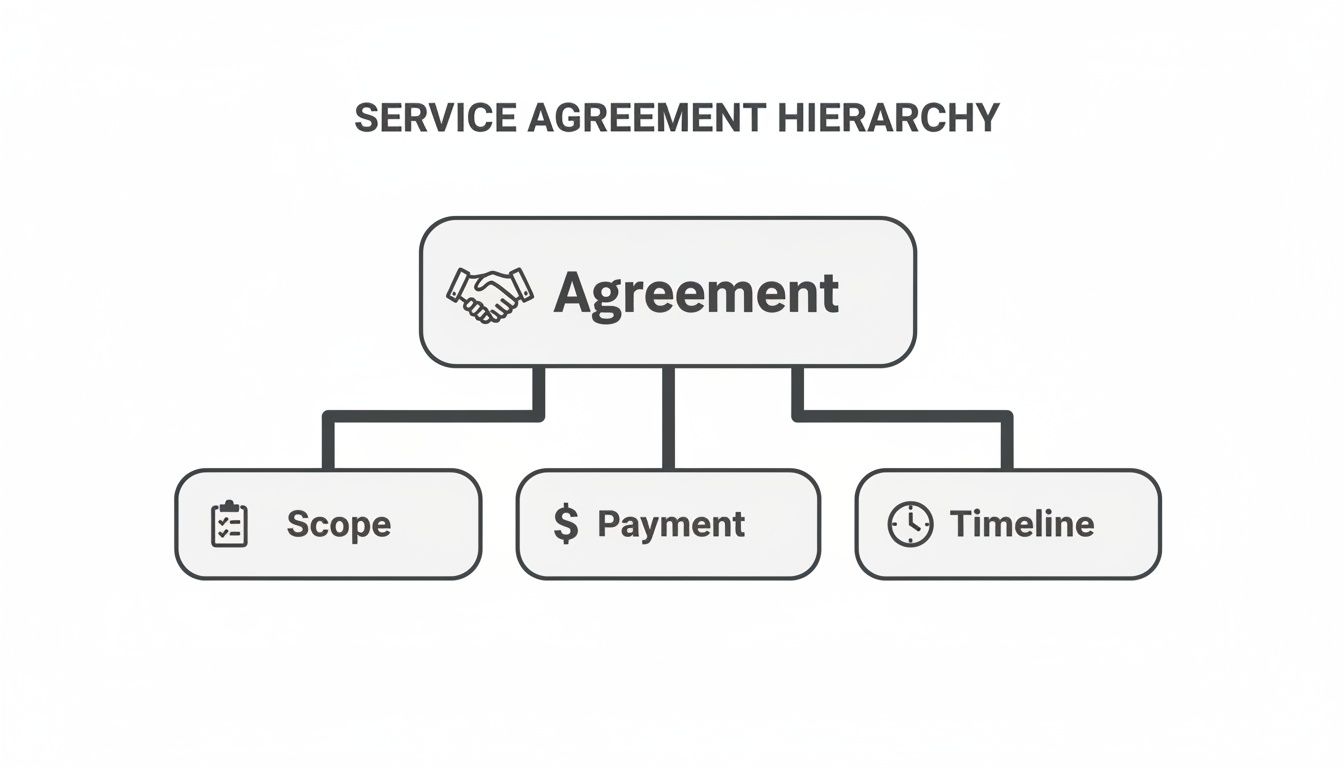
This breakdown makes it clear: a solid agreement has to define exactly what will be done, how it will be paid for, and when it needs to be finished.
The Statement of Work (SOW)
A Statement of Work (SOW) is the project-specific document that lives under the MSA. It’s where you get into the nitty-gritty details of a particular job, including things like:
- Deliverables: What specific outcomes or products will be created?
- Timeline: What are the key milestones and the final due date?
- Pricing: How much will this specific project cost, and what are the payment terms?
For instance, a marketing agency might have a year-long MSA with a client. When that client decides they need a website redesign, the agency issues an SOW just for that project. A few months later, if they want to launch a social media campaign, a new and separate SOW will be created for that work.
The Retainer Agreement
A Retainer Agreement is what you use when a client pays a recurring fee to keep you "on call." This is very common for lawyers, consultants, and creative agencies who provide ongoing advice or services. The client essentially pays to secure a certain number of your hours or simply to guarantee your availability when they need you. It ensures they have access to your expertise over a set period.
If you want to discuss your business law matter, contact Kons Law at (860) 920-5181.
The Must-Have Clauses in Every Service Agreement
A good service agreement is more than just a piece of paper; it’s a roadmap for your professional relationship. Think of its key clauses as the foundational pillars holding everything up. If one is weak or missing, the whole structure can become unstable, leaving you exposed to risk.
Getting these non-negotiable components right from the start is the best way to prevent headaches down the road. By clearly defining the rules of the game in writing, you create a single source of truth that you and your client can always refer back to. This clarity is your number one defense against scope creep, payment disputes, and misunderstandings.

Core Components of a Strong Agreement
While every agreement needs to be shaped to fit the specific project, a few clauses are universally essential. They form the backbone of the contract and tackle the most common areas where things go wrong.
Here are the absolute must-haves you should insist on in any service agreement:
- Scope of Services: This is the big one. It needs to be a crystal-clear description of the exact work to be done, including specific deliverables, milestones, and who is responsible for what. A vague scope is an open invitation for conflict.
- Payment Terms: This section lays out the money trail—how much the services cost, the payment schedule (e.g., upfront deposit, monthly invoices, payment on completion), and what payment methods are acceptable. It should also be clear about what happens if a payment is late.
- Term and Termination: Every relationship needs a beginning and an end. This clause sets a clear start and end date for the agreement. It also spells out the conditions under which either party can legally walk away, such as a major breach of the contract or after giving a certain amount of notice.
- Confidentiality: If you or your client will be sharing sensitive information, a confidentiality or non-disclosure clause is a must. It’s a legally binding promise that prevents proprietary data from being shared with anyone else.
- Intellectual Property (IP) Ownership: Who owns the final product? This clause clarifies whether the client gets full ownership of the work or if the service provider keeps certain rights. Don’t leave this to assumptions.
Planning for Disagreements
Even with the best-laid plans, disagreements can still pop up. A smart service agreement anticipates this possibility and includes clauses for handling liability and resolving disputes before they escalate. An indemnification clause, for example, defines who foots the bill if a third-party claim arises from the work performed. You can learn more by exploring our detailed explanation of indemnification clauses in contracts.
A proactive approach to dispute resolution is a hallmark of a professional agreement. Including a clear process for handling conflicts saves time, money, and stress by establishing the rules of engagement before a problem occurs.
When a simple conversation can’t fix the problem, your agreement should tell you what happens next. Here’s a quick comparison of the usual routes.
Comparing Dispute Resolution Methods
When a conflict can't be resolved through direct negotiation, the agreement should outline a clear path forward. The table below breaks down the most common methods for handling disputes.
| Method | Process | Key Advantage |
|---|---|---|
| Mediation | A neutral third party guides a discussion, helping both sides find a solution they can agree on. | Collaborative and often saves the business relationship. The outcome isn't binding unless everyone agrees. |
| Arbitration | A neutral arbitrator (or a panel) hears both sides and makes a decision that is legally binding. | More formal than mediation but less so than court. It’s private and usually faster than litigation. |
| Litigation | The dispute goes to a public court, following formal legal procedures and ending in a judge's or jury's verdict. | Delivers a final, legally enforceable judgment, but it can be extremely expensive and take a long time. |
Deciding which method is right for your agreement is a strategic choice that can have a big impact if a disagreement ever arises.
If you want to discuss your business law matter, contact Kons Law at (860) 920-5181.
How to Avoid Common Pitfalls and Legal Risks
Signing a service agreement is a great first step, but it doesn't automatically shield you from every potential problem. A contract isn't just a piece of paper you sign and file away; its real value is tested when things don't go according to plan. To navigate these challenges from a position of strength, you need to understand the common pitfalls before they happen.
One of the most persistent—and costly—issues we see is scope creep. It happens innocently enough. The project is underway, and the client asks for "just one more thing." Then another. Before you know it, these small, informal requests have ballooned the project far beyond its original objectives, but the price hasn't changed.

A tightly defined Scope of Services clause is your first line of defense. But it's not enough on its own. You must pair it with a clear change order process that requires any new work to be documented, priced, and approved in writing. No exceptions.
Payment disputes are another frequent source of friction. A client might delay payment, question an invoice, or flat-out refuse to pay. Your Payment Terms clause should proactively address this by spelling out late fees, interest penalties, and the exact steps for resolving invoice discrepancies. Having these rules established upfront depersonalizes the enforcement process and makes it a matter of policy, not a personal conflict.
When One Party Fails to Deliver
So, what happens when someone doesn't hold up their end of the bargain? In legal terms, this is called a breach of contract. A breach can be minor, like missing a single deadline, or it can be a material breach, like a complete failure to provide the agreed-upon services. Your agreement needs to define what constitutes a breach and outline the road to resolution.
For a contract to be legally enforceable, it must contain a few key elements: an offer, acceptance, consideration (something of value exchanged), and a mutual intention to be legally bound. When those are in place, a breach gives the non-breaching party access to legal remedies.
These remedies are the tools you can use to make things right. They typically include:
- Termination: The right to end the contract, which is especially critical in cases of a material breach.
- Damages: Financial compensation to cover the losses you incurred because of the breach.
- Specific Performance: In some cases, a court can order the breaching party to actually perform their contractual duties.
Navigating Broader Economic Risks
It's not just project-specific issues that can create risk; external economic factors matter, too. For instance, the global trade environment has seen significant shifts, with slowing growth driven by protectionist policies and tariff uncertainties. We've seen these developments prompt many companies to take a more cautious approach, focusing on cost-saving and resilience rather than bold new investments. You can discover more about these U.S. international trade trends on bea.gov.
A truly resilient service agreement anticipates challenges on both the micro (project) and macro (economic) levels. A well-constructed contract provides a clear roadmap for what to do when—not if—the unexpected occurs.
If you want to discuss your business law matter, contact Kons Law at (860) 920-5181.
Navigating Connecticut-Specific Business Laws
A service agreement that works perfectly in California could leave your business exposed in Connecticut. Why? Because contract law isn’t a one-size-fits-all game. Every state has its own statutes and court decisions that shape how agreements are interpreted and enforced. For anyone doing business in the Nutmeg State, understanding these local nuances isn't just a good idea—it's fundamental to creating a contract that will actually protect you when it matters most.
Connecticut has its own unique rulebook that directly impacts service agreements. These regulations touch on everything from the state's strict definition of an independent contractor to consumer protection laws that kick in depending on your clientele. Get the worker classification wrong, for instance, and you could be facing serious penalties. This makes it absolutely critical that your agreement is drafted with a clear understanding of Connecticut labor and business law.
Connecticut courts interpret contract language through the lens of established state legal principles. A clause that seems crystal clear in another state might be viewed entirely differently here, making local legal insight a powerful advantage.
Key Legal Considerations in Connecticut
When you're drafting or signing a service agreement in Connecticut, there are a few specific areas you absolutely need to get right. These state-specific factors can be the difference between a rock-solid contract and one that leaves you vulnerable to legal challenges and unnecessary risk.
Here are a few of the big ones to keep on your radar:
- Independent Contractor Laws: Connecticut uses a specific "ABC test" to determine if a worker is a true independent contractor or an employee. Your agreement’s terms must be carefully structured to meet these criteria, or you risk misclassification.
- Consumer Protection Statutes: The Connecticut Unfair Trade Practices Act (CUTPA) offers broad protections to consumers. If you sell services to the public, your agreement can't include terms that could be considered unfair or deceptive under this powerful law.
- Statute of Limitations: There are hard deadlines in Connecticut for filing a lawsuit over a broken contract. Knowing these time limits is essential for protecting your ability to enforce your rights.
Successfully starting a business in CT is about more than a great idea—it’s about building a solid legal foundation from the ground up. Ensuring your service agreements are tailored to Connecticut law is a cornerstone of that foundation, protecting your operations from day one.
If you want to discuss your business law matter, contact Kons Law at (860) 920-5181.
Why a Lawyer is Your Most Important Partner
While this guide gives you a solid foundation for understanding service agreements, knowing what they are and creating one that actually protects your business are two different things. Bringing a business lawyer into the process isn't just a "nice-to-have"—it's a strategic investment in your company's future. An experienced attorney sees what a generic template misses, spotting hidden liabilities and making sure every clause complies with Connecticut's specific laws.
The global services market is expanding at an incredible rate, growing by 9% annually and recently adding about $700 billion to global commerce in just one year. With the U.S. leading the pack as the world's biggest service exporter, having a rock-solid agreement is more critical than ever. You can see more on these global trade trends at unctad.org. A lawyer takes a standard document and turns it into a powerful tool that secures your place in this growing market.
From a Defensive Shield to a Business Tool
It's easy to see legal fees as just another business cost. A better way to think about it is as the ultimate protection for everything you've built.
Your lawyer is your advocate, negotiating terms that lock down your revenue, protect your intellectual property, and align with your long-term goals. They help transform your agreement from a simple defensive shield into a proactive instrument for growth.
A well-crafted service agreement, reviewed by legal counsel, is a sign of professionalism. It shows clients you take your commitments seriously, building trust and setting the stage for a successful partnership right from the start.
This kind of proactive legal thinking is at the heart of what a business lawyer does. To get a better sense of how they can support your day-to-day operations, take a look at our guide on what a business lawyer does. They are your most important partner for minimizing risk and maximizing every opportunity.
If you want to discuss your business law matter, contact Kons Law at (860) 920-5181.
Answering Your Questions About Service Agreements
Even with a solid grasp of the fundamentals, it's the real-world questions that pop up day-to-day that matter most. Let's tackle some of the most common ones I hear from clients, giving you the direct answers you need to handle these agreements with confidence.
Can I Just Use a Free Template I Found Online?
It's tempting, I know. A free template seems like a quick, easy fix. But more often than not, it creates more problems than it solves. A generic document downloaded from the internet has no idea what your business does, what your client relationship looks like, or what Connecticut law requires.
Think of it this way: using a one-size-fits-all agreement is like using a generic key for your house—it might fit in the lock, but it won’t actually protect you. You’re left wide open to payment disputes, intellectual property theft, and other liabilities. It's always a smarter, safer investment to have an attorney draft or review your agreement to make sure it's built specifically for your business.
What’s the Difference Between a Service Agreement and an Invoice?
This is a great question because it gets to the heart of how these documents work together. A service agreement is the proactive playbook for your entire project. You set it up before any work begins to define the scope, deliverables, payment terms, and what's expected of everyone involved.
An invoice, on the other hand, is reactive. It's simply the bill you send after you've already performed the work according to the rules in the agreement. The agreement governs the relationship; the invoice is just a tool you use within that relationship to get paid.
How Do I Handle a Client Asking for More Work Mid-Project?
Ah, the classic "scope creep." This is precisely why a well-drafted service agreement is your best friend. Your contract should have a dedicated "Change Order Process" clause built right in.
This clause lays out the ground rules. It requires any new requests to be put in writing, complete with an estimate for the additional cost and time. Before any extra work starts, both you and the client have to sign off on this new addendum. This simple process keeps expectations clear and ensures you get paid fairly for every bit of work you do.
When Should I Get a Lawyer Involved with My Agreement?
The short answer? It's always a good idea to consult an attorney before you sign any service agreement, whether you’re the one providing the service or the one receiving it.
But it becomes absolutely critical in certain situations: high-value projects, long-term partnerships, or any contract that involves valuable intellectual property. An attorney’s review isn’t just about spotting typos; it’s about making sure your interests are protected and that the contract will hold up if things go wrong.
If you want to discuss your business law matter, contact Kons Law at (860) 920-5181.
