
You wouldn’t buy a house without a thorough inspection, right? You’d want an expert to check the foundation, the roof, and the plumbing for any hidden issues that could turn your dream home into a financial nightmare.
Due diligence in the business world is the exact same principle, just on a much larger scale. It’s the deep-dive investigation you perform before you sign on the dotted line for a major transaction, whether that's buying a company, taking on a huge investment, or entering a critical partnership.
It's the process of swapping out assumptions and best-case scenarios for hard facts and verified data. This is where you roll up your sleeves and confirm that an opportunity is truly what it seems.

Why Is This So Important?
The whole point of due diligence is to achieve total clarity before a deal is locked in. It’s your chance to uncover any red flags—hidden debts, looming lawsuits, operational trainwrecks—that could blow up in your face later.
With a comprehensive review, you gain the confidence to move forward, the leverage to negotiate better terms, or the crucial insight to walk away from a deal that’s just too risky. It’s no wonder this process is taken so seriously. In fact, the global market for due diligence services was valued at $15.2 billion in 2023 and is expected to nearly double to $28.9 billion by 2032. That massive growth shows just how essential risk management has become.
What Are We Actually Trying to Achieve?
Ultimately, a proper due diligence investigation is about answering some very important questions to protect your interests. The insights you gather are absolutely vital for structuring a successful deal and are a cornerstone of sound business transaction law.
Let's break down the core goals into a simple table.
Key Objectives of Business Due Diligence
| Objective | Description |
|---|---|
| Risk Identification | To uncover hidden liabilities, pending lawsuits, compliance gaps, or operational weaknesses that could cause future problems. |
| Information Verification | To confirm that all the information provided—from financial statements to customer lists—is accurate and not just wishful thinking. |
| Valuation Confirmation | To determine if the asking price or investment valuation is realistic and justified by the company's actual health and potential. |
| Strategic Planning | To gather the intelligence needed to plan for a smooth integration after the deal closes, including operational and staffing changes. |
Without this methodical investigation, you're essentially flying blind. You’re exposing yourself to financial pitfalls and operational headaches that a disciplined due diligence process would have brought to light from the very beginning.
The Core Types of Due Diligence
Due diligence isn't a single, monolithic task. It’s more like a team of specialists—an accountant, a lawyer, a market analyst, and a compliance officer—all examining a business from different angles. Each brings a unique expertise to the table, and together, they build a complete, 360-degree picture of the company's health, its hidden risks, and its true potential.
Breaking it down by category is the only way to get the full story. Each type of due diligence answers a different set of crucial questions, moving you from hopeful assumptions to hard, verified facts. This is how you find out exactly what you're buying into before you sign on the dotted line.
Financial Due Diligence
This is usually where everyone starts, and for good reason. Financial due diligence is all about putting a company's financial records under a microscope to make sure the numbers are real, accurate, and sustainable. It's far more than a quick glance at a tax return.
An expert dives deep to:
- Analyze Historical Performance: They'll scrutinize audited financials, income statements, and balance sheets, looking for trends in revenue, profit margins, and overall stability.
- Assess Cash Flow: Is the company actually generating cash? Consistent, healthy cash flow is the lifeblood of any business, and this analysis proves its strength.
- Examine Debts and Liabilities: This is where hidden problems often surface. The review uncovers all outstanding debts, potential future liabilities, and any off-balance-sheet items that could become a serious risk down the road.
This area is so fundamental that it often commands the most attention and resources. As businesses work to prevent fraud and navigate volatile markets, this focus is only intensifying. In fact, projections show the related commercial due diligence market is expected to nearly double, jumping from USD 4.5 billion in 2025 to USD 9.2 billion by 2033.
Legal Due Diligence
While the financials tell one story, a company's legal standing tells another, equally critical one. Legal due diligence is a meticulous review of every legal document and potential liability, ensuring there are no skeletons hiding in the company's closet.
A legal team will investigate a huge range of areas, including:
- Corporate Structure: Are the articles of incorporation, bylaws, and shareholder agreements in good order? This confirms the company is a legitimate, properly-formed entity.
- Contracts and Agreements: Key contracts with customers, suppliers, and employees are examined for unfavorable terms, restrictions, or "change-of-control" clauses that could be triggered by a sale.
- Litigation History: Any past, current, or even threatened lawsuits are uncovered. A surprise lawsuit can bring devastating financial and reputational damage.
- Intellectual Property: This is about verifying ownership of patents, trademarks, and copyrights. For many modern companies, their IP is their most valuable asset.
Commercial and Operational Due Diligence
This investigation looks outside the four walls of the company to see how it fits into the broader market and how efficiently it runs day-to-day. It answers the big-picture question: "Is this a competitive business with a real future?"
Commercial due diligence evaluates the market itself—the customers, the competition, and industry trends. In contrast, operational due diligence looks at how the business actually functions, from its supply chain management to its production floor.
Key questions here involve assessing customer concentration (is the company dangerously reliant on just a few big clients?), the strength of its supplier relationships, and the condition of physical assets like machinery and facilities.
Compliance Due Diligence
Finally, compliance due diligence confirms the business is playing by the rules. It verifies adherence to all relevant local, state, and federal regulations, which is absolutely essential for avoiding hefty fines, penalties, and operational shutdowns.
This review covers everything from industry-specific regulations and environmental laws to data privacy mandates. A deep understanding of what is regulatory compliance is a critical part of protecting any business from unforeseen legal entanglements. Each of these pillars provides a unique view, and only by combining them can you make a truly informed decision.
When Is Due Diligence Most Critical?
Knowing how to do your homework is only half the battle; knowing when to do it is what separates a savvy business leader from one who walks into a disaster. While it’s always a good idea to look before you leap, some high-stakes situations make due diligence an absolutely non-negotiable part of the process.
These are the moments where a simple assumption can unravel into a catastrophic financial mess. Think of it like this: you might check your tire pressure before a quick trip to the grocery store, but you’d get a full mechanical inspection before a cross-country road trip. The same logic applies in business—the bigger the journey, the deeper you need to dig.
Mergers and Acquisitions
The classic, and most critical, trigger for due diligence is a merger or acquisition (M&A). When one company decides to buy another, it isn't just buying the brand and the inventory. It's absorbing every asset, liability, contract, and cultural quirk that comes with it.
Without a deep dive, the acquiring company is flying completely blind. Imagine discovering crippling debt, a mountain of pending lawsuits, or a toxic workplace culture only after the deal is signed. In the M&A world, due diligence is your shield. It helps you:
- Validate the Purchase Price: Is the company really worth the asking price? A close look at its financial health, market position, and real growth potential will tell you.
- Identify Integration Challenges: Uncovering major differences in technology, operational workflows, or company culture ahead of time is key to planning a smooth transition instead of a chaotic one.
- Uncover Hidden Risks: This is where you hunt for skeletons in the closet. We're talking about things like unresolved legal disputes, environmental liabilities, or the fact that 80% of their revenue comes from a single client who might be about to walk.
The M&A landscape is where due diligence truly shines. In fact, acquisition-related investigations make up a massive 52% of the market share for these services, an industry fueled by global deal volumes that have topped $3 trillion annually since 2021. To navigate this high-stakes game, smart buyers now routinely spend over 1% of the total deal value just on uncovering these hidden risks. Explore further data on this booming market to see what this means for business leaders.
Securing Investments and Financing
Due diligence isn't just for buyers. When a company is looking for a major cash injection—whether from venture capitalists, private equity, or a traditional bank—the people with the money will be conducting their own rigorous investigation. Their goal is simple: protect their investment and make sure your business is a sound bet.
From an investor's perspective, due diligence is the process of confirming that a compelling story is backed by solid fundamentals. They are looking for proof that the company has the leadership, market position, and operational discipline to deliver the promised returns.
When it comes to a business loan, a lender is focused on one thing: your ability to pay them back. They will scrutinize your financial statements, cash flow projections, and the value of any collateral you put up. This isn't personal; it's how they protect their institution from taking on a bad risk.
Forming Strategic Partnerships and Joint Ventures
Entering a strategic partnership or joint venture means tying your company's reputation and future success to another business. Before you link your brand with someone else's, it's absolutely crucial to verify their stability, reputation, and how they operate.
This kind of due diligence is all about making sure your potential partner is financially sound, compliant with regulations, and doesn't have a history that could come back to haunt you. A partner's undisclosed legal trouble or shaky finances can quickly become your problem, making a thorough vetting process essential for protecting your own business.
If you want to discuss your business law matter, contact Kons Law at (860) 920-5181.
Navigating the Due Diligence Process
So you understand the what and the why of due diligence, but what does it actually look like on the ground? It’s not a chaotic paper chase. Think of it as a methodical, structured investigation with clear phases—a playbook for anyone about to dive into this critical business stage.
The whole process officially gets underway after the parties reach a foundational, non-binding agreement. This is almost always a Letter of Intent (LOI), a document that sketches out the deal's proposed terms and gives the buyer an exclusive window to conduct their investigation. If you want to get into the weeds on this crucial starting point, you can read our guide on what is a Letter of Intent.
Setting the Stage: The Data Room and Initial Requests
Once that LOI is signed, the next move is creating a secure space to share sensitive information. In today's world, this is almost always a virtual data room (VDR). It’s a cloud-based vault where the seller can upload thousands of documents—financial statements, key contracts, employee records, board meeting minutes, you name it.
The buyer's team, a mix of lawyers, accountants, and other specialists, then fires off a detailed due diligence request list. This is their exhaustive wish list, a catalog of every single piece of information they need to see, all neatly organized by category. This first exchange really sets the pace for the entire investigation.
The Deep Dive: Information Review and Analysis
Here's where the real work begins. This phase is the heart of the due diligence process, where the investigative team methodically combs through every document in the VDR to build a complete, unvarnished picture of the business. This isn't just about ticking boxes; it's a deep forensic analysis.
Here’s what’s happening behind the scenes:
- Document Scrutiny: Lawyers are poring over contracts, hunting for red flags like change-of-control clauses or nasty termination terms. At the same time, accountants are cross-referencing financial statements with tax returns and bank records to make sure the numbers add up.
- Management Interviews: The team will sit down with key executives and department heads. These conversations are invaluable, offering the kind of context and color that documents just can't provide. You get insights into company culture, operational hurdles, and the real story on future prospects.
- Site Visits: In many deals, especially those involving manufacturing or retail, seeing is believing. Physical site visits allow the team to inspect facilities, check the condition of equipment, and verify inventory firsthand.
The image below shows the typical business events that kick off this whole investigative journey.
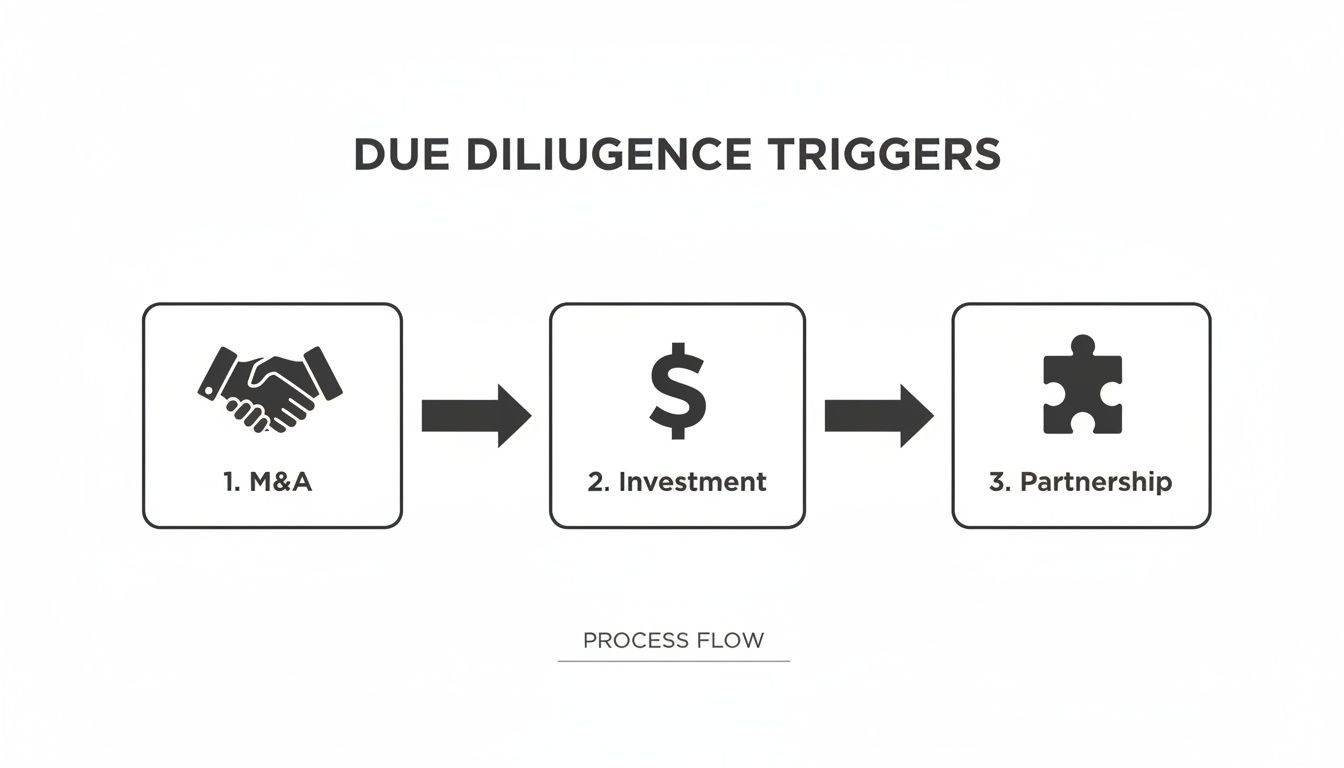
Whether it's a full-blown acquisition, a significant investment, or a new strategic partnership, the need to look under the hood remains the universal starting point.
The Final Phase: Reporting and Decision-Making
As the investigation moves along, the team starts compiling its findings. They'll send follow-up questions to the seller to clear up anything that’s ambiguous or to dig deeper into potential problems they've uncovered.
The goal isn’t just to find problems—it’s to understand their real-world impact. A minor contract issue might be an easy fix, but an undisclosed lawsuit could torpedo the entire deal. The analysis phase is all about quantifying risk and telling the difference between a small hiccup and a major liability.
Finally, everything culminates in a comprehensive due diligence report. This document lays it all out: the key findings, the identified risks, and a clear-eyed assessment of the target company. It becomes the ultimate guide for the buyer, giving them the leverage to renegotiate the price, add protective clauses to the final agreement, or, if the risks are just too high, confidently walk away.
A Practical Checklist and Common Red Flags

Think of due diligence as a high-stakes investigation. You’re not just reading documents; you’re looking for the story behind the numbers and the potential problems hiding between the lines. Knowing what to look for—and what a red flag looks like—is your best defense against a bad deal.
These warning signs aren't always glaring. They’re often subtle clues that, once spotted, can save you from a costly misstep. Identifying these issues early gives you the leverage to renegotiate the price or, just as importantly, the confidence to walk away.
Uncovering Common Red Flags
During a thorough review, certain issues should immediately set off alarm bells. These are often symptoms of deeper, more systemic problems that could put your entire investment at risk.
Here are some of the most critical red flags to watch for:
- Inconsistent Financials: When the financial statements, tax returns, and bank records don’t tell the same story, something is wrong. It could be sloppy bookkeeping, or it could be outright fraud.
- Customer Concentration: Does 80% of the company's revenue come from a single client? That's not a strong business; it's a house of cards. If that one client leaves, the entire operation could collapse.
- Hidden Lawsuits: Undisclosed or unresolved legal disputes are financial time bombs. Any pending litigation needs to be examined to understand the potential costs and reputational fallout.
- Key Staff Without Contracts: If the brilliant software engineer or the top salesperson doesn't have a solid employment contract, what’s stopping them from walking out the day after you take over?
To better understand what to look for, here’s a quick guide to common red flags and the underlying risks they represent.
Due Diligence Red Flag Indicator
| Red Flag | Potential Risk |
|---|---|
| Messy or incomplete financial records | Inability to verify profitability; potential for hidden liabilities or fraud. |
| Over-reliance on a few key customers | Revenue instability; high risk if a major client departs. |
| Pending or undisclosed litigation | Significant financial exposure and potential damage to the company's reputation. |
| High employee turnover, especially in key roles | Underlying operational or cultural problems; loss of institutional knowledge. |
| Vague or missing contracts with major suppliers | Supply chain disruption; risk of sudden price increases or service termination. |
| Intellectual property is not properly protected | Competitors could copy products or services; loss of competitive advantage. |
These are just a few examples, but they illustrate how a seemingly small issue can point to a much larger problem. A thorough investigation is what separates a calculated risk from a blind gamble.
Your Essential Due Diligence Checklist
While every transaction is unique, a structured checklist is the best way to ensure no stone is left unturned. It’s a roadmap that guides your investigation and keeps the process organized and efficient.
The following list is a great starting point, broken down by core business areas. For a more exhaustive guide, be sure to review our mergers and acquisitions due diligence checklist.
Breaking Down the Investigation
Financial Checklist
- Request audited financial statements for the past 3-5 years.
- Review all federal, state, and local tax returns for the same period.
- Analyze schedules of all debts, accounts receivable, and accounts payable.
- Scrutinize cash flow statements and future projections.
Legal Checklist
- Review the company's articles of incorporation, bylaws, and minute book.
- Request copies of all significant contracts, including with customers, suppliers, and landlords.
- Investigate all pending, threatened, or past litigation and regulatory inquiries.
- Verify the ownership and status of all intellectual property (patents, trademarks, copyrights).
Operational Checklist
- Analyze customer concentration and satisfaction data.
- Review a list of key suppliers and the terms of their agreements.
- Assess the condition of all physical assets, like real estate and equipment.
- Evaluate the company’s internal processes and technology systems.
Human Resources Checklist
- Review employment agreements, especially for key personnel.
- Examine employee handbooks, benefit plans, and compensation structures.
- Investigate any history of labor disputes or employee claims.
- Confirm full compliance with all employment and labor laws.
The Role of Legal Counsel in Due Diligence
While your accountants are buried in spreadsheets and your operational team is touring facilities, a sharp business attorney acts as the strategic anchor for the entire due diligence process. Their job isn’t just about reviewing documents—they’re the architects of risk mitigation, making sure the deal you’re about to sign is built on a rock-solid legal foundation.
Hiring experienced legal counsel isn’t a luxury; it’s one of the most critical moves you can make to protect your interests.
An attorney's first task is to give the target company a thorough legal health check. This means a deep dive into corporate records, articles of incorporation, bylaws, and shareholder agreements to confirm the business is in good standing and that ownership is crystal clear. They’re hunting for any skeletons in the legal closet that could blow up the deal later.
More Than Just Paperwork
The legal team’s investigation goes far beyond the corporate minute book. They scrutinize every single contract the company has signed, looking for poison pills like unfavorable terms, change-of-control clauses triggered by the sale, or any restrictions that could hamstring you after the acquisition. This proactive review keeps you from inheriting someone else’s bad deals.
Uncovering litigation risk is another huge piece of the puzzle. This involves:
- Reviewing Past and Pending Lawsuits: Are there current legal battles? Is there a history of disputes that points to a recurring, systemic problem?
- Investigating Threatened Litigation: Looking for warning signs of future legal challenges that haven't escalated to a formal lawsuit just yet.
- Ensuring Full Regulatory Compliance: Verifying that the company is playing by all the industry-specific, state, and federal rules to avoid crippling fines and penalties down the road.
A skilled attorney doesn’t just hand you a list of problems. They connect the dots, explaining what those findings actually mean for the transaction and your financial exposure. They translate abstract legal risks, like a poorly worded contract or a looming regulatory inquiry, into tangible business consequences you can understand.
The real magic of legal counsel is their ability to turn identified risks into powerful contractual protections. A potential liability becomes a bargaining chip, leading to price adjustments, specific indemnities, or warranties that shield you from future costs.
This strategic guidance is indispensable. A business law firm makes sure every potential legal issue is found, quantified, and handled in the final agreement. It's a careful, proactive approach that safeguards your investment and ensures the deal closes on terms that actually protect you.
Ultimately, legal due diligence is all about giving you the clarity and security needed to move forward with confidence. If you want to discuss your business law matter, contact Kons Law at (860) 920-5181.
Frequently Asked Questions About Due Diligence
Even after you get a handle on the basics, plenty of questions pop up once you're in the thick of a deal. Getting straight answers to these common sticking points is key to moving forward with confidence. Here are a few of the questions we hear most often.
How Long Does Due Diligence Usually Take?
There’s really no magic number here. The timeline is almost entirely dictated by the size and complexity of the business being examined.
For a smaller, straightforward acquisition, you might wrap things up in 30 to 60 days. But for a larger M&A deal involving multiple locations, tangled legal structures, or international operations, it’s not uncommon for the process to stretch to 90 days or even longer.
A few things really move the needle on timing:
- The Seller’s Preparation: A seller who has their act together with a well-organized virtual data room can shave weeks off the process. If they’re slow to produce documents, expect delays.
- The Target Company’s Complexity: More assets, more contracts, more employees—it all adds up. Each piece requires its own line of investigation.
- The Scope of Your Investigation: Are you just reviewing documents, or are you planning on-site visits, in-depth management interviews, and specialized environmental audits? The deeper you dig, the more time you’ll need.
What Is the Difference Between an Audit and Due Diligence?
This is a great question, and it’s a point of confusion for a lot of people. The easiest way to think about it is that an audit looks backward, while due diligence is all about looking forward.
An audit is a formal review of a company’s past financial statements, usually done by an independent CPA. Its entire purpose is to verify that the historical numbers are accurate and comply with accepted accounting standards. It’s a snapshot in time, confirming what has already happened.
Due diligence, on the other hand, uses that audited financial data as a starting point. It’s a forward-looking investigation designed to uncover future risks and size up potential opportunities. It’s less about verifying past numbers and more about assessing the overall health and future viability of the business.
Can a Small Business Do Its Own Due Diligence?
It can be tempting for an entrepreneur to roll up their sleeves and try to handle due diligence themselves to save money. And while an owner can definitely gather some initial information, going it alone is a huge risk.
You might be an expert in your industry, but that doesn't make you an expert in corporate law or forensic accounting. It's incredibly easy to miss a problematic clause buried in a contract, misread the story the financials are telling, or overlook a compliance issue that could blossom into a massive legal headache down the road.
Bringing in professionals—like a business attorney and a sharp accountant—isn't just a cost. It's an investment in protecting your own future. They are trained to spot the hidden red flags you aren't, ensuring the deal you’re making is as solid as you think it is.
Navigating the complexities of a business transaction requires careful planning and expert guidance. If you want to discuss your business law matter, contact Kons Law at (860) 920-5181.
