
At its heart, a confidentiality agreement is a legally binding contract that creates a promise of silence around sensitive information. You've probably heard it called a Non-Disclosure Agreement, or NDA, and its main job is to protect your company’s most valuable assets—things like customer lists, financial data, or a new business plan—when you have to share them with someone else.
The Legal Shield for Your Business Ideas
Think of a confidentiality agreement as a legal shield. It’s a formal document that stops employees, contractors, partners, or potential investors from taking your proprietary information and using it for their own benefit or passing it along to competitors. Without that shield, your "secret sauce" is left completely exposed.
This agreement establishes a formal, confidential relationship between the person sharing the information and the person receiving it. It spells out exactly what information is considered secret and lays down the legal consequences if that trust is ever broken.
Why Is This Agreement So Important?
A well-written NDA isn't just paperwork; it's a fundamental tool for any business that wants to innovate and collaborate without unnecessary risk. Its importance really comes down to a few key functions:
- Protecting Intellectual Property: It acts as the first line of defense for great ideas that might not yet be ready for patent or trademark protection.
- Maintaining Competitive Advantage: It keeps your strategic plans, unique processes, and hard-won customer data out of the hands of your rivals.
- Building Trust in Partnerships: It creates a safe space for open conversations with potential partners, investors, or vendors, allowing you to share critical data with peace of mind.
- Setting Clear Expectations: It legally defines the other party's duty to protect your information, which eliminates any room for misunderstanding or "he said, she said" arguments later.
Ultimately, a confidentiality agreement is a proactive strategy to secure your business's future. For a deeper dive on this, you can explore our guide on protecting trade secrets and see how these agreements fit into the bigger picture. Understanding this foundation is the first step to effectively safeguarding your company's intellectual assets. If you want to discuss your business law matter, contact Kons Law at (860) 920-5181.
Choosing the Right Type of Agreement
Confidentiality agreements aren't a one-size-fits-all solution. Just like any other business strategy, the right agreement depends entirely on the situation. Picking the correct structure is the first step in making sure the document is legally effective and actually protects what you need it to.
The key is to match the type of agreement to the flow of information. This ensures everyone involved understands their obligations right from the start.
The Unilateral Agreement: A One-Way Street
The most common version you'll run into is the unilateral confidentiality agreement. Think of it as a one-way street for your sensitive information. In this setup, one party (the "Disclosing Party") shares confidential details, and the other party (the "Receiving Party") legally promises to keep them under wraps.
This is the go-to structure when the information exchange is lopsided. A classic example is a startup founder pitching a groundbreaking business idea to a potential investor. The founder is sharing their secret sauce, but the investor isn't sharing anything confidential in return.
The Mutual Agreement: A Two-Way Exchange
What happens when both sides are bringing valuable secrets to the table? That's when you need a mutual confidentiality agreement. This creates a two-way street where both parties wear two hats: they are both a Disclosing Party and a Receiving Party. Each side agrees to protect the information shared by the other.
These agreements are standard practice in collaborative business relationships, such as:
- Joint Ventures: Two companies exploring a partnership will need to share financial projections, customer lists, and internal processes.
- Mergers and Acquisitions: During the due diligence phase, both the buyer and seller exchange incredibly detailed corporate information that must be protected.
The Multilateral Agreement: A Multi-Party Pact
Sometimes, a project involves more than two parties, making separate agreements a logistical nightmare. A multilateral confidentiality agreement solves this by binding three or more parties under a single, unified contract. Everyone is held to the same set of rules.
This approach is perfect for complex research projects or scenarios where a consultant is working with multiple partners to create an integrated solution.
This simple decision tree can help you figure out if you even need an NDA in the first place.
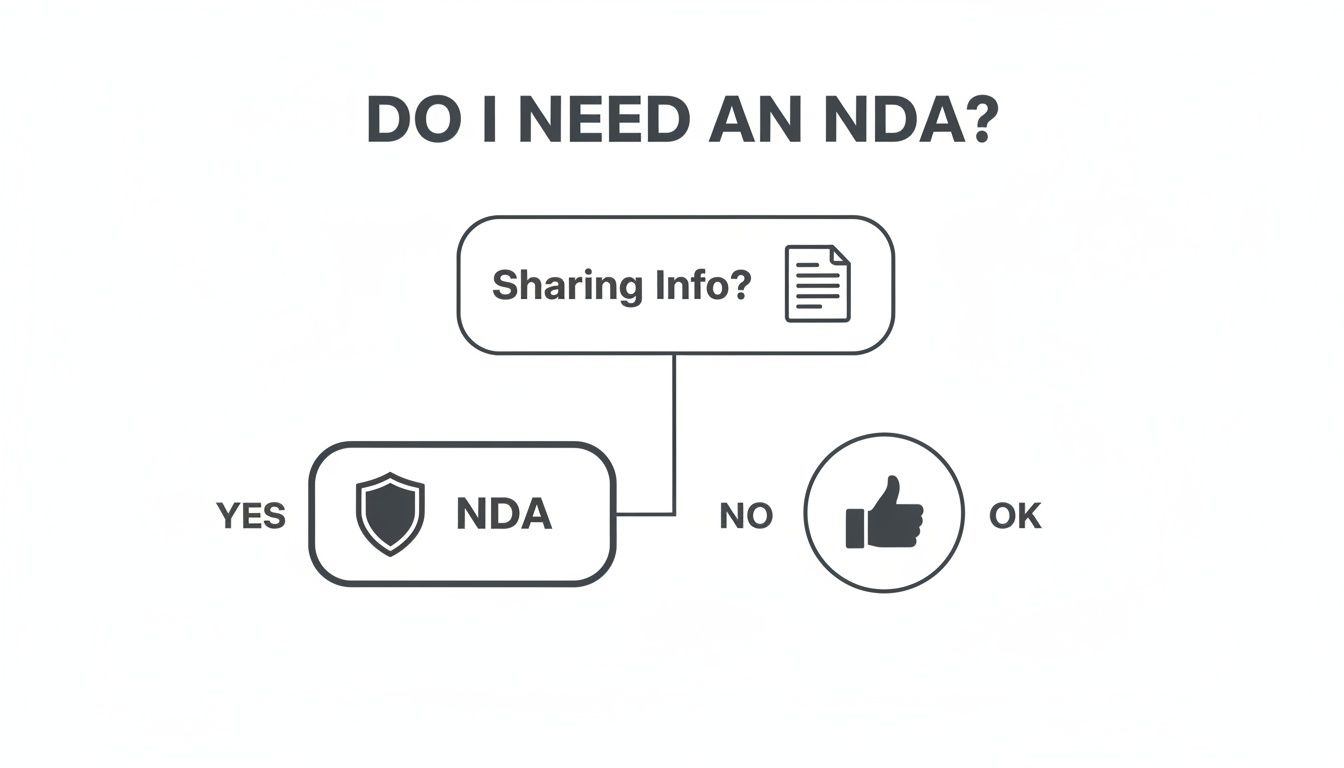
As the chart shows, the main reason to use a confidentiality agreement is simple: you're sharing sensitive information. Beyond these agreements, businesses often use other tools to protect data, like having a solid an online privacy policy agreement for customer information.
Your choice between a unilateral, mutual, or multilateral agreement comes down to how many people are in on the secret. For more specific situations, especially involving your team, it's worth learning about the non-disclosure agreement for employees. If you need to discuss your business law matter, contact Kons Law at (860) 920-5181.
Anatomy of an Ironclad Agreement
A confidentiality agreement is only as strong as the sum of its parts. Think of it like a well-built machine—if one component is weak or poorly designed, the entire structure can fail when you need it most. Getting these essential clauses right is the key to crafting a document that offers real, enforceable protection for your business's most sensitive information.
These clauses are the DNA of your agreement. They set the rules, draw the boundaries, and spell out the consequences if those lines are crossed. Ambiguity is the enemy here; vague language can create dangerous loopholes, rendering your agreement completely useless.
Defining What Is Confidential
The absolute heart of any NDA is the Definition of Confidential Information. This is where you get specific about what, exactly, the agreement is meant to protect. Being lazy or vague in this section is a critical, and common, mistake. You simply can't protect something you haven't clearly identified.
Your definition needs to be broad enough to cover all your assets but specific enough for a court to enforce. For instance, instead of just saying "business information," you should be listing items like:
- Financial data and internal projections
- Customer lists and specific contact information
- Marketing strategies and detailed business plans
- Proprietary software code and product schematics
- Trade secrets like manufacturing processes and chemical formulas
This level of detail slams the door on misinterpretation. It creates a bright line, telling the other party precisely what they are forbidden from sharing.
An NDA that's too broad or hazy can be tossed out by a court for being unreasonable. The goal isn't to lock down everything under the sun—it's to be precise and fair, clearly protecting what's yours without trying to restrict information that's already out in the wild.
Exclusions from Confidentiality
Just as critical as defining what is confidential is spelling out what is not. This is handled by the Exclusions clause, which prevents the agreement from overreaching. By carving out specific types of information that aren't protected, you make the contract fairer and, in turn, much more likely to be upheld by a judge.
Common exclusions you'll see are for information that:
- Was already public knowledge before you shared it.
- The receiving party already knew, and can prove it, before you signed the NDA.
- Becomes public knowledge later, but not because the receiver broke the rules.
- The receiving party develops on their own, without using any of your confidential information.
Term Duration and Obligations
Every promise of silence needs an expiration date. The Term or Duration clause establishes a clear timeframe for how long the duty of confidentiality lasts, which is often between three to five years. For highly sensitive information like trade secrets, however, some agreements might extend this protection indefinitely.
Next, the Obligations clause gets into the nitty-gritty of how the receiving party must protect your information. This usually means they have to treat it with the same level of care they use for their own secrets and limit access only to people who absolutely need to know. For new businesses, getting these obligations right is a crucial step in building a solid legal foundation. Using a good small business contract template can offer some great structural guidance.
Remedies for a Breach
Finally, what happens if things go wrong? The Remedies for Breach clause outlines the consequences. This is your game plan if someone leaks your information, often giving you the right to seek an injunction (a court order to stop the disclosure immediately) and sue for any financial damages the breach caused.
The importance of well-defined terms isn't just a local concern; it’s a global standard. A survey of international petroleum contracts, for instance, revealed common approaches to confidentiality. Brunei’s 2003 model agreement used a five-year term, while Cambodia’s 2004 model extended protections for two years after the main contract ended. These examples show just how critical it is to get the details right.
Avoiding Common Mistakes That Invalidate Agreements
A confidentiality agreement that can't hold up in court gives you a false sense of security—and that can be far more dangerous than having no agreement at all. One seemingly small mistake can make the entire document unenforceable, leaving your most sensitive business data completely exposed.
The first step toward creating a real legal shield is understanding the common traps that businesses fall into.
Many unenforceable NDAs fail for a simple reason: they’re just too aggressive. Courts are often skeptical of contracts that feel lopsided or unreasonably restrict a person's ability to earn a living. When an agreement goes too far beyond its core purpose of protecting specific, legitimate secrets, its legal footing gets very shaky.
Defining Information Too Broadly
One of the most common errors we see is a definition of "Confidential Information" that's incredibly vague or tries to cover everything under the sun. If you attempt to label every single piece of information related to your business as confidential, a court will likely see it as an unfair attempt to stifle competition, not protect actual secrets.
An agreement that tries to protect information already floating around in the public domain or just general industry know-how is almost guaranteed to be struck down. The key here is specificity and reasonableness. Your definition has to be precise enough to pinpoint what is truly proprietary and valuable to your business, not just a blanket claim on every conversation.
Setting an Unreasonable Time Limit
Another critical mistake is setting a time limit for confidentiality that's indefinite or just way too long. It might feel safer to demand silence forever, but most courts won't enforce that. The term of confidentiality must be reasonable and tied directly to the useful life of the information being protected.
A typical timeframe is somewhere between three to five years. Now, for true trade secrets—like a proprietary formula for a product—a longer or even indefinite term might be perfectly appropriate. But for things like general business plans or last year's financial projections, a perpetual gag order is usually seen as an unreasonable restraint on trade.
Accidentally Creating an Illegal Non-Compete
This is probably the most serious pitfall: drafting a confidentiality agreement so broadly that it ends up acting as a non-compete clause in disguise. This is a huge area of legal scrutiny right now. An agreement that stops a former employee from using any information they learned on the job, including general skills and industry knowledge, can easily be interpreted as an illegal restriction on their ability to find new work.
A landmark 2022 study highlighted this exact problem, finding that many modern NDAs try to protect far more than just traditional trade secrets. This trend has pushed courts in multiple states, including legal trendsetters like California, to strike down NDAs that function as non-competes, especially with employees. The implications for businesses here in Connecticut are significant, as our courts are also refusing to enforce agreements that overreach. You can explore the full analysis of how these agreements can act like non-competes and why courts are pushing back.
To stay on the right side of the line, your agreement must be laser-focused on protecting specific, defined proprietary information. It should never prevent someone from using the general knowledge and experience they gained while working with you.
If you want to discuss your business law matter, contact Kons Law at (860) 920-5181.
Knowing When You Need a Business Lawyer
It's tempting to grab a free confidentiality agreement template online. They seem quick, easy, and, best of all, free. But that convenience can create a false sense of security, leaving your most valuable information dangerously exposed.
Knowing when to skip the template and call an attorney isn't just a legal question—it's a critical business decision. A boilerplate document simply can't account for the unique risks and nuances of your specific situation.
High-Stakes Scenarios Demanding Legal Counsel
A generic agreement is a one-size-fits-all solution, and in high-stakes deals, "one size" rarely fits anyone well. Think of it this way: you wouldn't use a generic key for a high-security vault. Your confidential information deserves the same level of custom protection.
You should always bring in legal counsel when the stakes are high. Here are a few situations where an attorney's guidance is non-negotiable:
- Mergers and Acquisitions: When you're buying or selling a business, the amount of sensitive financial and operational data on the table is staggering. An ironclad, custom-drafted agreement is essential to protect both sides.
- Highly Valuable Trade Secrets: Is your competitive edge tied to a secret formula, a proprietary process, or a unique algorithm? A lawyer can build maximum, multi-layered protection into your NDA to safeguard the core of your business.
- International Partnerships: Doing business across borders introduces a whole new world of complexity. A template won't address critical issues like which country's laws apply or how you would enforce the agreement overseas.
- Complex Employee Agreements: For key executives or engineers with access to your crown jewels, a specialized NDA is a must. A lawyer will draft terms that are enforceable without illegally handcuffing an employee's future career prospects—a balance that is tricky to get right.

An experienced attorney provides far more than just a document; they offer strategic advice tailored to your goals. They ensure your agreement is robust, enforceable, and perfectly aligned with your business objectives. To better understand the different roles an attorney can play, you can learn more about what a business lawyer does in our detailed guide.
Investing in legal counsel upfront is a proactive move. It's about preventing costly, time-consuming disputes down the road and securing your company's future. If you need to discuss a business law matter, contact Kons Law at (860) 920-5181.
Building a Strong Legal Foundation for Your Business
A thoughtfully prepared confidentiality agreement is more than just a legal document; it's a foundational piece of your business's security. It's the essential step you take to shield the very ideas and information that set you apart from the competition. By understanding the nuances between different NDAs, ensuring key clauses are included, and steering clear of common legal traps, you give your business the freedom to innovate and grow securely.
Don't leave your company's most valuable assets exposed. It's critical to see legal advice not as an expense, but as a strategic investment in your long-term stability and success. This mindset helps you get ahead of potentially costly disputes, stopping them before they even start.
For a truly robust legal framework, it's also wise to look at broader compliance standards. Many of these, like those outlined in a practical SOC 2 compliance checklist, have explicit requirements for protecting confidential information.
Ultimately, a strong agreement is about fostering a secure environment for collaboration and innovation. When you know your intellectual property is protected, you can operate with the confidence needed to push your business forward.
If you need to discuss a business law matter or want to ensure your company has the right legal safeguards in place, contact Kons Law at (860) 920-5181. Taking the right legal steps today is how you secure your company’s future.
Common Questions About Confidentiality Agreements
When you're dealing with confidentiality agreements, a lot of questions can pop up. Let's tackle some of the most common ones business owners ask when trying to keep their valuable information under wraps.
How Long Should a Confidentiality Agreement Last?
This is a big one. The duration of an NDA needs to be reasonable, or a court might not enforce it. A typical timeframe is somewhere between three to five years, which is generally seen as long enough to protect sensitive business information without tying someone's hands forever.
Now, there are exceptions. Indefinite terms usually get a skeptical look from judges and can get the whole agreement thrown out. The main exception is for true trade secrets—think of a secret recipe or a one-of-a-kind manufacturing process. In those rare cases, where the secret needs to last forever, a perpetual term can be justified.
Can I Just Use a Free Online Template?
It’s tempting to grab a free template online—it seems fast and cheap. But this is one of those areas where you truly get what you pay for, and the risks are significant. These one-size-fits-all documents are not built for your specific business, your unique information, or Connecticut law.
A generic template often fails to:
- Properly define what’s actually confidential for your business.
- Comply with specific state laws, which could make it useless in a Connecticut court.
- Account for the specific risks tied to your industry or the deal you’re making.
Relying on a template can give you a false sense of security, leaving you with a piece of paper that won’t protect you when you actually need it to.
What’s the Difference Between an NDA and a Non-Compete?
This is a frequent point of confusion, but they serve two very different purposes. At its core, a confidentiality agreement (NDA) protects information, while a non-compete agreement restricts future work.
Think of it this way: an NDA stops someone from spilling your secrets. A non-compete, on the other hand, is meant to stop a former employee from taking a job with a direct competitor for a set amount of time in a specific area. Their goals are completely different, and mixing them up can result in a contract that a court won't enforce.
What Happens If Someone Breaks the Agreement?
When someone violates a signed confidentiality agreement, it’s a breach of contract. This gives you legal options to go to court and seek remedies. The most common actions include:
- An Injunction: This is a court order that forces the person to immediately stop sharing the information.
- Monetary Damages: You can also sue for financial compensation to cover any losses your business suffered because of the leak.
If you want to discuss your business law matter, contact Kons Law at (860) 920-5181.
