You found the space that fits your business. The location works, the layout is close, and the rent quote seems manageable. Then the landlord sends a lease that runs dozens of pages, loaded with defined terms, expense pass-throughs, default clauses, insurance requirements, and remedies that don't look negotiable until you read them carefully.
That document is not just a permission slip to occupy space. It's a long-term operating contract for your business. It affects cash flow, buildout costs, staffing decisions, relocation flexibility, and what happens if the relationship goes bad.
Under Connecticut commercial lease laws, that matters more than many business owners expect. Commercial tenants in Connecticut usually can't rely on the kind of built-in statutory protections that people associate with residential leasing. In practical terms, the lease often is the law of the deal. If a protection is missing, vague, or drafted in the landlord's favor, you may be stuck with it for years.
Your Essential Guide to Connecticut Commercial Leases
Many owners first focus on the visible business terms. Monthly rent. Square footage. Parking. Signage. Possession date. Those matter, but they rarely tell the full story. The larger risk usually sits in the clauses that determine who pays for taxes, insurance, maintenance, common-area costs, repairs, and legal fees.
A Connecticut commercial lease also controls how much freedom you'll have once your business changes. Can you assign the lease if you sell the company? Can you sublet if you shrink? Do you get renewal rights at a defined rate or only if the landlord agrees later? Can you build out the space without delays tied to approval language that gives the landlord broad discretion?
For new owners, lease review should happen alongside broader planning for entity structure, operations, and risk allocation. Businesses thinking through those early decisions often benefit from practical guidance on starting a business in Connecticut before they lock themselves into a long occupancy commitment.
Why the lease deserves business-level attention
A commercial lease can look routine because it's common. It isn't routine in consequence. A weak clause on operating expenses can change occupancy cost every year. A weak assignment clause can interfere with a future sale. A weak repair clause can leave you paying for conditions you assumed were the landlord's responsibility.
Practical rule: Don't evaluate a commercial lease by base rent alone. Evaluate the total business risk it creates.
What small and mid-sized businesses often miss
A few issues repeatedly create problems:
- Expense pass-throughs: Base rent may look competitive, but additional rent can shift major operating costs to the tenant.
- Buildout language: Tenant improvement work often gets delayed when approval, permitting, and reimbursement terms are vague.
- Use restrictions: A narrow permitted-use clause can interfere with future revenue lines.
- Default provisions: Short cure periods and broad default language can turn minor problems into a significant advantage for the landlord.
The businesses that handle leases best usually do one thing early. They treat lease negotiation as risk management, not paperwork.
The Legal Framework Contract Law vs Statutory Rules
Connecticut commercial leasing starts from a simple premise. Adults in business can make their own deal. That sounds efficient, and often it is. It also means the lease text carries unusual weight because the state gives commercial landlords and tenants broad room to allocate risk by contract.
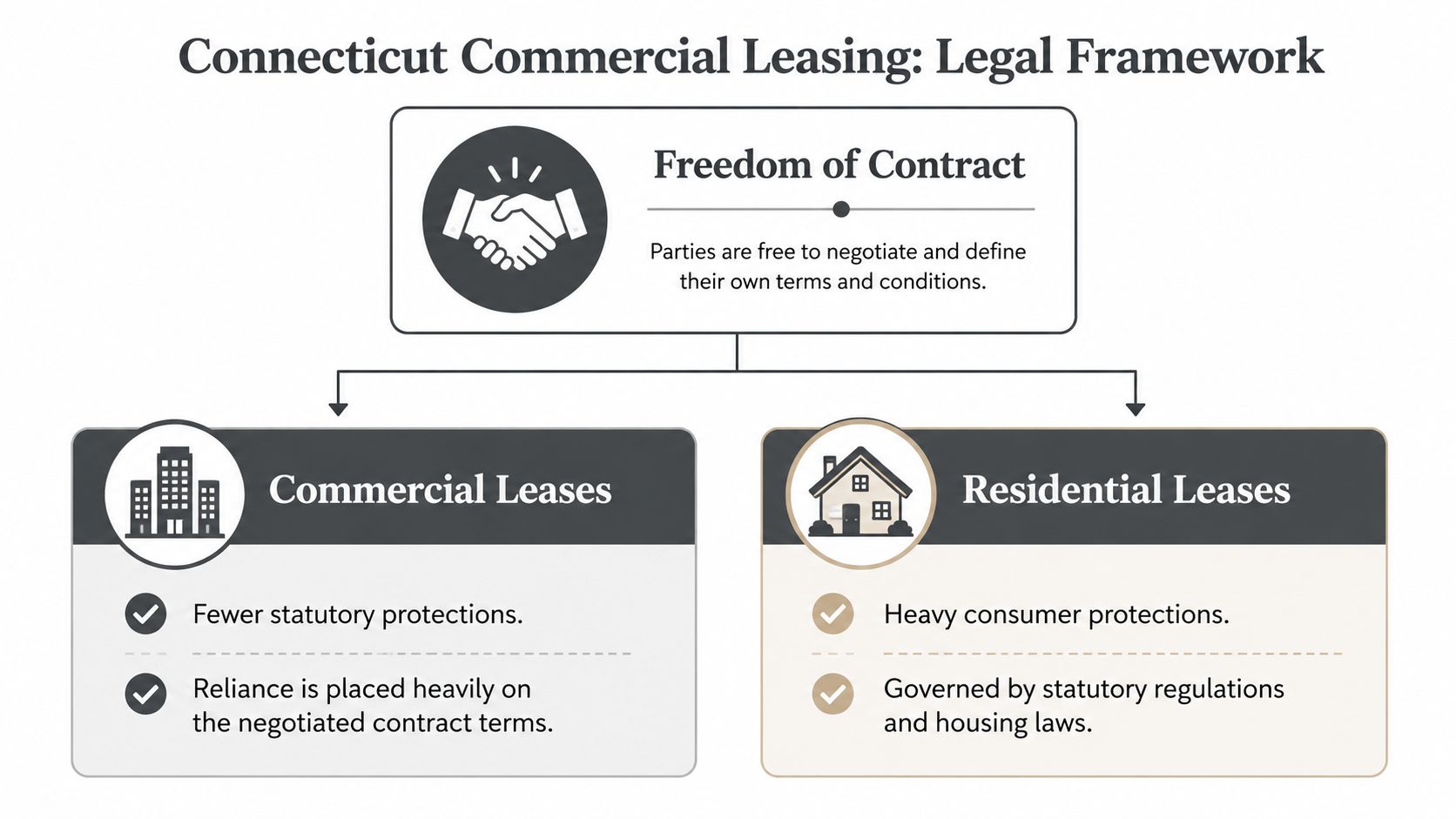
According to a Connecticut leasing guide, the state does not impose a statutory maximum term on a commercial lease, but leases lasting 99 years or more are subject to conveyance tax rules. The same guide states that Connecticut does not require statutory disclosures in commercial leases and does not recognize an implied warranty of fitness for intended use in commercial leases (Connecticut real-estate leasing guide).
That last point is a major dividing line between commercial and residential leasing. In a commercial setting, tenants generally shouldn't assume the law fills in missing protections for the condition or suitability of the premises. If your business depends on ventilation, power capacity, delivery access, drainage, parking ratios, or code-compliant buildout, the lease should address those points directly.
Commercial leases are negotiated documents first
Business owners sometimes ask whether a landlord “has to” include a fair repair standard, a broad use clause, or a workable renewal option. Often, the answer is no. The stronger question is whether the landlord will agree after the issue is framed properly.
That's why even general overviews of landlord-tenant laws in Connecticut should be treated as background, not a substitute for lease-specific review. Commercial leasing operates on negotiated allocation of responsibility.
Where long-term risk hides
The longer the lease, the more careful the drafting should be. Long-duration deals magnify small wording choices. A vague tax clause may not matter much in a short commitment. In a long lease, it can become a recurring budgeting problem. The same is true for renewal mechanics, exclusivity rights, casualty language, and maintenance obligations.
Commercial tenants usually have more leverage before signing than after opening for business.
For small and mid-sized businesses, the practical lesson is straightforward. Under Connecticut commercial lease laws, you should assume the document is your main protection. If something matters to operations, cost control, or exit flexibility, it belongs in the lease.
Decoding Key Commercial Lease Provisions and Structures
Connecticut's commercial leasing market is flexible by design. IBISWorld identifies a standalone Commercial Leasing in Connecticut industry and notes that a lease may be structured as a gross, modified gross, net, percentage, or ground lease, with cost allocation changing depending on the form. It also notes that two properties with the same base rent can have materially different total occupancy costs because taxes, insurance, and maintenance may be allocated differently (IBISWorld on Commercial Leasing in Connecticut).
That's why the phrase “rent is $X per square foot” doesn't tell you enough. You need to know what's included, what's excluded, and what can increase over time.
Commercial lease types at a glance
| Expense | Gross Lease | Modified Gross Lease | Triple Net (NNN) Lease |
|---|---|---|---|
| Base rent | Usually includes most operating costs | Base rent plus some shared costs | Lower base rent, with more costs passed through |
| Property taxes | Usually landlord pays | Often shared or partially passed through | Usually tenant pays or reimburses share |
| Insurance | Usually landlord pays | Often shared in part | Usually tenant pays or reimburses share |
| Common area maintenance | Usually landlord pays | Often shared | Usually tenant pays or reimburses share |
| Utilities | Varies by lease | Often partly tenant-paid | Often tenant-paid |
| Repair exposure | Depends on wording | Depends on wording | Often broader tenant responsibility |
The table gives the general pattern, but don't assume labels control everything. A lease can call itself “NNN” and still carve out some landlord obligations. A “gross” lease may still pass through utilities, HVAC service, after-hours use, or capital-related costs under certain circumstances.
Clauses that change the economics fast
Small businesses often focus on annual rent increases. Those matter, but several other clauses may hit harder.
- CAM language: Common area maintenance charges need definition. Ask what counts as CAM, what is excluded, whether management fees are capped, and whether capital expenditures can be passed through.
- Tax allocation: Clarify whether your share is based on rentable area, usable area, or another formula. That definition affects cost.
- Insurance pass-throughs: Confirm whether the landlord can charge for all insurance or only specified coverage connected to the property.
- Tenant improvement terms: Spell out who designs, who approves, who owns the plans, and when any allowance is paid.
A useful comparison point for shared-occupancy risk is how parties allocate responsibilities in co-tenancy agreements. The same discipline applies in a lease. Shared costs should never be left to broad assumptions.
What usually works in negotiation
The best tenant revisions are specific and operational. Instead of asking for “fair CAM,” ask for exclusions. Instead of asking for “reasonable rent increases,” ask for a defined method. Instead of assuming the landlord will maintain major systems, put the responsibility in writing and identify the systems by name.
A lease form is only a starting draft. Its business impact comes from the details inside the expense and responsibility clauses.
Essential Legal Formalities and Tenant Protections
A signed commercial lease can still leave a tenant exposed if the formalities are wrong. That issue catches business owners off guard because they assume signature alone equals security. In Connecticut, that isn't enough when the lease term goes beyond one year and third-party rights become relevant.
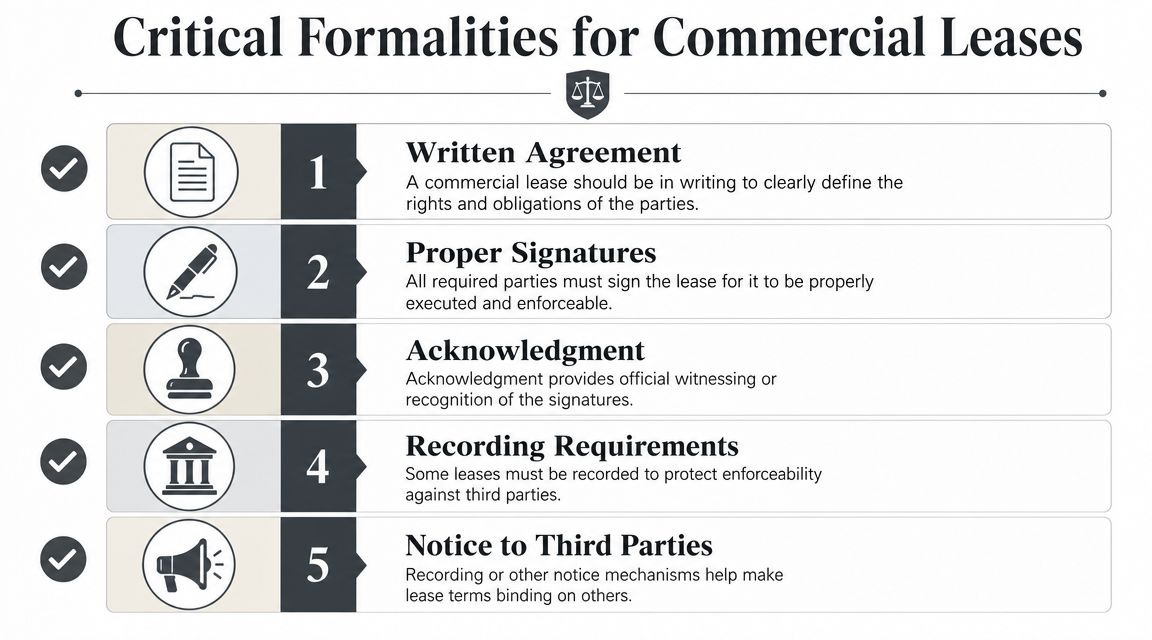
For a Connecticut commercial lease term exceeding one year to be enforceable against third parties, it must be in writing, executed, witnessed, acknowledged, and recorded. If it is not recorded, the lease may bind the original landlord and tenant but may offer no protection if the property is sold to someone else (Connecticut commercial lease formalities).
That rule has practical force. If your business is investing in signage, equipment installation, tenant improvements, or customer goodwill at a specific location, you want your lease rights protected against a later transfer of the building.
Recording is not a technicality
Many tenants treat recording as the landlord's concern. It isn't. It directly affects your position if ownership changes or if another party later disputes your rights.
A long-term tenant with renewal options, expansion rights, or a purchase option has even more at stake. Rights like those are much more valuable when the legal formalities support them. A good negotiated clause can lose practical force if the lease isn't handled correctly after signing.
Protections worth negotiating into the document
The strongest tenant protections are often simple but carefully drafted:
- Renewal options: State when notice must be given and how rent will be set during the renewal term.
- Expansion or contraction rights: Important if your staffing needs may change.
- Right of first offer or refusal: Useful when neighboring space may become available.
- Landlord work obligations: If the landlord must deliver improvements or building systems in working order, describe them precisely.
- Estoppel and SNDA terms: These clauses often affect financing, priority, and occupancy stability.
Tenants also sometimes overlook related financial protections in other contexts, including help with security deposits in CT. While commercial leasing differs from residential rules, the broader lesson is the same. Rights tied to money and possession should be documented with precision.
If your lease term is longer than a year, proper execution and recording should be on your checklist before you spend money on the space.
Navigating Assignment Insurance and Repair Obligations
The rent provisions may get the most attention, but day-to-day risk usually lives elsewhere. Assignment, subletting, insurance, indemnity, and repair clauses determine whether your business can adapt and who pays when something goes wrong.
Assignment and subletting affect your exit options
An assignment transfers the tenant's full leasehold interest to another party. A sublease keeps the original tenant in place while allowing another occupant to use some or all of the space. The distinction matters because the lease may treat them differently.
If you might sell the business, merge, downsize, or move operations, a rigid anti-assignment clause can become a real obstacle. The most landlord-favorable forms let the landlord block a transfer in its sole discretion, recapture the space, or collect excess profits from a sublease. Those terms deserve review.
What works better for tenants is language that permits transfers subject to reasonable conditions, especially for affiliate transactions, internal reorganizations, or a sale of substantially all business assets. Landlords still want control over who occupies the property, and that's understandable. The goal is to narrow discretion so it can't be used unpredictably.
Insurance and indemnity decide who writes the check
Insurance requirements are often more detailed than tenants expect. The lease may require commercial general liability coverage, property coverage for the tenant's own property, business interruption coverage, and landlord-specific endorsements. The right insurance package depends on the business, the premises, and the lease language.
For business owners trying to understand how liability coverage and indemnity interact, a plain-language professional indemnity guide can help frame the issue. The lease, however, controls the legal allocation between landlord and tenant, so policy review and lease review should happen together.
Repairs are never “standard” unless the lease says so
One of the most expensive mistakes is assuming structural or major-system repairs are automatically the landlord's responsibility. Sometimes they are. Sometimes they aren't. A roof leak, slab issue, HVAC failure, plumbing problem, or storefront defect can land on either side depending on the document.
Review these provisions closely:
- Maintenance standard: Does the tenant maintain only the interior, or also systems serving only the premises?
- Capital replacements: Can the landlord pass through major replacement costs as operating expenses?
- Compliance duties: Who pays if code compliance work is triggered by your use, your buildout, or a general building condition?
- Surrender condition: Are you required to remove alterations or restore the premises at lease end?
A strong commercial lease says who handles each category, not just that the tenant must keep the space in “good order.”
Handling Defaults Disputes and Landlord Tenant Remedies
Defaults rarely begin with a dramatic event. More often, they start with a missed payment, a disputed charge, delayed insurance certificate, unapproved alteration, or failure to meet an operating covenant. Then the notices begin. Cure periods matter. So does the landlord's choice of remedy.
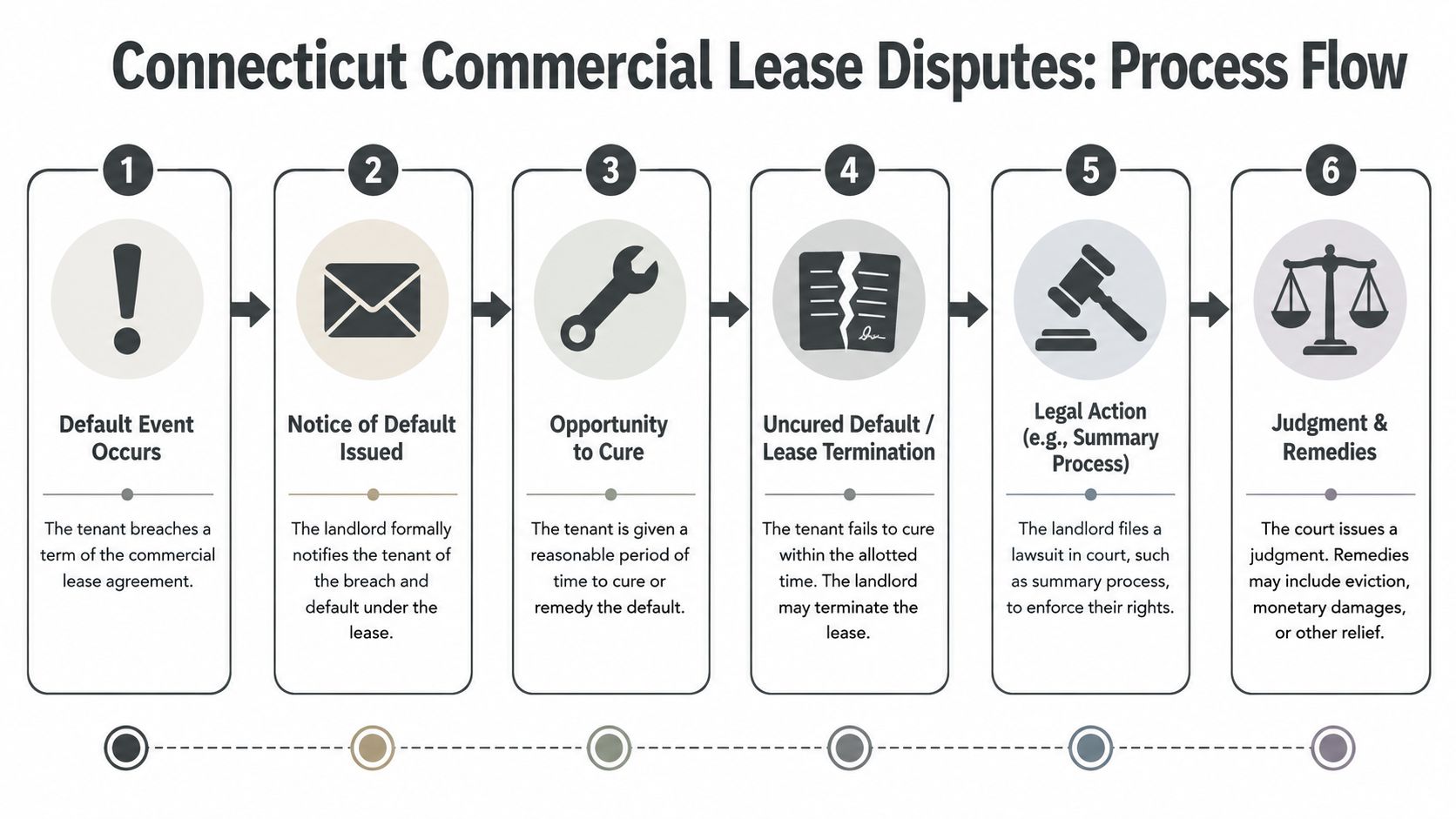
Under Connecticut guidance, a landlord generally has two paths after a tenant breach. The landlord may terminate and sue for damages, in which case the landlord must mitigate damages, or the landlord may refuse surrender and sue for rent as it comes due, in which case there is no duty to mitigate. Courts are generally more comfortable with a full monetary judgment when the remaining lease term is two years or less, and more cautious when more than two years remain (damages for breach of commercial lease under Connecticut law).
How this plays out in real business terms
Suppose a tenant's sales fall, and the tenant vacates early without a negotiated exit. The landlord may treat that move as a surrender and termination, or may refuse to accept surrender and continue charging rent under the lease terms. That choice affects mitigation duties and litigation strategy.
For the tenant, this means “walking away” is rarely a clean solution. Vacating the premises doesn't necessarily end liability. For the landlord, preserving remedies often depends on taking consistent positions in notices, communications, and reletting efforts.
The legal and financial result after default often turns on the lease language and the time left on the term, not just on whether rent was missed.
Clauses that shape the dispute before it starts
Some default clauses are manageable. Others are traps. Review these carefully before signing:
- Notice and cure periods: Late fees and default interest are one issue. The larger issue is whether you have enough time to fix a problem before remedies accelerate.
- Cross-default provisions: A default under one agreement may trigger default under another related document.
- Confession-style language or broad fee-shifting: These can increase pressure quickly if a dispute escalates.
- Acceleration wording: If the lease allows aggressive recovery after default, exposure can rise fast.
What usually does not work
Silence. Delay. Informal side promises. Many lease disputes become expensive because one side relies on oral assurances that never make it into a written amendment or waiver.
If trouble is coming, document the issue early. Preserve notices. Propose a written workout if needed. A short deferral agreement, temporary rent structure, or surrender arrangement can be far cheaper than litigating a poorly documented breakdown.
Negotiation Strategy and When to Seek Legal Counsel
The businesses that negotiate well usually don't try to win every point. They identify the clauses that affect cash flow, control, and exit options, then push for clarity where it matters most.
A practical lease negotiation checklist
Start with the provisions that shape the business case:
- Define occupancy cost clearly: Ask what counts as additional rent, what expenses are excluded, and how your share is calculated.
- Tighten CAM language: Cap what can be passed through where possible, and require transparency in reconciliations.
- Lock in renewal mechanics: Don't leave future rent entirely to later agreement if renewal matters to your business model.
- Clarify buildout obligations: State who performs work, who approves plans, and when possession and rent commencement occur.
- Preserve transfer flexibility: Assignment and subletting language should account for sale, restructuring, and growth changes.
- Limit repair surprises: Identify responsibility for structure, roof, slab, HVAC, plumbing, and code-triggered work.
- Review default provisions closely: Cure periods, legal fees, and landlord remedies deserve line-by-line attention.
- Handle post-signing formalities: Make sure execution and recording steps match the legal requirements for the term involved.
A helpful companion for business owners preparing for that process is this guide on how to negotiate a commercial lease. The most effective negotiations usually start before the first full draft is circulated, when the parties are still trading business terms.
When legal review adds the most value
Legal review is most useful before the tenant has weakened their negotiating position on nonbinding discussions and before money is committed to design, contractors, or moving plans. It also matters when the lease includes unusual features such as a ground lease, major tenant improvement obligations, exclusivity language, or a long term that makes small drafting errors more expensive over time.
For small and mid-sized companies, the central lesson of Connecticut commercial lease laws is simple. The lease itself is your main source of protection. If a right matters, negotiate it. If a cost matters, define it. If a future option matters, document it now rather than hoping the other side will be cooperative later.
A commercial lease can support growth, but only if the document matches how the business operates.
If you want to discuss your business law matter, contact Kons Law at (860) 920-5181.
