Corporate and business law is the rulebook for how a company is built, how it runs, and how it grows. It's far more than just a list of compliance checkboxes; it's the very foundation that supports everything you do, from hiring your team to sealing a major deal.
Why Corporate and Business Law Is Your Strategic Blueprint
Think about what it takes to build a house. You wouldn't just start throwing up walls without a detailed architectural plan. That would be a recipe for disaster—wasted materials, a shaky structure, and a final product that doesn't work. Corporate and business law is that essential blueprint for your company, making sure every piece fits together and the entire enterprise is built to last.
This legal blueprint has two distinct, yet deeply connected, parts.
First, you have corporate law. This is the framing and foundation of the house itself. It's all about the internal mechanics of your company: how it’s formed, what the duties of directors and shareholders are, and the ground rules for making big decisions.
Then there's business law. This governs all the activity that happens in and around the house you’ve built. It's a much broader field that covers your company's interactions with the outside world—things like drafting contracts, managing employees, and navigating business transactions.
Distinguishing Corporate Law from Business Law
It's easy to use these terms interchangeably, but knowing the difference is key to running your business effectively. Both are crucial for stability and growth, but they have different areas of focus.
-
Corporate Law Focus: This is all about the legal entity itself. Think entity formation (like an LLC or corporation), establishing corporate governance rules, managing shareholder agreements, and handling complex moves like mergers and acquisitions. It’s about making sure the company is a legally sound and well-managed organization from the inside out.
-
Business Law Focus: This covers the massive range of laws that regulate your commercial activities. We're talking about contract law, employment law, intellectual property, and all kinds of regulatory compliance. Basically, if it involves a commercial transaction or relationship, it falls under the business law umbrella.
When you get a solid handle on both, legal requirements stop being a burden and start becoming a strategic advantage. For instance, a well-structured corporate entity can shield your personal assets from business debts. A meticulously drafted contract can save you from a costly dispute down the road. The expertise involved is extensive, and understanding what a business lawyer does can really clarify how these pieces all fit together.
Turning Legal Requirements into a Competitive Edge
The real power comes from a mindset shift: stop seeing the law as a set of restrictive rules and start seeing it as a strategic tool. A proactive legal strategy doesn’t just put out fires; it creates opportunities.
By establishing a robust legal foundation from day one, you build a resilient company that can weather challenges and seize opportunities for growth. This proactive approach builds investor confidence, clarifies stakeholder relationships, and cuts down on operational friction.
Ultimately, this legal blueprint provides the stability and clarity you need to pursue your vision with confidence. Every decision, from your first hire to expanding into a new market, rests on this foundation. Without it, you’re not just risking legal trouble—you’re building your entire business on shaky ground.
Choosing the Right Business Structure
One of the very first, and most critical, decisions you'll make as a business owner is choosing your legal structure. This isn't just about paperwork or checking a box on a form. This decision sends ripples through everything you do—from how you pay taxes to your personal liability if the business owes a debt.
Think of it like building a house. A sole proprietorship is like a tent: easy and fast to set up, but it offers little protection from the elements (or lawsuits). A partnership is a duplex, where you share the space and responsibility. An LLC or corporation? That’s more like a brick house—it takes more work to build, but it provides a solid wall of protection between your business and your personal life. The right choice depends entirely on your needs and what you're building.
Understanding Your Primary Options
The most common business structures each strike a different balance between protection, complexity, and taxes. A huge part of what a business lawyer does is walk founders through these trade-offs, helping them pick the entity that truly fits their vision and comfort level with risk.
- Sole Proprietorship: This is the default for anyone doing business on their own. It’s the simplest path forward, but it comes with a major catch: there is zero liability protection. Legally, you and the business are one and the same, meaning your personal assets are on the line.
- Partnership: When two or more people team up to run a business, a partnership is the typical starting point. Like a sole proprietorship, it's fairly easy to start, but partners are usually personally liable for all business debts—even those created by their other partners.
- Limited Liability Company (LLC): The LLC has become a go-to for many new businesses, and for good reason. It creates a legal shield, separating your personal assets from the company's debts, much like a corporation. At the same time, it offers more flexibility in how it's managed and often has simpler tax requirements.
- Corporation (S Corp & C Corp): Corporations are the most formal structure, with strict rules for things like meetings and record-keeping. They offer the strongest liability protection but also come with the most administrative work. The main difference between an S Corp and a C Corp boils down to how they are taxed.
This infographic does a great job of showing how these structural decisions fit into the bigger legal picture.
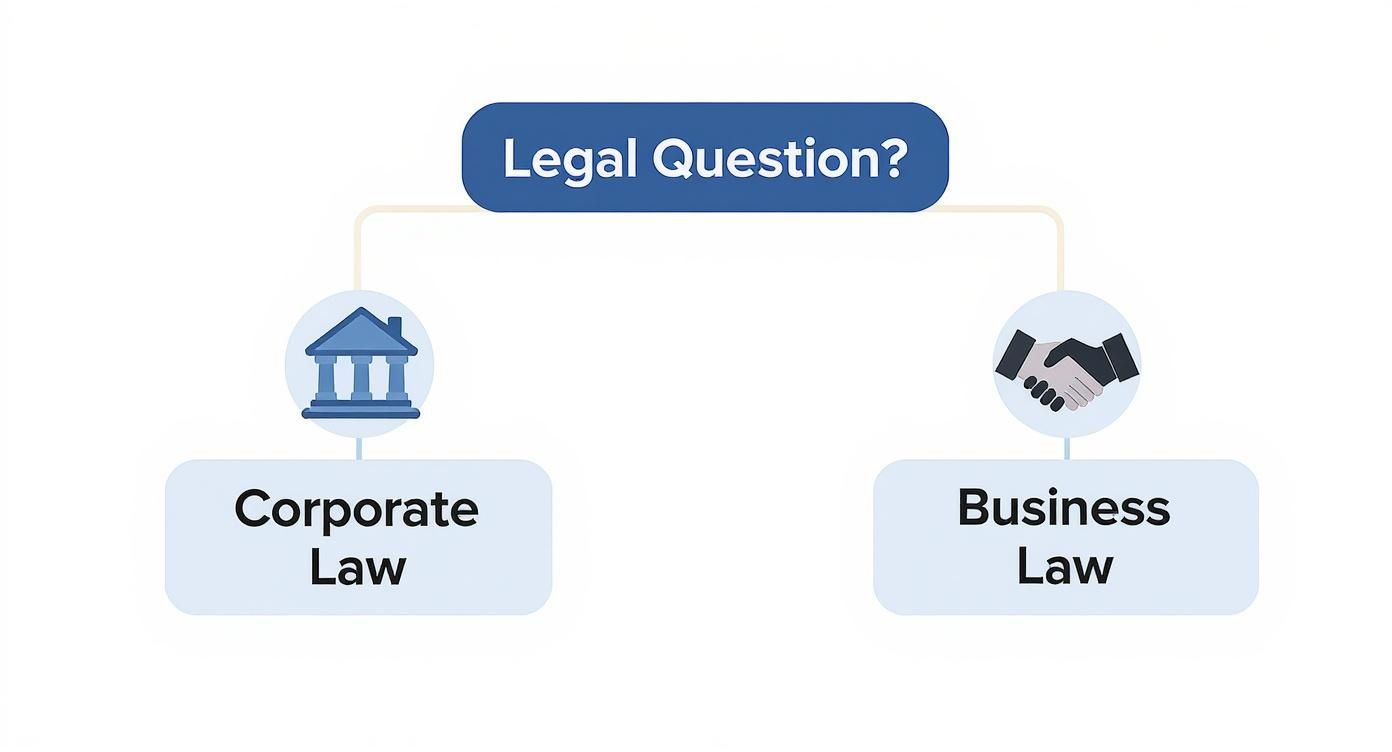
As you can see, figuring out your company's structure is a core corporate law matter, while the day-to-day operations fall more broadly under business law.
Comparison of Business Entity Types
To really get a feel for how these entities work in the real world, it helps to see them side-by-side. The choice you make directly impacts your personal liability, how you're taxed, and the amount of administrative upkeep required. Let's break down the key differences in a simple table.
| Feature | Sole Proprietorship | Partnership | LLC | S Corporation | C Corporation |
|---|---|---|---|---|---|
| Personal Liability | Unlimited personal liability. Your personal assets are at risk. | Unlimited personal liability, often for all partners' actions. | Protects personal assets from business debts and lawsuits. | Protects personal assets. | Strongest protection for personal assets from business liabilities. |
| Taxation | Profits/losses reported on your personal tax return (pass-through). | Profits/losses passed through to partners' personal returns. | Flexible. Can be taxed as a sole proprietorship, partnership, S Corp, or C Corp. | Profits/losses passed through to shareholders' personal returns. | The corporation pays taxes on profits, and shareholders pay taxes on dividends (double taxation). |
| Management & Admin | Very simple. No formal requirements. | Simple, but a partnership agreement is highly recommended. | Moderate. Requires an operating agreement and some state filings. | More complex. Requires a board of directors, bylaws, and regular meetings. | Most complex. Strict requirements for records, meetings, and reporting. |
| Best For... | Freelancers, consultants, and single-owner small businesses. | Businesses owned by two or more people who trust each other implicitly. | Small business owners wanting liability protection and tax flexibility. | Small businesses wanting liability protection with pass-through taxation. | Businesses planning to raise significant capital from investors. |
While you can change your business structure down the road, it's often a complicated and expensive process. It's far better to get it right from the start with guidance you can trust.
Ultimately, the best structure comes down to your unique situation. Are you a solo consultant? A founding team? A startup with big plans to seek venture capital? Each of these paths points toward a different legal setup. Making the right choice lays a solid foundation, helps you avoid future headaches, and sets your business up for long-term success. If you want to discuss your business law matter, contact Kons Law at (860) 920-5181.
Navigating Essential Business Contracts and Transactions
Contracts are the absolute backbone of your business. Think of them as the legally enforceable promises that map out your relationships with everyone you work with—customers, suppliers, partners, you name it. They’re far more than just a formality; they turn a handshake deal into a clear, predictable outcome where everyone knows exactly what’s expected of them.
At its core, every single contract—from a simple invoice to a complex multi-page agreement—boils down to three key ingredients. Getting these right is the first real step to mastering business law.
- Offer: One person puts a specific proposal on the table. For instance, a web designer offers to build a five-page website for $5,000.
- Acceptance: The other person agrees to those exact terms, no strings attached. The client says "yes" to the $5,000 price for the five-page website.
- Consideration: This is the "what's in it for me" part. Something of value has to be exchanged. The designer gives their time and expertise, and the client provides the payment.
If you're missing any one of these, you don't really have a legally binding agreement. It's just a conversation. This simple foundation is what underpins everything from hiring your first employee to leasing an office.
From Daily Agreements to High-Stakes Deals
While those foundational contracts keep the daily gears turning, corporate and business law also governs the big, complex transactions that can literally define a company's future. We’re talking about things like mergers and acquisitions, which demand a much more intense level of legal scrutiny.
You can see just how important this kind of work is by looking at the legal industry itself. The third quarter of 2025 saw a massive surge in demand for legal help, and it was transactional work leading the way. Mergers and acquisitions (M&A) activity shot up by 7.6%, and corporate law work as a whole grew by 4.3%—one of the busiest periods seen in the last two decades.
These deals aren’t simple. They involve tough negotiations, deep-dive due diligence, and incredibly detailed legal documents designed to manage risk and ensure everything changes hands smoothly.

Avoiding Common Contractual Pitfalls
Believe it or not, a badly written contract can be even worse than having no contract at all. It opens the door to confusion, arguments, and can leave your business wide open to serious financial risks. Getting a legal review ahead of time helps you sidestep some common—and costly—mistakes.
A well-crafted contract is really a risk management tool. It thinks about what could go wrong ahead of time and gives you a clear roadmap for how to handle it, saving you a world of time, money, and stress down the line.
Some of the most common traps we see include:
- Vague or Ambiguous Terms: Phrases like "reasonable efforts" or "in a timely manner" sound good, but they can mean completely different things to different people. A solid contract uses precise, measurable language.
- Weak Termination Clauses: Your agreement has to spell out exactly how and when either party can walk away—and what happens when they do.
- Missing a Dispute Resolution Clause: Deciding before there's a problem how you'll handle disagreements (like through mediation or arbitration) can stop a small issue from spiraling into a full-blown, expensive lawsuit.
Before a major deal gets underway, the parties often use a preliminary document to sketch out the basic terms. To get a better handle on this critical first step, you can read our guide on what a letter of intent is and how it works.
Ultimately, proactive contract management is one of the smartest things you can do to protect your assets and make sure your agreements hold up when it counts. If you want to discuss your business law matter, contact Kons Law at (860) 920-5181.
Staying Ahead of the Curve: Regulatory and Corporate Compliance
Running a business means navigating a pretty complex maze of rules. Think of it like a building code for your company—just as a house needs the right plumbing, wiring, and structural supports to be safe and legal, your business has to follow specific legal standards to operate. Getting this right isn't just about dodging fines; it’s about building a solid reputation and ensuring your company is built to last.
This web of rules touches everything. You've got federal labor laws dictating how you pay people, state privacy laws governing customer data, and even local zoning ordinances telling you where you can set up shop. A good corporate and business law partner helps you map all this out so you can stay focused on growth, not on constantly looking over your shoulder.
Where to Focus Your Compliance Efforts
While the rulebook is different for every industry, a few areas are non-negotiable for nearly every modern business. Dropping the ball here can lead to some serious legal and financial headaches, so they should be at the top of your list.
A few of the big ones include:
- Employment and Labor Laws: This covers the entire employee lifecycle, from hiring and wages to workplace safety and anti-discrimination rules. A simple mistake, like misclassifying an employee as an independent contractor, can blow up into major fines and back-pay demands.
- Data Privacy and Security: In our digital-first world, how you handle customer data is under a microscope. Rules like the GDPR in Europe and a growing number of U.S. state laws put strict controls on how businesses collect, store, and use personal information.
- Industry-Specific Regulations: If you're in a field like healthcare, finance, or manufacturing, you know there’s an extra layer of specialized rules. Navigating these often requires deep industry-specific knowledge.
Getting a handle on your obligations is the first step. For a more detailed breakdown, check out our guide on what is regulatory compliance and what it really means for your business.
The Ever-Changing Compliance Landscape
The rules aren't set in stone. They shift and evolve with new technology, changing public expectations, and global trends. This is why staying compliant requires constant vigilance, not a "set it and forget it" approach.
Staying compliant is an ongoing process, not a one-time task. It involves creating a culture of awareness, implementing clear internal policies, and regularly reviewing your practices to ensure they align with the latest legal standards.
We're seeing this play out right now. For example, by 2025, major shifts in global corporate law are being driven by tech innovation and a huge focus on environmental, social, and governance (ESG) factors. Data privacy continues to be a hot-button issue, with tough enforcement of laws like GDPR showing a worldwide commitment to protecting personal info. As highlighted by how global corporate law is changing on globallawexperts.com, what happens on the global stage can have a direct ripple effect on businesses right here at home.
Building a Strong Compliance Framework
So, how do you keep up? It’s all about being proactive instead of reactive. Don't wait for a problem to find you; build a system that prevents issues from happening in the first place.
A solid compliance framework usually involves these five steps:
- Risk Assessment: Figure out which specific regulations apply to your business and identify your biggest risk areas.
- Policy Development: Create clear, written policies that set the standard for your company and give your team practical guidance.
- Training and Education: Make sure your team understands their responsibilities by providing regular training on key compliance topics.
- Monitoring and Auditing: Put systems in place to check that your policies are actually being followed and are still effective.
- Enforcement and Response: Have a clear plan for what happens when a rule is broken and how you'll respond quickly to fix any compliance issue.
Navigating this intricate world can feel like a lot, but you don’t have to go it alone. If you want to discuss your business law matter, contact Kons Law at (860) 920-5181.
Effective Corporate Governance and Shareholder Management
Think of strong corporate governance as the internal compass for your company. It's much more than just a set of rules or a schedule of meetings; it's the entire system of checks and balances that keeps leadership aligned with the best interests of the company and its owners—the shareholders. In short, it’s the operating system for your business.
This system clearly lays out the roles, responsibilities, and rights for everyone involved, from the board of directors down to each individual shareholder. Without it, a business can easily lose its way, leading to messy internal disputes, bad strategic calls, and a complete erosion of investor trust. A huge part of corporate and business law is building and maintaining this critical framework.

Defining Roles and Responsibilities
At the very core of governance, you'll find three key groups, each with its own distinct legal obligations. Getting these roles right is fundamental to accountability and smooth operations.
- Directors: The board of directors is elected by shareholders to oversee the company's long-term vision and management. They have a fiduciary duty to act with unwavering loyalty and care, which means the corporation’s interests must always come first.
- Officers: These are the people appointed by the board—like the CEO and CFO—who handle the day-to-day running of the business. They're on the ground executing the board's strategy and are also bound by those same fiduciary duties.
- Shareholders: As the owners, shareholders hold the power to elect directors and vote on major corporate moves, like a merger or a change to the company's charter.
This structure is designed to create a separation of powers, promoting transparency and preventing any one person from having absolute control. It’s a foundational element for protecting the business and the money invested in it.
Essential Practices for Accountability
Good governance isn't theoretical; it's demonstrated through consistent, documented action. Just having a board isn't enough—they have to actively govern. This comes down to a few core practices that create a clear, defensible record of responsible management.
Effective governance is built on a foundation of transparency and diligence. It's about creating a culture where decisions are made thoughtfully, documented properly, and always aligned with the company's best interests. This builds the trust necessary to attract and retain investment.
Here are the key practices you can't skip:
- Maintaining Corporate Records: This is non-negotiable. It means keeping detailed minutes of all board and shareholder meetings, maintaining up-to-date bylaws, and carefully tracking every stock issuance. These documents are the official history of your company's life.
- Conducting Regular Board Meetings: Formal, consistent meetings ensure that directors are actually engaged in strategic oversight. It gives them a dedicated forum to hash out challenges, review performance, and make informed decisions as a team.
- Upholding Fiduciary Duties: Directors and officers have to constantly avoid conflicts of interest (the duty of loyalty) and make decisions with the same level of prudence a reasonable person would in their shoes (the duty of care).
Managing Shareholder Relations
Moving beyond the boardroom, managing the relationships between shareholders is absolutely critical, especially in smaller, closely held companies. A well-crafted shareholder agreement acts like a prenup for business owners, setting clear rules for how ownership works before conflicts arise.
This document is your roadmap for handling crucial issues like stock transfers, profit distributions, and what happens if a shareholder wants out. By tackling these potential friction points from the start, you create a stable, predictable environment for everyone involved.
If you want to discuss your business law matter, contact Kons Law at (860) 920-5181.
Strategies for Resolving Business Disputes
Even with the sharpest contracts and the best of intentions, disagreements are just part of doing business. How you handle these conflicts is what really matters—it can be the difference between a small hiccup and a full-blown crisis.
A smart approach to dispute resolution, a cornerstone of corporate and business law, is all about finding a way forward that protects your bottom line, minimizes disruption, and, when possible, preserves valuable relationships.
What Are Your Options?
Most people immediately think of lawsuits when they hear "business dispute," but heading to court is almost always the last resort. Litigation is notoriously expensive, drags on forever, and airs all your dirty laundry in public.
Fortunately, you have other, better options. These methods are collectively known as Alternative Dispute Resolution (ADR), and they offer more privacy, flexibility, and control than a courtroom battle ever could.
Choosing the Right Path
The best strategy really depends on the situation. What’s the core of the disagreement? How important is your relationship with the other party? What’s your end game?
- Negotiation: This is the most straightforward route. You and the other party (with or without lawyers) talk directly to hammer out a solution you can both live with. It’s informal, completely private, and you stay in the driver's seat.
- Mediation: Think of a mediator as a neutral referee. This third party doesn’t make decisions but helps guide the conversation, keeping things productive so you and the other party can find common ground. It’s confidential and fantastic for saving relationships, making it perfect for disputes between partners or with key suppliers.
- Arbitration: This is more structured, like a private mini-trial. A neutral arbitrator hears both sides and issues a decision that is legally binding. It’s generally faster and less formal than court, but once the arbitrator rules, that decision is usually final.
For a closer look at how these stack up against a traditional lawsuit, check out our detailed comparison in alternative dispute resolution vs litigation.
So, When Is Litigation Actually Necessary?
While ADR is almost always the preferred first step, sometimes the courtroom is unavoidable.
Litigation becomes necessary when one party is unwilling to cooperate in good faith, a binding legal precedent is needed, or the dispute involves complex legal issues that require a judge's interpretation. It provides a formal framework for discovery and enforceable judgments when other methods fail.
Let's say a former employee is blatantly violating a non-compete agreement and refuses to stop. Negotiation isn't going to work. In that case, litigation might be the only way to get a court-ordered injunction to shut them down and recover damages.
The goal is always to resolve disputes as efficiently as possible while fiercely protecting your company’s interests. An experienced business attorney can analyze the specifics of your situation and help you choose the most effective path forward.
If you want to discuss your business law matter, contact Kons Law at (860) 920-5181.
Common Questions in Business Law
When you're busy growing a business, the legal side of things can feel like a different language. It's only natural to have questions. Here are some straightforward answers to the questions we hear most often from business owners.
Does My Small Business Really Need A Lawyer?
Absolutely. It’s a common myth that lawyers are only for massive corporations or for when you’re already in trouble. The truth is, bringing in legal counsel early on is one of the smartest investments a small business can make.
Think of it as building a house. A business lawyer helps you pour a solid foundation from day one. That means making crucial early decisions like choosing the right business structure (LLC vs. S Corp, for example), drafting ironclad contracts that actually protect you, and ensuring you’re compliant with all the right regulations. Getting these things right from the start helps you sidestep incredibly expensive mistakes down the road and builds a resilient company ready for whatever comes next.
What’s The Difference Between A Shareholder And A Director?
People often use these terms interchangeably, but in the corporate world, their roles are fundamentally different. Getting this straight is key to good corporate governance.
-
Shareholders are the owners. They buy stock, which is their slice of the company pie. Their main power comes from electing the board of directors and voting on major corporate decisions.
-
Directors, on the other hand, are elected by the shareholders to serve on the board. Their job is to oversee the company's management, set the long-term vision, and make sure the business is run in the best interest of the owners (the shareholders). It's common for an individual to wear both hats, acting as both a shareholder and a director.
I Think A Business Dispute Is Brewing. What’s My First Move?
The second you sense a dispute on the horizon, stop and gather all your paperwork. Your very first step should be to carefully review any relevant documents, especially the contract or agreement at the center of the issue. This paperwork defines everyone's rights and responsibilities and will be the roadmap for resolving the problem.
Before you fire off an angry email or make another phone call, it's critical to consult with a business attorney. An experienced lawyer can review your situation, explain your legal standing and options, and map out the best path forward—whether that’s a simple negotiation, formal mediation, or legal action.
This initial consultation is crucial. It stops you from saying or doing something that could accidentally weaken your case. Your attorney will help you craft a strategic response designed to solve the issue efficiently while keeping your company’s best interests protected.
If you want to discuss a business law matter, contact Kons Law at (860) 920-5181.
