A vendor misses a delivery that keeps your production line moving. A financial firm withholds a bonus you were told you earned. A broker-dealer demands repayment on a promissory note after you leave, while your side of the compensation accounting remains unresolved. In each situation, the contract may be broken, but that conclusion doesn't tell you what you can recover or what you should request.
Breach of contract remedies are a decision, not a menu you select automatically. Monetary damages may compensate for a measurable shortfall, while equitable remedies may require someone to act, stop acting, unwind a transaction, or return a benefit. The right choice depends on the transaction, the evidence, the availability of substitutes, and whether money can repair the loss.
What Happens After a Contract Is Broken
Suppose a supplier agrees to provide specialized equipment at a fixed price, then refuses to deliver when your customer deadline approaches. You might replace the equipment elsewhere, pay more, and seek the difference. Or the equipment may be so specialized that no practical substitute exists before the customer deadline. Those two facts can lead to very different litigation strategies.
A similar problem appears in financial-professional disputes. An advisor may have earned deferred compensation under a written plan, but the firm argues that departure forfeited the payment. A departing representative may face a promissory-note claim for upfront compensation, while arguing that the broker-dealer failed to credit commissions or breached the termination agreement. The question isn't simply, “Who breached?” It's also, “What result would actually fix the harm?”
The two remedy families
The first family is monetary relief. Expectation damages generally aim to place the injured party where they would have been if the contract had been performed. Depending on the agreement, that can involve a market-price difference, lost profits, incidental expenses, or other provable loss. The second family is equitable relief, which concerns court-ordered conduct rather than a payment alone.
Historically, common-law courts treated money damages as the usual remedy, while equity developed tools such as specific performance and injunctions for situations where damages were inadequate. Contract law therefore evolved from a performance-centered model into a damages-centered system with a limited equitable safety valve. That structure was formalized further through the Uniform Commercial Code, whose Article 2 framework is adopted in 49 U.S. states for sale-of-goods disputes, as described in this historical contract-law overview.
Practical rule: Don't demand a remedy because it sounds stronger. Demand the remedy that matches the asset, the financial proof, and the court's ability to enforce it.
The next step is to identify the loss, test whether the other side could reasonably foresee it, and determine whether a substitute transaction was available. That analysis usually determines whether the case belongs primarily in a damages model or requires an equitable request as well.
Monetary Damages and How Each Type Is Calculated
Expectation damages are the default breach-of-contract remedy in U.S. doctrine. They generally put the injured party in the position they would have occupied had performance occurred, often using the contract-market difference or a lost-profit model, with adjustments for incidental losses and expenses saved. The Cornell Legal Information Institute's breach-of-contract explanation describes that basic framework.
Use one running example. A supplier agrees to provide goods for $10,000, but breaches. You reasonably buy comparable goods for $12,500, creating a direct market difference of $2,500. If you also spend $300 arranging the replacement and save $200 in expenses you would've incurred under the original deal, a preliminary expectation calculation is $2,500 plus $300, less $200, for $2,600.
Four categories, four different questions
Compensatory damages address the direct shortfall. They can follow the market-price model above or, where appropriate, a lost-profit calculation. A business claiming lost profits must support the model with records such as sales history, margins, contract pricing, and expenses avoided.
Consequential damages cover additional losses caused by the breach, but foreseeability limits them. If the supplier knew at formation that delay would cause a particular customer penalty, that evidence may matter. A loss arising from an unusual circumstance that wasn't communicated may be too remote.
Punitive damages aren't ordinary contract compensation. They generally require conduct beyond a simple failure to perform, and a contract claim alone usually doesn't create a punitive award. Don't build a recovery strategy around punishment unless the facts support an independent basis recognized by the applicable law.
Liquidated damages use a pre-agreed amount instead of proving the loss from scratch. The clause is more likely to stand when the amount was reasonable in light of anticipated or actual harm, the difficulty of proving loss, and the inconvenience of obtaining another adequate remedy. A clause that functions as a penalty rather than a reasonable estimate faces serious enforcement problems. The UCC's buyer-deposit rule also addresses restitution, limiting return to the excess over the seller's liquidated damages or, without such terms, 20% of the total performance value or $500, whichever is smaller. See UCC Section 2-718 on liquidated damages and deposits.
| Damage Type | What It Covers | Availability | Calculation Basis |
|---|---|---|---|
| Compensatory | Direct financial shortfall | Common when loss is provable | Market difference, lost profits, incidental loss, less expenses saved |
| Consequential | Additional foreseeable business loss | Requires a strong foreseeability record | Documented downstream loss tied to known circumstances |
| Punitive | Exceptional misconduct beyond ordinary nonperformance | Rare in contract-only disputes | Applicable law and conduct, not ordinary contract arithmetic |
| Liquidated | Agreed substitute for later proof | Depends on reasonableness, not punishment | Contract formula tested against anticipated or actual harm |
Interest can materially affect the final amount and should be analyzed separately from the underlying loss. For Connecticut-related judgment issues, review this creditor's guide to interest after judgment.
Equitable Remedies When Money Is Not Enough
Money works well when the market supplies a replacement. It works poorly when the subject matter is unique, the timing cannot be recreated, or the requested relief concerns control over an asset or relationship. Specific performance is available only when monetary damages are inadequate, and the doctrine is organized in sections 357–369 of the First Restatement and 359–369 of the Second Restatement. Under UCC Section 2-716, it applies especially to unique goods or other proper circumstances, as summarized in this overview of equitable remedies.
What each remedy actually does
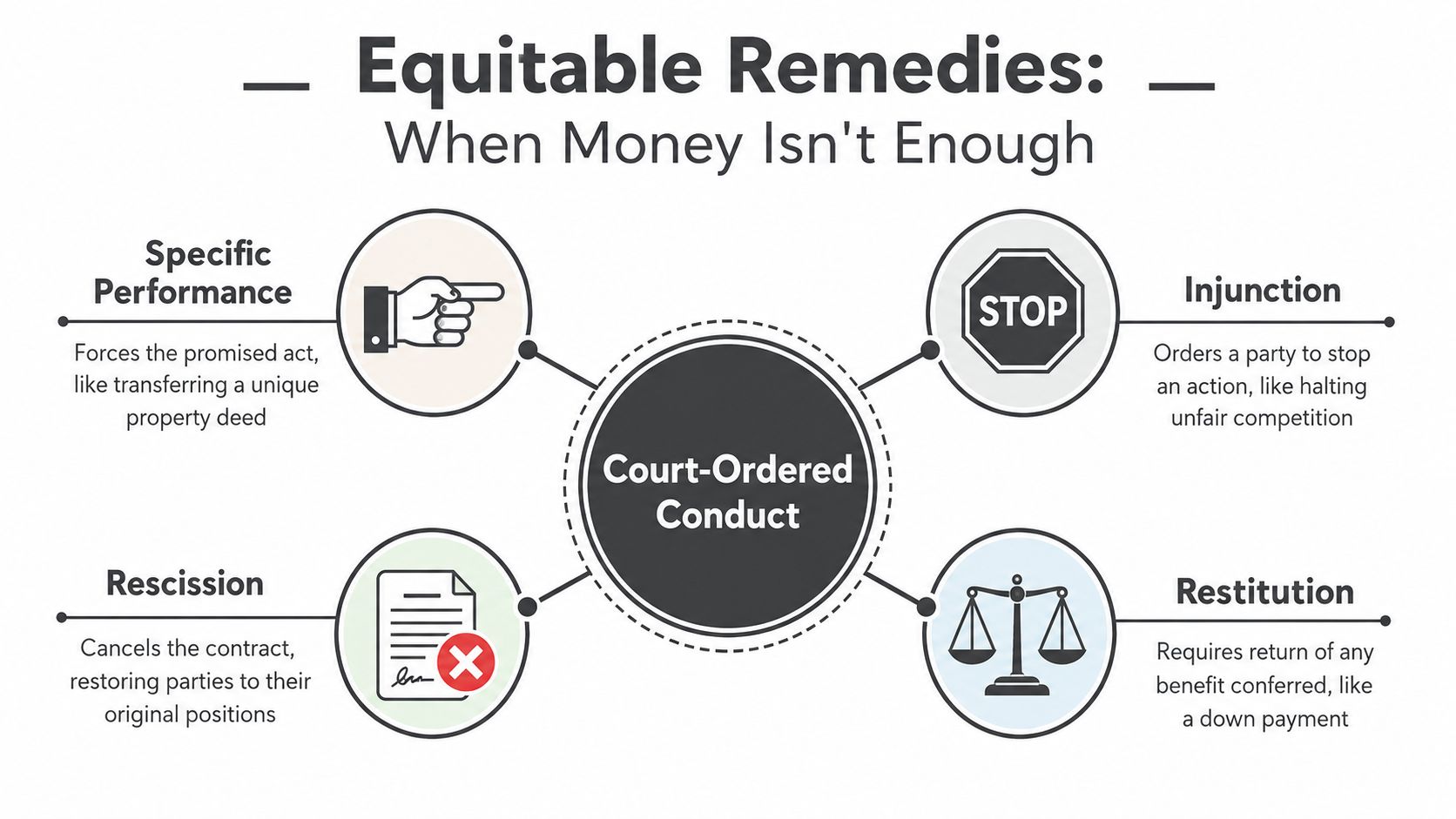
Specific performance orders the breaching party to perform the promised act. A court might consider it for a unique parcel of land, a one-of-a-kind asset, or goods that can't realistically be replaced. It isn't a general entitlement to receive the deal exactly as promised.
An injunction orders someone to do something or stop doing something. In a business dispute, the requested relief might concern misuse of confidential information, interference with a contractual relationship, or conduct that would cause harm money can't prevent. The claimant still must satisfy the governing requirements for injunctive relief.
Rescission unwinds the transaction. Instead of enforcing the agreement, the court treats the parties as moving back toward their pre-contract positions when the legal grounds for cancellation exist.
Restitution prevents one party from keeping an unjust benefit. If a buyer paid a deposit and the seller never performed, restitution may focus on returning the money rather than awarding the buyer the expected value of the entire deal.
| Equitable Remedy | Court's Focus | Typical Commercial Use |
|---|---|---|
| Specific performance | Whether the promised performance is uniquely necessary | Land or irreplaceable goods |
| Injunction | Whether conduct should be ordered or stopped | Ongoing interference or misuse |
| Rescission | Whether the transaction should be unwound | Voidable or fundamentally defective agreement |
| Restitution | Whether a benefit should be returned | Deposits, payments, or transferred value |
Courts often ask whether the claimant could cover in the market. If a comparable replacement exists and the loss can be calculated, damages usually control. If the asset is unique, money may not be adequate, but the claimant still needs evidence supporting that conclusion.
Pleading matters, too. A party seeking specific performance should generally plead damages in the alternative where the applicable procedure permits it. If the equitable request fails, an unsupported or omitted damages theory may leave the claimant without a practical fallback. In disputes involving possession of specific property, a replevin action guide can help distinguish recovery of the item itself from a conventional damages claim.
Defenses and Mitigation Duties That Limit Recovery
A strong breach claim can still produce a modest award if the claimant can't prove the amount, allowed losses to grow, or seeks damages that the parties couldn't reasonably have anticipated. Courts apply guardrails to prevent contract damages from becoming a windfall.
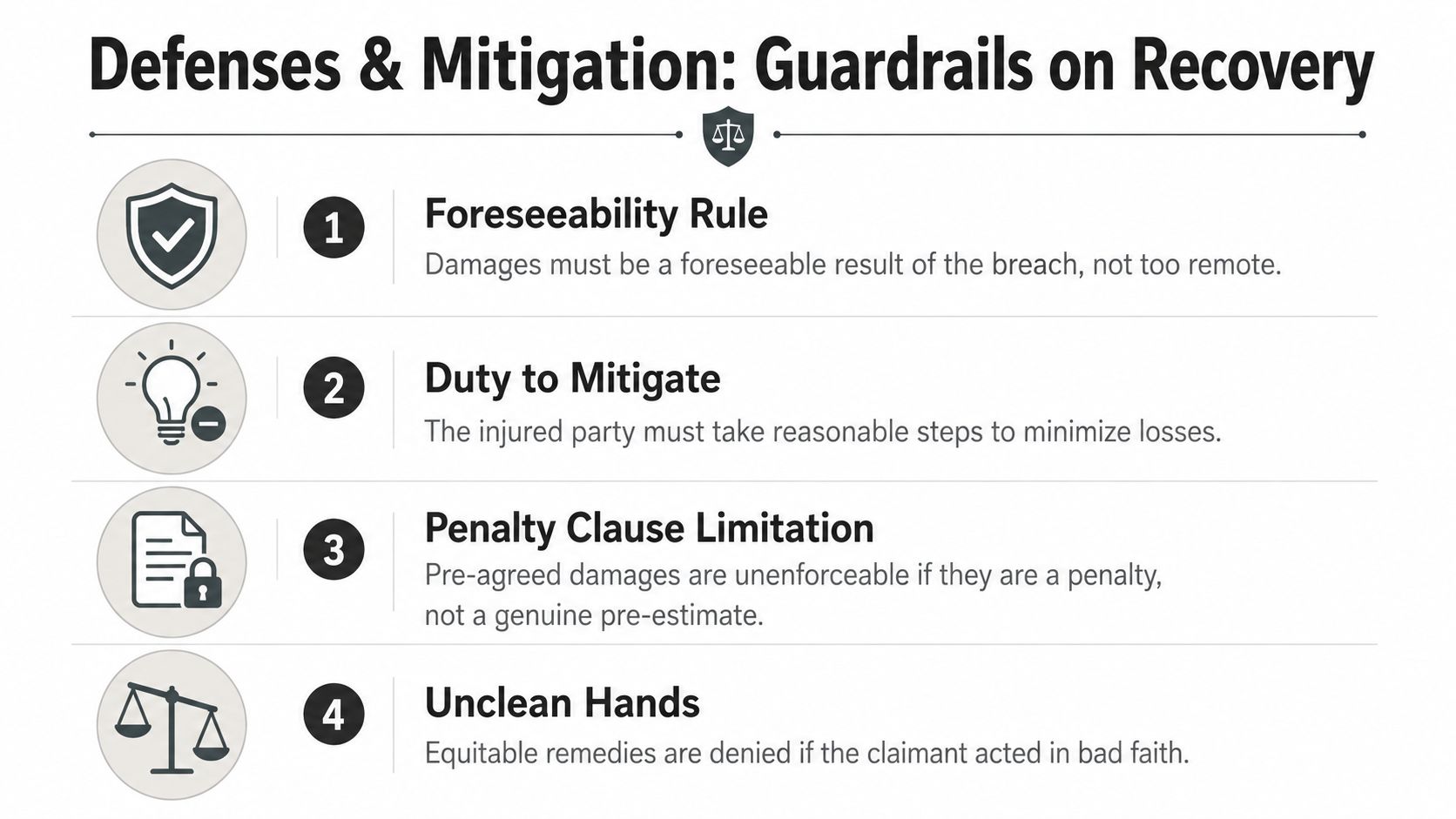
The foreseeability rule traces to Hadley v. Baxendale and appears in Restatement (Second) of Contracts Section 351 and UCC Section 2-715. A breaching party generally faces liability for losses arising in the ordinary course or from special circumstances the party had reason to know about. A seller who knew a delayed shipment would trigger a disclosed customer obligation is in a different position from a seller who never received that information.
Mitigation changes the arithmetic
Assume a buyer pays $12,500 to replace goods that should have cost $10,000, creating a $2,500 market difference. If the buyer could have obtained a reasonable replacement for $11,000 but waited without a sound business reason, the seller may argue that the avoidable portion is $1,500. The buyer's recoverable direct loss may therefore be reduced to the reasonable $1,000 difference, subject to the contract and applicable law.
The mitigation rule doesn't demand reckless action or an unsafe choice. Under Restatement (Second) of Contracts Section 350, damages can't be recovered for harm that could have been avoided without undue risk, burden, or humiliation. The same source explains that consequential damages are limited by foreseeability under Section 351 and UCC Section 2-715, as discussed in this contract-remedies analysis.
Other defenses can change the result
- Material breach: A serious failure may excuse the other party's remaining performance, while a minor breach may support damages without ending the agreement.
- Prior breach: A party that materially breached first may face difficulty demanding the other side's later performance.
- Impossibility: Performance may be excused when an unforeseen event makes it legally or objectively impossible, subject to the contract and governing law.
- Waiver: A party's words or conduct may show that it intentionally relinquished a contractual right.
- Liquidated-damages limitation: A pre-agreed amount may fail if it operates as a penalty rather than a reasonable measure of anticipated or actual harm.
Preserve contemporaneous price data, margin records, replacement invoices, customer communications, and mitigation decisions. A defendant can use those records to challenge an inflated claim. A claimant can use them to show that the replacement was reasonable, the downstream loss was foreseeable, and the claimed amount isn't speculation.
Deadlines can independently defeat an otherwise viable claim. Review the applicable Connecticut statutes of limitations before negotiations create a false sense of safety.
Choosing the Right Remedy for Your Situation
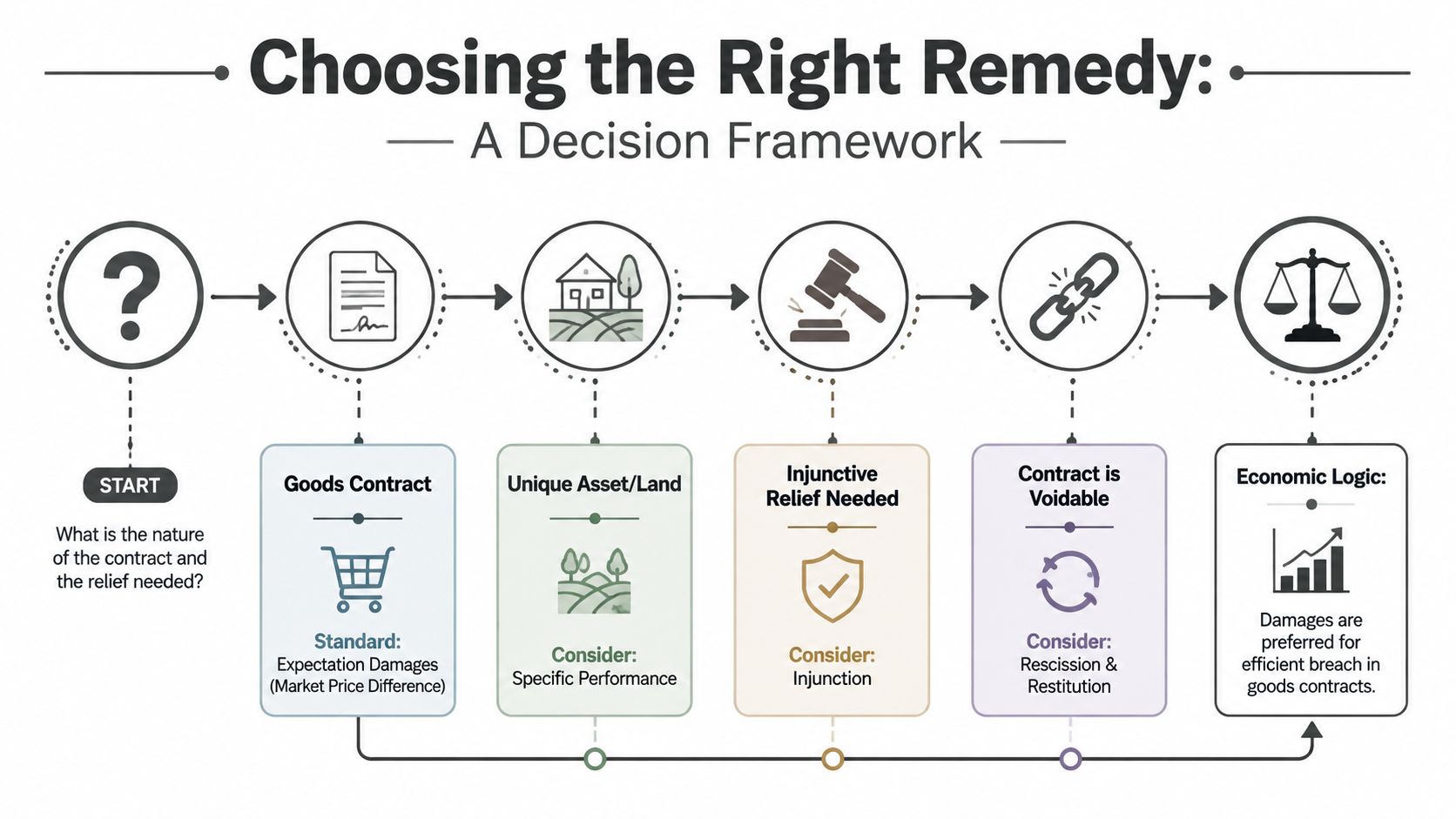
Remedy selection becomes clearer when you start with the transaction rather than the legal label. A standard goods contract usually presents a market question: what would a reasonable substitute have cost, and what additional loss was foreseeable? A property or unique-asset dispute presents a different question: can money acquire the promised subject matter at all?
A 2024 economic analysis notes that parties often prefer damages for goods contracts because specific performance can create high production-cost problems, while specific performance is more attractive for property transfers because the asset already exists. The analysis appears in this economic discussion of specific performance and damages.
Use this sequence before making a demand
- Classify the subject matter. Is it ordinary inventory, a service, land, confidential information, a payment stream, or a unique asset?
- Test substitute performance. Identify actual market alternatives, their availability, timing, quality, and cost.
- Build the damages model. Compare the promised position with the position after breach, then subtract expenses saved and losses that could reasonably have been avoided.
- Check the contract's remedy language. Review liquidated damages, limitations, cure provisions, arbitration clauses, forum clauses, and conditions precedent.
- Select equitable relief only where money fails. Explain precisely why a market substitute isn't realistic and what order the court could enforce.
- Plead alternatives. Request damages where appropriate even if specific performance, an injunction, rescission, or restitution is the preferred remedy.
Some courts are also becoming more demanding about specific-performance requests. Recent coverage concerning India describes courts requiring independent valuation evidence up front, limiting decrees that would require prolonged judicial supervision, and warning that plaintiffs should plead damages in the alternative. Those developments illustrate a broader practical point, though the governing rule depends on the jurisdiction: a remedy can be theoretically available and still fail because the evidence or proposed order is inadequate.
Decision point: The strongest remedy is often the one a court can calculate or supervise without guessing.
Remedies in Financial-Professional Disputes
A compensation dispute often looks simple until the parties compare the contract with the firm's accounting. An advisor may have a written bonus formula, production-credit schedule, or deferred-compensation plan. The firm may point to a forfeiture provision, performance condition, or termination clause. The remedy usually starts with expectation damages, but the calculation depends on the language that defines when the payment was earned.
Consider a withheld bonus. The advisor should assemble the plan, amendments, compensation statements, performance records, and communications about eligibility. If the contract sets a formula and the records show the condition was satisfied, the claimed loss may be the unpaid amount, adjusted for any contractual offsets. If the firm disputes the underlying performance metric, the fight becomes evidentiary before it becomes mathematical.
Promissory notes and repayment claims
A departing representative may receive upfront compensation documented by a promissory note. After the representative transitions, the broker-dealer demands repayment. The response shouldn't assume that the note ends the analysis.
Counsel may examine whether the note was accelerated correctly, whether payments or credits were omitted, whether the firm breached a related compensation agreement, and whether the claimed balance includes amounts that should be offset. The representative may also need to compare the repayment demand with production credits, deferred compensation, commissions, or other amounts allegedly earned during the relationship. The best defense may involve reducing the balance rather than denying that every obligation exists.
Termination and Form U5 issues
A wrongful-termination dispute may involve the reason for separation, promised compensation, restrictive covenants, or the accuracy of a Form U5 disclosure. The contract remedy may include unpaid compensation or other provable loss, while the requested relief may also involve correction of records, preservation of evidence, or an injunction where legally available.
The forum matters. Financial-professional disputes may proceed in court or through arbitration before FINRA, AAA, or JAMS, depending on the agreements and claims. A party evaluating a Form U5 issue should preserve the disclosure, employment agreement, termination communications, internal review materials, and any arbitration language before sending an accusatory demand.
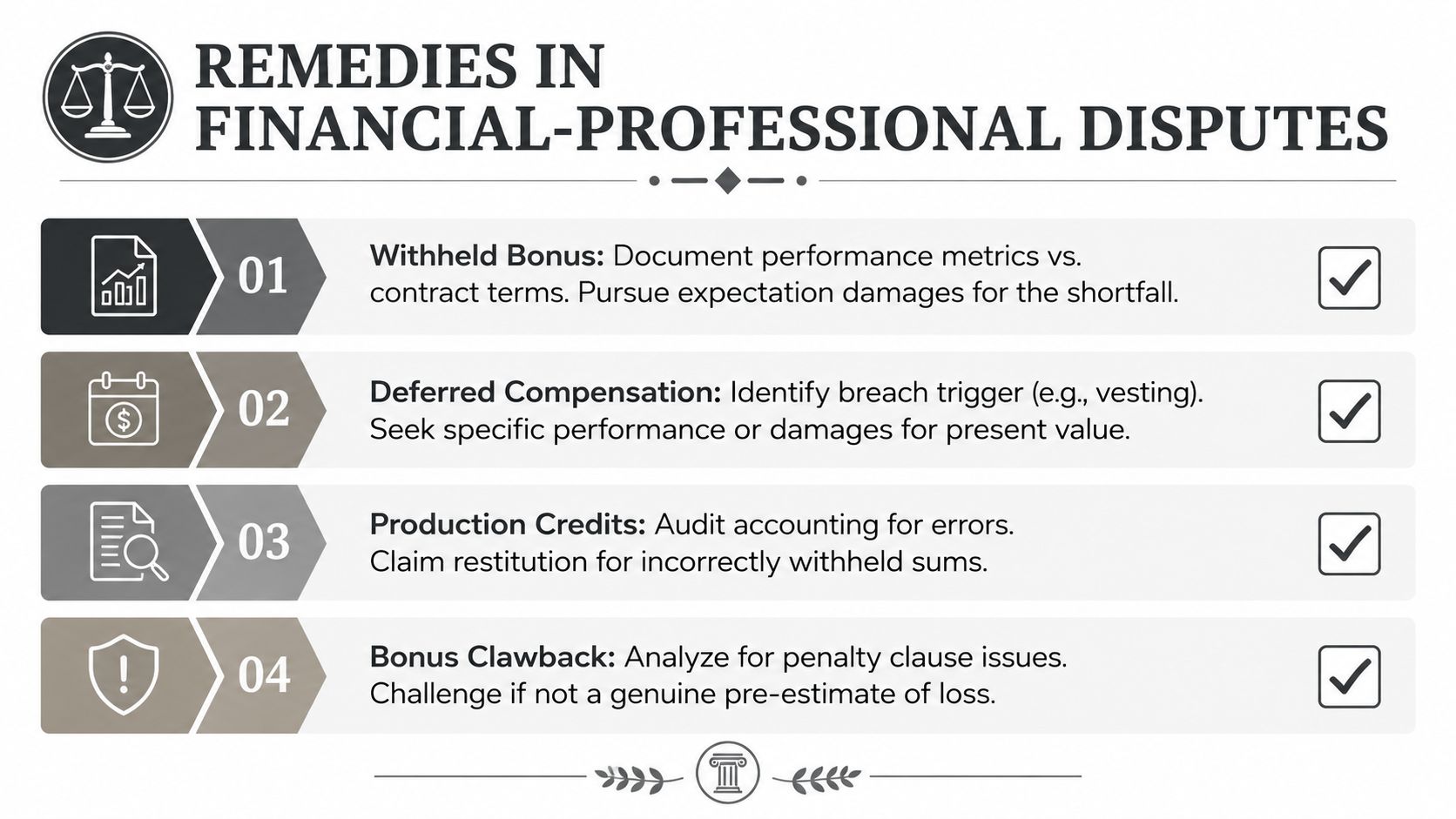
A bonus clawback also deserves careful review. If the firm characterizes the repayment as liquidated damages, test whether the amount reasonably relates to anticipated or actual harm and the difficulty of proving loss. A clause designed mainly to punish departure may face a different analysis from a clause designed to estimate a difficult-to-measure loss. The UCC deposit rule doesn't automatically govern an employment or advisor dispute, so the agreement and applicable law remain central.
Practical Next Steps for Pursuing or Defending a Claim
Start with preservation, not escalation. Collect the signed contract, amendments, schedules, side letters, promissory notes, compensation plans, invoices, payment records, emails, text messages, customer notices, and accounting exports. Keep the original files and record when each document was created or received.
Next, calculate a realistic range. Separate direct loss from consequential loss, identify saved expenses, document replacement opportunities, and mark every assumption in the model. A demand that identifies the contract provision, breach, calculation, requested remedy, and response deadline is more useful than a demand that labels the other side dishonest.
A claimant's preparation list
- Prove the promise: Identify the exact clause and any condition attached to performance.
- Prove the breach: Preserve the refusal, missed payment, non-delivery, inaccurate accounting, or termination communication.
- Prove the amount: Use contemporaneous prices, margin records, invoices, compensation statements, and payment histories.
- Prove mitigation: Explain the replacement search, timing, cost, and any reason a substitute wasn't reasonable.
- Protect the forum: Review arbitration, venue, notice, cure, and limitations provisions before filing or making admissions.
Defenders should reverse the same process. Test whether the claimant used the correct contract version, satisfied all conditions, calculated the loss consistently with the agreement, pursued avoidable losses, and included consequences the defendant couldn't reasonably foresee. Examine prior breach, waiver, impossibility, materiality, and any contractual limitation before conceding the remedy.
Court and arbitration also create different practical considerations. Review the agreement before choosing a forum, then confirm the applicable deadline and notice requirements. Kons Law's practical guide to suing for breach of contract can help frame the initial questions, but a lawyer should evaluate the specific contract and facts before you rely on a general timeline.
If you want to discuss your business law matter, contact Kons Law at (860) 920-5181. Bring the agreement, payment or compensation records, key communications, and any demand or arbitration notice so counsel can evaluate the breach, damages, equitable options, defenses, and forum together.
Kons Law advises businesses, financial professionals, and advisors on contract disputes involving compensation, promissory notes, deferred payments, termination, and related commercial claims. If you want to discuss your business law matter, contact Kons Law at (860) 920-5181 to review the facts and identify a practical path forward.
