
Securing a great commercial lease isn't about what happens at the negotiating table—it's about the prep work you do long before you ever meet the landlord. This foundational work is what gives you leverage. It turns a simple price discussion into a strategic business decision where you're in the driver's seat.
Build Your Leverage Before You Negotiate
The real work of negotiating a commercial lease happens well before you sit down with a landlord. This isn't about haggling; it's about being prepared. When you do your homework, you stop being a passive space-seeker and become an informed business owner who knows the market and your own value.
This initial stage truly sets the tone for everything that follows. Walking into a negotiation unprepared is like trying to build a house without a blueprint. You might end up with something, but it’s probably not what you actually need or can afford.
Conduct Detailed Market Research
How can you tell if a landlord’s offer is fair? You need a benchmark. Understanding the local commercial real estate market is your first and most powerful tool. Without it, you’re just negotiating in the dark.
Your research should hit a few key areas:
- Comparable Rents: See what businesses like yours are paying for similar spaces in your target neighborhoods. Don't just look at price per square foot—consider the building's age, amenities, and foot traffic.
- Vacancy Rates: A high vacancy rate in an area gives you a ton of negotiating power. It means landlords are competing for tenants and are more likely to offer concessions. A low rate means you'll have more competition.
- Common Concessions: Are local landlords offering a few months of free rent or a generous tenant improvement allowance? Knowing the standard helps you make reasonable requests.
When you ground your requests in solid market data, the conversation shifts from "what I want" to "what is fair based on the current market." This data-driven approach is far more persuasive to a landlord than just asking for a better price.
Define Your Must-Haves and Nice-to-Haves
Not every lease term carries the same weight. To negotiate effectively, you have to know the difference between your absolute necessities and the perks that would be nice but aren't deal-breakers. This clarity keeps you from trading away something critical for a minor win.
I always advise clients to create a simple two-column list:
- Must-Haves: These are your non-negotiables. Think specific square footage, ground-floor access for a retail shop, enough parking for your clients, or essential zoning permissions.
- Nice-to-Haves: These are the items you'd like but can live without. This could be a corner office with a view, access to a shared conference room, or the option to sublease part of your space down the road.
This simple framework gives you the flexibility to trade a "nice-to-have" to lock in a "must-have."
Assemble Your Professional Team Early
Trying to handle a commercial lease negotiation on your own is a huge risk. Landlords have professional representation, and you should too. Putting your team together before you even start looking for a space shows you're a serious, prepared tenant.
Your core team should include:
- A Commercial Real Estate Broker: Their market intelligence is invaluable. They know the local trends, have relationships with landlords, and can find properties you’d never discover on your own.
- A Business Law Attorney: A lawyer specializing in commercial real estate is non-negotiable. They'll review the lease for hidden traps, protect your interests, and help structure key documents.
This team brings the professional credibility and expertise you need to level the playing field. For example, your attorney will be critical in drafting and reviewing the initial offer. Understanding what is a Letter of Intent and having it properly structured by a legal pro can set a positive, clear tone for the entire negotiation.
If you want to discuss your business law matter, contact Kons Law at (860) 920-5181.
Decoding Critical Lease Clauses and Terms
Let’s be honest: commercial lease agreements are dense, complicated legal documents. They are almost always drafted by the landlord’s attorney, and their number one goal is to protect the landlord’s interests—not yours. To get a fair deal, you have to understand the language and the real-world impact of the most critical clauses.
Think of your lease as the operating system for your business's physical space. One tiny bug or a hidden backdoor can create massive headaches down the road. Getting a handle on these terms lets you spot potential landmines and turn one-sided language into a balanced agreement that actually helps your business grow.
The infographic below really drives home how crucial your prep work is. Your leverage comes from solid research and a clear plan, well before you even look at the lease document itself.
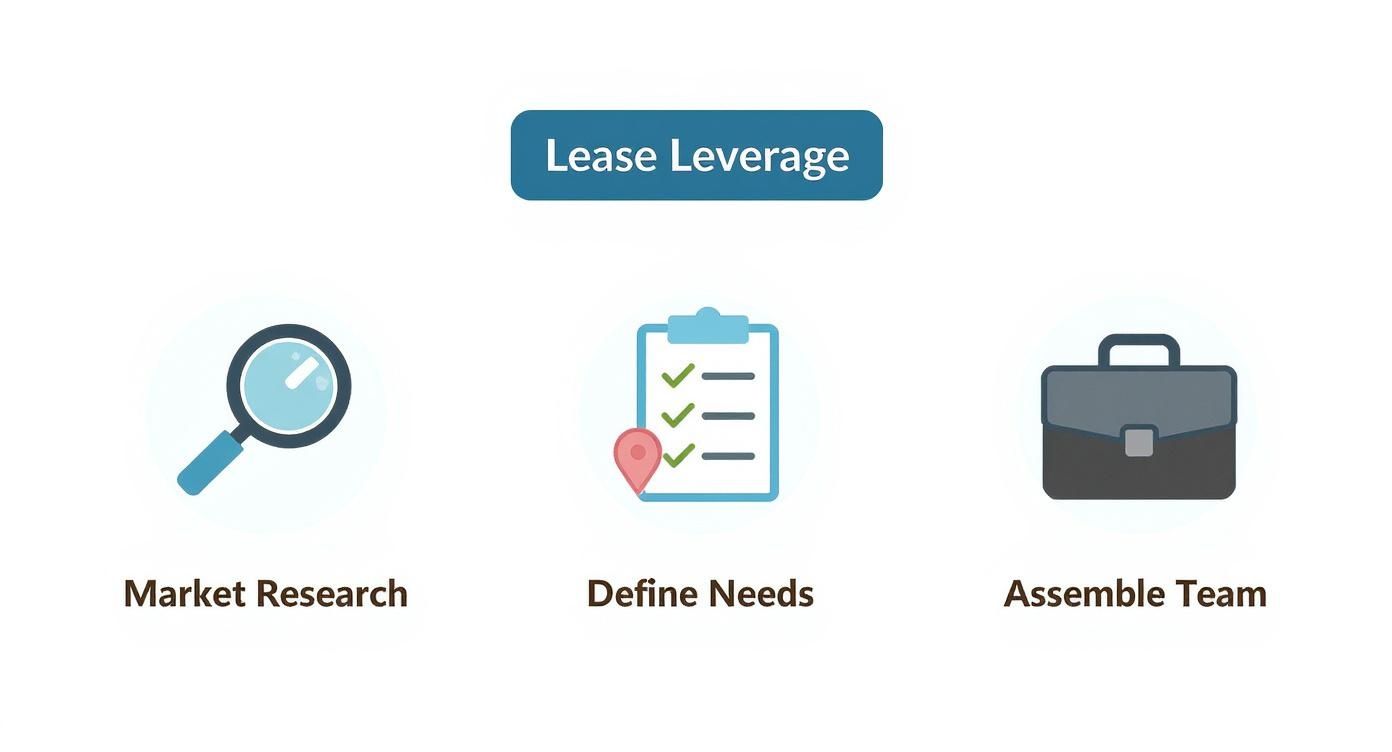
As you can see, your strength in these negotiations is built on a foundation of market knowledge, knowing exactly what you need, and having a professional team in your corner.
Understanding Your Rent Obligation
Most tenants fixate on the base rent, but that number is often just the starting line for your financial commitment. You absolutely have to understand the total cost of occupancy, which is almost entirely dictated by the type of lease you sign.
There are a few common structures, and each one shifts costs differently between you and the landlord.
Common Commercial Lease Types Explained
The structure of your lease determines who pays for what. Here’s a quick breakdown of the most common types you’ll encounter and how they affect your bottom line.
| Lease Type | What the Tenant Pays | Best For |
|---|---|---|
| Gross Lease | A single, all-inclusive flat rent. Landlord covers taxes, insurance, and maintenance. | Tenants who need predictable, fixed monthly costs, like in a multi-tenant office building. |
| Net Lease | Base rent plus a portion of one or more of the building's operating expenses. | Businesses that want a lower base rent and are willing to take on some variable costs. |
| Triple Net (NNN) | Base rent plus a pro-rata share of all three major expenses: property taxes, insurance, and Common Area Maintenance (CAM). | Stand-alone retail or industrial tenants who want maximum control over their space and expenses. |
As you can see, what looks like a lower rent in a NNN lease can quickly become expensive if operating costs are high. It's vital to know which lease type you're signing and what it means for your budget.
CAM charges are notorious for causing surprise costs. Always, always demand a detailed breakdown of what’s included and negotiate a cap on how much they can increase each year. A 3-5% annual cap is a perfectly reasonable request to protect yourself from runaway expenses.
Clauses That Define Your Flexibility
Beyond the money, some clauses have a huge impact on how you can actually run your business in the space. These are mission-critical negotiation points that affect your operational freedom every single day.
The Use Clause
This clause spells out exactly what you're allowed to do in the space. A landlord might try to make it incredibly narrow, like "a retail store selling only handmade candles." This helps them control their tenant mix, but it completely hamstrings your ability to evolve.
Your goal? Negotiate the broadest use clause possible. Something like "for general retail use" or "for general office use" gives you the breathing room to adapt your business model without having to ask the landlord for permission.
Sublease and Assignment Rights
What if you outgrow the space? Or need to downsize? The right to sublease (rent part of your space to someone else) or assign (transfer the whole lease to another business) is your escape hatch. Landlords love to restrict these rights.
Push for language that says the landlord cannot "unreasonably withhold, condition, or delay" their consent. This establishes a fair standard and stops them from arbitrarily blocking a perfectly good subtenant or buyer for your business. Many legal documents, including leases, can be tricky; for a better grasp on structuring agreements, check out our guide on a small business contract template.
Securing Funds for Your Build-Out
Almost no commercial space is move-in ready. You'll likely need to customize it, whether that means new paint and flooring or building out offices and installing specialized equipment. The Tenant Improvement (TI) Allowance is money the landlord provides to help you pay for this work.
This allowance is one of the most valuable things you can negotiate. The key to success here is to get detailed quotes from contractors before you sign anything. When you can present a thoroughly researched build-out budget, you have the data to back up your request for a higher TI allowance. Landlords are far more willing to invest in a tenant who has a clear, professional plan.
If you want to discuss your business law matter, contact Kons Law at (860) 920-5181.
Mastering Proven Negotiation Strategies
You've done the research and assembled your team. Now it's time to put that preparation into action. This isn't about winning a fight; it's about having a strategic conversation that leads to a mutually beneficial lease. The goal here is to turn all that market data and your list of business needs into real, favorable terms.
It all starts with setting the right tone. You want to walk in looking like a professional, serious, and desirable tenant—the kind of business a landlord is eager to secure for the long haul.
Draft a Powerful Letter of Intent
Before you get bogged down in the landlord’s dense, pre-drafted lease agreement, start the conversation with a Letter of Intent (LOI). This is your opening move. An LOI is a non-binding document that outlines the key terms of the deal as you see them, letting you frame the negotiation from the get-go.

A well-crafted LOI gets straight to the point on the most critical items:
- Proposed Base Rent: Lead with a number that's firmly grounded in your market research.
- Lease Term: Clearly state your desired term, whether it’s five or ten years.
- Tenant Improvement (TI) Allowance: Specify the amount you need for the build-out, backed by real contractor quotes.
- Concessions: This is where you ask for things like a free rent period to ease your start-up costs.
- Key Clauses: Briefly mention must-haves, like your right to sublease or the need for a broad use clause.
Submitting a professional LOI shows the landlord you’ve done your homework and have a clear vision. It also streamlines the whole process by getting both sides to agree on the major deal points before anyone spends time and money on legal reviews of the full lease.
Use Market Conditions to Your Advantage
That market research you did? It’s not just for your internal budget—it’s your single most powerful bargaining chip. Landlords know exactly what the local vacancy rates are, what new construction is coming online, and what their competitors are offering. When you can anchor your requests in hard data, they become far more persuasive.
For instance, a high vacancy rate in the area means landlords are competing for tenants. That's your cue to be more assertive.
Don’t be afraid to ask for what you want, especially when the market is in your favor. A request for a few months of free rent or a larger TI allowance isn't an outrageous demand; it's a standard part of the commercial lease negotiation process.
Leveraging market data is especially potent when asking for financial incentives. In tougher markets, landlords often prefer to offer significant concessions rather than lowering their advertised "face" rents. A perfect example happened in Manhattan as the market faced pressure from rising sublease space. The average tenant allowance for office leases jumped from $84.66 per square foot in 2019 to $101.58 in 2020. During that same time, the average free rent period offered grew to 11.7 months. Landlords are definitely using free rent and other incentives to attract tenants.
Know When to Stand Firm and When to Compromise
Negotiation is a dance of give and take. If you walk in expecting to win on every single point without conceding anything, the conversation will grind to a halt. This is precisely why that "must-haves" versus "nice-to-haves" list you made is so critical.
Be ready to stand your ground on your non-negotiables—the items essential for your business’s survival and success. This might be a specific zoning requirement, a cap on annual CAM increases, or the absolute right to sublease.
At the same time, have your "nice-to-haves" ready to use as bargaining chips. Maybe you can agree to a slightly shorter free rent period in exchange for a bigger TI allowance. Or perhaps you can trade an exclusivity clause for a more favorable renewal option. The goal is to secure the terms that truly matter while maintaining a positive, collaborative relationship with the landlord. An experienced legal professional is invaluable here, helping to structure and negotiate complex commercial transactions to protect your interests.
If you want to discuss your business law matter, contact Kons Law at (860) 920-5181.
Timing Your Move with Market Dynamics
The commercial real estate market is a living, breathing thing. It shifts and sways with economic trends, local development projects, and the overall mood of the business community. Knowing how to read these cycles isn't just for market analysts; it's a core skill for any business leader who wants to negotiate a commercial lease from a position of strength.
Timing isn’t just about when your current lease is up. It’s about strategically aligning your move with the market’s rhythm to give yourself the most leverage possible.
Walking into a negotiation at the right moment can completely change the conversation. A landlord who is confident they can fill a space tomorrow will be far less flexible than one who is staring at a growing list of empty properties. By learning to read these signals, you can figure out when to act fast to grab a great spot or when to be patient and push for better terms.
Reading the Market for Tenant Leverage
Your power at the negotiating table is tied directly to the health of the local real estate market. The two most important numbers to watch are vacancy rates and the new construction pipeline. These metrics tell the real story of supply and demand, which is the foundation of any good deal.
- High Vacancy Rates: When you see "For Lease" signs everywhere, you're in a tenant's market. Landlords are fighting over a smaller pool of businesses, which means they’re more open to offering perks like free rent, generous tenant improvement allowances, and more flexible terms.
- New Construction Surplus: A boom in new commercial buildings can flood the market with space. This puts pressure on landlords of both new and older properties to get aggressive with their offers to attract and keep tenants. This is a huge advantage for you.
On the flip side, a market with low vacancy and very little new construction puts landlords in the driver's seat. In that kind of environment, you'll need to start your search much earlier and be ready for them to hold firm on their terms.
Aligning Your Search with Broader Economic Trends
The timeline for finding a space and striking a deal is heavily influenced by what’s happening in the wider economy. National and even global trends in construction and leasing have a direct impact on how long it takes to close a deal and who has the upper hand. A slowdown in new construction, for example, can tighten the market very quickly, even if demand stays flat.
Recent data shows that while global office leasing has recovered a bit, a lack of new supply is becoming a real issue. New construction starts have hit record lows in some areas, and a big chunk of what’s being built is already pre-leased. This supply crunch means more competition for the best spaces.
As a result, tenants are often facing longer negotiation periods and have to start looking much earlier to lock down a good location. Discover more insights about global real estate perspectives to see how these trends are shaping negotiation leverage right now.
Knowing the market’s temperature is crucial. A "hot" market with low supply means you need to be decisive and ready to move. A "cold" market with plenty of options allows you to be more methodical and push for a better deal.
Developing a Strategic Timeline
Timing your move isn't just about watching the market; it's about building a timeline that gives your business the advantage. One of the biggest mistakes tenants make is starting the process too late. It forces them into a corner, where they have to take whatever deal they can get out of pure desperation.
A smart timeline should begin 12 to 18 months before your current lease expires. That might sound like a lot of time, but it gives you the breathing room you need for:
- Thorough Market Research: To really understand the trends and find hidden opportunities.
- Site Selection: To find several solid options without feeling rushed into a decision.
- Negotiation Rounds: For all the back-and-forth on the Letter of Intent (LOI) and the lease itself.
- Legal Review: So your attorney has enough time to properly analyze and revise the lease document.
- Build-Out and Relocation: To plan for any construction and the actual move.
When you start early, you put yourself in control. You create the freedom to walk away from a bad deal—and that’s a powerful negotiating tool that landlords respect immediately.
If you want to discuss your business law matter, contact Kons Law at (860) 920-5181.
You’ve made it. After all the back-and-forth, you’ve finally agreed on the major deal points, and the landlord’s attorney has just sent over the final lease. It’s a huge relief, and the temptation to just sign it and get back to business is immense.
But this is where some of the most expensive mistakes happen. The deal isn't done until it's signed, and this final review is your last, best chance to protect your company.
This document isn't just a summary of your talks; it's the legally binding blueprint for your business's home for the next several years. Even a tiny difference between what you discussed and what's written in the fine print can lead to massive financial headaches down the road. It’s time for a careful, line-by-line review.
The Attorney’s Critical Role
Let me be blunt: this is not a DIY project. The most important thing you can do at this stage is to have your business law attorney perform a detailed review. Their job is to put the final lease side-by-side with your Letter of Intent (LOI) and all other written notes to make sure every single point you negotiated made it into the contract accurately.
Landlord-drafted leases are, by design, incredibly one-sided. It is not uncommon to find that a concession you agreed on verbally—like a cap on CAM increases—has been mysteriously left out or worded in a way that now benefits the landlord. Your attorney is trained to catch these games and make sure the language is airtight.
A verbal agreement is only as good as the paper it’s written on. If a term you negotiated isn’t explicitly stated in the final lease document, it effectively does not exist in the eyes of the law.
Spotting Common Red Flag Clauses
While your lawyer will dive into the legal nitty-gritty, you should also be on the lookout for a few common "red flags" that often get slipped into final drafts. They’re usually buried in dense legalese but can seriously limit your rights or expose you to unnecessary risk. Knowing what to look for helps you have a smarter conversation with your attorney.
Here are a few of the most dangerous ones to watch for:
- Automatic Renewal Traps: Often called a "holdover" clause, this can lock you into another full lease term if you fail to give notice of your intent to leave by a very specific, and often early, deadline. Miss that date, and you could be on the hook for years of rent you never wanted.
- Broad Landlord Relocation Rights: Some leases give landlords the power to move your business to another "comparable" spot in the building. "Comparable" is a dangerously vague word. The disruption and cost of an unplanned move could be devastating to your operations.
- Unforgiving Personal Guarantees: If you signed a personal guarantee, read this part with a microscope. It needs to have clear limits and shouldn't extend to future renewals without your express consent. An open-ended personal guarantee puts everything you own—your house, your savings—on the line.
What to Expect During the Signing Process
After your attorney reviews the document, they’ll almost certainly have a list of changes to send back to the landlord's lawyer. This final round of edits is completely normal. Don't let anyone pressure you into accepting bad terms just to speed things up.
Once all the revisions are made and the truly final version is ready, you'll move to the signing stage. This involves a few key steps:
- Final Walk-Through: Before you sign anything, do one last walk-through of the space to confirm its condition is as expected.
- Signing the Document: All required parties—including any business partners or guarantors—will need to sign. This is often handled electronically now, but make sure you understand the platform.
- Document Everything: Keep perfect copies of the fully executed lease, the LOI, all email chains, and any related paperwork. Store them somewhere safe; you will definitely need to refer back to them during your tenancy.
This last review isn’t just a formality. It’s how you ensure all your hard-fought negotiation wins are set in stone in a contract that helps your business grow, rather than holding it back.
If you want to discuss your business law matter, contact Kons Law at (860) 920-5181.
Tying It All Up: The Final Review and Getting Expert Help
You've made it through the gauntlet. From poring over market data to the back-and-forth of the negotiation, you're finally at the finish line with a lease in hand. This is a huge milestone. Before you pick up that pen, though, there's one last critical step: the final review.
This is your last chance to make sure everything you fought for is actually in the document. Go line by line and confirm that all the agreed-upon terms are spelled out correctly. Are the tenant improvement allowances and free rent periods exactly as you negotiated them? What about those crucial clauses for renewal options, sublease rights, and any personal guarantees? Don't just skim—this final check protects your business from costly oversights down the road.
Key Takeaway: The final lease document should be a perfect reflection of your verbal and written agreements. If it's not in the contract, it didn't happen.
Let's be honest: navigating the complexities of a commercial lease isn't something you should tackle alone. Even the most seasoned business owner can miss the nuances hidden in dense legal language. Bringing in a skilled business law attorney isn't just a good idea; it's essential for securing a contract that helps your business grow, rather than holding it back. To get a better sense of how they can protect you, it's worth understanding what a business lawyer does in these situations.
If you want to discuss your business law matter, contact Kons Law at (860) 920-5181.
Your Top Commercial Lease Questions, Answered
If you’re stepping into the commercial lease negotiation process for the first time, it’s natural to have questions. You're not just renting a space; you're making a major financial commitment to your business's future.
Let’s clear up some of the most common sticking points business owners run into. Getting these answers straight will give you the confidence and clarity you need to negotiate from a position of strength.
How Much Can I Really Negotiate Off a Commercial Lease?
There's no magic number here. Your negotiating power is a direct result of market conditions, how long the property has been vacant, and how badly the landlord wants you as a tenant. A solid credit history and a willingness to sign a long-term lease make you a far more appealing candidate.
Instead of getting hung up on a specific discount on the base rent, think bigger. You’ll often get more financial mileage by negotiating for valuable concessions. Asking for a few months of free rent at the beginning of the term or pushing for a larger tenant improvement allowance can put significantly more money back in your pocket.
What Exactly Is a Tenant Improvement (TI) Allowance?
A Tenant Improvement (TI) Allowance is a fund the landlord provides to help you build out the raw space to fit your business’s unique needs. This can cover everything from putting up new walls and running electrical wiring to fresh paint and new flooring.
The key to negotiating a great TI allowance is to come prepared. Don't pull a number out of thin air. Before you even think about signing, get detailed, written quotes from a few different contractors. When you can present the landlord with real data justifying your request, your argument becomes much more compelling. In a market that favors tenants, you can often secure a pretty substantial allowance, especially if you’re signing a longer lease.
Do I Really Need to Hire a Lawyer to Review the Lease?
Yes. Full stop. This is absolutely non-negotiable.
Commercial lease agreements are dense, complex legal documents written by the landlord’s attorney with one goal: to protect the landlord's interests. They are not written to be fair to you. An experienced business law attorney knows exactly where to look for vague language, hidden costs, and clauses that could put your business at serious risk down the line.
Think of it this way: the fee for a legal review is a small, one-time investment. A bad lease, on the other hand, can create financial and operational headaches that cost you for years. Your lawyer will be your advocate, ensuring the final document accurately reflects what you agreed to, protects your rights, and clearly defines your obligations. It's the smartest money you'll spend in this entire process.
If you want to discuss your business law matter, contact Kons Law at (860) 920-5181.
