
An email from Compliance lands at 6:12 a.m. A branch manager wants to “quickly discuss” outside business activity. A client complaint suddenly turns into questions about disclosures, supervision, or how a product was presented. Or the problem starts inside your own firm. You spot conduct that looks wrong, raise it internally, and then your production grid changes, your authority shrinks, or your role disappears.
That's when financial professionals start searching for Dodd-Frank lawyers.
Individuals searching for information on Dodd-Frank aren't looking for a history lesson. They want to know three things. What does Dodd-Frank control in their day-to-day business, what protection does it give them if they report misconduct, and what happens if a regulator or employer turns a compliance issue into a career problem.
For advisors, registered representatives, OSJs, RIAs, and firm principals, Dodd-Frank is part whistleblower statute, part enforcement framework, and part operating environment. It affects how some advisers register, how derivatives activity is regulated, how regulators evaluate market conduct, and how retaliation claims work when reporting goes badly. If your issue already involves an SEC investigation, timing and positioning matter more than is often acknowledged.
The Moment Every Financial Professional Dreads
A familiar pattern shows up in real life.
An advisor gets a request for documents and thinks the issue is narrow. Then the request expands to emails, text messages, marketing pieces, notes of client meetings, and compensation records. Another professional reports a concern up the chain, expecting the firm to investigate discreetly, only to find that the relationship with management changes almost overnight. A practice owner learns that a departing producer has raised accusations tied to supervision, commissions, or books of business, and suddenly the business issue becomes a regulatory one too.
The instinct is usually the same. Keep your head down, answer what's asked, and hope the matter burns out. Sometimes that works for routine housekeeping questions. In higher-stakes matters, it usually doesn't.
Why the first response often creates the biggest problem
Dodd-Frank matters tend to punish sloppy framing. If you're responding to a regulator, casual explanations can turn into admissions. If you're considering a whistleblower submission, internal reporting alone may not do what you think it does. If you're dealing with retaliation, many professionals borrow assumptions from Sarbanes-Oxley and miss the advantages Dodd-Frank may offer.
Early strategy matters because the first version of events often becomes the file everyone reads later.
That's why specialized counsel matters here. Not because every problem becomes litigation, but because the pressure points are different in securities and financial-services disputes. You may be dealing with SEC exposure, FINRA reporting consequences, employment retaliation, compensation disputes, Form U5 language, or all of them at once. Good Dodd-Frank lawyers don't treat those as separate worlds. They look at the whole record and decide what to say, where to say it, and what not to concede.
Demystifying Dodd-Frank's Core Components
For financial professionals, Dodd-Frank isn't one rule. It's a set of frameworks that changed registration, supervision, derivatives regulation, whistleblower rights, and consumer-finance oversight. The practical question isn't “what's in the statute?” It's “which parts touch my practice, my firm, or my risk?”
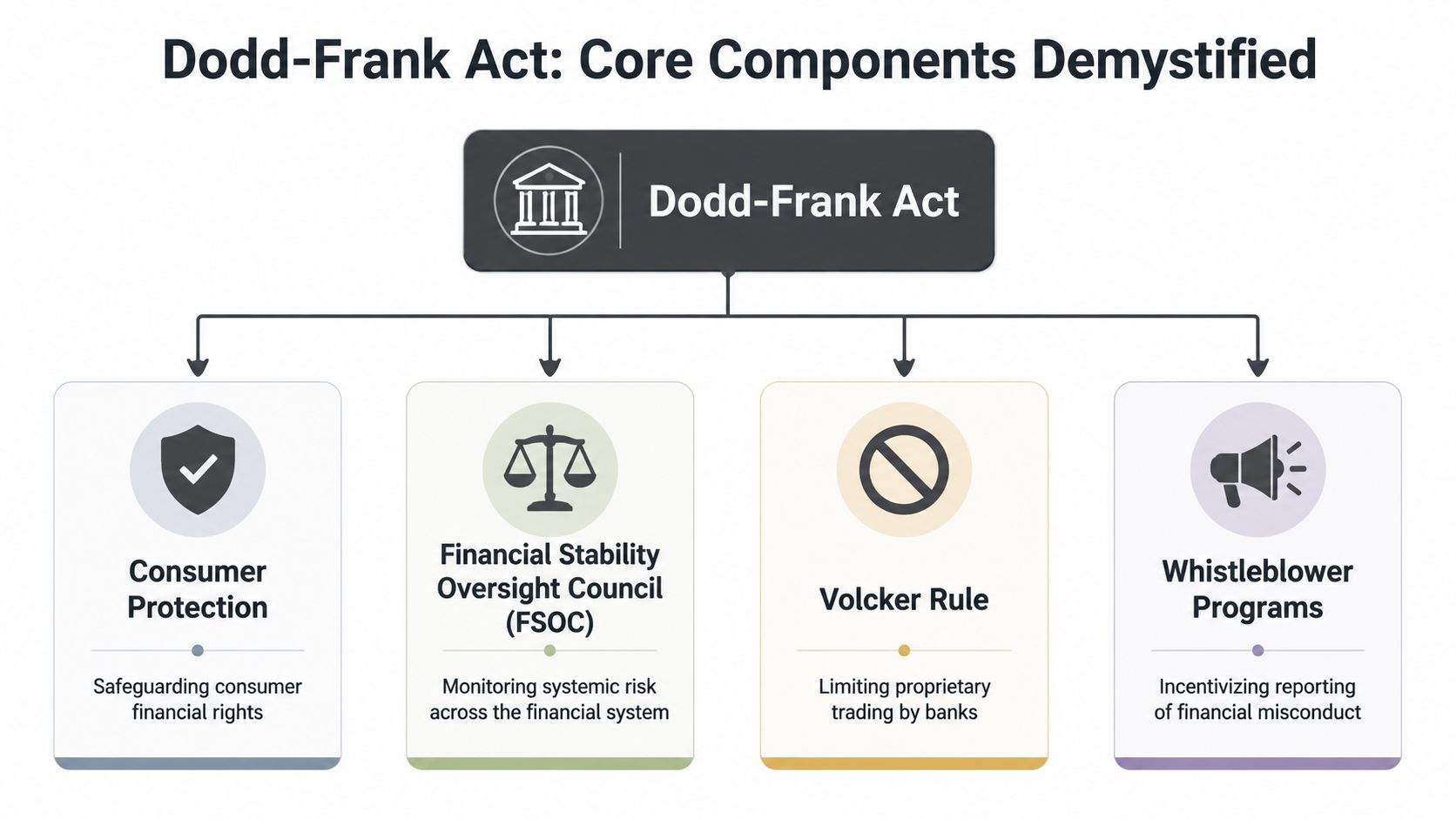
Registration rules changed who deals with the SEC
One of the clearest business impacts involved investment adviser registration. The Act raised the threshold for mandatory SEC registration to $100 million in assets under management, while also allowing permissive registration for pension consultants advising at least $200 million and for advisers required to register with 15 or more states. That change is summarized in Katten's analysis of Dodd-Frank rules for investment advisers.
For advisory businesses, that matters because registration drives oversight, exam risk, reporting obligations, and the cost of compliance. A firm that misunderstands where it belongs can create trouble before a regulator ever alleges fraud.
Another Title IV point often matters in structuring private advisory businesses. Advisers who solely advise venture capital funds, family offices, or funds managing less than $150,000,000 are expressly exempt from SEC registration in certain circumstances, while advisers managing private funds can't use the intrastate adviser exemption regardless of location, as Cornell Law School's Title IV summary explains.
Some rules matter only for certain market participants
Dodd-Frank's Title VII matters most to firms involved in swaps and derivatives. Under that framework, swap dealers and major swap participants face capital and margin requirements, registration obligations with the SEC and CFTC, central clearing and exchange-trading requirements for standardized contracts, and mandatory transaction reporting. Paxton's Title VII discussion captures how those rules changed transparency and market access.
If you don't operate in that space, Title VII may feel remote. But if your firm does, the compliance burden isn't optional. Registration status, reporting, and conduct standards shape whether the business can stay in the market at all.
Custody and compliance are operational issues, not academic ones
Dodd-Frank also expanded SEC authority over custody safeguards for registered advisers. Section 411 requires registered advisers to take steps to safeguard client assets over which they have custody, including verification by an independent public accountant, within the limits described in SIFMA's discussion of expanded SEC authority.
For firms, the lesson is simple:
- Map your regulatory status carefully. Registration mistakes create avoidable enforcement exposure.
- Treat custody and books-and-records controls as business infrastructure. These aren't back-office details.
- Review written policies against actual practice. Firms often have polished manuals that don't match what advisors really do.
A useful starting point is understanding how your procedures align with broader regulatory compliance obligations. In practice, Dodd-Frank problems rarely arise because a firm had no policy at all. They arise because the policy, supervision, and field behavior didn't match.
Understanding the Whistleblower Program Dynamics
A financial advisor raises a concern about altered records, hidden conflicts, or sales practice misconduct. Two weeks later, access is cut off, compensation changes, and HR starts asking pointed questions. At that point, the first legal issue is often not whether misconduct occurred. It is whether the advisor used the right reporting channel to preserve the protections and remedies Dodd-Frank provides.
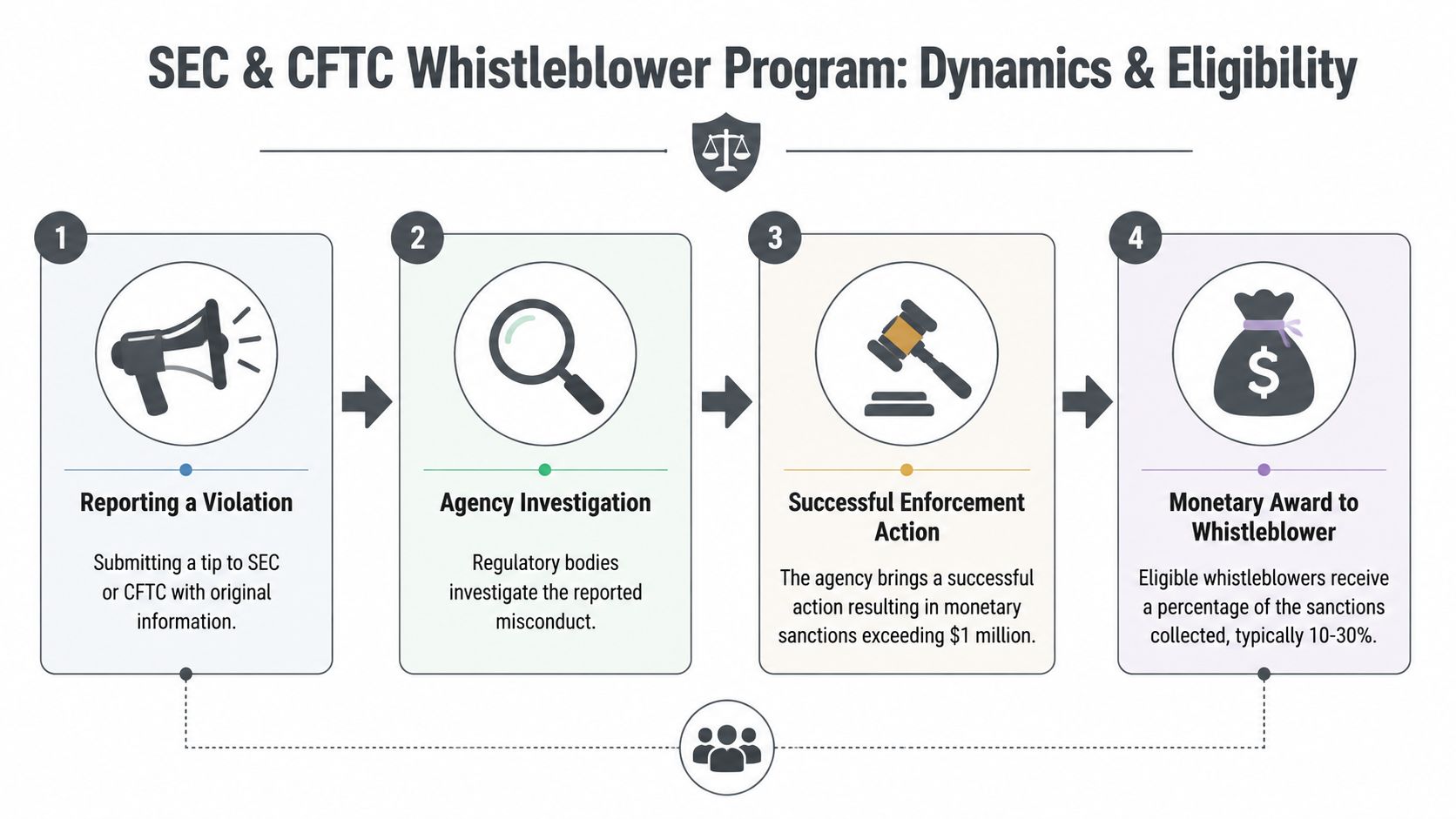
Rewards and retaliation are separate legal questions
Clients regularly assume that if they report wrongdoing and then get fired, sidelined, or pressured to resign, they automatically qualify for a bounty. They do not. Dodd-Frank creates one set of rules for monetary awards and another for anti-retaliation protection. Mixing them up causes bad reporting decisions early, when the record is still being created.
For an SEC or CFTC award, the person generally must provide original information voluntarily through the agency's formal whistleblower process, and the matter must lead to a qualifying enforcement result. An internal complaint to a branch manager, compliance officer, or HR may still matter a great deal, but it does not by itself create an award claim.
That distinction matters more than many professionals realize. In practice, the reward side of the statute is narrower. The anti-retaliation side is often the part that affects a person's job, licensing exposure, references, and exit negotiations.
Digital Realty changed the reporting analysis
The Supreme Court's decision in Digital Realty Trust, Inc. v. Somers sharpened a point that firms and employees still get wrong. Internal reporting alone does not place someone within Dodd-Frank's anti-retaliation provision as a statutory whistleblower. For that status, reporting to the SEC matters. NELA's analysis of Dodd-Frank after Digital Realty explains the practical effect clearly.
That does not mean internal reporting is always a mistake. It means sequence, documentation, and objective matter. In some cases, internal reporting helps show good faith and puts the firm on notice. In others, it gives the firm time to isolate the employee, shape the narrative, and control the documents before any external submission is made.
I usually tell clients to stop treating this as a moral question and treat it as a procedural one. If the goal is to preserve Dodd-Frank protections tied to SEC reporting, counsel should assess the TCR filing path before the dispute turns into a termination file.
Why Dodd-Frank is often stronger than SOX for financial professionals
For many financial professionals, the more important comparison is not reward versus retaliation. It is Dodd-Frank versus Sarbanes-Oxley.
SOX still matters, especially where internal reporting and Department of Labor procedures are central to the case. But Dodd-Frank often offers a better fit for advisors and employees outside the classic public-company model. NELA's analysis notes that Dodd-Frank's anti-retaliation statute of limitations is far longer than SOX's 180-day deadline, and it applies to any employer, not only public company employers. Those differences change settlement posture, filing strategy, and the amount of pressure a terminated professional can realistically bring to bear.
That is one reason this area is misunderstood. People hear "whistleblower" and think only about awards. For many advisors, the more valuable protection is the ability to bring a retaliation claim under a statute that is often broader and more forgiving than SOX.
The reporting channel should match the conduct
The legal theory should drive the reporting plan. If the issue involves fabricated performance numbers, concealed conflicts, unsuitable recommendations, or altered books and records, start by assessing whether the facts fit a securities fraud claim under federal and state law. A rushed internal complaint with vague language can weaken a later case if it fails to identify what regulation or fraud theory is in play.
Firms also make mistakes here. Many have written escalation procedures that look polished on paper and fail under pressure because supervisors, compliance, and HR are not following the same script. This policy management compliance guide is a useful reminder that reporting systems only work when the underlying policy process is clear, current, and enforced.
A practical summary:
| Scenario | What usually matters most |
|---|---|
| Internal report only | Employment protections may exist, but an SEC award path may not |
| TCR submitted with original information | Dodd-Frank whistleblower status and award eligibility are stronger if the matter leads to a qualifying action |
| Report made to another regulator or through a firm hotline only | Retaliation analysis and reward analysis should be handled separately |
The central mistake is assuming every whistleblower problem is one claim. It is usually at least two. One concerns whether the government will treat the person as a qualifying whistleblower for award purposes. The other concerns what happens to that person's job once the reporting starts.
Navigating Common Regulatory and Enforcement Issues
Not every Dodd-Frank problem begins with whistleblowing. Many start with supervision failures, off-channel communications, private securities transactions, outside business activity, inaccurate books and records, marketing issues, or a Form U5 that says more than it should. For advisors, those issues often collide. An internal complaint becomes a regulatory inquiry. A termination turns into a U5 dispute. A compensation fight suddenly includes allegations about conduct.
Where firms and professionals usually misjudge exposure
The first mistake is assuming that if the regulator hasn't contacted you yet, the issue is still internal. That's often wrong. By the time management interviews you, preserves records, or limits your access, the firm may already be thinking about disclosure, self-reporting, or termination strategy.
The second mistake is treating all whistleblower-related retaliation claims as if they follow the Sarbanes-Oxley timetable. They don't.
According to NELA's analysis of Dodd-Frank after Digital Realty, Dodd-Frank's anti-retaliation statute of limitations is 6 to 10 years, while Sarbanes-Oxley uses a 180-day deadline. The same analysis explains that Dodd-Frank covers “any employer”, while SOX is limited to public company employees.
That difference changes legal strategy for private-firm advisors, hybrid professionals, and employees outside classic public-company structures. In many matters, the issue isn't just urgency. It's choosing the right statute.
Many lawyers still give SOX-style advice in situations where Dodd-Frank may offer the broader and longer-running claim.
Common issue clusters in practice
When financial professionals come in with a “Dodd-Frank issue,” it's often one of these clusters:
- Regulatory inquiry plus employment fallout. You answered compliance questions, then lost accounts, title, or compensation.
- Internal reporting plus retaliation. You raised concerns about sales practices, valuation, disclosures, or supervision, then got pushed out.
- Termination plus U5 risk. The firm is separating from you and framing the exit in a way that may damage registration and recruiting.
- Practice breakup plus regulatory allegations. A transition dispute becomes a misconduct narrative.
For firms trying to reduce these risks before they mature into disputes, a structured policy review helps. A visual policy management compliance guide can be useful as a planning tool because it forces leadership to compare written supervision against actual workflows, approvals, and escalation practices.
The practical point is that Dodd-Frank lawyers don't just react to a filing deadline. They identify which framework governs the dispute, preserve the right evidence, and avoid forcing a client into the wrong statute out of habit.
How Dodd Frank Lawyers Provide Critical Support
A financial advisor reports a supervision problem, expects a routine compliance review, and instead gets cut out of key accounts, sidelined internally, and handed separation papers. At that point, the legal problem is no longer just regulatory. It is regulatory, employment-related, reputational, and often tied to future licensing and recruiting.
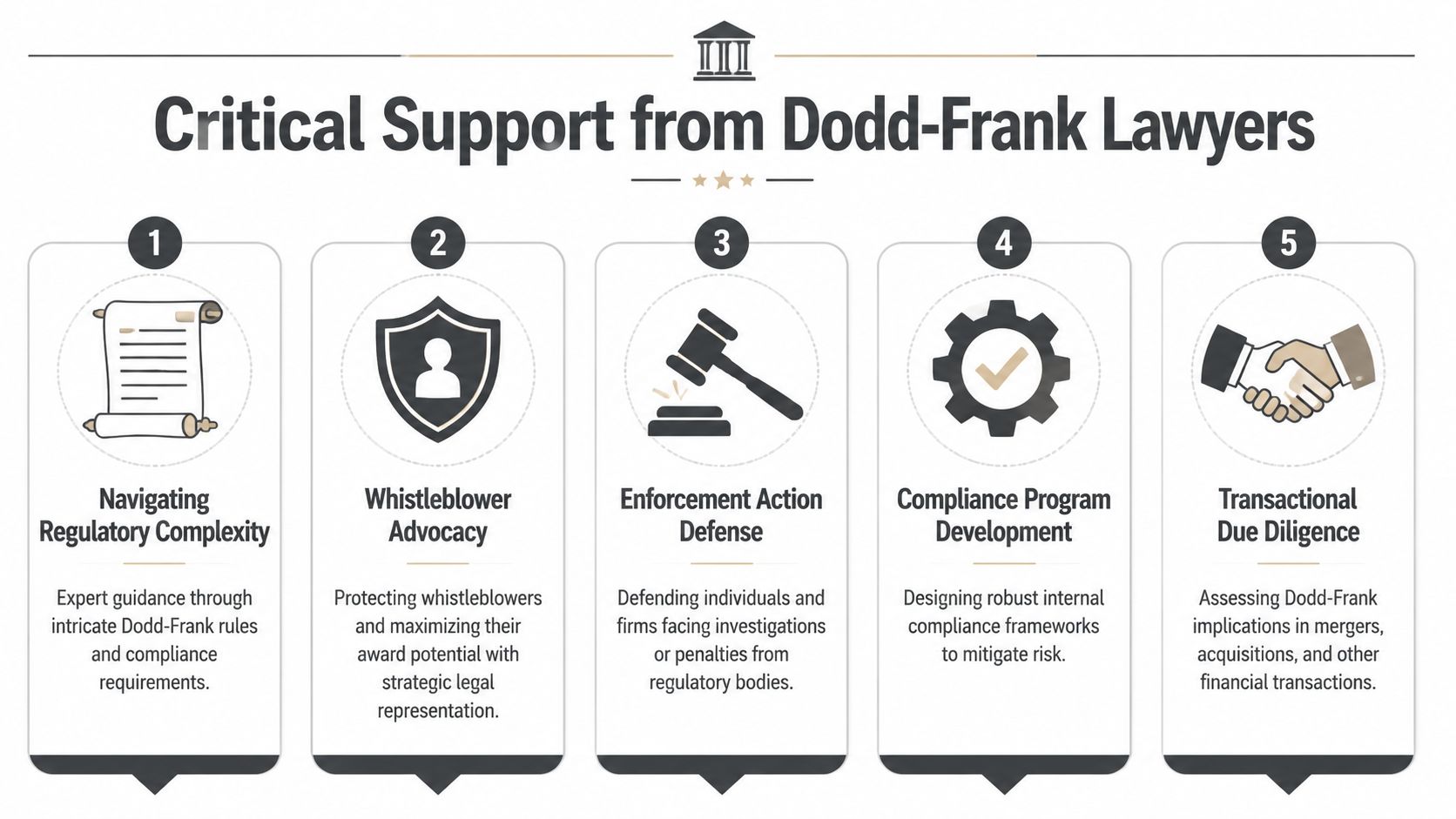
Good Dodd-Frank counsel handles that mix with discipline. The job is to identify which risk matters first, preserve options that can still be preserved, and avoid careless statements that create a second problem while trying to solve the first.
On the defense side, counsel narrows exposure and protects future mobility
If a regulator, firm, or arbitration claimant is building a conduct case, counsel starts by tightening the record. That includes written responses, interview preparation, document handling, compensation issues, and Form U5 language. For many advisors, the U5 is not a side issue. It affects recruiting, client transition, and how future employers read the dispute.
This work is practical, not abstract. A sales-practice review may also trigger deferred compensation disputes. A termination can become a registration problem. Settlement language that looks acceptable in the moment can create avoidable disclosure trouble a year later.
Lawyers who regularly handle these matters also know where business law and securities law overlap. A firm deciding who should coordinate internal investigations, employment decisions, and outside advisors can benefit from a broader look at what a business lawyer does in cross-functional disputes.
On the whistleblower side, counsel keeps the reward analysis separate from the retaliation case
This distinction is missed constantly.
A Dodd-Frank reward claim and a Dodd-Frank retaliation claim are related, but they are not the same case and do not turn on the same facts in the same way. One question is whether the information qualifies and leads to a successful enforcement result. Another is whether the employer took adverse action after protected conduct. A lawyer who blurs those tracks can damage both.
That matters because Dodd-Frank often gives financial professionals stronger retaliation protection than SOX in the situations that matter most. The filing path, available remedies, forum, and timing analysis can differ sharply. An advisor who has already reported concerns internally may still have a viable strategy, but only if counsel evaluates the retaliation claim on its own terms instead of treating it as a byproduct of the potential award.
Strong representation usually looks quiet at first. Careful intake, document preservation, timeline development, and disciplined reporting decisions do more for a client than broad accusations made too early.
Counsel also protects the business behind the dispute
For firms, the legal work often begins before anyone threatens a claim. Counsel reviews reporting channels, investigation protocols, compensation changes after complaints, supervisory escalation, and separation documents. The point is to match written procedures to what managers and compliance personnel do in practice.
A useful legal review usually covers these areas:
- Reporting structure. Who receives complaints, who documents them, and when outside counsel should take over.
- Retaliation screening. Whether pay changes, territory shifts, title changes, or access restrictions are reviewed after protected activity.
- Disclosure control. How the firm drafts U5 language, client explanations, and regulator correspondence.
- Transaction and recruiting risk. Whether mergers, acquisitions, or team moves expose weak supervision or stale misconduct issues.
Some firms also need help rebuilding public-facing communications after a dispute or investigation. That is a business function, not legal advice, but it still affects how the firm stabilizes after the matter. Resources like Explore our marketing solutions can help leadership address that operational side without confusing it with legal strategy.
A Hiring Checklist for Your Legal Counsel
Choosing among Dodd-Frank lawyers isn't about finding the person who sounds most confident on the phone. It's about finding counsel who understands securities regulation, employment retaliation, and the business realities of an advisory practice at the same time.
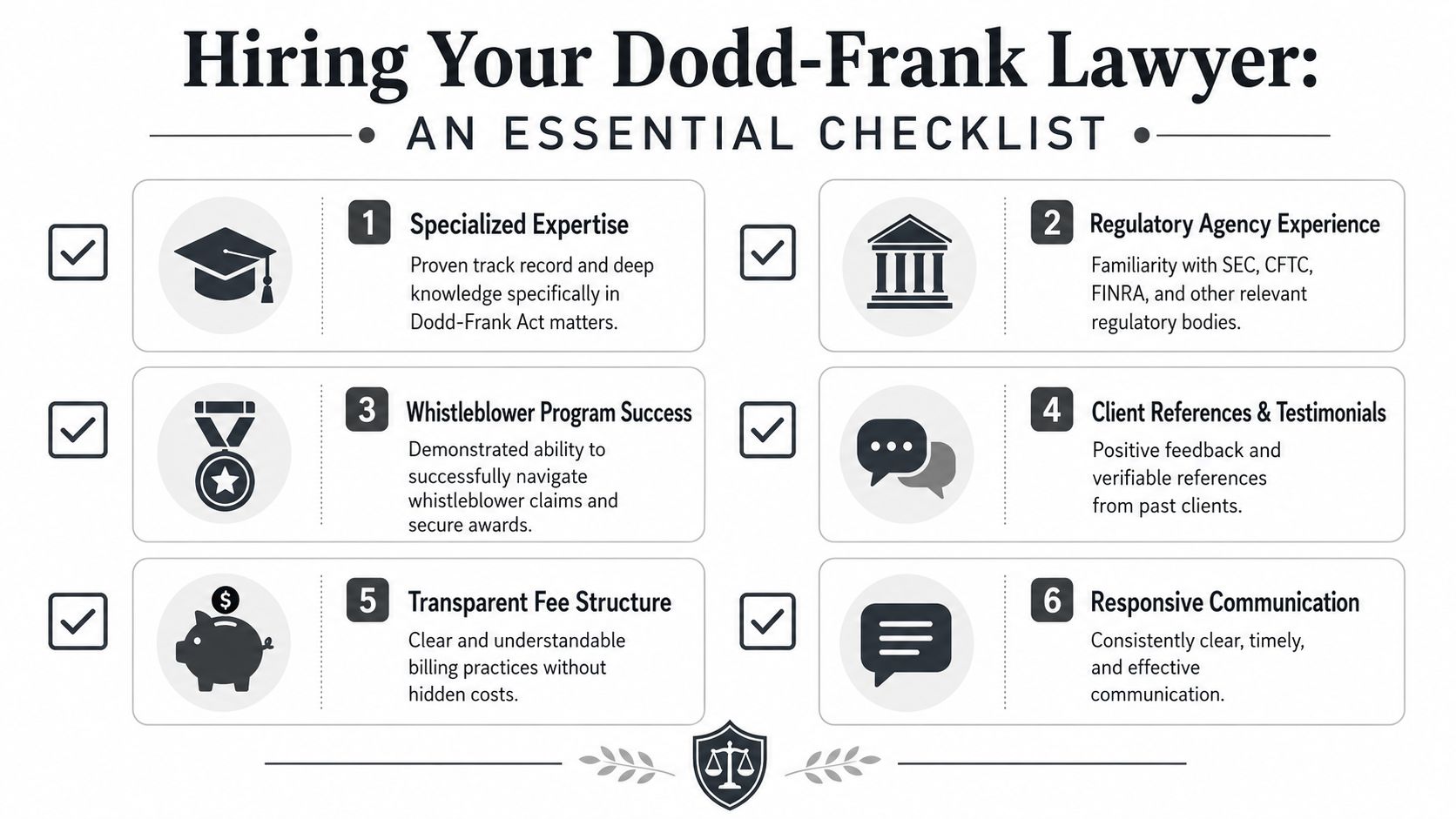
Questions worth asking before you sign
Use a short, direct checklist.
- Agency experience. Have they handled matters involving the SEC, CFTC, and FINRA, not just general employment disputes?
- Whistleblower precision. Can they explain the difference between a reward claim, an anti-retaliation claim, and a U5 or termination dispute without collapsing them together?
- Forum strategy. Have they worked in court, arbitration, and regulatory investigations, and do they know when each forum shifts the strategic advantage?
- Industry fluency. Do they understand production credits, deferred compensation, promissory notes, branch supervision, outside business activity, and recruiting disputes?
- Writing judgment. How do they approach regulator responses, internal investigation reports, and negotiated disclosure language?
- Practical responsiveness. Will they help you make decisions quickly when your access is cut off, your book is in play, or your firm is pressuring you to sign?
A bad fit usually shows up early
Watch for warning signs. If a lawyer talks only about headline whistleblower awards, they may not understand the employment side. If they treat every retaliation issue as SOX, they may miss a stronger Dodd-Frank route. If they dismiss U5 language as secondary, they don't understand brokerage reality.
A useful baseline is whether counsel can clearly explain the role a business lawyer should play when regulatory, employment, and firm-governance issues overlap. In this space, narrow advice creates wide problems.
Frequently Asked Questions for Financial Advisors
Is a FINRA complaint the same as an SEC whistleblower submission
No. They serve different purposes. A FINRA complaint may raise conduct issues, but an SEC whistleblower claim depends on the federal whistleblower framework and the reporting mechanics that go with it. If your objective is protection under that framework, the reporting route must match the legal strategy.
Can my employment agreement waive my right to a Dodd-Frank jury trial
Not if the claim falls within the protection described earlier from the linked legal analysis. That analysis explains that jury trials are explicitly permitted and can't be waived by employment agreements or pre-dispute arbitration clauses for the relevant retaliation claims under that framework.
I reported internally. Do I automatically qualify for a reward
No. Internal reporting and reward eligibility are not the same thing. Reward eligibility turns on the formal requirements tied to a qualifying SEC or CFTC matter, not merely on whether you raised a concern in good faith.
I work for a private firm. Does Dodd-Frank still matter to me
Often, yes. As discussed earlier, Dodd-Frank can reach beyond public-company settings in ways many professionals overlook. That's one reason private-firm advisors and employees shouldn't assume SOX is the only statute worth analyzing.
If my firm retaliated, what should I do first
Preserve documents lawfully, stop casual explanations by text or email, and get the reporting sequence reviewed quickly. Don't assume the firm's internal characterization of events is accurate or final.
Do Dodd-Frank lawyers also handle business-side disputes around the same event
They should be able to spot them. In real cases, the same facts can affect compensation, separation agreements, customer communications, U5 language, and regulatory exposure. Treating each issue in isolation usually costs more later.
If you want to discuss your business law matter, contact Kons Law at (860) 920-5181.

