
When someone owes you money, it can feel like your hands are tied. A creditors' rights lawyer is the legal expert who unties them. They're far more than just a "debt collector"; they are specialists who use the full force of the legal system to turn your unpaid invoices and outstanding loans back into cash in the bank.
What Does a Creditors' Rights Lawyer Actually Do?
Think of a creditors' rights lawyer as the strategist for your accounts receivable. Their job is to protect your company's financial health by methodically and legally pursuing what you're owed. They know the rules, they know the courts, and they know how to get results.
Imagine your unpaid debt is money locked away in a safe, and the debtor isn't handing over the key. A creditors' rights attorney knows every legal combination to get that safe open. They have a whole toolkit of strategies, and they always start with the most direct, cost-effective options first.
The Path to Recovery
Getting your money back isn't a single action—it's a process. A lawyer who specializes in this area will walk you through a series of steps, each one escalating if the last one didn't work. The ultimate goal is always to recover your funds as efficiently as possible while keeping you on solid legal ground.
This journey almost always includes these key stages:
- The Initial Demand: It starts with a formal demand letter. This isn't just a reminder; it's a legal document that shows you're serious.
- Negotiation and Settlement: Before heading to court, a good lawyer will try to work out a realistic payment plan or settlement that gets you paid without the time and expense of a lawsuit.
- Commercial Litigation: If talking doesn't work, the next step is filing a lawsuit to get a court judgment.
- Enforcing the Judgment: This is the most critical part. A court victory is just a piece of paper until you enforce it. This is where your lawyer turns that paper into actual money.
At its heart, the work of a creditors' rights lawyer is about transforming a legal right to get paid into a real financial recovery. They close the gap between what you're owed on paper and the money that actually hits your account.
This structured approach makes sure no stone is left unturned. For any local business, understanding the basics of navigating debt collection in Connecticut is the perfect starting point. Each phase demands specific legal knowledge and a strategic game plan to give you the best shot at success.
If you want to discuss your business law matter, contact Kons Law at (860) 920-5181.
The Debt Recovery Playbook
A creditors' rights lawyer doesn't just jump straight into a lawsuit. Instead, we work from a clear, escalating strategy designed to recover what you're owed as efficiently as possible. It’s a methodical process that starts with the simplest, most cost-effective measures before moving to more forceful legal actions.
Think of it as a playbook where each step is a calculated move designed to maximize your chances of getting paid. The whole process flows logically from negotiation to litigation and, finally, to enforcement.
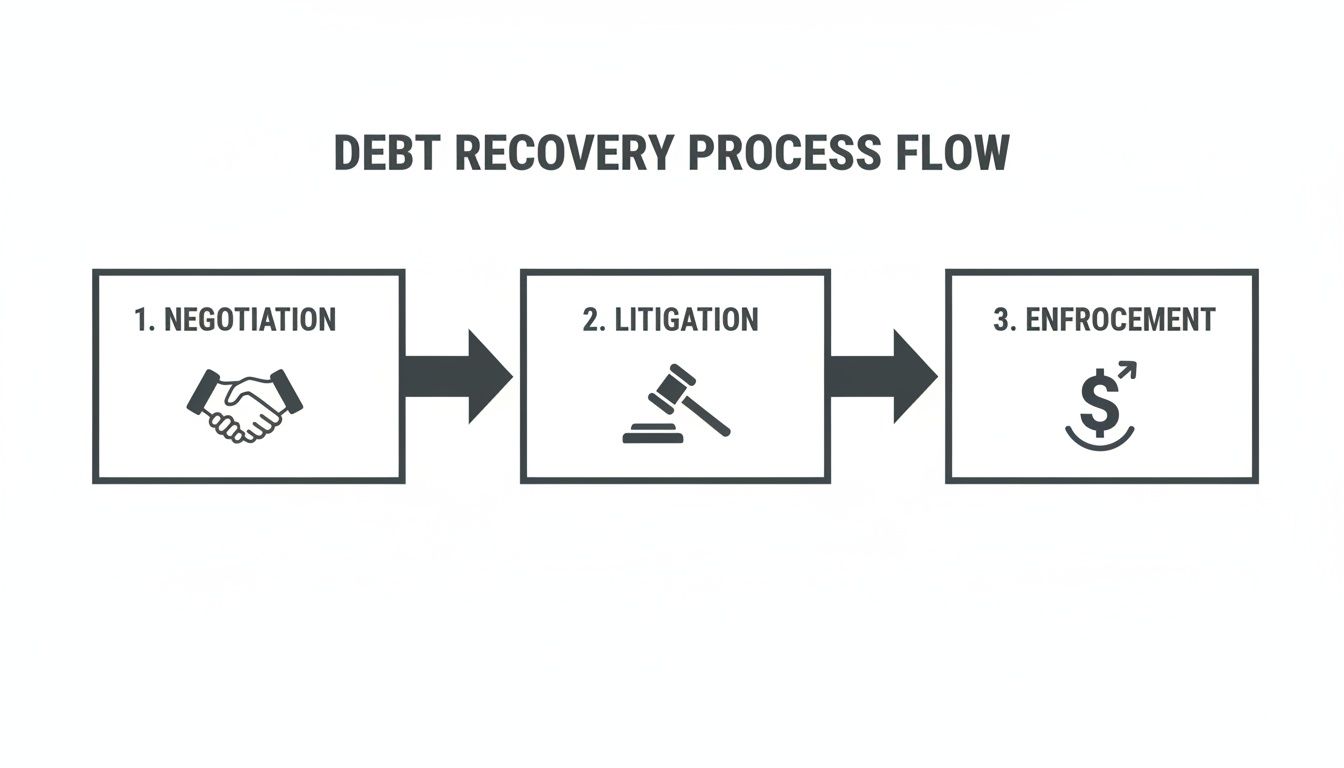
This visual shows how each stage builds on the last, giving you a clear path from the initial dispute all the way to recovering your funds.
Starting With the Demand Letter
The first tool we pull from the playbook is the formal demand letter. This is so much more than a simple reminder about an overdue invoice. When it arrives on law firm letterhead, it signals that things have escalated and you are fully prepared to take legal action.
It puts everything on the record: the official debt, a hard deadline for payment, and a clear warning of what comes next if the deadline is missed.
Often, this single action is enough to get a debtor's attention. Leveraging a powerful template demand letter is a great first step, as it shows you mean business without the immediate expense of court proceedings. For a deeper look at this crucial first stage, check out our guide on how to collect unpaid invoices and protect your business.
Negotiation and Settlement Strategies
If the demand letter doesn't get the job done, the next step is usually negotiation. A skilled creditors' rights lawyer acts as your advocate, working to secure a favorable settlement or a realistic payment plan. The goal here is to find a practical solution that avoids the time and expense of a full-blown lawsuit.
An attorney can often negotiate terms that you might not get on your own, such as:
- Lump-Sum Settlements: Agreeing to a reduced, one-time payment to close out the debt quickly.
- Structured Payment Plans: Creating a legally binding agreement for the debtor to pay off the balance over a set period.
- Consent Judgments: Getting a court judgment by agreement, which can be enforced immediately if the debtor misses a payment.
This phase requires a delicate balance of being firm but flexible, all while aiming to recover as much as possible without having to file a lawsuit.
Here's a quick comparison of the most common debt recovery methods to help you see how these different approaches stack up.
Comparing Debt Recovery Methods
| Remedy | Typical Timeline | Relative Cost | Best For |
|---|---|---|---|
| Demand Letter | 1-2 weeks | Low | Initial, cost-effective attempts when the debtor may be responsive. |
| Negotiation/Settlement | 2-6 weeks | Low to Moderate | Resolving disputes amicably when both parties want to avoid litigation. |
| Litigation | 6+ months | High | Complex cases or when the debtor is completely unresponsive to other methods. |
| Judgment Enforcement | Varies widely | Moderate to High | Turning a court victory into cash when the debtor refuses to pay the judgment. |
This table illustrates that there isn't a single "best" approach; the right strategy depends entirely on the specifics of your case, the debtor's behavior, and your ultimate goals.
When Litigation Becomes Necessary
When all other avenues are exhausted, we move to commercial litigation. This means filing a lawsuit to get a legal judgment against the debtor. Recent data shows just how critical this step has become; litigation for things like contract disputes and debt collection has surged, now making up nearly 40% of all lawyer work hours. This trend highlights how essential litigation is for resolving tough financial disputes.
A court judgment is the ultimate validation of your claim. It transforms your invoice from a private agreement into a legally enforceable order from the court, opening the door to powerful enforcement tools.
The entire point of litigation is to secure that judgment. It's the key that unlocks the final, most critical phase of the recovery playbook: turning that legal win into actual cash in your bank account.
If you want to discuss your business law matter, contact Kons Law at (860) 920-5181.
Turning a Court Judgment Into Cash
Winning a lawsuit feels like the finish line, but it’s really just the final lap. You have a court judgment in hand, which is a massive victory, but that piece of paper doesn't automatically wire money into your business account. This is where a skilled creditors' rights lawyer steps in to handle the most critical phase: judgment enforcement.
Think of the judgment as the architect's approved blueprint. Now, you need a master builder to actually construct the path to your money. Without this enforcement stage, your hard-won court victory is, frankly, just symbolic. The real goal is to legally compel a non-compliant debtor to pay what the court has ordered them to pay.

Key Tools for Judgment Enforcement
An experienced attorney has a whole toolkit of powerful mechanisms to turn that judgment into actual cash. The right tool for the job always depends on what we know—or can find out—about the debtor's assets and financial situation. Navigating these options requires a precise touch and an intimate understanding of Connecticut's court rules.
Common enforcement actions we use include:
- Bank Executions: This is often the cleanest shot. It allows us to legally seize funds directly from the debtor's known bank accounts. If we have the account info, it's one of the fastest and most effective ways to satisfy the debt.
- Property Liens: By placing a lien on the debtor's real estate, we essentially secure your claim against their property. This means the debtor can't sell or refinance their property without paying your judgment first. It puts you in a powerful position.
- Wage Garnishments: If the debtor is an individual earning a regular paycheck, we can get a court order forcing their employer to withhold a portion of their wages and send it directly to you. This continues until the entire debt is settled.
These aren't simple requests you can just fill out on a form. They are formal legal actions that must be filed perfectly. Even a minor paperwork error can cause significant delays or get the action thrown out entirely, which is exactly why you need a professional handling it.
Uncovering Hidden Assets
But what if you don't know where the debtor is keeping their money? This is a common problem. A creditors' rights lawyer can initiate what's called a judgment debtor examination. This is a court-supervised hearing where the debtor is legally required to show up and answer questions about their finances, all under oath.
A judgment debtor examination forces total transparency. The debtor has to disclose everything—bank accounts, property, income sources, and other assets—giving us the roadmap we need to execute the judgment.
This process is an incredibly powerful discovery tool that often uncovers assets the debtor was trying to conceal. As soon as those assets are identified, your lawyer can immediately move to seize them using the right enforcement tool. Our guide on how to collect on a judgment dives even deeper into these strategies.
Ultimately, successfully collecting what you're owed requires persistence and deep local expertise. An attorney who knows the ins and outs of Connecticut's court procedures can accelerate the entire process and dramatically increase your chances of a full recovery.
If you want to discuss your business law matter, contact Kons Law at (860) 920-5181.
What’s This Going to Cost, and How Long Will It Take?
When you're staring at a delinquent account, two questions always jump to the front of the line: "How much will this cost me?" and "How long until I see my money?"
It’s a fair question. Pursuing a debt is an investment of both time and resources, and you need to know what you're getting into before you start. The honest answer is: it depends entirely on how the debtor responds.
Sometimes, a simple, firm demand letter is all it takes to get a check in the mail within a few weeks. That’s the best-case scenario—quick, straightforward, and relatively inexpensive. But if the debtor decides to ignore you, forcing the matter into court, the timeline can stretch out for months, sometimes even longer. Naturally, the costs go up with each step. A good creditors' rights lawyer will walk you through all these potential paths right from the start, so there are no surprises.
The Different Ways Lawyers Charge for Their Services
To help you plan, it's good to understand the common ways law firms structure their fees. Each model has its pros and cons, and the best fit depends on your specific situation. Getting a handle on how a lawyer retainer works is a great first step in budgeting for legal help.
You'll typically run into one of these three models:
- Hourly Rates: This is the traditional model. You pay the attorney for the actual time they put into your case. It’s common for complex litigation where it’s nearly impossible to predict how much work will be involved.
- Flat Fees: For routine, predictable tasks—like drafting that initial demand letter or filing a basic lawsuit—a lawyer might offer a single, all-in price. This gives you cost certainty for that specific service.
- Contingency Fees: Think of this as a "pay-for-performance" model. The attorney doesn’t charge you anything upfront. Instead, they take an agreed-upon percentage of whatever money they successfully recover for you. If they don't win, you don't owe them a fee for their time.
A contingency fee is powerful because it puts you and your lawyer on the exact same team. They only get paid when you get paid. This can be a huge advantage, especially when the unpaid debt has already put a squeeze on your cash flow.
Choosing the right fee structure is a strategic move. A flat fee might be perfect to kick things off with a demand letter, but a contingency arrangement often makes more sense for a complicated case involving judgment enforcement. Your lawyer should discuss these options openly with you to figure out what works best for your business and the debt you're trying to collect.
If you want to discuss your business law matter, contact Kons Law at (860) 920-5181.
How to Choose the Right Law Firm
Picking the right legal partner is probably the single most important decision you'll make in the whole debt recovery process. This isn't just about hiring a lawyer. It's about finding a strategic ally who gets your business, knows the local courts inside and out, and has a proven history of turning unpaid invoices into actual revenue.
The right firm acts as an extension of your own team, fully dedicated to protecting your bottom line.

There are over 1.3 million lawyers in the U.S., but creditors’ rights is a specific niche. For small and mid-sized businesses, finding a specialist who lives and breathes this work gives you a serious strategic edge. These firms are built for one thing: efficiently pursuing and recovering what you're owed. Learn more about these valuable lawyer statistics on Clio's blog.
Key Qualities to Look For
When you're vetting a potential creditors' rights lawyer, you need to zero in on a few core strengths that separate the great firms from the merely good ones. Your goal is to find a partner whose skills line up perfectly with your business objectives.
Look for these non-negotiable attributes:
- Deep Experience in Commercial Collections: Make sure the firm specializes in business-to-business debt. The rules, strategies, and even the tone are completely different from consumer collections, and you need someone who understands that world.
- A Strong Track Record of Success: Don't be shy about asking for case studies or examples of their work. A reputable firm should have no problem showing you how they’ve successfully enforced judgments and recovered funds for clients like you.
- Specific Knowledge of Connecticut Courts: Every state, and even every courthouse, has its own unique procedures and personalities. A local attorney who knows the landscape can navigate the system far more effectively and avoid costly delays.
- A Clear Communication Style: You need a lawyer who will keep you in the loop. Ask them point-blank how they report progress and how often you can expect to hear from them. The last thing you want is to be left in the dark.
Important Questions to Ask During a Consultation
That initial consultation is your opportunity to interview them, not the other way around. Come prepared with a list of questions that cut right to the heart of their process and philosophy. You need to find out if their approach fits your needs—are you trying to preserve a long-term business relationship, or is it time to take aggressive legal action? This is a critical step for anyone looking for a commercial litigation attorney near them.
Your ideal legal partner is one who not only has the right skills but also truly understands your ultimate business goal. They should be able to tailor their strategy to match your desired outcome, whether that's a quick, quiet settlement or a hard-fought court victory.
By focusing on real-world experience, local knowledge, and clear communication, you can find a true partner who is committed to recovering what you are rightfully owed.
If you want to discuss your business law matter, contact Kons Law at (860) 920-5181.
Let's Protect Your Business and Recover What You're Owed
Getting paid is the lifeblood of any business. When invoices go unpaid, it’s not just an accounting problem—it disrupts your cash flow and threatens the stability you’ve worked so hard to build. This is where a skilled creditors' rights lawyer becomes your most important partner.
An experienced attorney provides the legal strength and strategic insight needed to navigate the entire process, from sending the first demand letter to enforcing a court judgment. They’re the ones who turn past-due accounts back into real revenue.
Choosing the right firm is about more than just hiring a lawyer; it's about finding a team that digs in to understand your goals and has a proven track record of executing successful recovery plans. The need for this kind of focused legal help is huge. In the United States, the Bankruptcy Lawyers & Attorneys industry is a multi-billion dollar market, a number that really drives home how often creditors need specialists to protect their financial interests. You can discover more about the legal services industry on IBISWorld.
Bringing in a professional creditors' rights lawyer isn't just an expense—it's an investment in your company's financial health. It’s about taking firm, decisive action to protect your assets and keep your business on solid footing.
Don't let unpaid debts put your business at risk. The right attorney can be the difference between writing off a major loss and achieving a full recovery. If you’re ready to discuss your business law matter, give us a call at Kons Law at (860) 920-5181.
Common Questions About Creditors' Rights
Going after a debt legally can feel like stepping into a whole new world, so it's only natural to have questions. Getting straight answers helps you make smart decisions for your company’s bottom line and sets the right expectations for the road ahead. Here are some of the most common questions business owners have when they're thinking about bringing in a creditors' rights lawyer.
When Should I Hire a Lawyer Instead of Using a Collection Agency?
You bring in a lawyer when phone calls and letters just aren't cutting it anymore. A collection agency's reach stops where the courthouse doors begin. A creditors' rights lawyer is what you need when the debt is substantial, the debtor is pushing back on the claim, or you can see a lawsuit on the horizon.
Agencies simply can't take legal action—they can’t file liens, sue anyone, or enforce a judgment from the court. If your debtor is giving you the silent treatment or arguing every point, a letter from a law firm signals you mean business and often gets them to pay up. For any situation that involves real legal defenses or trying to collect after you’ve won in court, an attorney isn't just a good idea—it's a necessity.
What Is the Difference Between Commercial and Consumer Debt?
The main difference is the rulebook you have to play by. Commercial debt is money one business owes another for things like goods or services. Consumer debt, on the other hand, is what an individual owes for personal expenses—think credit cards, medical bills, or a car loan.
This isn't just a technicality; it's a critical distinction. Consumer debt collection is a minefield of federal regulations, especially the Fair Debt Collection Practices Act (FDCPA), which puts tight restrictions on how and when you can contact someone. Commercial collections are a different ballgame with far fewer rules, which allows for a more direct and firm approach. An experienced lawyer knows exactly where those lines are drawn and builds their strategy around them.
The legal playbook for collecting from a business is fundamentally different from collecting from an individual. Getting these rules wrong can land a creditor in legal hot water, making professional guidance indispensable.
What Happens if the Debtor Files for Bankruptcy?
The moment a debtor files for bankruptcy, the court issues an "automatic stay." It’s like a legal stop sign that immediately freezes all collection efforts—every phone call, lawsuit, and enforcement action has to stop cold. At this point, your creditors' rights lawyer's job changes completely, but it becomes more important than ever.
Your attorney stops being a collector and becomes your champion inside the bankruptcy system. Their new game plan will be to:
- File a Proof of Claim: This is the official way to tell the court, "Hey, they owe us money," making sure you're in line for any payouts.
- Challenge the Discharge: If you have proof the debtor committed fraud, your lawyer can argue that your specific debt shouldn't be wiped away with the others.
- Maximize Your Recovery: They'll fight for your interests to get you the largest possible piece of the pie from whatever assets are left or from the debtor's repayment plan.
Bankruptcy doesn't automatically mean the debt is a total loss, but it absolutely means you need an expert in your corner fighting for every dollar.
If you want to discuss your business law matter, contact Kons Law at (860) 920-5181.
