It’s a common point of confusion, but the terms corporate law and business law aren't just interchangeable legal jargon. While they definitely overlap, they describe two distinct legal fields. Think of it this way: business law is the big picture, the entire universe of legal issues a company can run into. Corporate law is one very specific, very important star within that universe.
Distinguishing Corporate Law from Business Law
Let's use an analogy. Business law is your general practitioner. This is the lawyer you see for the day-to-day health of your company. They handle a huge range of commercial needs that keep your business running smoothly—things like drafting customer contracts, navigating employment issues, protecting your trademarks, or making sure you're complying with industry regulations. It's the legal framework for any commercial operation, whether you're a sole proprietor, a partnership, or an LLC.
Corporate law, on the other hand, is the specialist—the heart surgeon. This area of law deals exclusively with the legal DNA and internal mechanics of a corporation. It’s a practice focused on the complex, high-stakes events that are unique to the corporate structure.
The Scope of Corporate Law
Corporate law is all about the architecture of the corporation itself. The focus is technical and structural, making sure the entire entity is built and operates according to a strict set of legal blueprints.
The main areas include:
- Entity Formation: Walking founders through the intricate process of legally incorporating a business, which includes critical decisions like choosing between an S-corp or C-corp structure.
- Corporate Governance: Writing the internal rulebook. This means drafting bylaws, clearly defining shareholder rights, and spelling out the fiduciary duties of the board of directors.
- Major Transactions: Steering the ship through transformative events like mergers, acquisitions (M&A), and the sale of company stock or major assets.
Here is a quick comparison to help crystallize the difference.
Corporate Law vs Business Law At a Glance
This table breaks down the primary scope and common activities for each legal field, offering a straightforward look at how they differ in practice.
| Legal Area | Primary Focus | Common Issues Handled |
|---|---|---|
| Business Law | External commercial activities & operations | Contracts, employment, intellectual property, collections, regulatory compliance |
| Corporate Law | Internal structure & major life-cycle events of a corporation | Entity formation, governance (bylaws, board duties), M&A, stock sales |
As you can see, the focus is fundamentally different. One looks outward at how the business interacts with the world, while the other looks inward at how the corporation is structured and run.
Visualizing the Relationship
This concept map does a great job of showing how business law is the broader field that contains the more specialized discipline of corporate law.
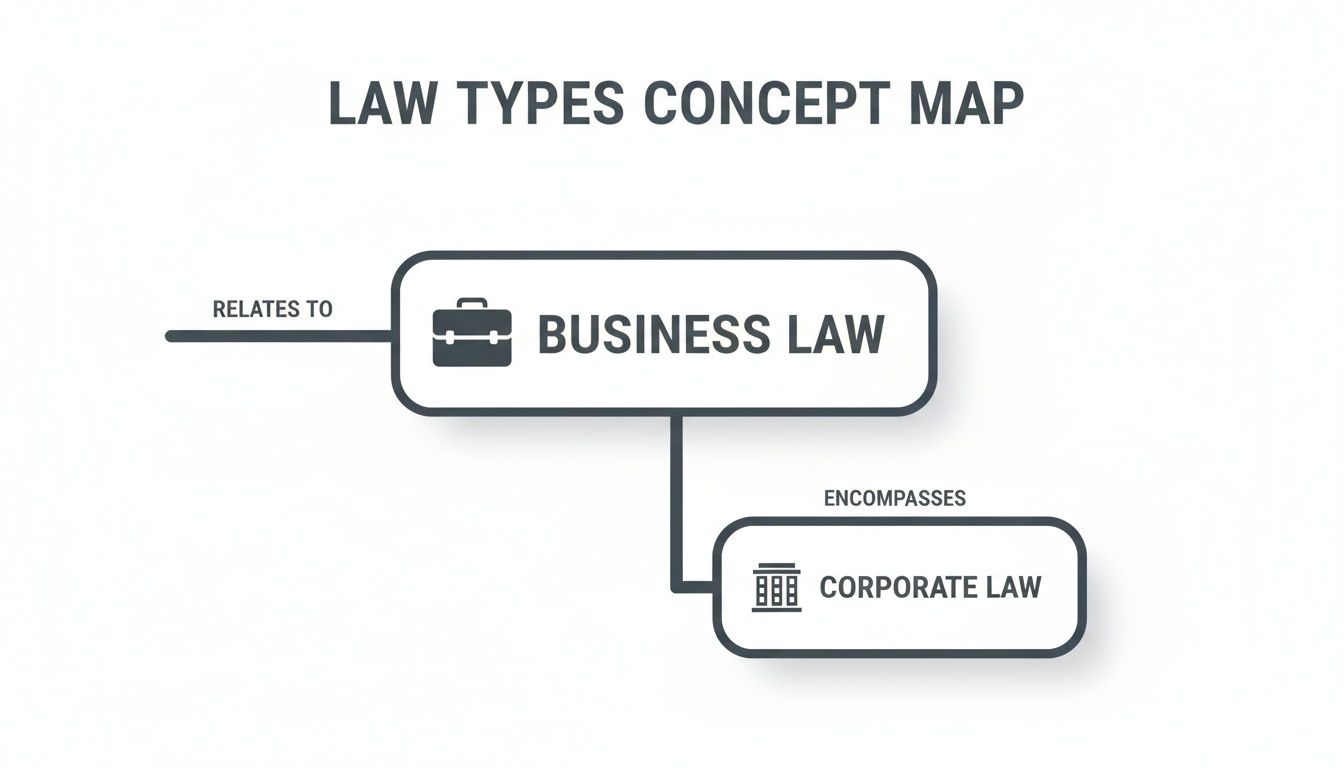
The key takeaway is that while all corporate law matters fall under the wide umbrella of business law, the reverse isn't true. For example, drafting a simple vendor agreement is purely a business law issue; it has nothing to do with the complex rules of corporate governance. Understanding this difference is the first step in getting the right legal help for your company's specific needs.
If you want to discuss your business law matter, contact Kons Law at (860) 920-5181.
The Blueprint for a Corporation: Formation and Governance
Think of an architect drafting a detailed blueprint before a single brick is laid. That's what corporate law does for a business—it provides the essential framework for building and maintaining a stable corporation. This all starts with entity formation, the critical first step that defines the company's financial and legal structure for years. It's so much more than just filing paperwork; it’s a strategic decision that touches everything from your tax bill to your personal liability.

Choosing the right corporate structure is everything. The two most common paths are the S-corporation (S-corp) and the C-corporation (C-corp), and each comes with its own set of pros and cons. This single choice dictates how your company is taxed, how profits get distributed, and who can even own a piece of it.
For instance, an S-corp lets profits and losses pass directly to the owners' personal income, dodging corporate-level taxes and the dreaded "double taxation." But S-corps have tight rules, including a cap of 100 shareholders who must all be U.S. citizens or residents. A C-corp, on the other hand, has unlimited growth potential with zero restrictions on shareholders but gets taxed at both the corporate level and again when profits are distributed to shareholders.
Laying the Foundation with the Right Structure
Picking the right structure demands a hard look at your long-term goals. Are you planning to chase venture capital funding down the road? Investors almost always prefer a C-corp. Are you a small, closely-held business that values tax simplicity above all else? An S-corp might be the smarter play.
Let’s break it down side-by-side:
| Feature | S-Corporation (S-corp) | C-Corporation (C-corp) |
|---|---|---|
| Taxation | Pass-through taxation (avoids corporate tax) | Taxed at the corporate level, then dividends are taxed |
| Shareholders | Max 100; must be U.S. citizens/residents | No limit on number or type of shareholders |
| Ownership | Generally owned by individuals | Can be owned by other corporations and entities |
| Investor Appeal | Less attractive to venture capitalists | The standard for venture capital and institutional investors |
Establishing the Rules with Corporate Governance
Once the company is formed, the focus of corporate law shifts to corporate governance. This is basically the internal "rulebook" that dictates how the company runs, makes decisions, and balances the competing interests of its stakeholders—shareholders, directors, and officers. Without solid governance, even the most brilliant businesses can crumble from internal fights and a lack of clear direction.
The key pieces of corporate governance include:
- Drafting Bylaws: These are the ground rules for the corporation's internal affairs, spelling out procedures for board meetings, voting rights, and officer duties.
- Defining Shareholder Rights: This involves creating shareholder agreements that clarify rights on voting, receiving dividends, and what happens when disputes arise.
- Board of Directors' Responsibilities: Corporate law clearly outlines the fiduciary duties of directors—the duties of care, loyalty, and good faith—to make sure they always act in the company's best interests.
Strong corporate governance isn't just about checking legal boxes. It's about building a resilient legal architecture that minimizes risk, heads off costly internal conflicts, and lays a clear path for sustainable growth.
This framework is absolutely vital. The global legal services market is projected to hit $1,006.53 billion by 2028, a number that speaks volumes about the growing complexity of running a business today. For companies trying to get formation and governance right, this highlights the immense value of getting specialized legal help.
Ultimately, you can't have one without the other. Skipping proper formation or governance is like building a skyscraper on a shaky foundation. To dig deeper into these internal rules, check out our guide on what corporate governance entails. A well-built corporate entity, guided by clear and fair rules, is one that’s positioned for success.
If you want to discuss your business law matter, contact Kons Law at (860) 920-5181.
Navigating High-Stakes Corporate Transactions
Once a company is up and running, corporate law shifts from the daily grind of governance to the defining moments of its lifecycle. These are the high-stakes, bet-the-company transactions that can chart a new course for the future, and none are bigger than Mergers & Acquisitions (M&A).
An M&A deal is a world away from a simple handshake and a press release. It's a grueling, complex process that, if done right, can unlock incredible value. Get it wrong, and it can lead to disaster.

A poorly managed deal can easily saddle a company with unforeseen debts, culture clashes that tank morale, and crippling regulatory penalties. But a well-structured acquisition? That can accelerate growth, carve out a bigger piece of the market, and forge powerful new synergies. The stakes couldn't be higher.
Demystifying the M&A Process
The M&A journey isn't random; it follows a structured path where corporate and business law counsel are your essential guides. Every stage is designed to maximize value while sniffing out and neutralizing risk before it can do any damage.
Here's how it generally breaks down:
- Initial Due Diligence: This is the deep-dive investigation. The buyer’s team scrutinizes every inch of the target company—financials, contracts, intellectual property, and any potential liabilities hiding in the shadows.
- Company Valuation: Both sides come to the table to agree on a fair price. This involves complex financial models and market analysis to justify the numbers and terms.
- Negotiation and Structuring: Lawyers get to work drafting and hammering out the definitive agreements. They’ll structure the deal as either an asset sale or a stock purchase, each with vastly different tax and liability outcomes.
- Closing the Deal: This is the final step where all documents are signed, funds are wired, and legal ownership of the company or its assets officially changes hands.
A successful merger or acquisition comes down to precision. A lawyer’s job is to make sure every agreement is airtight, every potential risk is uncovered during due diligence, and every move complies with securities and antitrust laws. It’s all about protecting the business from future fallout.
This kind of careful legal work is more in demand than ever. In fact, law firm demand recently climbed 3.9% in a single quarter, driven largely by transactional work. Mergers and acquisitions led the pack with a 7.6% jump, a clear sign of just how many industries are being reshaped by these deals.
Beyond Mergers: Asset Sales and Stock Purchases
While M&A grabs the headlines, corporate law also governs other major transactions that change a company’s ownership or structure. For any business leader thinking about a big move, understanding the difference is crucial.
- Asset Sales: Just like it sounds, the buyer acquires specific assets—like equipment, inventory, or IP—but not the entire company. This is often a smart way to avoid taking on the seller's hidden liabilities.
- Stock Purchases: Here, the buyer purchases the seller’s shares, acquiring the whole company. That means they get all the assets, but just as important, they also inherit all the liabilities.
The choice between these two structures has massive legal and financial ripple effects. Getting it right requires diligent legal work to spot hidden risks before you sign on the dotted line.
For a deeper look into this critical phase, check out our mergers and acquisitions due diligence checklist. These are high-stakes events, and expert guidance is the best way to protect your interests.
If you want to discuss your business law matter, contact Kons Law at (860) 920-5181.
The Everyday Legal World of Business Law
While corporate law is about the big-picture architecture of a company, business law gets down to the nitty-gritty of daily commercial life. Think of it this way: if corporate law is the blueprint for your headquarters, business law is the set of rules that keeps everything inside running smoothly, safely, and profitably.
It’s the legal framework that governs every transaction, every hire, and every customer interaction. Business law is less about the company’s internal structure and more about its relationships with the outside world—the vendors, clients, and partners that make commerce happen.
Contracts: The Lifeblood of Your Business
At the absolute heart of business law, you'll find the commercial contract. Contracts are like the circulatory system of your company; they manage the vital flow of promises, obligations, and payments that keep the whole enterprise alive and kicking. A well-written agreement prevents confusion and gives everyone a clear roadmap if things don’t go as planned.
A poorly drafted contract, on the other hand, is just a ticking time bomb. Vague language or missing clauses can ignite costly disputes that drain your resources and tarnish your reputation. This is why effective business law counsel is so focused on proactive contract management.
This involves a few key activities:
- Drafting: Building clear, precise, and legally solid agreements from the ground up that protect your interests, whether for sales, services, or partnerships.
- Reviewing: Scrutinizing contracts from other parties to spot hidden risks, unfavorable terms, and potential liabilities before you sign on the dotted line.
- Negotiating: Skillfully advocating for terms that benefit your company, making sure the final deal is balanced and fair.
Navigating the Maze of Regulatory Compliance
Beyond contracts, business law demands a sharp eye for regulatory compliance. Every industry is tangled in a web of rules, and pleading ignorance simply won’t fly. From data privacy and employment law to specific industry regulations, staying compliant isn't optional.
Failing to comply can trigger steep fines, legal battles, or even a complete shutdown of your operations. For instance, employment laws dictate everything from hiring practices and wage requirements to workplace safety. One misstep can expose you to serious legal trouble. Good legal guidance helps you understand these obligations and put the right policies in place to stay on the right side of the law.
Resolving Conflicts When Things Go Wrong
Even with the best contracts and compliance plans, disputes are an inevitable part of business. This is where commercial litigation and dispute resolution come in. Business law provides a structured process for sorting out conflicts when one party doesn't hold up their end of the bargain.
But not every disagreement has to end in a courtroom showdown. In fact, there are several ways to find a solution.
Proactively managing legal risks means having a plan for disputes before they ever arise. The goal is to resolve conflicts efficiently and cost-effectively, so you can get back to what you do best—running your business.
An experienced lawyer will help you choose the right path forward:
- Mediation: A neutral third party helps both sides find a solution they can agree on. It's almost always faster and cheaper than going to court.
- Arbitration: A private arbitrator hears the evidence and makes a binding decision. It’s more formal than mediation but still a step below litigation.
- Litigation: If all else fails, the dispute heads to court for a judge or jury to decide. This is the most formal and often the most expensive option.
This complex environment is placing increasing pressure on companies. Today, corporate law departments are grappling with transformative pressures, as they must handle everything from mergers and compliance to litigation. This is especially critical for navigating the modern regulatory maze, which includes stricter rules on foreign direct investment and evolving cross-border tax regulations. For more detail on these trends, you can read a full report on how corporate regulations are changing on GlobalLawExperts.com.
If you want to discuss your business law matter, contact Kons Law at (860) 920-5181.
Handling Specialized Financial and Collection Matters
Beyond the day-to-day legal needs of a business, you'll eventually run into highly specialized issues that require a very specific kind of legal know-how. For many companies, two of the most critical are navigating the thorny world of financial services law and keeping cash flow healthy through smart debt collection.
These aren't your typical legal hurdles. They are high-stakes situations where one wrong move can have immediate and severe financial consequences. Whether you're an investor trying to claw back losses from professional misconduct or a business owner staring at a stack of unpaid invoices, having the right legal strategy is everything.
Navigating FINRA Securities Arbitration
If you've suffered major financial losses because of a broker's or financial advisor's negligence or outright fraud, your main path to justice usually isn't a traditional courtroom. Instead, it's through the Financial Industry Regulatory Authority (FINRA). This is a mandatory arbitration forum where the vast majority of disputes between investors and brokerage firms get handled.
The process is complex, with its own unique rulebook. An investor might bring a claim for a number of reasons, like:
- Unsuitability: The broker pushed investments that were completely wrong for your risk tolerance or financial situation.
- Churning: The broker was trading excessively just to rack up commissions, with no real benefit to you.
- Misrepresentation: You were given false or misleading information about an investment, which led directly to your losses.
Winning a FINRA arbitration requires a deep understanding of securities law and the forum's specific procedures. It’s a battle of detailed evidence, expert testimony, and making a persuasive case to a panel of arbitrators. Going it alone means you're at a massive disadvantage against the well-funded legal teams that big financial institutions have on retainer.
The Importance of Collections and Creditors’ Rights
On the operational side of your business, almost nothing is more fundamental than getting paid for your work. When customers don't pay, it can choke your cash flow and put the financial stability of your entire company at risk. This is exactly where a systematic, legally-sound approach to collections and creditors’ rights becomes essential.
A professional collections strategy is much more than just sending a few reminder emails. It's a progressive legal process designed to recover what you're owed efficiently and, just as importantly, in full compliance with the law.
A proactive and legally sound collections process isn't just about chasing down debt; it's a core business function that directly protects your company's revenue and financial health. Ignoring overdue accounts is essentially giving away your hard-earned profits.
An effective legal collections strategy usually follows a clear and escalating path:
- Demand Letters: The first step is often a formal, legally drafted letter. It clearly states the amount owed and what will happen if it isn't paid. This professional approach signals you're serious and often gets the bill paid without any more fuss.
- Litigation: If those demands are ignored, the next step is to file a lawsuit to get a legal judgment against the debtor.
- Judgment Enforcement: Getting the judgment is only half the battle. A skilled attorney will then use powerful legal tools—like wage garnishments, bank levies, or property liens—to actually enforce that judgment and get your money. Understanding these tools is key; you can learn more about specific tactics like what a charging order is and how it can be used to satisfy a judgment.
If you want to discuss your business law matter, contact Kons Law at (860) 920-5181.
Knowing When to Call a Business Law Attorney
Too many business owners treat lawyers like an emergency service—you only call when the building is already on fire. Frankly, that’s one of the most expensive mistakes you can make. The real value of smart corporate and business law counsel isn't just about damage control; it's about getting ahead of problems before they ever start.
Think of legal advice as a strategic investment in your company’s future, not just an expense line item. Recognizing the right moments to pick up the phone will save you from sleepless nights, lost revenue, and messy disputes down the road. It’s about finding a firm that gets what you’re trying to build and helps you sidestep the landmines along the way. Waiting until you’re served with a lawsuit means you’re already on the defensive.
Key Trigger Events for Seeking Legal Counsel
Certain moments in a business's lifecycle are critical inflection points. These are the times when one wrong move can echo for years, and getting an expert opinion isn't just a good idea—it's essential. Getting an attorney involved early ensures your foundation is solid and your interests are protected from day one.
Here are a few of the most common times you should be calling for legal advice:
- Forming a New Company: The entity you choose—LLC, S-corp, C-corp—has massive implications for your personal liability, taxes, and future ability to raise money. This isn't a decision to make lightly.
- Signing a Major Contract: Whether it's a huge new client, a critical supplier, or a strategic partner, a poorly drafted contract can lock you into unfavorable terms and expose your business to incredible risk.
- Raising Capital: Bringing on investors means navigating a minefield of complex securities laws. A misstep here can lead to crippling fines and turn your new partners into adversaries.
- Facing a Potential Lawsuit: The moment you get a demand letter or even a hint that a conflict is escalating, you need a game plan. Immediate legal advice is your first line of defense.
Shifting to a Proactive Mindset
When you start using legal support as a proactive tool, you fundamentally change how you run your business. Instead of constantly putting out fires, you’re building a legal framework that shields your operations and clears the path for growth. A good relationship with your law firm provides far more than just crisis management; it gives you ongoing strategic guidance.
The smartest business leaders don't wait for a crisis to find legal support. They build a relationship with a law firm early, using their counsel to identify risks, seize opportunities, and navigate complex decisions with confidence.
This proactive approach turns your lawyer into a key member of your advisory team. They can spot hidden liabilities in a potential acquisition, make sure your hiring process is compliant, and help you structure deals that actually support your long-term vision. To get a better sense of the full range of support a legal partner can offer, you can learn more about what a business lawyer does in our detailed guide. Protecting your business starts with knowing when to ask for help.
If you want to discuss your business law matter, contact Kons Law at (860) 920-5181.
Have Questions? We Have Answers.
Running a business means you're constantly juggling questions about legal and financial matters. It's completely normal. Below are some of the most common questions we hear from business owners, along with straightforward answers to help you find your footing.
When Is the Right Time to Hire a Lawyer?
Honestly? The best time to get a lawyer is before you're convinced you need one.
Think of it like this: legal counsel is a proactive investment, not a reactive expense. Bringing an attorney on board early—when you're forming the company, negotiating a key contract, or getting ready to raise capital—sets you up for success. If you wait until you're served with a lawsuit or a partnership blows up, you're already on the defensive. That's a much more stressful and expensive place to be.
Do I Still Need a Corporate Lawyer if I Just Have an LLC?
Great question. While "corporate law" technically applies to S-corps and C-corps, the principles behind it—good governance and clear rules—are vital for any business.
For an LLC, this all comes down to the operating agreement. This document is your company's rulebook, defining everything from member roles and profit distributions to how major decisions get made. A skilled business law attorney is crucial for drafting an operating agreement that actually protects you and for handling all the other legal hurdles an LLC faces, like contracts and compliance.
What’s the Biggest Mistake You See Businesses Make?
Hands down, the most frequent and costly mistake is pulling generic contracts off the internet. Those one-size-fits-all templates are a ticking time bomb.
They almost never account for Connecticut's specific laws or the unique realities of your business and the deal you're trying to make. A poorly written contract can be completely unenforceable or, even worse, leave you wide open to massive financial and legal risk.
A custom-drafted contract isn't just a document; it's one of the most powerful risk management tools you have. It makes sure everyone is on the same page and gives you a solid foundation to stand on if a dispute ever pops up.
Can't My Business Just Handle Its Own Debt Collections?
You can certainly send a friendly reminder or two, but formal debt collection is a legal minefield. It's heavily regulated by strict state and federal laws, and one wrong move can backfire spectacularly.
An improper collection attempt can actually lead to a lawsuit against your company. Using a law firm ensures the entire process is handled professionally and legally—from drafting demand letters that get results to enforcing a judgment with tools like bank levies or property liens. This approach not only dramatically increases your chances of getting paid but also shields you from legal trouble.
If you want to discuss your business law matter, contact Kons Law at (860) 920-5181.
