
A founder often reaches Rule 504 at a very specific moment. Revenue may be starting to move, the product may be ready for launch, and the business needs outside capital, but a full registered offering is nowhere near practical. The raise is still private, still relatively small, and often built around people the company already knows.
That's where Rule 504 of Regulation D gets attention. On paper, it looks approachable. It can accommodate both accredited and non-accredited investors, and it doesn't force the issuer into the same federal disclosure structure that people associate with larger exempt offerings. For a small business owner or financial advisor helping a client think through private capital formation, that can sound like the clean answer.
The problem is that Rule 504 becomes more difficult the moment the offering stops being local and simple. The federal exemption is only part of the analysis. State law, resale restrictions, timing, documentation, and the risk that separate fundraising efforts get treated as one integrated offering all matter. Those are the issues that create significant exposure.
An Introduction to Small Business Capital Raising
Small businesses usually don't start by asking how to understand securities exemptions. They start with a practical need. The company needs inventory, payroll runway, manufacturing capacity, software development, or working capital to bridge to the next stage.
When bank financing isn't available or isn't enough, owners and advisors start looking at private offerings. That search often includes friends-and-family capital, angel checks, strategic investors, and other alternatives to VC funding that let a business raise money without pursuing traditional venture capital. For many issuers, the amount sought sits below the point where full SEC registration makes economic sense.
Why Rule 504 gets attention
Rule 504 is attractive because it was built for smaller offerings. It gives non-public companies a way to sell securities without registering the offering with the SEC, assuming the issuer qualifies and follows the exemption carefully. That "assuming" matters more than many summaries admit.
A lot of clients hear a simplified version of the rule. They hear that it allows smaller raises, that non-accredited investors can participate, and that it involves less federal process. All of that can be directionally true. It can also lead people to underestimate the compliance burden.
Practical rule: If your offering is likely to reach investors in multiple states, Rule 504 usually gets harder before it gets easier.
What experienced advisors focus on first
The first question isn't whether Rule 504 exists. The first question is whether it's the right exemption for the actual raise the company plans to conduct. That means looking at:
- Who the issuer is. Public companies and certain other issuers aren't eligible.
- Who the investors will be. The investor mix shapes risk, disclosure practice, and offering strategy.
- Where the investors are located. State law often determines whether the raise stays manageable.
- How the company intends to market the deal. Many issuers often make preventable mistakes in this area.
- What other offerings are happening around the same time. Separate rounds can create integration problems.
Rule 504 can work well in a narrow lane. A non-reporting business, raising a modest amount, from a controlled investor group, with careful state law review, may find it useful. A business trying to advertise broadly across several jurisdictions often discovers that the exemption is less straightforward than advertised.
That gap between the summary and the actual execution is where deals get into trouble.
What Is Rule 504 and Who Can Use It
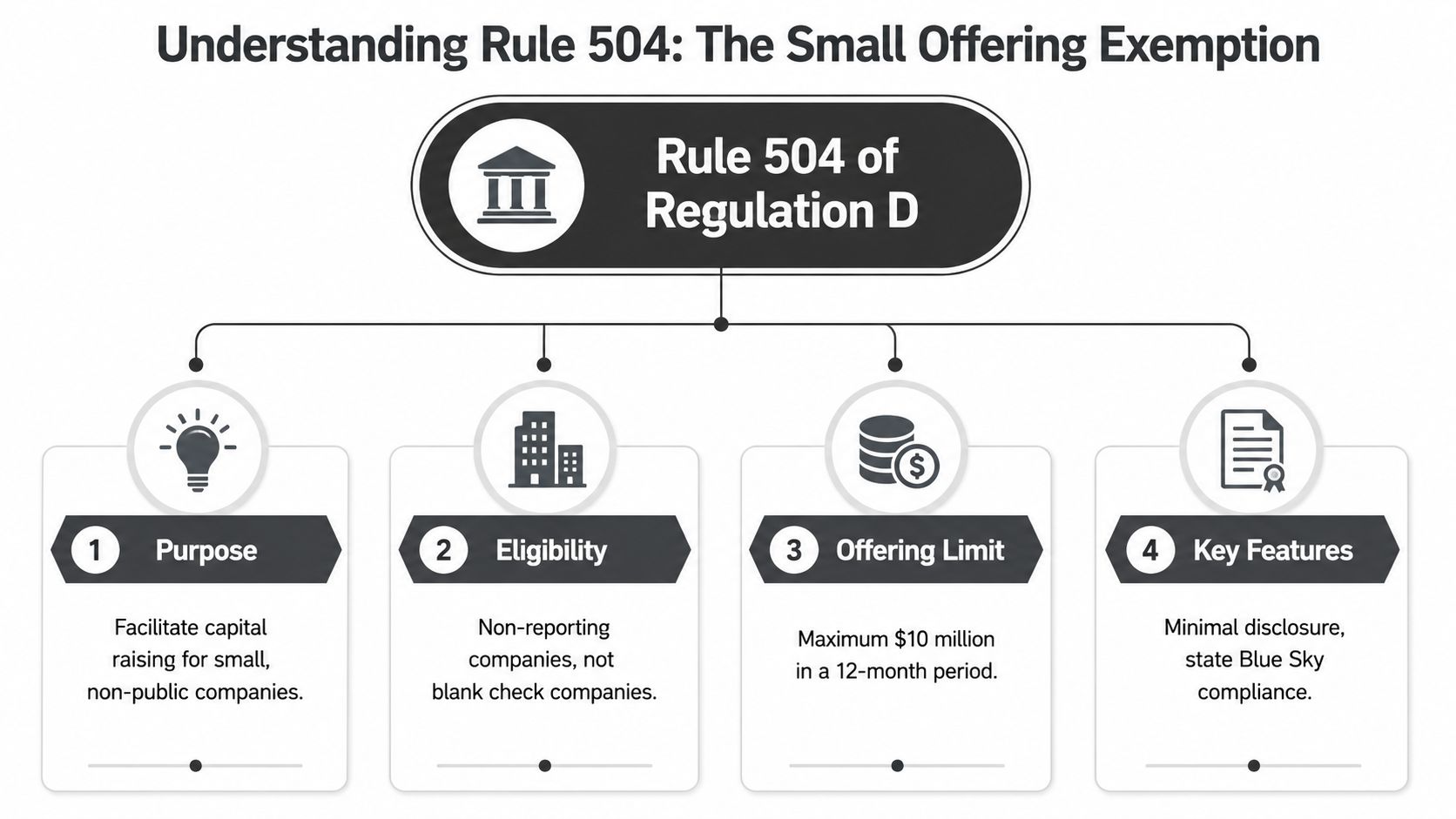
Rule 504 is the small offering exemption within Regulation D. It gives certain issuers a path to raise private capital without going through SEC registration, but eligibility is narrow and should be confirmed before any term sheet, pitch deck circulation, or investor outreach begins.
The issuers that fit Rule 504
The best candidate is usually a privately held operating company that isn't already an SEC reporting company and isn't trying to use a shell structure to enter the market. That point isn't just practical. It's part of the eligibility framework.
As summarized in this Regulation D overview), Rule 504 eligibility is restricted to non-reporting companies that are not investment companies, blank check companies, or disqualified under bad actor provisions; there are no limits on the number or sophistication of investors, allowing sales to any investor including non-accredited ones. For business owners, that means Rule 504 may remain available even where the investor base includes people who would not fit an accredited investor standard under another exemption.
Who is excluded
Some issuers should stop the Rule 504 analysis early. That includes:
- Exchange Act reporting companies
- Investment companies
- Blank check or similar development-stage companies without a defined business plan
- Issuers with bad actor disqualification issues
That last category deserves real attention. If a company, its control persons, or other covered participants have disqualifying histories, Rule 504 may be unavailable. This isn't an afterthought item for the closing binder. It should be part of the diligence checklist before the offering starts.
Why eligibility matters more than people think
Clients often focus on investor appetite and offering documents. Eligibility comes first. If the issuer doesn't qualify, the rest of the structuring work won't save the exemption.
A second practical point is that Rule 504 is often mistaken for a general startup fundraising permission slip. It isn't. It's a technical exemption with a defined issuer profile. If the company sits outside that profile, advisors should pivot early rather than forcing a bad fit.
A good Rule 504 offering starts with a sober issuer-level screening, not with marketing strategy.
For financial advisors and business owners, counsel clearly demonstrates its value. The right question isn't "Can we probably use Rule 504?" The right question is "Can this issuer clearly document its eligibility before any offer is made?"
Understanding Key Financial Limits and Timeframes
The central structural limit under Rule 504 is the offering cap. This isn't flexible, and it isn't something an issuer can approximate. If the company crosses it, even by a small amount, the exemption risk becomes immediate.
According to the SEC's Rule 504 small business guidance, Rule 504 of Regulation D permits an aggregate offering limit of exactly $10,000,000 over a 12-month period, calculated by adding securities sold within the prior 12 months and during the current offering, while subtracting prior sales that violated Section 5(a) of the Securities Act.
The rolling 12-month calculation
Issuers often misunderstand this point. The cap is not "per round" in the casual sense. It applies over a rolling 12-month period. If the company sold securities during that lookback period, those prior sales may count toward the Rule 504 ceiling.
That means a founder can't safely say, "We raised earlier this year under another tranche, so this is a new offering." The analysis requires a ledger of prior securities sales, dates, exemption positions, and whether they fit into the current Rule 504 calculation.
What this means in practice
Advisors should insist on a timeline before documents are finalized. That timeline should identify:
- Prior capital raises and when they closed
- Security type used in those raises
- Amounts sold
- Whether any sales may create aggregation risk
- Whether the current raise can stay clearly within the cap
A company that has done SAFEs, notes, equity sales, or bridge rounds should not assume those instruments are irrelevant to the cap analysis. The right answer depends on facts and offering structure, but the wrong move is ignoring prior activity.
Investor count is not the main constraint
One reason issuers consider Rule 504 is that it doesn't impose the same investor-number limitation people associate with some other exemptions. It can accept both accredited and non-accredited investors without requiring accredited status verification.
That flexibility is useful, especially for community-based raises or closely held businesses where likely investors include local supporters, industry contacts, or long-time customers. But that feature shouldn't distract from the cap and timing analysis. The absence of an investor-count limit doesn't make the exemption forgiving.
| Core issue | Practical consequence |
|---|---|
| Aggregate cap | The issuer must stay within $10,000,000 in the relevant 12-month period |
| Rolling timeframe | Earlier sales can affect the current offering |
| No accredited verification requirement | Investor onboarding may be simpler than under Rule 506(c) |
| No limit on investor sophistication | The issuer still bears anti-fraud and state compliance risk |
For most issuers, the key discipline is simple. Build the cap analysis before taking money, not after checks start arriving.
Navigating General Solicitation and Resale Restrictions
The most common Rule 504 misunderstanding is that it permits broad advertising. That isn't how experienced securities lawyers treat it, and businesses that rely on that assumption can create unnecessary risk.

Start with the default rule
The default posture under Rule 504 is not "market freely." Securities sold in the offering are generally restricted securities, and investor resale is limited. The SEC's investor guidance states that issuers using Rule 504 must file Form D electronically within 15 days after the first sale, and that purchasers cannot resell those securities for at least six months or up to one year without registration unless an exemption applies.
That has two immediate consequences. First, investors need to understand they are buying into an illiquid position. Second, the issuer's documents and communications need to match that restricted status.
General solicitation is narrower than many founders think
A lot of online summaries blur an important distinction. Rule 504 can, in limited situations, permit broader solicitation, but that depends on compliance with specific state law pathways. If that state law foundation is absent, the issuer should not assume it can advertise the deal through public websites, social platforms, blast emails, webinars, or open pitch events.
Broad outreach is where Rule 504 mistakes become expensive. Marketing practices that look ordinary in startup culture can undermine an exemption.
This is one reason advisors often review offering communications before they go out. "Testing interest" language can still function like an offer. So can a polished investor deck sent too widely, especially when there is no clear control over who receives it.
If your team is preparing documents, it's worth reviewing related guidance on private securities transactions because the sales process itself can create regulatory problems separate from the offering document package.
Form D timing is not optional
The Form D filing requirement is straightforward, but it still gets missed. The filing is due within 15 days after the first sale, not whenever the company gets around to compliance cleanup. That means the company should know in advance what event counts as the first sale and should be ready to file quickly once it happens.
A practical way to reduce risk is to decide before launch who owns each step:
- Counsel tracks first-sale timing and filing responsibility.
- Management confirms when subscription documents and funds are accepted.
- Investor relations or finance maintains the capitalization and investor log.
- Operations avoids public communications that conflict with the exemption strategy.
The mistakes here usually aren't complex. They come from casual execution.
Comparing Rule 504 vs Rules 506b and 506c
Most issuers don't choose between exemptions in the abstract. They choose based on who they want to raise from, whether they need publicity, and how much state-level friction they can tolerate. Rule 504 has a place, but it's often not the best tool once the investor base expands beyond a controlled circle.
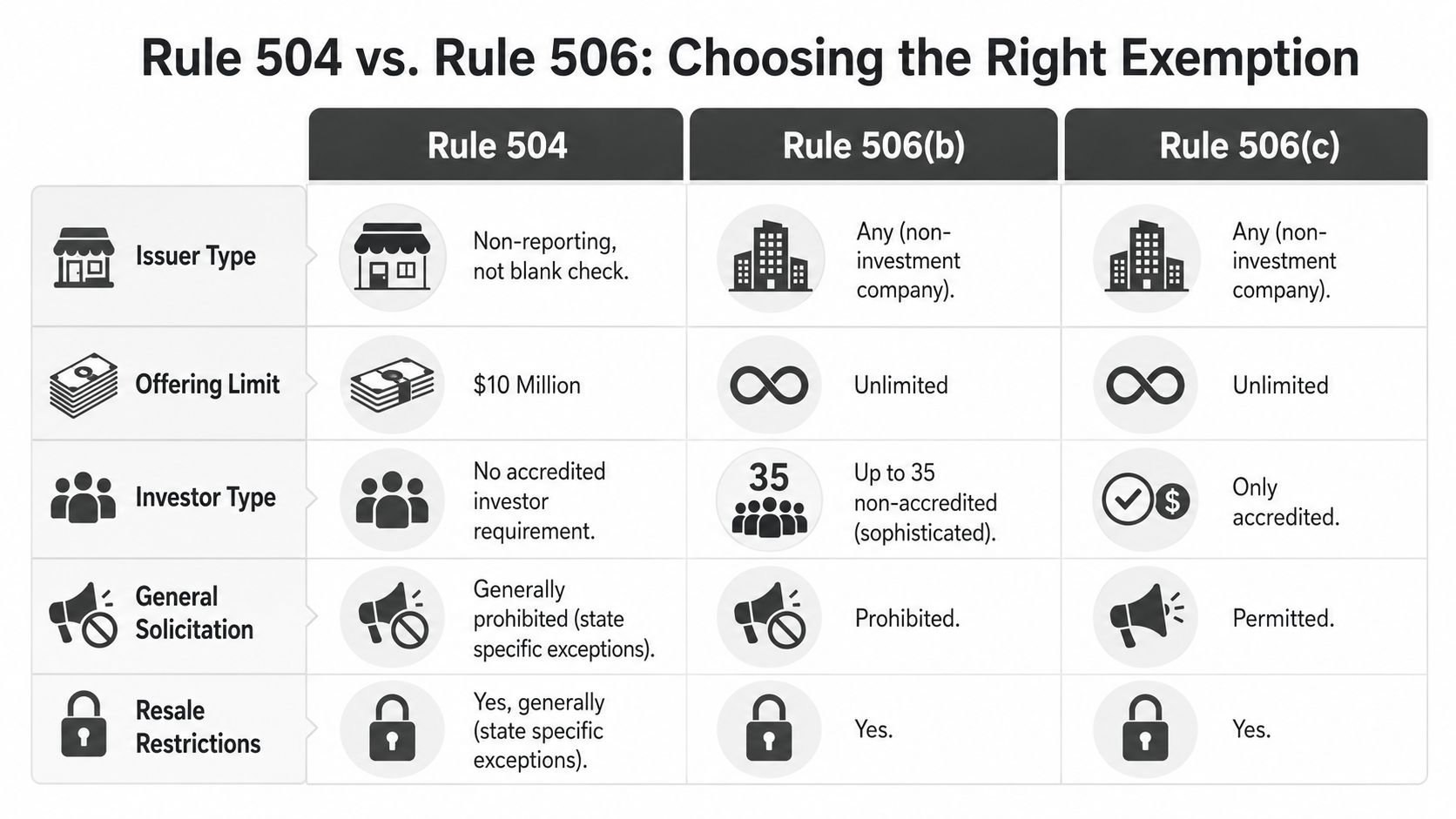
Rule 504 became more relevant after the SEC expanded it and eliminated Rule 505. As noted in this summary of the SEC amendments, Rule 504's offering limit was raised to $10,000,000 in part to make it a more viable alternative after Rule 505, which had a $5 million cap, was eliminated.
Rule 504 vs Rule 506 at a glance
| Feature | Rule 504 | Rule 506(b) | Rule 506(c) |
|---|---|---|---|
| Offering limit | $10 million | Unlimited | Unlimited |
| Typical issuer profile | Non-reporting, eligible small issuer | Broad private issuer use | Broad private issuer use |
| Non-accredited investors | Allowed | Allowed in limited circumstances | Not allowed |
| General solicitation | Limited and state dependent | Prohibited | Permitted |
| State law burden | Significant | Reduced by federal preemption | Reduced by federal preemption |
| Accredited investor verification | Not required | Not required in the same manner | Required |
For advisors who want a concise refresher on the mechanics around filing Form D and accredited investors, that framework helps explain why Rule 506 often becomes the default despite Rule 504's apparent simplicity.
Where Rule 504 wins
Rule 504 can be attractive when the company wants to include non-accredited investors without using a Rule 506(c) accredited-only model, and when the raise is contained enough that state-by-state compliance remains manageable. A tightly controlled local or regional raise is usually where the exemption performs best.
It may also fit an issuer that wants less federal disclosure burden than another path would require, provided the issuer is realistic about state law and resale limitations.
Where Rule 506 often wins
Rule 506(b) and Rule 506(c) usually become stronger choices once the raise needs broader geographic reach. The practical reason is federal preemption of much of the state registration burden. That doesn't eliminate all state notice obligations, but it materially changes the compliance load.
Rule 506(c) is the route when public marketing matters and the issuer is prepared to sell only to accredited investors and verify that status. Rule 506(b) remains attractive when the company has an existing investor network and doesn't want public solicitation.
For companies documenting investor commitments, side letters, and purchase terms, a sound subscription agreement framework matters regardless of exemption, but the investor representations and compliance architecture will differ.
Choose the exemption that matches the planned conduct. Don't choose the exemption first and then hope the facts cooperate.
Avoiding Common Compliance Traps and Blue Sky Law Issues
Rule 504 is often sold as the simple small-issuer exemption. That description leaves out the part that makes practitioners cautious. The federal exemption does not solve the state law problem for you.
Blue Sky law is where many Rule 504 deals become impractical
Rule 504 offerings can trigger state registration, qualification, notice, disclosure, and fee issues that are much more substantial than founders expect. The popular assumption that Rule 504 allows broad solicitation is also wrong in many real-world settings.
As explained in this discussion of Rule 504 fundraising pitfalls, general solicitation is not broadly available under Rule 504 unless the issuer complies with specific state registration protocols, and state filing fees can run from $300 to $1,000 per state. For a multi-state offering, that isn't a side issue. It can reshape the economics of the raise.
The hidden cost isn't only money
The harder problem is process. Once investors are spread across states, the issuer may need to evaluate different filing mechanics, different disclosure expectations, and different deadlines. That requires a state-by-state map before outreach begins, not after subscriptions arrive.
A practical Rule 504 review usually asks:
- Which states are in play
- Whether an exemption exists in each state
- Whether registration or qualification is required
- What legends, disclosures, or delivery rules apply
- Whether the intended solicitation method is even permitted
Many "simple" raises fail at this point. The company starts collecting soft commitments online, then learns that the actual compliance path varies materially by jurisdiction.
The integration trap is real
Separate offerings can be treated as one if the facts support integration. For Rule 504, that matters because the offering cap and exemption structure can be compromised when issuers treat successive financings as independent without careful analysis.
The trap usually appears in one of two forms. The company did a prior raise and assumes it doesn't count. Or the company begins one exempt offering while another is still active, with overlapping investors, similar terms, or related financing objectives.
Neither problem is academic. If the SEC or a regulator looks at substance over labels, an issuer may discover that two "rounds" function as one.
If that happens, the consequences can extend beyond exemption validity and into enforcement exposure. Businesses facing scrutiny over offering practices should understand how regulators approach SEC investigations and enforcement matters, because cleanup after a flawed raise is far more expensive than prevention.
If your fundraising plan depends on multiple tranches, multiple investor groups, or a shift from private outreach to broader marketing, integration analysis should happen before the first solicitation.
The practical takeaway is blunt. Rule 504 is not a free pass for small raises. It can work, but only when the issuer is disciplined enough to treat state law and offering integration as core structuring issues, not administrative details.
Actionable Checklist for a Compliant Rule 504 Offering
A compliant Rule 504 offering usually reflects planning more than paperwork. The work starts before the first investor call and before any pitch materials circulate. Issuers that treat compliance as a closing task tend to create the most avoidable problems.
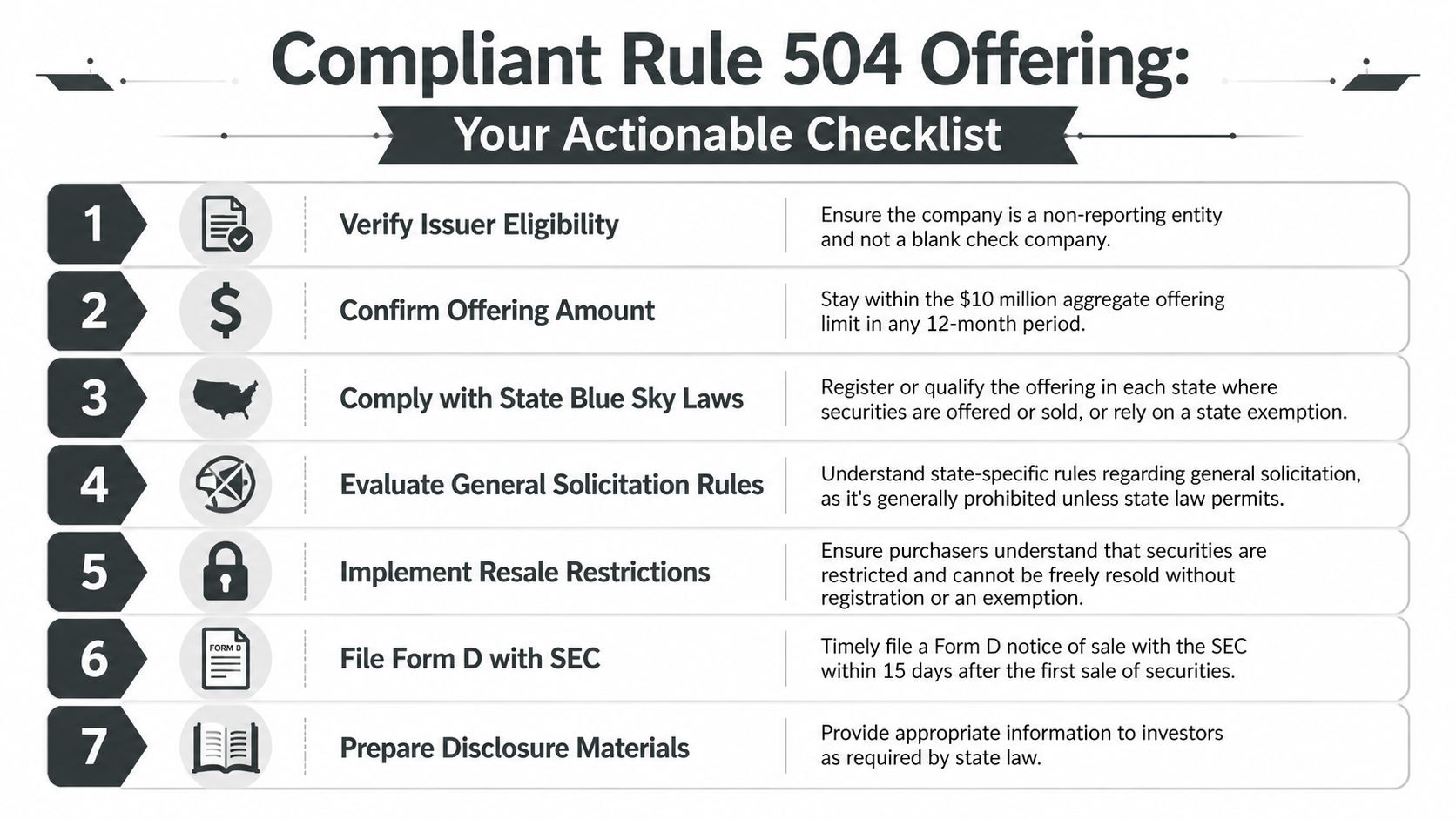
A working pre-launch checklist
Use this list before the offering begins, and revisit it when investor outreach changes:
- Confirm issuer eligibility. Verify that the company is a non-reporting issuer and not excluded from Rule 504 use.
- Build the 12-month cap analysis. Review prior securities sales and document why the current raise stays within the Rule 504 limit.
- Map investor states early. Don't treat state location as intake trivia. It drives Blue Sky analysis.
- Decide solicitation boundaries before outreach. If the company intends to market broadly, test that approach against state law first.
- Draft investor documents to reflect resale restrictions. The securities are not casually tradable by default.
- Prepare the Form D filing workflow. The filing deadline arrives quickly after the first sale.
- Check bad actor and offering-participant issues. Resolve disqualification questions before launch, not after subscriptions are accepted.
- Create a centralized offering log. Track dates, documents, funds received, investor residence, and communication history.
- Review integration risk if any prior or parallel raise exists. Separate labels won't control if the facts point the other way.
- Use a broader compliance process. A practical small business compliance checklist helps keep corporate, financing, and governance obligations aligned.
What actually works
What works is a controlled offering with a defined investor list, disciplined communications, and early state law review. What doesn't work is improvising after social posts, email blasts, or loosely documented soft commitments have already gone out.
Businesses also shouldn't rely on generic internet summaries. Rule 504 looks short at the rule-text level and much more complicated in execution. That difference is where counsel adds value.
If you want to discuss your business law matter, contact Kons Law at (860) 920-5181.
If you want to discuss your business law matter, contact Kons Law at (860) 920-5181.
