
You're three weeks into a transaction that looked straightforward on paper. The buyer has issued a term sheet, the seller wants certainty, and the controller is rebuilding financial statements while lawyers are opening the data room. Meanwhile, the buyer's investment committee wants a defensible valuation, the founder wants tax-efficient proceeds, and every advisor has a different view of what should be negotiated first.
That is where mergers & acquisitions consulting earns its place. M&A work isn't one service delivered by one professional. It's a coordinated layer of financial, operational, tax, and legal advisors, each responsible for a different source of transaction risk. The deal moves when those advisors share assumptions, surface conflicts early, and keep price, structure, timing, and execution aligned.
A Deal in Motion and Why Outside Help Matters
Consider a regional industrial parts manufacturer being sold to a private equity-backed strategic acquirer. The headline valuation may be attractive, but the founder isn't focused only on the number. They want a clean exit, manageable indemnity exposure, and a structure that doesn't create avoidable tax friction. The buyer wants evidence supporting the valuation, confidence in customer retention, and a practical integration plan.
The company's controller has a different problem. Historical statements may be accurate but not transaction-ready. Owner expenses, one-time litigation costs, unusual inventory adjustments, and inconsistent revenue classifications can all affect normalized earnings. Until those issues are documented, neither side knows whether it's negotiating over enterprise value or over accounting presentation.
The first advisors in the room
A capable team usually includes:
- A sell-side M&A advisor, who manages positioning, buyer outreach, valuation framing, and process control.
- Corporate counsel, who advises on confidentiality, letters of intent, legal diligence, purchase agreements, liability allocation, and closing mechanics.
- A quality of earnings provider, who tests the financial statements and explains normalization adjustments.
- A wealth or tax planner, where the owner's liquidity, estate, and tax objectives require advice beyond the company sale itself.
On the buyer's side, the group may add a buy-side advisor, industry specialists, tax counsel, financing sources, and integration leaders. Each person sees a different part of the transaction. The problem starts when those views never become one decision framework.
Practical rule: Every advisor should be able to explain how their finding changes price, structure, risk allocation, timing, or post-close execution.
Why coordination determines outcomes
Mid-market transactions rarely fail because no one can find a buyer or draft a purchase agreement. They stall because the financial advisor promises a valuation outcome that legal diligence can't support, the buyer underestimates integration requirements, or the seller accepts an attractive price with liability terms that undermine the exit.
Set the workstreams at the outset:
- Valuation and strategy, including the buyer universe, market positioning, and financial model.
- Deal sourcing and execution, including outreach, indications of interest, management presentations, and negotiation.
- Diligence coordination, including financial, commercial, operational, legal, tax, technology, and human resources review.
- Structuring and value realization, including consideration mix, risk allocation, integration, separation, and governance.
The right outside team doesn't eliminate disagreement. It makes disagreement visible while the parties still have time to solve it.
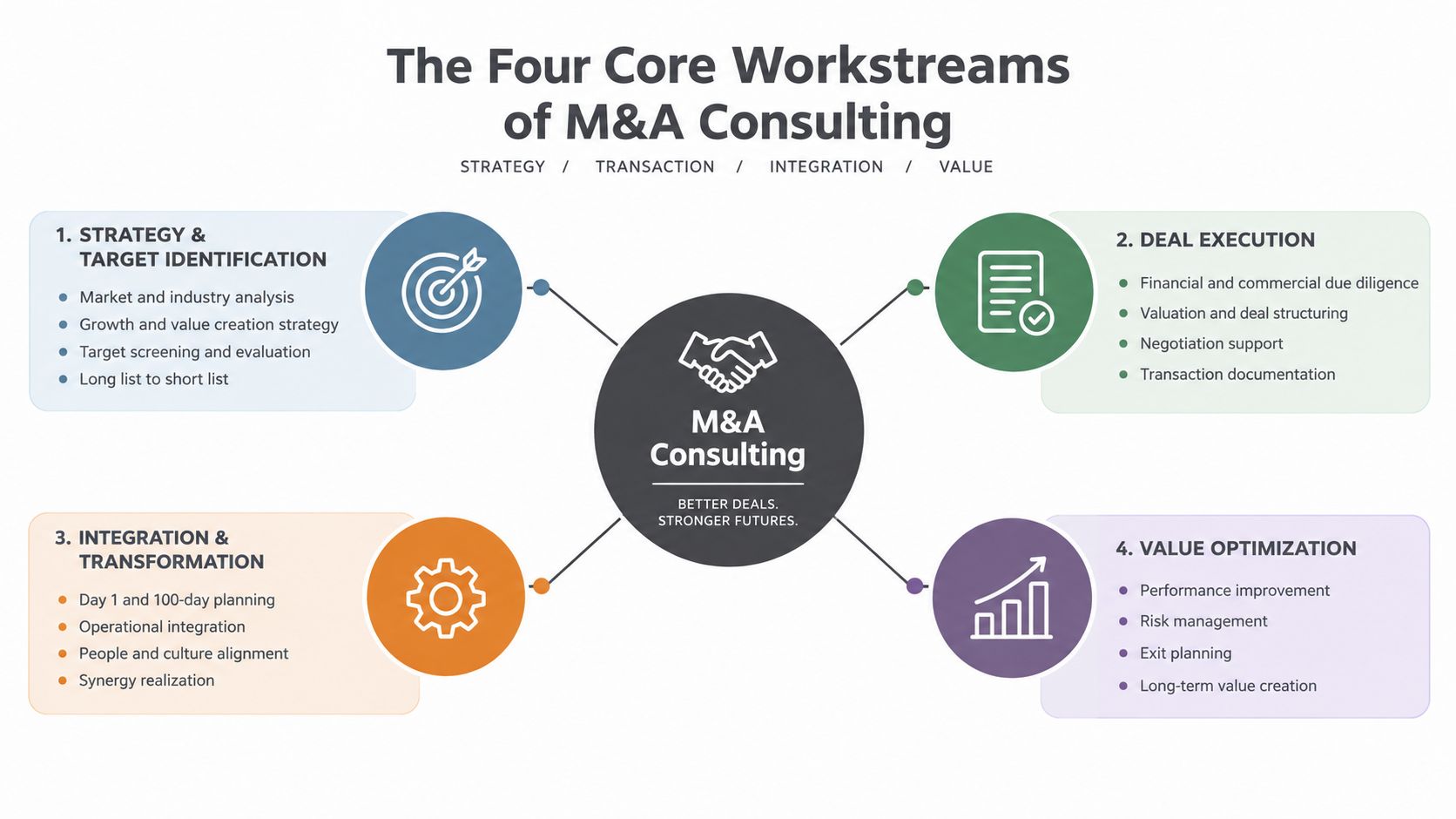
The Four Core Workstreams of M&A Consulting
M&A consulting becomes more useful when the label is broken into decisions that affect transaction economics. Valuation may establish the range, but sourcing determines who gets invited, diligence tests whether the range survives scrutiny, and structuring decides how much of the agreed value the client can retain.
Valuation is a range, not a verdict
A consultant typically triangulates discounted cash flow analysis, comparable-company data, and precedent transactions. Those methods often produce different answers because they measure different things. A DCF depends heavily on assumptions about growth, margins, capital expenditure, and working capital. Comparables reflect current market sentiment. Precedents may include control premiums, strategic synergies, or transaction-specific terms that don't apply to the client.
The practical question is which methodology deserves the negotiating anchor. A seller with durable recurring demand may emphasize cash-flow quality, while a strategic buyer may focus on synergies and replacement cost. The advisor's job is to make the assumptions explicit and show where the model is vulnerable.
Sourcing changes leverage
A broad auction can create competitive tension, but it can also expose confidential information to buyers who aren't serious. A targeted buy-side search serves a different purpose. It identifies a limited group of credible buyers whose capabilities, geography, financing, and strategic objectives fit the target.
Proprietary relationship channels can be more valuable in the middle market because a buyer may engage differently when the opportunity arrives through an established relationship rather than a mass process. That doesn't mean an auction is wrong. It means the process should reflect the seller's priorities, including confidentiality, speed, certainty, and buyer quality.
Diligence and negotiation are connected
A consultant should run diligence as an integrated risk register, not as disconnected reports. A customer concentration issue might affect valuation, financing, earn-out design, and post-close sales planning at the same time.
The same principle applies to consideration. Suppose the buyer offers $20 million at closing plus a potential $2 million earn-out. If the earn-out depends on revenue, the seller may prefer a clearly defined metric and protection from the buyer redirecting customers or changing accounting policies. If it depends on EBITDA, the parties must address cost allocations, acquisition accounting, integration expenses, and the buyer's control over operating decisions. The headline price can remain unchanged while the probability of receiving the contingent amount changes dramatically.
For a practical transaction checklist, review this mergers and acquisitions checklist. It helps connect the advisory workstream to the legal actions required to keep the process moving.
Due Diligence as a Multi-Domain Risk Model
A diligence request list is only the starting point. Effective diligence asks what can impair value, who will own the risk, and what document should reflect the answer. Buy-side advisory practices commonly combine financial, tax, commercial, operational, human resources, information technology, cybersecurity, and transaction-tax review because liabilities rarely stay inside one category. Holland & Knight's transaction advisory overview describes this broader approach and its connection to valuation and integration planning.
Five lenses, one risk register
Financial diligence tests the quality of earnings. The provider may examine owner add-backs, one-time legal settlements, revenue recognition, inventory reserves, and working-capital trends. The output should identify which adjustments are supportable, which require negotiation, and which belong in a purchase-price adjustment rather than normalized EBITDA.
Commercial diligence examines customer concentration, churn behavior, pricing power, win rates, pipeline durability, and competitor pressure. A strong sales forecast doesn't substitute for evidence that customers renew, expand, and pay on time.
Operational diligence looks at supply-chain redundancy, key-person dependency, plant capacity, quality systems, technology architecture, and the buyer's ability to combine operations without disrupting service.
Legal diligence covers ownership, contracts, change-of-control provisions, pending claims, intellectual property chains, employment arrangements, and compliance. The review often includes UCC and fixture filings, tax liens, litigation and judgment records, bankruptcy records, and intellectual property databases, as well as corporate records and credit reports, as outlined by Wolters Kluwer's overview of M&A deal phases.
Tax diligence tests entity structure, tax attributes, transfer pricing, sales-tax exposure, payroll compliance, and the consequences of an asset versus equity transaction. Tax findings can change the preferred structure even when the parties agree on enterprise value.
| Workstream | Typical Provider | Representative Finding | Deal Impact |
|---|---|---|---|
| Financial | QoE provider or transaction accountant | Earnings include unsupported add-backs | Reprice, revise working-capital target, or require protection |
| Commercial | Strategy or industry consultant | A small group of customers drives a material share of revenue | Add retention conditions, adjust valuation, or build a mitigation plan |
| Operational | Operations or technology specialist | Critical systems depend on undocumented processes | Require transition support, escrow, or integration investment |
| Legal | Corporate counsel | A key contract requires consent before a change of control | Obtain consent, restructure the transaction, or allocate specific risk |
| Tax | Tax advisor | Entity structure creates exposure after closing | Change transaction form, seek indemnity, or adjust consideration |
The diligence findings feed directly into the purchase agreement. A discovered liability might produce a specific indemnity. A weak working-capital history may justify a revised target. A regulatory issue may require a closing condition. Escrow, holdback, and representations-and-warranties insurance should reflect the actual risk profile, not a generic market position.
Professionals moving from law firm practice into corporate roles may also benefit from corporate counsel transition tips from Five Star, particularly because in-house counsel must translate diligence findings into operational decisions. For a legal document-focused reference, see this mergers and acquisitions due diligence checklist.
How M&A Consultants Get Paid and Who Pays Whom
Fee design shapes behavior. A seller's advisor paid only at closing may push to preserve momentum even when a buyer's concern deserves attention. An advisor paid primarily by the hour may provide careful analysis without having the same economic incentive to solve process bottlenecks.
The principal fee models
A monthly retainer is common for sell-side mandates and extended diligence. It compensates the advisor for reserving senior time, preparing materials, managing outreach, and carrying the process before a closing is certain.
A pure success fee is more common when a buy-side advisor is pursuing proprietary targets or a narrow mandate. The advisor assumes more risk, but the client should examine how the fee applies to transactions the client sourced independently.
A Lehmann or modified-Lehmann formula calculates compensation as a percentage of transaction value, often with scaling between minimum and maximum amounts. It balances a continuing engagement with closing-based compensation, but a cap can create distorted incentives near the top of the fee range.
An hourly or day-rate engagement suits a valuation opinion, focused diligence assignment, or specific negotiation project. It provides cost visibility for a defined scope, although the client must manage the boundaries carefully.
| Fee Model | Who Pays | Best For | Main Risk |
|---|---|---|---|
| Monthly retainer | Usually the engaging client | Sell-side preparation and long processes | Cost continues if the process drifts |
| Pure success fee | Usually the party retaining the advisor | Proprietary buy-side searches | Pressure to close or ambiguity about fee-triggering events |
| Lehmann or modified-Lehmann | Usually the engaging client | Full-process advisory mandates | Incentive distortion near a fee cap |
| Hourly or day rate | The client receiving the work | Narrow diligence or valuation projects | Scope expansion and unpredictable total cost |
The buyer typically retains its own buy-side advisors. In some transactions, the purchase agreement gives the buyer a credit or other mechanism related to agreed sell-side expenses, but the allocation must be documented rather than assumed. Sellers generally pay their own banker, M&A counsel, accountants, tax professionals, and other consultants.
Watch the engagement letter for break fees, exclusivity payments, and phantom transaction fees. A break fee may be reasonable where the advisor has devoted substantial resources and the client walks without a legitimate reason. Exclusivity can protect an advisor from being bypassed after doing the work, but it shouldn't prevent the client from responding to a superior opportunity. A phantom fee triggered by a refinancing, internal transfer, or unrelated sale deserves particular scrutiny.
Earn-outs deserve the same attention as fee terms. This guide to earn-out agreements explains why contingent consideration requires precise definitions, reporting rules, and enforcement provisions.
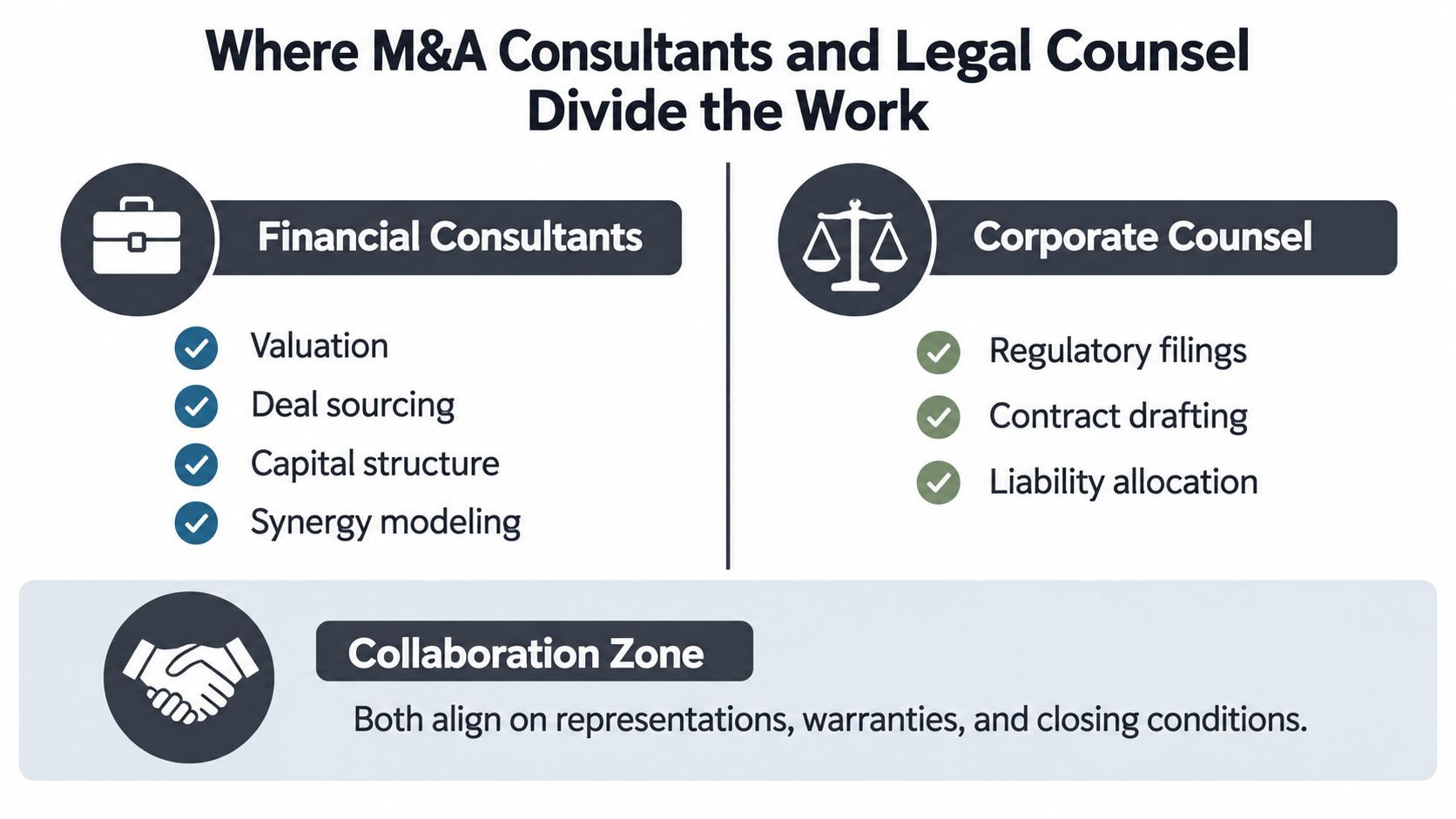
Where M&A Consultants and Legal Counsel Divide the Work
Financial consultants and corporate counsel work toward the same closing, but they don't own the same decisions. Confusion at that boundary creates duplicated effort, missed risks, and late-stage negotiation problems.
The consultant's commercial mandate
The financial or operational advisor usually owns:
- Valuation, including DCF assumptions, comparable companies, precedent transactions, and sensitivity analysis.
- Deal sourcing, including buyer identification, outreach, process management, and management presentations.
- Capital structure modeling, including financing capacity, debt levels, and sources and uses.
- Synergy analysis, including revenue opportunities, cost opportunities, implementation assumptions, and timing.
- Commercial negotiation, including price, earn-out economics, rollover equity, and working-capital targets.
Some of these subjects appear in legal documents but aren't primarily legal. The purchase price, working-capital target, and commercial earn-out metric begin as business decisions. Counsel then drafts them so the language reflects the deal the parties negotiated.
Counsel's legal mandate
Corporate counsel owns entity structure, acquisition vehicles, securities compliance, definitive agreement drafting, disclosure schedules, legal diligence, regulatory filings, closing conditions, and liability allocation. Counsel also tests whether a business promise can be enforced under the proposed documents.
That distinction matters in contract review. A consultant may identify a customer or supplier risk, but counsel determines whether the relevant agreement contains an assignment restriction or change-of-control trigger. A consultant may propose transition support, while counsel drafts the transition services agreement, service levels, termination rights, and remedies.
The overlap is the collaboration zone:
- Representations and warranties
- Indemnification caps and baskets
- Escrow and holdback
- Earn-out milestones
- Non-competes and non-solicitation provisions
- Transition services
- Closing conditions and regulatory approvals
Kons Law can fit into that legal workstream by helping structure the acquisition vehicle, draft and negotiate the letter of intent and purchase agreement, conduct legal diligence, coordinate regulatory filings, negotiate with seller counsel, and establish post-close governance. Its role is not to replace financial or tax specialists. It is to convert the agreed commercial position into enforceable documents and a workable closing plan. A focused business acquisition attorney can be especially useful when the transaction involves several entities, negotiated risk allocation, or operational commitments after closing.
A clean handoff keeps the final two weeks from becoming a document-production emergency. The advisor should provide counsel with a settled model, clear commercial positions, and a prioritized risk register. Counsel should return drafting issues that require a business decision before they become closing blockers.
The Overlooked Half of a Deal, Integration and Carve-Outs
Signing is not value realization. It's the point at which the buyer inherits the operational consequences of the model it approved. Integration and separation work often exposes assumptions that were easy to overlook while the deal team focused on valuation, financing, and definitive documents.
Leading 2026 outlook commentary says half of respondents expect moderate to significant growth in carve-out activity over the following 12 to 24 months, while AI-driven transformation and execution discipline have become central themes in deal planning. The KPMG global M&A outlook also emphasizes the growing importance of carve-outs and post-close execution. Those projections don't mean every transaction needs a large integration office. They do mean buyers and sellers should define operational ownership before signing.
Two different operating problems
A full integration moves the acquired business into the buyer's systems, reporting lines, controls, sales process, technology environment, and culture. The buyer must protect customer relationships while capturing cost or revenue opportunities.
A carve-out has the opposite challenge. The divested business must operate independently, often with its own finance, human resources, information technology, compliance, supply chain, and customer-support capabilities. Shared services that were invisible inside the seller become transition services that need scope, pricing, service levels, data access, and exit dates.
The workstreams that matter
A practical integration program addresses:
- Day 1 readiness, including banking access, payroll, authority matrices, customer communications, and employee notices.
- Functional playbooks, covering finance, sales, procurement, supply chain, technology, human resources, and compliance.
- Talent and culture, including key-person retention, reporting lines, decision rights, and communication cadence.
- Transition services, with defined services, dependencies, pricing, exit criteria, and contingency plans.
- Value capture, using a 30, 60, 90, and 180-day plan tied to accountable owners and measurable outcomes.
Integration should be managed as a revenue and cost program, not as a calendar of meetings.
The recurring failures are predictable. Teams underestimate transition services timelines, let two enterprise resource planning systems run indefinitely, ignore customer churn risk during operational changes, or assign integration to a project manager without giving functional leaders ownership of the economics.
A change-management specialist can help when retention, communication, role redesign, and adoption threaten the transaction thesis. For additional perspective on finding a strategic change consultant, focus on whether the consultant can connect workforce behavior to operational milestones rather than treating communication as a separate exercise.
The useful post-close measure is synergy realization as a percentage of plan at the 12-month mark. That measure forces the buyer to distinguish booked savings from projected savings and to explain why revenue opportunities, cost reductions, or separation milestones fell short.

Selecting the Right Advisor and Closing Thoughts
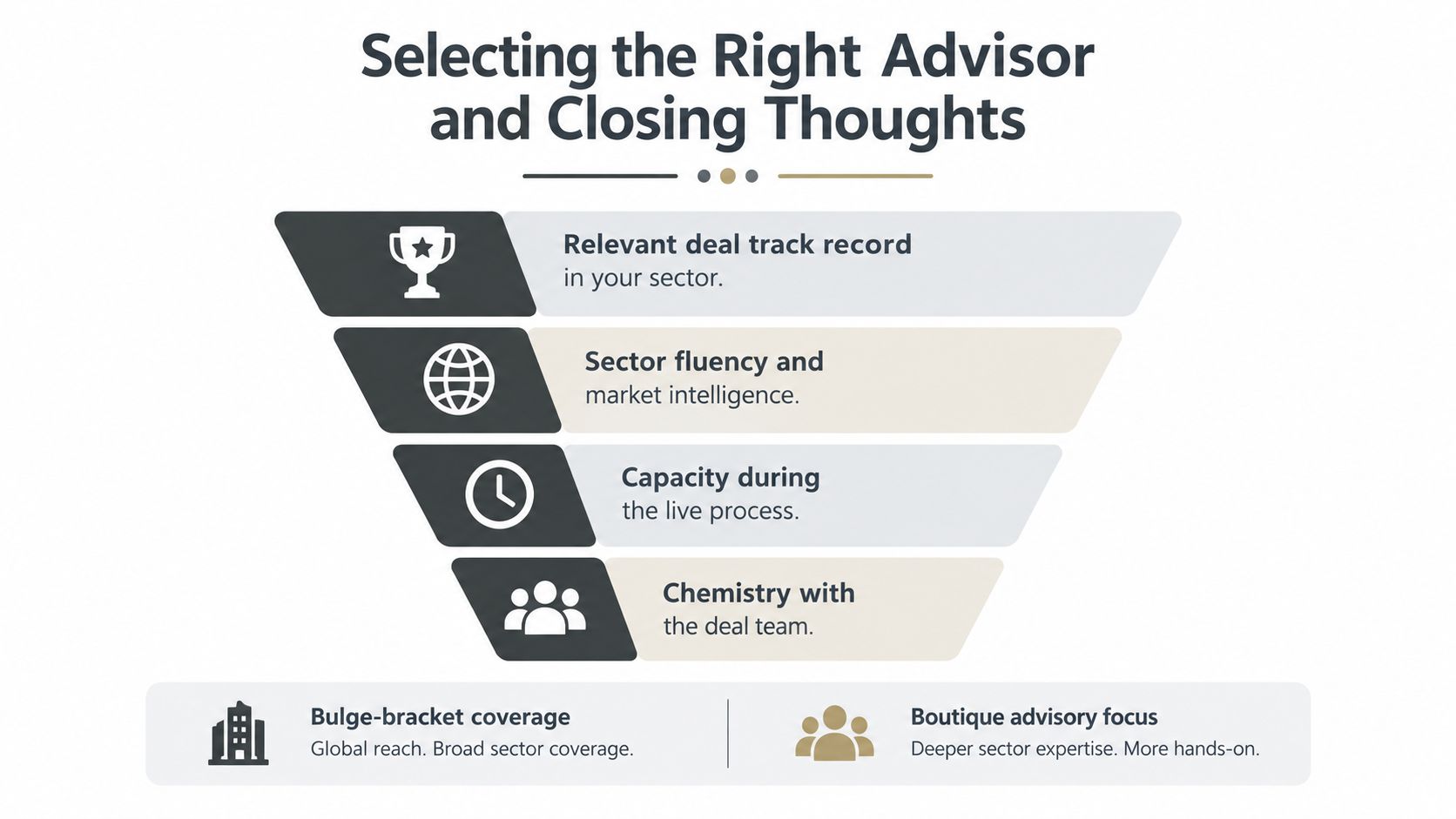
Advisor selection is a filtering exercise, not a beauty contest. A large financial institution may offer broad market coverage and extensive transaction resources. A boutique may offer more direct senior attention and deeper focus on a particular sector or transaction size. Neither model works if the team presenting the pitch disappears once the mandate is signed.
Ask for evidence that the proposed team has handled transactions with similar complexity. A relevant track record should include the sector, transaction type, ownership profile, financing conditions, and integration or separation requirements that resemble your situation. General deal volume is less informative than experience with the risks that can derail your process.
A practical selection filter
- Confirm comparable mandates. Ask for recent transactions involving similar businesses, structures, and diligence demands.
- Name the senior owner. The engagement letter should identify the banker or partner responsible for the file, not just the firm.
- Define the scope. List included services, exclusions, fee triggers, conflicts, and responsibilities for post-close work.
- Set the reporting cadence. Decide who receives process updates, risk registers, buyer feedback, and decision requests.
- Assign integration ownership. If the advisor isn't responsible for integration, identify the person who is before the letter of intent is signed.
- Test working chemistry. The team will handle confidential information, difficult personalities, and compressed decisions. Communication style matters.
Conflict checks deserve direct questions. Ask whether the advisor represents a competitor, a likely buyer, a lender, or a portfolio company that could create tension. Staffing turnover also matters. A polished pitch from senior professionals has little value if execution is delegated to a team that lacks the necessary judgment.
The cheapest proposal often reflects an advisor trying hardest to win the mandate, not the advisor best equipped to protect the client through closing.
Financial operations deserve the same scrutiny. If you're evaluating outside support for accounting or finance functions, choosing the right finance outsourcing company offers a useful framework for assessing capability, scope, controls, and continuity. The principle applies to M&A advisors as well: understand who does the work, how decisions are escalated, and what happens when the transaction becomes difficult.
Deloitte's 2026 survey reports that more than 80% of corporate executives and private equity dealmakers expect deal volume and deal value to increase over the next 12 months, as described in its 2026 M&A trends survey. That projection may create more opportunities, but it won't remove the need for disciplined diligence, structure, regulatory planning, and integration.
The strongest transaction teams understand their boundaries. Financial advisors test value and market options. Operational specialists test execution. Tax professionals test structure. Corporate counsel protects the legal position, allocates liability, manages regulatory requirements, and turns the commercial agreement into enforceable documents. When those roles are coordinated from the start, the buyer and seller spend less time repairing misunderstandings in the final days before closing.
If you want to discuss your business law matter, contact Kons Law at (860) 920-5181. Kons Law advises companies, investors, and financial professionals on acquisitions, business sales, commercial agreements, diligence, governance, and closing strategy. Visit Kons Law to connect with counsel about a transaction, term sheet, or deal structure.
