A Statement of Claim lands in your inbox just as you're trying to finish quarter-end reporting. The dispute may involve a Form U5, a promissory note, deferred compensation, a termination decision, or a customer allegation that you believe leaves out critical facts. You may feel pressure to explain your side immediately to compliance, the former employer, or opposing counsel.
That instinct can create problems. In FINRA matters, the forum clock is already running, and an unguarded email can become an exhibit before you've decided what the case is about. Preparing well means preserving the record, identifying the controlling rules, building a defensible damages position, and preparing for settlement and hearing at the same time.
The First 72 Hours After a Dispute Surfaces
The first mistake I see is treating the notice as an administrative problem. An advisor receives a FINRA notification, forwards it to a colleague, and starts drafting a factual response from memory. That approach feels efficient, but it can create inconsistent statements, lose relevant communications, and put the advisor in the position of defending an improvised narrative.
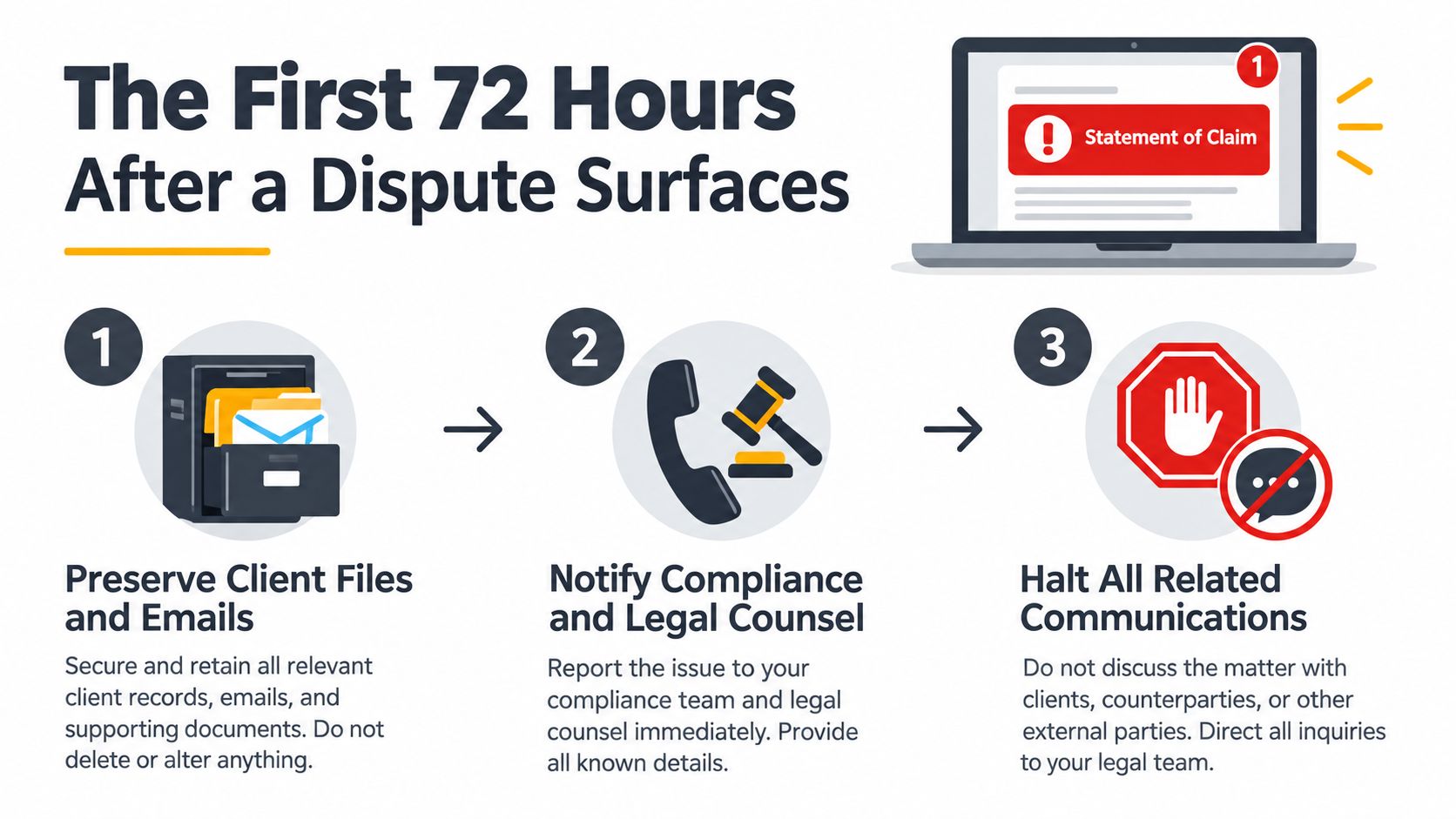
Start by preserving the evidence exactly as it exists. Don't rename, edit, delete, annotate, or selectively forward client files, emails, texts, CRM notes, Bloomberg messages, Teams conversations, or Slack threads. Ask the broker-dealer to place the matter on its litigation hold list, and confirm that relevant custodians and systems are included. If you're an independent advisor or practice owner, create a written hold covering personal devices and cloud accounts used for business communications.
Practical rule: Copy counsel before responding to opposing counsel, compliance, a former employer, or a regulator about the substance of the dispute.
Notify the applicable insurance carrier and tender the matter under the relevant financial adviser or professional liability policy. Coverage questions can be fact-sensitive, and late notice or an incomplete tender can complicate the defense. At the same time, decide who will direct the response. The supervisory team may control firm records, but outside counsel should generally coordinate legal strategy, privilege, discovery preservation, and communications.
Create a privileged communication log from the outset. Record the date, participants, subject, and purpose of legal communications without placing substantive legal advice in a shared operational file. Keep business facts and attorney analysis separate.
FINRA Rule 12200 creates a mandatory arbitration overlay for many disputes involving FINRA members and associated persons. That means the forum may be fixed before the parties discuss alternatives. FINRA reported that 3,607 arbitration and mediation cases were closed in 2024, and the average arbitration case closed in 12.5 months. FINRA's dispute-resolution materials also report that 84% of customer arbitration cases closed through settlement or paid damages, which is why early preservation and settlement positioning matter even when you expect to defend the case through hearing.
For a practical framework on responding to a demand before the dispute becomes a filed case, review this guide to responding to a demand letter.
Choosing the Right Forum and Mapping the Rules
A financial professional can face overlapping agreements after a dispute surfaces. Read the employment agreement, registered representative agreement, promissory note, transition agreement, operating agreement, and customer agreement together. Identify each signer, the claims covered by each arbitration clause, any consolidation language, and the law governing the contract. A clause buried in a compensation or transition document may determine the forum before the parties discuss strategy.
For a FINRA dispute, start with the Code of Arbitration Procedure and the claim category. Customer and intra-industry matters can involve different filing requirements and panel structures. FINRA states that claims involving more than $100,000 require a hearing before three arbitrators. The FINRA's arbitration rules and procedures guide provides a useful starting point, but counsel should confirm the current rule text and any case administrator scheduling orders.
AAA commonly applies when an advisor and an RIA are not proceeding under FINRA rules, or when an agreement assigns employment or commercial claims to the American Arbitration Association. JAMS may control a complex commercial agreement or a multi-party proceeding selected by contract. Check the seat of arbitration as well. It can affect court applications, subpoena practice, and the procedural law governing the proceeding.
| Forum | Typical Disputes | Key Rule Set | Discovery Scope | Best Fit |
|---|---|---|---|---|
| FINRA | Customer claims, intra-industry disputes, Form U5 issues, compensation and promissory note matters involving member firms | FINRA Code of Arbitration Procedure, including the 12000 and 12500 series | Panel-managed discovery, document exchange, motions, and hearing procedures | Broker-dealer and associated-person disputes |
| AAA | RIA employment disputes, commercial contract claims, deferred compensation and clawback fights | AAA Commercial or Employment Rules | Information sharing shaped by the applicable rules and arbitrator's orders | RIA-only or contract-specific proceedings |
| JAMS | Complex contract disputes and proceedings selected by agreement | JAMS Rules or the specific JAMS procedures selected by agreement | Flexible, case-managed discovery | Multi-party matters or cases where the contract specifies JAMS procedures |
Forum choice affects cost, pace, discovery, and presentation. A FINRA panel, an AAA employment procedure, or a JAMS case-management order may produce very different motion practice and document demands. Map those rules before drafting a claim or answer. Then align preservation, evidence requests, consolidation decisions, and hearing strategy with the forum that controls the dispute.
Building the Case Timeline and Statement of Claim Response
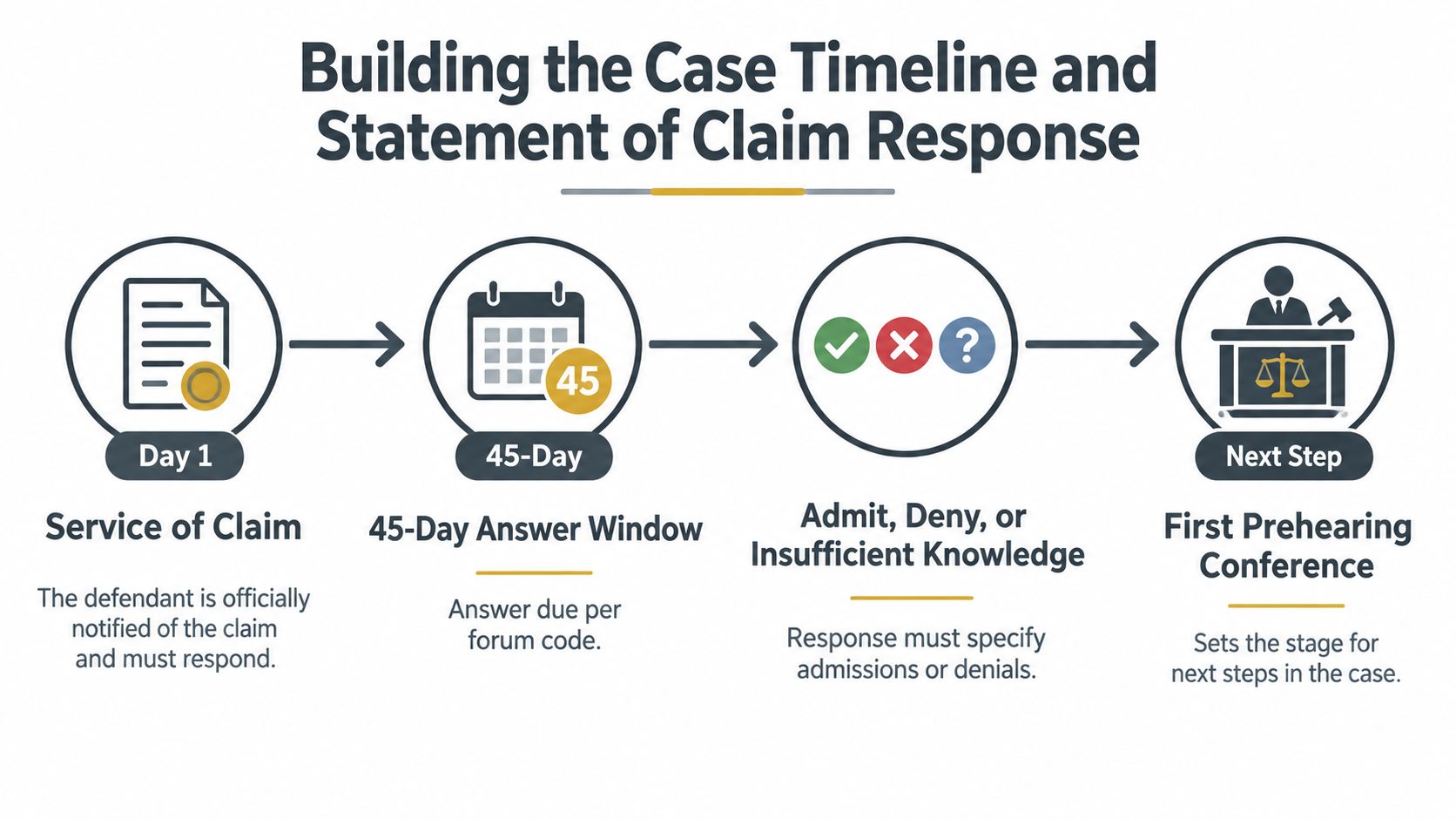
Service of the claim starts a procedural calendar that should exist in more than one person's head. FINRA gives a respondent 45 days to research and serve a response after receiving the Statement of Claim. FINRA's dispute materials also report 2,597 new case filings in 2025 and an overall turnaround time of 13.4 months, reinforcing that the process is active and that delay at the beginning can compress every later task.
The answer should respond to each material allegation with an admission, denial, or statement that the respondent lacks sufficient knowledge to admit or deny. Avoid blanket denials when the records support a narrower response. Plead affirmative defenses deliberately, including limitations, failure to mitigate, contractual offsets, release, waiver, arbitration scope, and any defenses tied to the employment or compensation agreement.
Build the calendar around the Initial Prehearing Conference. FINRA says the panel sets discovery, briefing, and motion deadlines at that conference, while its rules require parties to exchange intended hearing documents and materials at least 20 days before the first scheduled hearing date if those materials haven't already been produced. FINRA's rules for case administration should be checked against the scheduling order issued in the particular case.
Your working calendar should include:
- Answer deadline: Reserve time for factual interviews, privilege review, counterclaims, and verification before filing.
- Discovery milestones: Track production, deficiency letters, motions to compel, and the panel's response dates.
- Expert disclosures: Place report preparation and rebuttal work on the calendar well before the applicable prehearing deadline.
- Motion cutoff: Identify the date for dispositive-style motions, evidentiary motions, and motions in limine.
- Hearing preparation: Set internal deadlines for exhibit exchange, witness rehearsal, demonstratives, and opening statements.
A securities matter can run on a roughly 12-to-18-month preparation horizon, but the actual schedule comes from the forum and panel. FINRA's materials state that settled cases typically resolve in just over a year, while cases proceeding to hearing typically take 16 months. Prepare for the hearing early while preserving room to negotiate.
Collecting and Organizing Documents, Exhibits, and Digital Evidence
The documentary record should function as the spine of the case. A polished opening cannot repair a missing Form U5 amendment, an unexplained compensation ledger, or a text-message thread that changes the meaning of a termination email.
Issue a litigation hold when the dispute arrives. Then create a document map keyed to the elements of each claim and defense. In a Form U5 dispute, separate the original filing, amendments, internal review materials, termination notices, investigation records, compliance communications, and communications about the language ultimately reported. For a promissory note demand, add the note, repayment schedule, compensation statements, transition documents, recruiting communications, and mitigation evidence.
Build a record that an arbitrator can follow
Use topic folders for account opening, suitability, supervision, employment, compensation, regulatory communications, and damages. Number exhibits sequentially and maintain a master index that identifies the date, source, subject, and relevance of each item. A hyperlinked PDF index can help the panel move from the hearing outline to the supporting record without forcing anyone to search through a data dump.
Digital evidence requires more than screenshots. Preserve native emails and exports where possible, retain metadata, identify the custodian, and document the collection method. Coordinate with the broker-dealer's e-discovery vendor or an independent vendor when the dispute involves archived journals, Bloomberg messages, Teams, Slack, CRM records, or multiple cloud accounts.
Keep privilege and work product out of review platforms and production sets until counsel has completed the appropriate review. Don't mix confidential legal advice with ordinary business records in a folder that may later be shared with a vendor or opposing counsel.
A simple action-item record can help during interviews and collection. A template for meeting action items provides a practical way to assign custodians, identify missing records, and track follow-up without replacing counsel's privilege review. For retention questions, consult the firm's guidance on record retention requirements.
Preparing Witnesses and Experts for Testimony
Witness preparation isn't a script-writing exercise. It's the process of helping a truthful witness give accurate, complete, and disciplined testimony without guessing, arguing, or adopting a theory they don't own.
Start by assigning each fact witness a defined role. The registered representative may explain the client relationship and trade decisions. The OSJ supervisor may address review procedures and escalation. An operations analyst may explain a wire, account transfer, compensation calculation, or record-generation process. A former colleague may have relevant knowledge about a termination, Form U5 decision, or internal investigation.
Prepare a short narrative outline for each witness. The outline should identify the documents the witness can authenticate, the facts the witness personally knows, the facts the witness learned from someone else, and the issues where the witness must say, “I don't know.” That distinction matters. Arbitrators notice when a witness presents assumptions as firsthand knowledge.
Rehearse the weak points, not just the favorable story
A first preparation session often reveals the witness's instinct under pressure. Some people hedge. Others fill silence with speculation. Some become defensive when asked about a customer complaint, a supervisory failure, or a compensation decision. Those reactions are not reasons to abandon a witness, but they are signals that the preparation needs another round.
Use a repeating rehearsal loop:
- Conduct a mock direct examination using the documents and hearing outline.
- Run cross-examination on the most damaging facts, not merely the facts the witness likes discussing.
- Mark every hedge, guess, contradiction, argumentative answer, and unexplained gap.
- Revisit the source record and correct the outline.
- Repeat until the witness can answer accurately without volunteering unnecessary conclusions.
A witness who says less, but says it precisely, is usually more useful than one who tries to win the argument from the stand.
The same discipline applies to experts. Review the expert's credentials, assignment, assumptions, methodology, compensation, and prior testimony. Test whether the opinion addresses the issues in dispute. In a damages case involving deferred compensation, production credits, or a promissory note, the expert should be able to explain each input, source record, adjustment, and alternative scenario.
FINRA's 12500-series procedures can require written expert materials and prehearing disclosures. AAA Commercial Rule R-19 may govern expert disclosure in an AAA proceeding, while JAMS rules may apply when the contract selects JAMS. Don't rely on a generic expert checklist. Confirm the forum's current rule set and the panel's scheduling order.
Pressure-test the opinion against the opposing expert's likely attacks. For example, a damages opinion may need to address whether the advisor mitigated losses, whether a bonus was discretionary, whether deferred compensation vested, or whether a promissory note balance should be offset by earned compensation. If the expert can't explain the model to a non-specialist panel, the written report won't carry the case by itself.
Witnesses should also be prepared for questions that aren't central to their direct testimony. In advisor cases, panels may ask about suitability, supervisory review, client communications, Firm Element training, prior disclosures, transition compensation, or the reason a Form U5 was filed. Counsel should explain the subjects without coaching a false answer. The instruction is simple: answer the question asked, then stop.
For a deeper discussion of disciplined witness preparation, review this guide to preparing for a deposition. Deposition preparation and arbitration preparation aren't identical, but both expose whether a witness can separate personal knowledge from assumption.
Run settlement and hearing preparation in parallel
Securities arbitration is strongly resolution-oriented. FINRA's 2024 materials report that 84% of customer arbitration cases closed through settlement or paid damages, and industry guidance places the broader pre-hearing settlement range at roughly 60% to 72%, depending on the reporting set and case definition. The FINRA arbitration statistics discussion reflects why settlement planning belongs beside discovery and hearing preparation.
Open a settlement track when the case is sufficiently developed to price risk. FINRA mediation and AAA's optional mediation process can provide a structured setting, but mediation isn't a substitute for preparation. A mediator needs a clear damages model, the key documents, the disputed facts, and a realistic explanation of what a panel may do.
For a promissory note dispute, quantify the claimed balance, offsets, earned compensation, and mitigation issues. For a deferred compensation fight, identify vesting language, performance conditions, forfeiture provisions, and the employer's calculation. For a Form U5 matter, separate economic damages from reputational and regulatory consequences, and identify the relief the panel can award.
Reconcile settlement authority with the carrier, indemnitor, broker-dealer, or practice owner before each session. Keep a current posture memorandum after every offer and response. A stale assessment can cause counsel to negotiate from an outdated record or reveal a trial position unnecessarily.
Hearing Logistics, Pre-Hearing Motions, and the Final Checklist
A controlled hearing begins with logistics that seem mundane until they fail. Confirm whether the proceeding is remote, in person, or hybrid. FINRA may use Webex, while AAA and JAMS proceedings may use Zoom or an in-person venue depending on the administrator and panel. Verify the platform, exhibits, screen-sharing permissions, recording rules, witness locations, and backup contact method with the case administrator.
Pre-mark the exhibit set and give every participant the same indexed version. Confirm witness calendars, interpreter needs, technology access, and any sequestration instruction. The panel should never be forced to guess which exhibit a witness is discussing.
Motions should solve a defined problem
A motion in limine may address inadmissible expert material, irrelevant customer complaints, or an exhibit that creates unfair prejudice. A motion to compel should identify the specific request, the missing response, the meet-and-confer history, and why the material matters. A dispositive-style motion may be available in some proceedings, but arbitrators often need a clean legal and factual record before deciding whether early resolution is appropriate.
FINRA Rule 12504 exchange timing and JAMS Rule 16 deadlines can anchor this phase. AAA timing depends on the applicable rules and the arbitrator's order. The schedule in the case administrator's notice controls your internal plan.
| Motion Type | FINRA Rule / Deadline | AAA Deadline | JAMS Rule / Deadline |
|---|---|---|---|
| Motion to compel | Follow the panel's discovery schedule and FINRA motion procedures | Follow the arbitrator's scheduling order | Follow the case-management order under the selected JAMS rules |
| Motion in limine | File and serve by the panel's prehearing motion deadline | File by the deadline in the procedural order | File according to the schedule established under Rule 16 |
| Dispositive-style motion | Available only where permitted and scheduled by the panel | Depends on the applicable AAA rules and order | Depends on the selected JAMS rules and case-management order |
| Exhibit exchange | FINRA requires intended hearing materials not previously produced at least 20 days before the first scheduled hearing date | Follow the arbitrator's information-sharing order | Follow the procedural timetable and Rule 16 order |
Before the first session, complete the updated exhibit list, served exhibit packets, pre-marked demonstratives, witness order, interpreter confirmation, sequestration instructions, and opening-statement dry run. Assign one person to manage the live exhibit index and another to monitor witnesses and timing.
Your Arbitration Preparation Action Plan
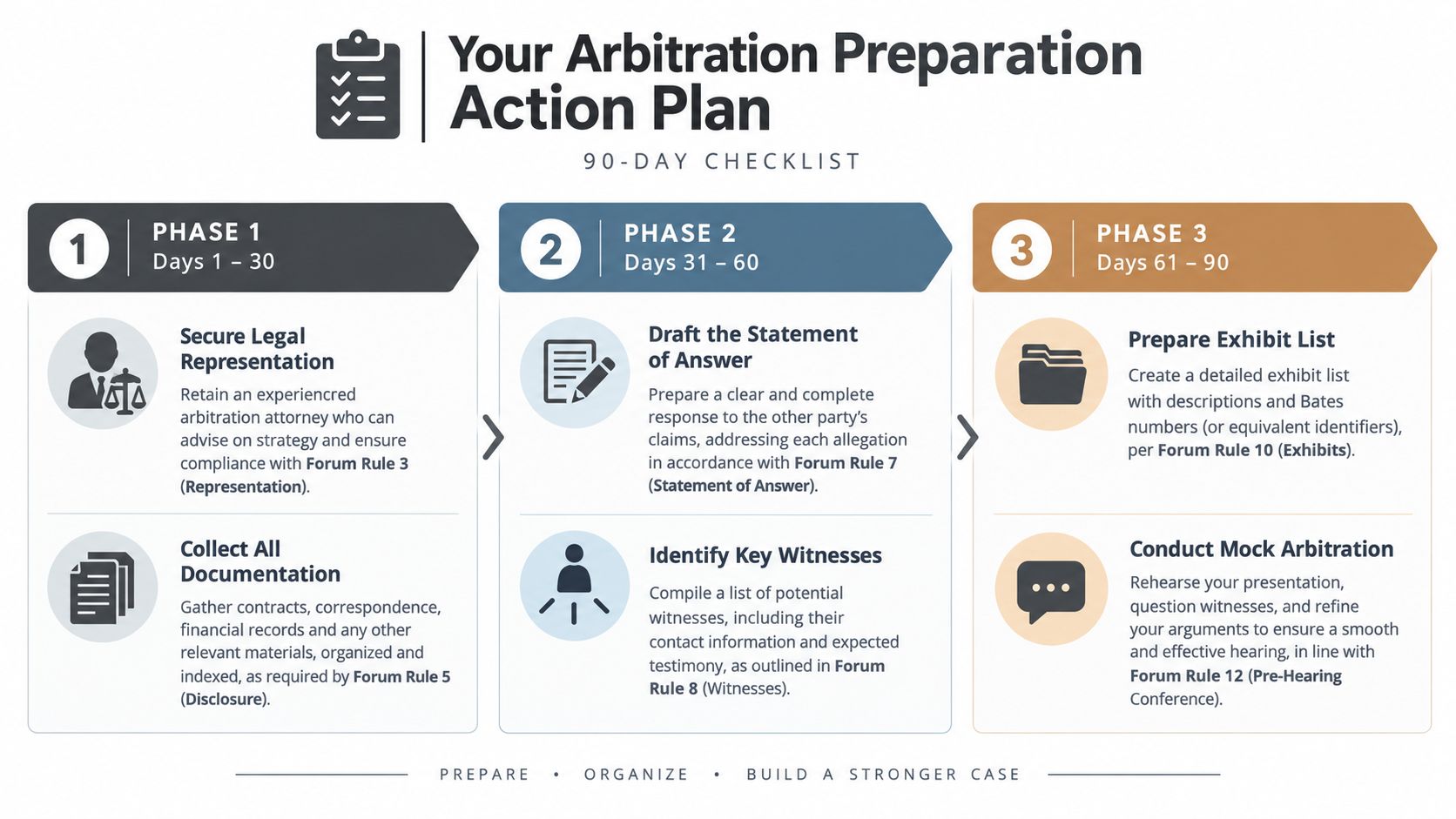
The question of how to prepare for arbitration becomes manageable when the work is sequenced. The first 90 days should produce concrete deliverables, not just meetings and general discussions.
Days 1 through 30
- Preserve communications: Issue the hold, identify custodians, and image relevant email, text, CRM, and messaging records within the first seven days.
- Retain counsel: Engage counsel experienced in securities arbitration before drafting the answer or responding substantively to opposing counsel.
- Confirm the forum: Read the arbitration clause and verify whether FINRA, AAA, or JAMS controls the dispute.
- Calendar the answer: FINRA's respondent deadline is 45 days under Rule 12303. The applicable AAA deadline may be 30 days, and JAMS Rule 6.2 may control a JAMS proceeding. Confirm the current rule and administrator's notice before relying on any deadline.
Days 31 through 60
- Build the document map: Organize the CRD record, Form U5 filings and amendments, employment documents, compensation records, communications, and damages materials.
- Complete disclosures: Prepare the applicable FINRA Rule 12508 and Rule 12510 disclosures, or the corresponding AAA or JAMS production required by the procedural order.
- Draft witness outlines: Tie each witness to specific issues and documents rather than broad themes.
- Lock expert work: Confirm the assignment, methodology, assumptions, report schedule, and rebuttal needs.
Days 61 through 90
- Open settlement discussions: Use mediation where it fits, but anchor every offer to a defensible damages model and confirmed settlement authority.
- Prepare the hearing record: Create the exhibit index, pre-mark demonstratives, and identify unresolved discovery or evidentiary issues.
- Rehearse: Run a full mock arbitration two weeks before the first session, including openings, direct examinations, cross-examinations, technology, and exhibit navigation.
The strongest preparation plan is case-specific. It accounts for the forum clause, the Form U5 or compensation issue, the available records, witness credibility, insurance constraints, and the relief a panel can award.
If you want to discuss your business law matter, contact Kons Law at (860) 920-5181. Kons Law can assess the arbitration forum, help organize the claim or defense, develop the evidence and damages strategy, and prepare advisors or financial firms for FINRA, AAA, or JAMS proceedings. Visit Kons Law to begin a case-specific conversation.
