
A representative gives notice on Monday, expects to begin at a new firm quickly, and assumes the transition is mostly administrative. By Friday, the old firm is reviewing the termination reason, the new firm is asking for registration information, clients are asking where their accounts went, and a compensation department is calculating an alleged repayment balance. That is where a broker-dealer change becomes more than a resignation.
A transition is a legal and regulatory lifecycle. The resignation letter is only the visible starting point. Registration filings, customer communications, account transfers, deferred compensation, restrictive covenants, Form U5 amendments, and FINRA requests can continue shaping the matter long after the representative has joined the new platform. The safest approach is to sequence those issues before the move, not solve them reactively after the first dispute appears.
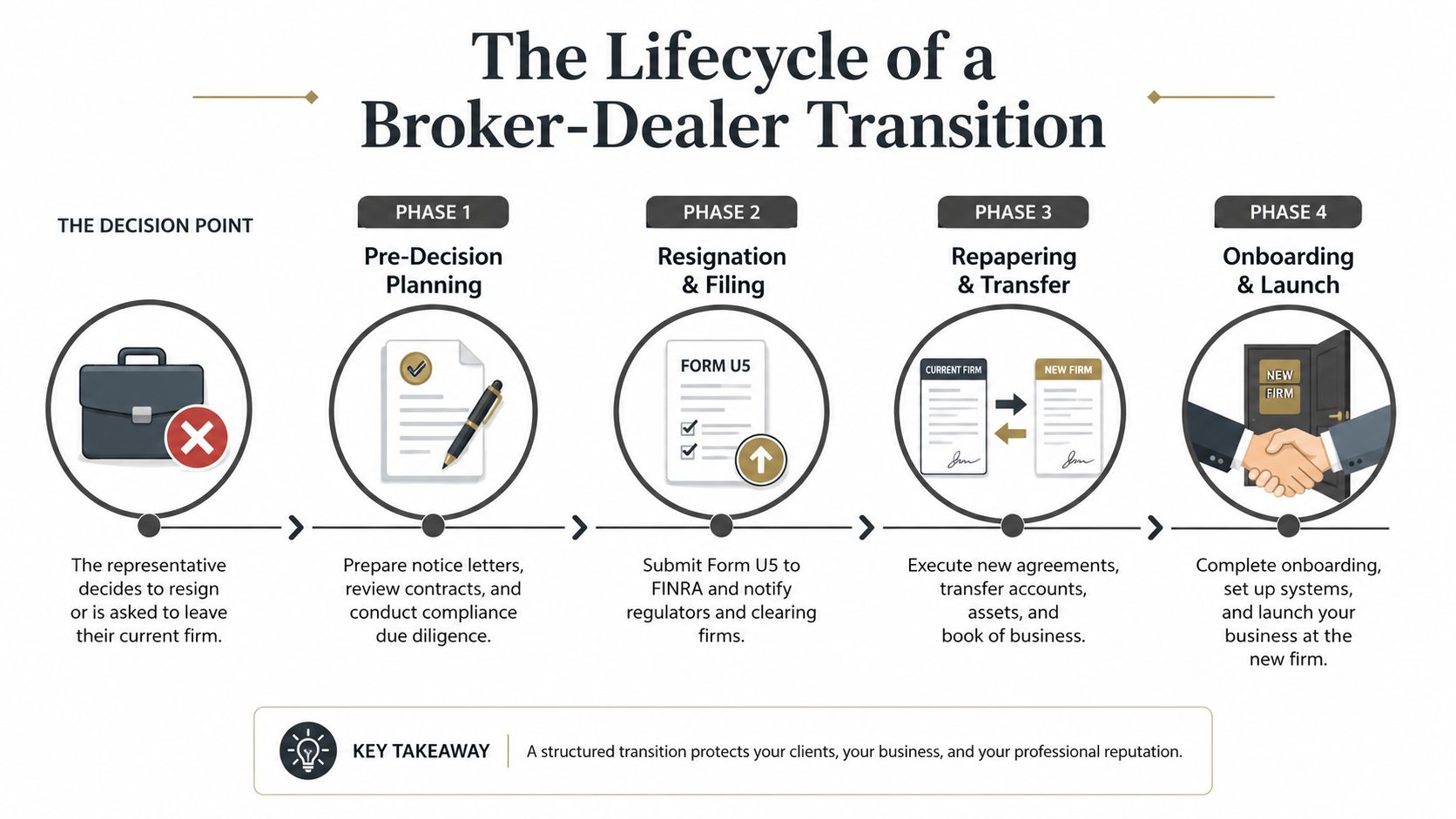
The Lifecycle of a Broker-Dealer Transition
The process usually begins when a representative decides to leave or learns that the firm intends to end the relationship. At that moment, the representative and the firm have different priorities. The representative wants a clean launch and access to clients. The firm must protect records, determine the termination language, preserve compensation rights, and meet regulatory filing obligations.
Phase one involves planning before the decision becomes public
Before sending notice, review the employment agreement, Form U4 disclosures, non-solicitation language, Protocol for Broker Recruiting status, deferred-compensation plan, promissory note, and any repayment schedule. Map customer relationships without taking firm property or confidential information. A customer-list strategy should identify what information the representative can lawfully use, what must remain with the firm, and what notice format the governing documents require. The broker recruiting protocol framework can matter, but it doesn't override every contract or state-law restriction.
Phase two is resignation and filing
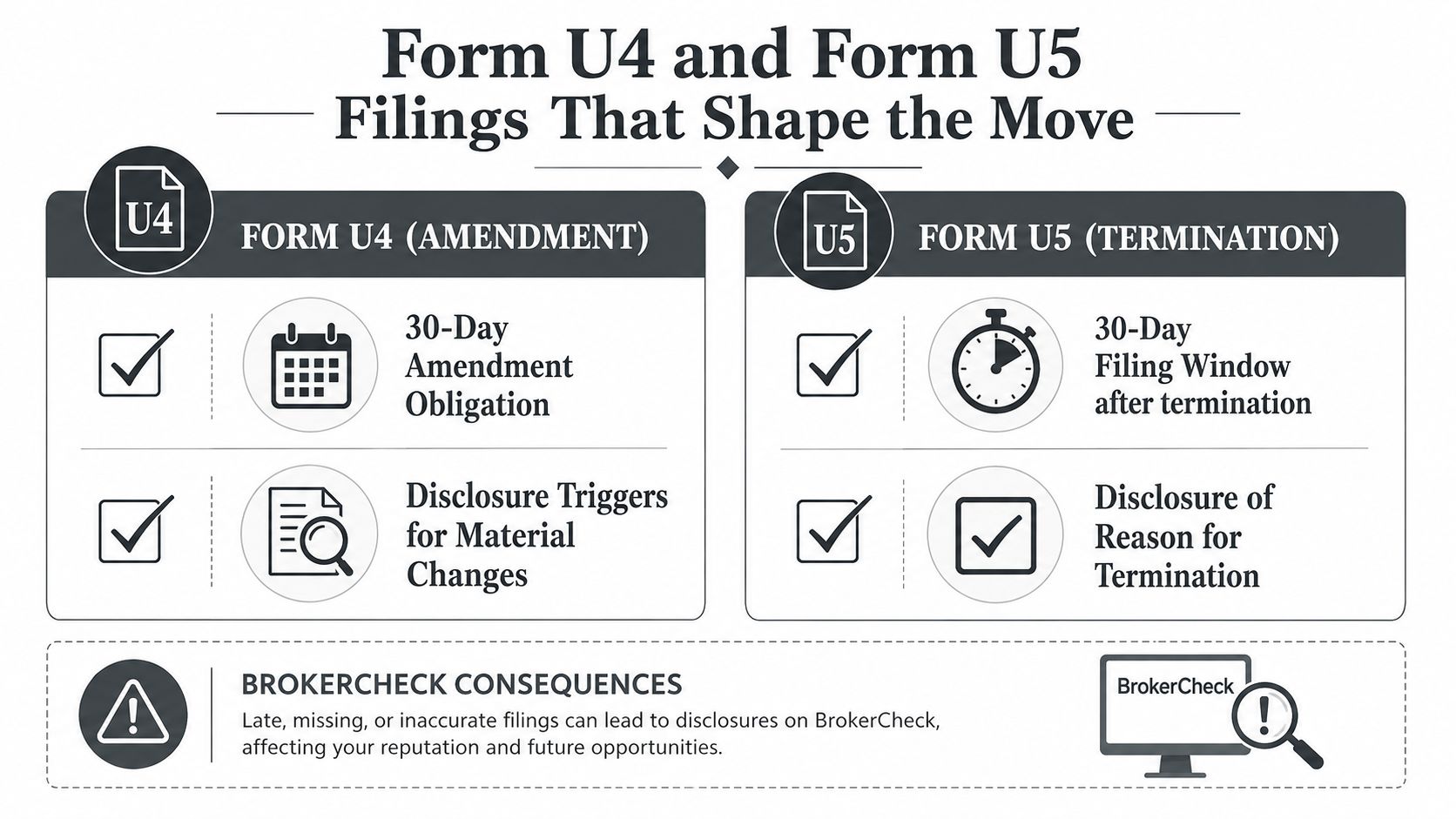
The resignation notice should be accurate, controlled, and consistent with the representative's intended explanation. The firm must file Form U5 within 30 days of the employment end date, and FINRA requires an amendment if the firm later learns that the original filing is inaccurate or incomplete, as explained in FINRA's Form U5 guidance. That means the filing can remain an active issue after the move.
Phase three is the client transition
Existing accounts don't automatically become accounts of the new firm. The parties must determine whether each customer will sign new account documents, participate in an approved negative-consent process, or remain with the legacy firm. Operations, compliance, and the representative must coordinate statements, account titles, transfer instructions, disclosures, and recommendations during the gap.
Phase four is post-departure housekeeping
The next thirty, sixty, and ninety days may involve unpaid production credits, deferred compensation, a promissory-note demand, a customer complaint, an amended U5, or a FINRA Rule 8210 request. Treat the transition as an open compliance file until those issues are resolved, documented, and assigned to someone responsible.
Why Broker-Dealer Change Is Now Industry-Standard
Broker-dealer change is no longer an unusual event that only follows a major merger or a disciplinary problem. The SEC reported that, as of 2024, the United States had approximately 3,340 broker-dealers with total assets of about $6.4 trillion, while the number of firms had declined by roughly 30% since 2010 and assets had increased by about $1.7 trillion. The SEC's broker-dealer data describes a market with fewer firms operating at greater collective scale.
That consolidation changes the context of an individual move. Clearing and carrying firms declined from 247 to 158 between 2010 and 2024, while other broker-dealers fell from 4,511 to 3,183, according to the same SEC data. Larger platforms may offer broader services, but transitions can involve more layers of supervision, centralized approval, custody arrangements, and account-transfer procedures.
FINRA's 2025 snapshot also shows movement among both individuals and firms. During that year, 11,294 broker-dealer-only registered representatives added investment-adviser registration and became dual-registered by year-end. At the same time, 1,800 dual-registered representatives became broker-dealer-only, and 3,545 moved to investment-adviser-only registration. FINRA also reported that 163 firms exited membership while 98 new firms joined, with all new entrants being small firms, as shown in the 2025 FINRA Industry Snapshot.
FINRA Registration and Mobility Snapshot
| Metric | Current Period | Prior Period | Trend |
|---|---|---|---|
| Broker-dealer-only representatives adding investment-adviser registration | 11,294 in 2025 | Not provided | Movement toward dual registration |
| Dual-registered representatives becoming broker-dealer-only | 1,800 in 2025 | Not provided | Continued movement into a single channel |
| Dual-registered representatives becoming investment-adviser-only | 3,545 in 2025 | Not provided | Advisory-model transitions remain material |
| Firms exiting FINRA membership | 163 in 2025 | Not provided | Membership churn |
| New FINRA member firms | 98 in 2025 | Not provided | New entrants were all small firms |
These figures don't establish that every representative will move annually, and they shouldn't be used to predict an individual outcome. They do establish that registration status, business model, and firm membership change often enough that compliance departments must treat transitions as routine operational work with serious legal consequences.
A representative moving from a brokerage channel to an advisory channel may face different supervision, compensation terms, disclosure duties, and customer-account mechanics. The central question isn't whether change is normal. It's whether the parties have sequenced the change well enough to avoid turning ordinary mobility into a filing, compensation, or customer dispute.
Form U4 and Form U5 Filings That Shape the Move
Form U4 and Form U5 create the regulatory record that follows a representative between firms. FINRA identifies Form U5 as the Uniform Termination Notice for Securities Industry Registration, and the form is used by broker-dealers, investment advisers, and issuers to terminate an individual's registration. FINRA also provides an amendment process for updating the termination date, reason, disclosure information, and residential information through the Form U5 materials.
The timing matters because a transition often contains incomplete information. A representative may resign before the firm finishes its internal review. A complaint may arrive after departure. A firm may initially describe the separation one way and later receive information that changes its assessment. FINRA's guidance requires the firm to file the U5 within 30 days of the employment end date, and the filing must be amended when the firm learns that the original disclosure is inaccurate or incomplete.
The filing sequence requires disciplined review
Before resignation, compare the proposed explanation with existing U4 disclosures, customer complaints, outside-business-activity records, promissory-note documents, and internal correspondence. A mismatch doesn't automatically prove misconduct, but it creates a question that a future employer, regulator, or customer may ask.
After the new firm files or reactivates the representative's Form U4, the representative should monitor the information that appears in the regulatory record. Under the requirements identified in the transition plan, material disclosure events can trigger a 30-day U4 amendment obligation, while certain reported disclosure events carry a 10-business-day amendment duty. Customer complaints, judgments, and arbitrations can also create a 30-day post-notice amendment requirement. Those deadlines should be confirmed against the applicable filing instructions and event facts rather than handled by memory.
Practical rule: Never treat a U5 as a document that becomes irrelevant once the new firm's onboarding is complete.
The most frequently disputed items include written customer complaints, pending arbitrations, and promissory-note obligations. Those issues can surface later in a FINRA production, even when the representative believed the matter was informal or resolved. The termination reason and later amendments can affect BrokerCheck visibility, future hiring decisions, reactivation of Form U4 information, and customer due diligence.
Repapering, Negative Consent, and Client Transfers
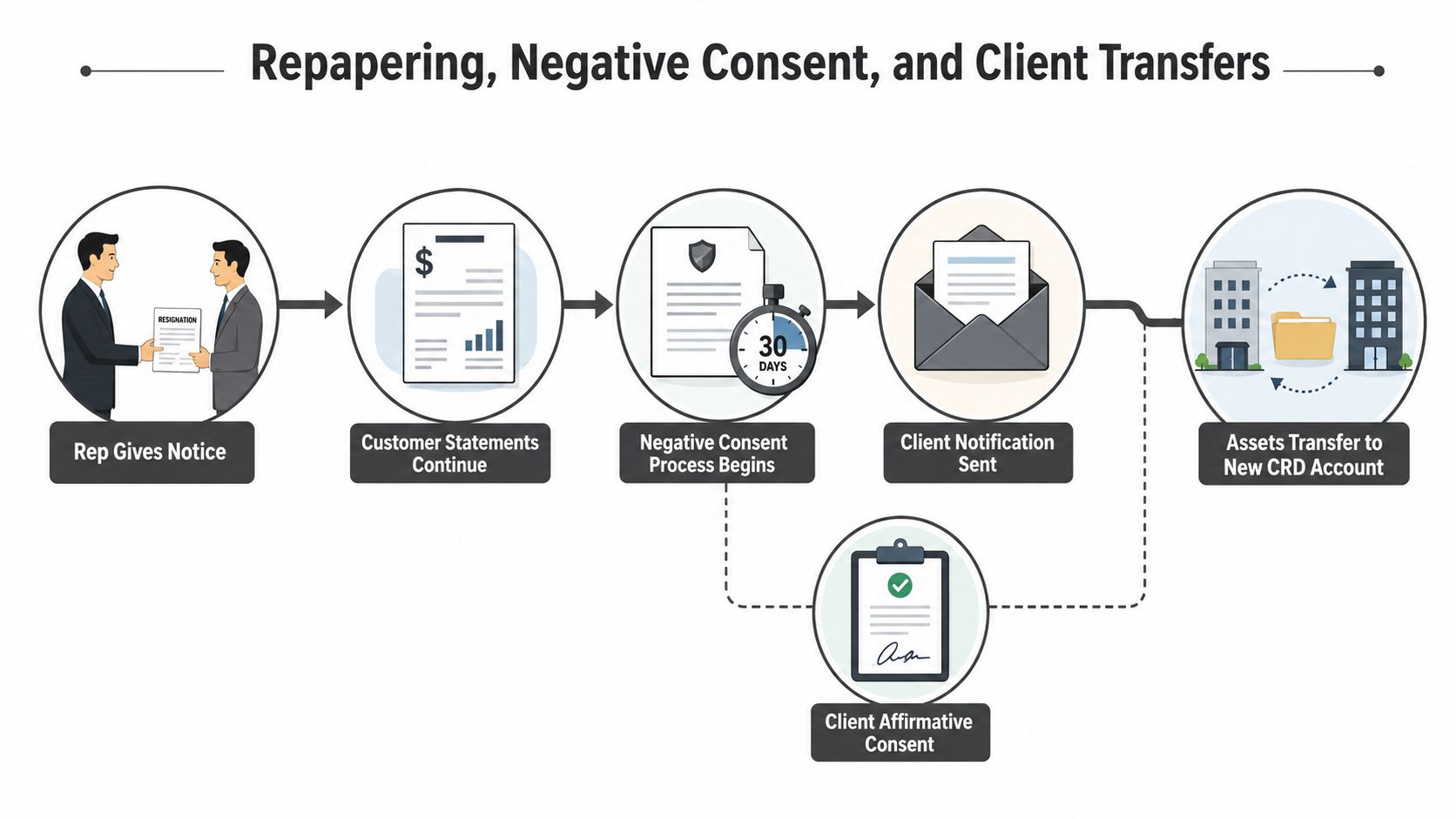
A representative gives notice, but the customer account doesn't move with the representative. Statements can continue under the legacy firm's account structure, and account titles remain associated with that firm until the customer signs new documents or the firms complete an authorized transfer process.
Assume a representative leaves a firm with a group of brokerage clients. The legacy firm must continue handling the accounts under its obligations while the receiving firm determines whether it can open corresponding accounts. The client may need to review new account agreements, fee schedules, disclosures, advisory documents, margin terms, product limitations, and transfer instructions. The receiving firm should not treat a client roster as permission to provide unsupervised recommendations during the transition.
Full repapering and negative consent serve different purposes
Full repapering requires affirmative client action. The customer signs the new firm's documents, the receiving firm reviews the account, and the assets move through the appropriate transfer mechanism. This approach creates a clearer record, but it can be slower and may leave accounts at the legacy firm while paperwork remains outstanding.
Negative consent works differently. In limited circumstances, a firm can notify customers that an account will transfer unless the customer objects within the stated period. FINRA's Regulatory Notice 15-22 permits this approach for certain directly held mutual fund and variable insurance product accounts when, among other limited situations, the firm is going out of business or the servicing representative is leaving and the firm won't continue the services.
FINRA's 2026 change also matters. Effective April 1, 2026, FINRA removed the staff pre-review requirement for draft negative-consent letters in the circumstances covered by its notice, as described in Regulatory Notice 26-03. The change can accelerate the process, but it places greater importance on notice quality, objection handling, documentation, and firm supervision. Removing pre-review doesn't eliminate the firm's responsibility to use negative consent only when permitted or to communicate clearly.
The operational sequence should be written before notice goes out
A workable transition plan identifies:
- Legacy-account control: Determine who services the account, sends statements, processes requests, and approves communications before the new account opens.
- Client notice records: Preserve the letter, delivery evidence, objection log, returned mail, and follow-up communications.
- Transfer reconciliation: Compare positions, cost basis, account registration, fees, beneficiaries, and restrictions before treating the new account as complete.
- Recommendation supervision: Route recommendations through the firm authorized to supervise them. A transition gap isn't a license for informal advice.
The most common failures are practical. A fee gets coded as advisory when the account remains brokerage-based. Cost basis doesn't match. A client assumes an asset transferred when it hasn't. Disciplined sequencing prevents those errors from becoming customer complaints or disclosure events.
Compensation Disputes and Promissory Note Defense
A transition can look complete once the registration moves, yet compensation disputes often begin afterward. A representative may still be owed trailing commissions, deferred compensation, production credits, vested or unvested equity, or payments under a retention plan. The new firm may use a different payout schedule, while the former firm may argue that the resignation caused forfeiture, repayment, or a reduction in credits.
Promissory notes add a separate contractual issue. A signing payment may be documented as a loan forgiven over time, with accelerated repayment tied to resignation, termination for cause, production levels, or another specified event. The document's label does not decide the outcome. Counsel must read its operative terms with the compensation grids, amendments, repayment schedule, and facts surrounding the departure.
The repayment claim and the U5 claim are separate disputes
FINRA Rule 13806 provides a special promissory-note arbitration procedure only when a member claims solely that an associated person failed to repay money owed under a promissory note. The rule does not allow additional allegations in that expedited proceeding, as reflected in FINRA's Rule 13806 materials. A repayment demand therefore presents a different dispute from one challenging the truth, completeness, or motive of a Form U5 statement. The filing itself can be reviewed through Form U5 dispute and filing guidance, but correcting a regulatory record may require relief different from defending a debt claim.
| Feature | Rule 13806 Expedited | Standard Arbitration | U5 Rule 13805 |
|---|---|---|---|
| Core issue | Sole repayment claim under a promissory note | Broader contractual, compensation, or employment claims | Dispute concerning the termination statement or related disclosure |
| Evidence | Note, payment history, and defenses within the rule's scope | Contracts, grids, communications, witness testimony, and damages evidence | Personnel records, investigation materials, complaints, and filing history |
| Procedure | Special expedited process, subject to rule requirements | Ordinary FINRA arbitration procedures | Procedure directed to the U5-related claim |
| Strategic concern | Speed may limit litigation of unrelated allegations | Broader record, with greater cost and complexity | Correcting the regulatory record may require relief separate from repayment |
A demand letter does not establish that expedited treatment applies. Counsel should verify the current rule, the amount claimed, whether repayment is the only claim, and whether the respondent's defenses require a broader forum. The pleading strategy can affect both the available discovery and the timetable.
Preserve compensation grids, offer letters, repayment schedules, payroll records, approval emails, and communications explaining the termination. Oral explanations may support the defense, but contemporaneous documents usually carry greater weight when assessing enforceability, forfeiture, or consistency between the underlying events and a later U5 amendment. Promissory note enforcement guidance can help frame the repayment issue when it overlaps with the employment dispute. A transition plan should treat compensation, registration, and U5 exposure as connected workstreams, not as issues that end when the resignation letter is delivered.
Restrictive Covenants and Practice Transitions
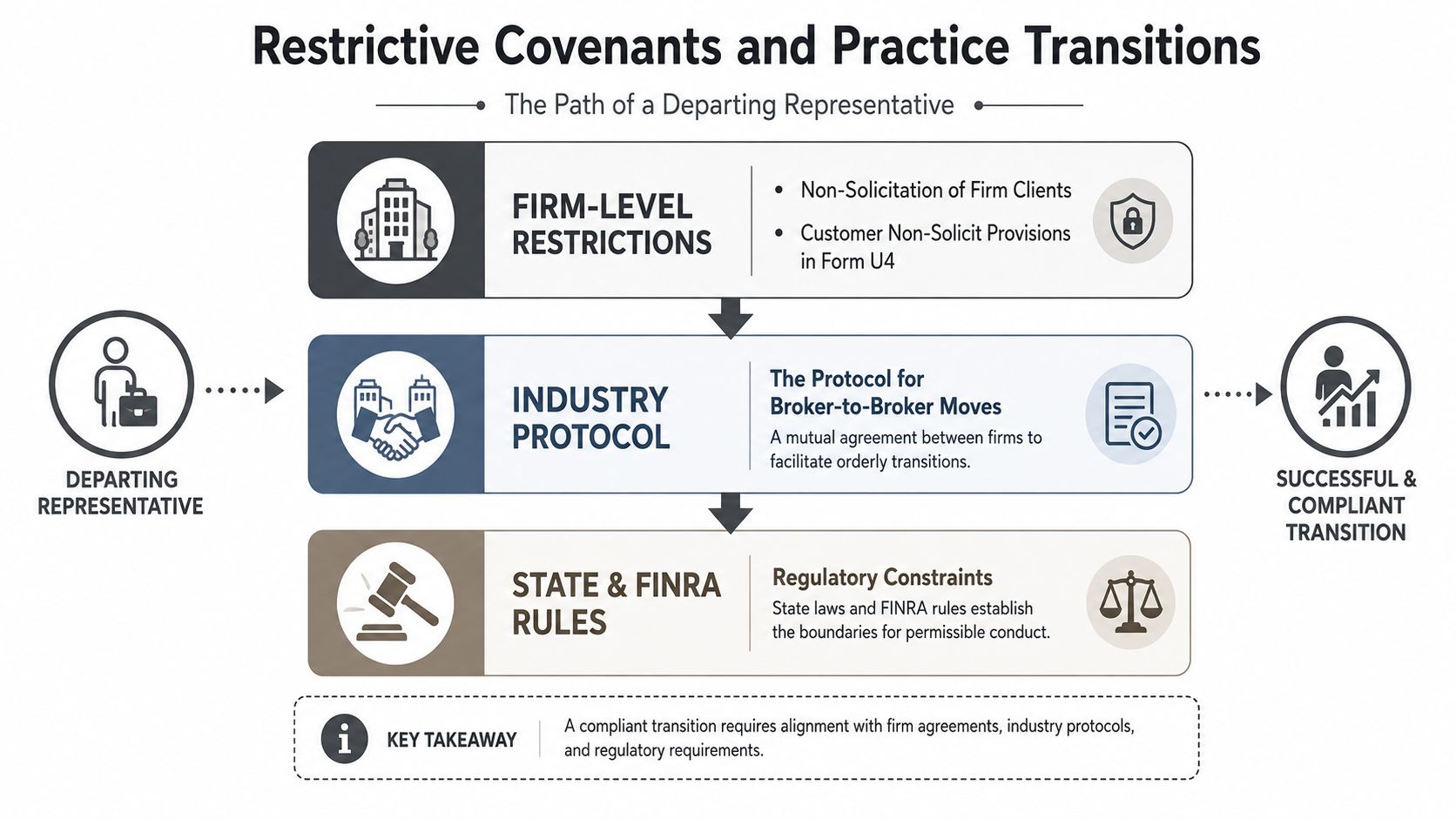
A departing representative usually faces several restriction layers at once. The employment agreement may contain customer non-solicitation language, confidentiality duties, notice requirements, a non-compete, or liquidated-damages provisions. The Form U4 package may incorporate those terms, while the Protocol for Broker Recruiting offers a separate framework for certain broker-to-broker moves.
The Protocol isn't a universal release. It generally depends on required notice practices, the identity of the protected representative and customer, the information removed at departure, and the conduct of both firms. A representative who follows the basic framework but takes prohibited records, contacts excluded customers, or violates a separate contractual duty may lose the protection the Protocol would otherwise provide.
Three layers should be reviewed separately
Firm-level restrictions may govern what the representative can solicit, retain, copy, or disclose. Review the exact customer definition, territory, duration, confidentiality language, and remedy clause. An overbroad list can create a factual dispute over whether a client was protected or merely included in a firm's database.
Industry protocol protections can provide a practical path for a compliant transition, including a required notice format and a post-departure protection window identified in the governing framework. The Protocol's mechanics don't authorize taking firm documents or bypassing customer privacy obligations.
State and regulatory limits can narrow enforcement. For example, California Business and Professions Code Section 16600 is a significant constraint on many employment non-compete theories, and other states have enacted or considered limits on non-compete provisions. The applicable law depends on the representative's work, contract, forum, and facts. A choice-of-law clause isn't automatically effective if it was selected to evade protections that otherwise apply.
Drafting problems often appear in remedies. Liquidated damages may function like an unenforceable penalty. A customer list may include people the representative never served. A firm may demand compliance from the representative while failing to follow its own obligations under the agreement or Protocol.
A transition plan should identify the information the representative may use before anyone sends a customer message.
For representatives, the review should happen before notice. For firms, the agreement, customer definitions, notice procedure, data-retention rules, and enforcement remedy should be tested against the likely transition scenario. That preparation is more effective than relying on an emergency injunction after client communications have begun.
FINRA Investigations, Rule 8210, and Post-Move Risk
A resignation can look routine until a customer complaint, disputed termination reason, outside-business-activity issue, missing record, or compensation disagreement links the former firm, receiving firm, and representative. FINRA may then examine conduct that began before the resignation and continued through registration, client transfers, and post-move supervision. An inquiry does not by itself establish dishonesty or incompetence, but the transition record can create questions that require coordinated answers.
FINRA Rule 8210 permits FINRA to require firms and associated persons to provide information, documents, and sworn testimony for investigations, complaints, examinations, and proceedings. The request may cover emails, client files, compensation records, account-transfer materials, employment agreements, and testimony about the separation. A practical overview of the rule is available in Kons Law's FINRA Rule 8210 guidance.
The response begins before the first letter
Preserve relevant communications before access changes. Identify each prior employer and the associated CRD information. Separate personal records from firm records, and do not delete, alter, or selectively produce material because it appears unfavorable. If the request overlaps with employment issues, a U5, or customer matters, coordinate with counsel and the current firm before responding.
An 8210 request may expose a conflict between the representative's account and the former firm's U5. If the firm later amends the filing, the new wording can affect future registration review and prompt questions at the receiving firm. The same event may require consistent treatment in a Form U4 disclosure, FINRA production, customer complaint response, and arbitration.
Treat the transition year as an active file
Maintain a chronology covering the resignation notice, access termination, customer communications, account-opening dates, transfer status, complaint receipt, U5 filing, amendments, and regulatory correspondence. Keep compensation records with compliance materials. Together, they may show whether a recommendation occurred before supervision began, whether a client objected to a transfer, or whether the firm learned information before amending its filing.
A Wells submission or internal investigation may follow an inquiry. The response depends on the allegations and the record. Counsel should coordinate overlapping obligations so explanations remain accurate and consistent before FINRA, the former firm, the receiving firm, and an arbitration panel.
A 90-Day Plan and When to Engage Counsel
A useful transition calendar starts before the resignation and continues after onboarding. The dates below are planning milestones, not substitutes for the deadlines attached to a particular agreement, filing instruction, customer notice, or regulatory request.
Sixty days before resignation
Review restrictive covenants, Protocol eligibility, deferred-compensation vesting and forfeiture terms, production-credit rules, promissory-note triggers, and customer-data restrictions. Build a document inventory without copying firm property. Decide which questions require written clarification before notice, especially whether a repayment clause accelerates when the representative leaves voluntarily or is terminated without cause.
Thirty days before transition
Finalize the resignation sequence, proposed explanation, U4 disclosure review, Protocol notice, customer-transfer strategy, and communications workflow. The firm should identify the person responsible for U5 preparation, internal investigation, customer notices, account restrictions, and compensation reconciliation. The receiving firm should determine which accounts require affirmative repapering and which, if any, qualify for a compliant negative-consent process.
The first sixty days after the move
Track the U5 filing and any amendment risk. Reconcile every transferred account, fee classification, cost-basis record, beneficiary designation, and unresolved client question. Keep a response file ready for an 8210 request, customer complaint, promissory-note demand, or arbitration filing.
Counsel involvement is most valuable before the parties commit to a position. Engage securities-defense counsel early when a restrictive covenant is ambiguous, a promissory note conflicts with compensation documents, a U4 disclosure is uncertain, the proposed U5 reason is disputed, or an 8210 letter arrives. Waiting can narrow the available remedies, especially once customer communications are sent or a filing becomes visible.
The cost-benefit analysis should include more than legal fees. Consider deferred compensation, withheld bonuses, production credits, accelerated loan repayment, lost client revenue, potential damages, and the effect of an inaccurate regulatory record. A flat-fee review may fit a pre-resignation contract and filing analysis. A broader arbitration or investigation may require staged work, with the engagement shaped by the documents and the forum rather than by an assumed outcome.
If you want to discuss your business law matter, Kons Law can help evaluate broker-dealer transitions, Form U5 issues, compensation disputes, promissory notes, restrictive covenants, and FINRA investigations. Contact Kons Law at (860) 920-5181 or visit Kons Law to discuss the facts and the next practical step.
