
You're staring at a separation draft, the other side wants a signature, and the clock is already making the document feel more important than it should. That's exactly when people miss the central point: a business separation agreement isn't just the paper that ends a relationship, it's the document that decides who keeps what, who still owes what, and who gets dragged into a dispute two years later.
A good draft does more than record that someone left. It allocates assets, liabilities, contracts, employees, client relationships, intellectual property, and transition obligations with enough precision that the deal can function after everyone stops talking. The headline number matters, but the mechanics beneath it matter more.
What a Business Separation Agreement Actually Does
A co-founder hands over a draft, the advisor is told it's “standard,” or the departing partner is asked to sign before the next payroll cycle, and the pressure is obvious. In those moments, the agreement can look like a simple exit letter. It's not.
A business separation agreement is both an exit document and a transaction-level allocation instrument. It decides which party keeps which assets, which liabilities stay behind, how contracts get assigned, who retains employees or contractors, and what happens to customer relationships and transition services after the split. When any one of those buckets is vague, enforcement gets messy fast.
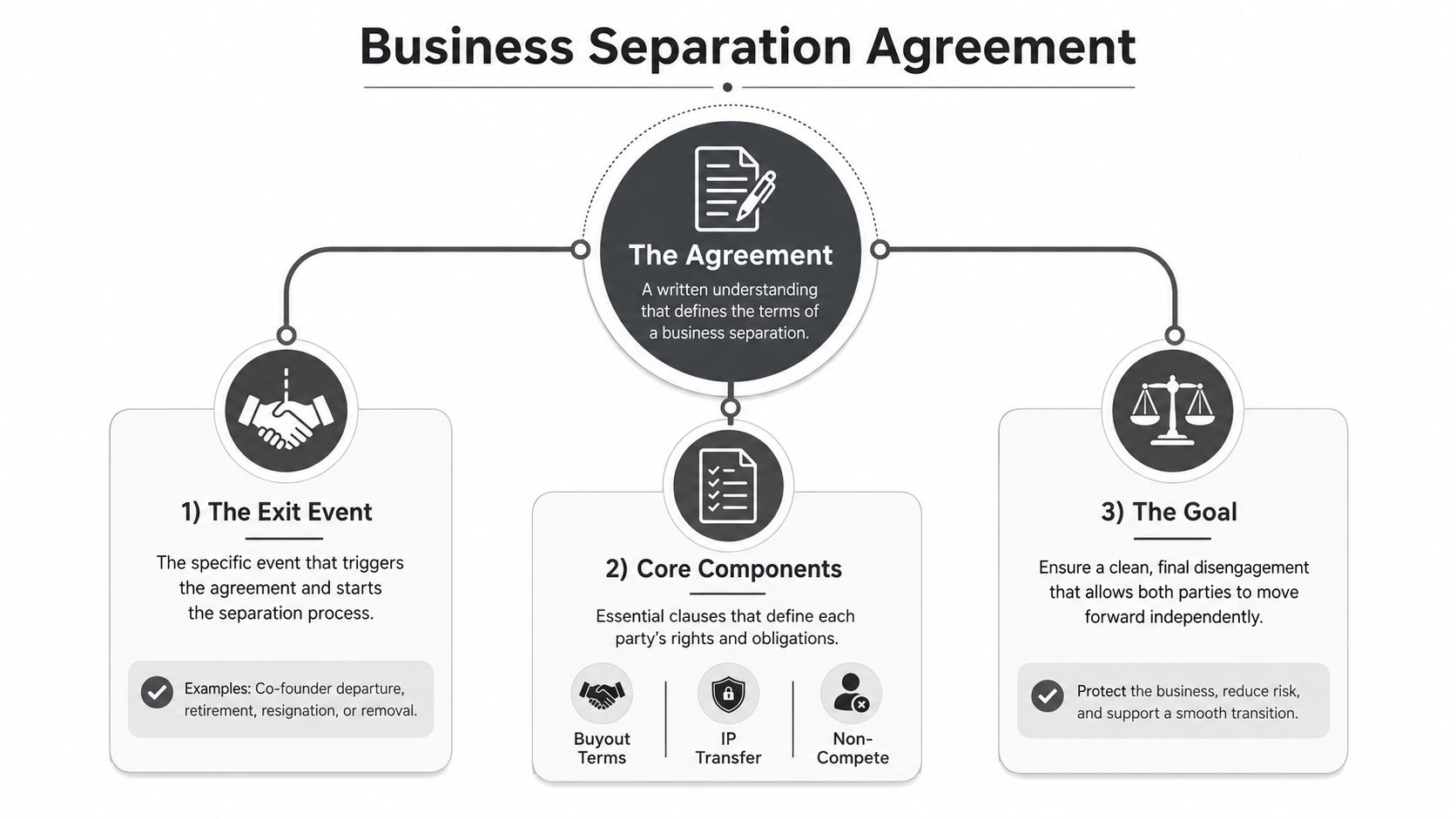
The agreement's legal mechanics usually matter more than the number printed on the first page. A clean buyout amount means little if the parties never specify who is responsible for a lease, a line of credit, a personal guarantee, or a customer account that generates after-close claims. That's why practitioners treat the document as the controlling record for later releases, obligations, and enforcement fights, not as a ceremonial ending.
Practical rule: if a liability, client relationship, or transition task isn't assigned in writing, someone will argue about it later.
For a quick compare-and-contrast perspective, it can help to compare shareholder agreement options while reviewing how ownership rights are documented. The right drafting frame is closer to a settlement than a farewell note, which is why a related resource on what is a settlement agreement can help clarify how releases and finality work in practice.
Common Triggers for a Business Separation Agreement
These agreements show up in different settings, and the trigger changes the drafting priorities. A partner leaving a multi-member LLC is dealing with a different problem than a financial advisor being pushed out of a broker-dealer, even if both people are told the process is just a “clean break.”
Partner and founder exits
In a partnership or founder breakup, the agreement typically unwinds equity, governance rights, IP ownership, and any lingering obligations tied to the business itself. The central question is simple: who keeps control of the enterprise, and on what terms does the other person leave? A business dissolution often needs separate mechanics, so a linked guide on how to dissolve a business partnership is useful when the split involves a broader wind-down.
Advisor transitions and forced departures
When an advisor leaves a registered investment adviser or broker-dealer, the separation agreement often becomes the document that controls deferred compensation, production credits, promissory-note claims, client communication, and the mechanics of moving books of business. That's where the draft stops being theoretical and starts determining who can service clients, who can solicit them, and who keeps the economic tail. For firms dealing with broader operating strain, a practical overview of overcoming small business hurdles can help frame the financial pressure that often sits behind these exits.
Mid-probe departures
The hardest cases are often the quiet ones. An advisor is asked to leave during an internal review, the parties want the matter contained, and everyone reaches for broad release language before the issues are fully mapped. That's when deferred pay, contested notes, and client-transfer restrictions tend to collide, and the separation agreement becomes the first document everyone cites when the dispute escalates.
A separation agreement is only as useful as the trigger it was built to address. A founder buyout, an advisor resignation, and a partnership unwind all demand different allocation choices.
Essential Clauses That Make or Break the Agreement
The fastest way to understand a business separation agreement is to strip away the legal jargon and ask what each clause decides. Most disputes aren't about whether the agreement exists, they're about whether it answered the right question in the right order.
| Clause | What It Decides |
|---|---|
| Party identification | Who is bound and who is leaving |
| Asset allocation | Who keeps equipment, accounts, IP, and goodwill |
| Liability allocation | Who is stuck with debt, leases, guarantees, and claims |
| Payment terms | When money moves and what triggers it |
| Employee and contractor transfer | Who may continue working with the business |
| Client and customer handoff | Who services the relationship and who may solicit |
| Mutual releases | Which future claims are waived |
| Indemnification | Who pays if a third-party claim lands later |
| Confidentiality and non-disparagement | What can be said after the split |
| Governing law and dispute resolution | Where and how the fight gets heard |
The highest-risk drafting point is the liability schedule. If a debt, lease, line of credit, or personal guarantee is not expressly assigned or waived, the departing party may still be exposed, especially where third-party consent is needed to release the obligation. That's why indemnification clauses in contracts deserve careful drafting, not boilerplate treatment.
The clauses that prevent later friction
Party identification sounds basic, but it matters when there are entities, affiliates, and individuals all signing in different capacities. Asset and liability allocation answers the practical question of who owns the problem after closing, and employee or contractor transfer clauses decide who has authority to keep the team intact. Intellectual property assignment matters just as much in a founder exit as it does in an advisor practice, because software, branding, client materials, and proprietary methods can all create post-exit fights.
Confidentiality, non-disparagement, and non-compete language should never be tossed in as decorative language. Governing law and dispute resolution do quiet work too, because they control the forum and the rules if the deal goes sideways. A sound draft gives the parties a map for what happens after the relationship ends, not just a signature page.
Valuation, Payment Architecture, and Compensation Mechanics
The money side of a breakup is where the argument usually starts. People focus on the headline buyout figure, then discover that timing, offsets, and payment conditions are what decide whether the deal feels fair in month one and enforceable in year two.
Price is only half the conversation
A strong separation agreement should define the buyout formula, the calculation method, and the conditions that trigger payment. That includes whether the payout is tied to a share transfer, whether a board resignation must be delivered first, and whether the departing party has any continuing obligations before funds are released. A separate overview of what is an earn-out agreement is helpful when the price needs to track future performance or unresolved liabilities.
Practical rule: the wrong payment structure can make a fair price feel unfair, because the parties experience cash flow before they experience legal finality.
Lump sum deals favor certainty. Installments reduce immediate pressure on the surviving business and can spread risk over time. Earn-outs work when the parties need a bridge between current disagreement and future reconciliation, especially if contingent liabilities or performance questions remain open.
The overlooked compensation items
Deferred compensation, bonuses, production credits, final expense reimbursements, and promissory-note repayment claims are often the items people miss until the dispute is already active. The form of payment matters, but so does the timing of each component and whether offsets apply to unresolved claims. In advisor breakups, those mechanics can decide whether the payout is clean or permanently contested.
A well-drafted agreement should say exactly what gets paid, when it gets paid, and what happens if one side argues that the other side still owes money. If the document doesn't answer those questions, the later argument usually turns into a billing dispute dressed up as a contract case.
Enforceability, Tax, and Regulatory Landmines
A separation agreement can be meticulously drafted and still fail where enforceability, tax, or regulation gets ignored. That's why the clauses people treat as routine often become the clauses that create the biggest headache later.
Restrictive covenants and the state law problem
Non-compete and non-solicitation terms are not uniform from state to state, and broad restraints can lose force fast if they're overreaching. The issue gets sharper when the draft uses generic language copied from a different industry or jurisdiction. A clause that looks efficient in a template can become the first thing a court or arbitrator trims back.
The NLRB shift matters more than many templates admit
Recent labor-law commentary warns that broad confidentiality, non-disparagement, and release language can create unfair-labor-practice exposure under the current NLRB approach. That's a material drafting problem, not a theoretical one, because many older forms still assume those clauses are automatic. A key mistake is treating the boilerplate as harmless when it may now restrict protected concerted activity.
Tax and regulated-professional issues
Tax treatment also needs to be built into the drafting, not bolted on afterward. Severance, deferred pay, and related payments can have payroll and tax consequences that should be sorted before signatures are exchanged. If the departing person is a securities professional or CFP certificant, the agreement may also intersect with Form U5 disclosures, FINRA inquiries, or CFP Board complaints, which is why the record needs to be internally consistent.
The older federal framework for age-related waivers still matters in employment exits too. Under the Older Workers Benefit Protection Act, enacted in 1990, a valid waiver generally requires a 21-day review period and a 7-day revocation period, and a group termination program extends review to 45 days (OWBPA separation agreement framework). Those deadlines made exit paperwork far more standardized and still shape how many employers handle releases.
If a clause feels standard but it touches enforceability, tax, or a license disclosure, it isn't standard at all.
Drafting and Negotiation Best Practices Plus a Checklist
The best negotiations don't start with the release language. They start with the economics, the transfer mechanics, and the questions that will matter if the other side later says the draft was incomplete.
Build the payment and transfer sequence first
Define the buyout price, how it was calculated, and when payment is due. Then add any conditions precedent, like transfer of shares before the payout is triggered. If the deal includes equity repurchase, the separation agreement usually sits beside a stock repurchase document, board or officer resignation letters, and a standalone NDA, because one document rarely handles every moving part cleanly.
A clean draft should also pin down who communicates with clients, who services open accounts, and who is allowed to solicit whom during the transition. That matters as much in a founder breakup as it does in an advisor exit, because confusion over servicing authority often creates the first operational dispute.
Use a real negotiation checklist
- Define liability allocation clearly. Specify who takes debts, leases, guarantees, and contingent claims.
- Assign IP without ambiguity. Cover code, branding, materials, databases, and work product.
- Set client handoff rules. Spell out communication, continuity, and solicitation limits.
- Draft releases carefully. Decide which claims are waived and which survive.
- Write indemnity procedures. Say how notice, defense, and settlement approval work.
- Choose forum and law deliberately. Arbitration, court, or agency process should be intentional.
- Review restrictive covenants. Add carve-outs where the law demands them.
Red flags are usually easy to spot once you know what to look for. Open-ended indemnities, missing personal-guarantee releases, and non-competes with no carve-outs are all signs the draft was built for speed, not durability.
A Worked Example and When to Call Counsel
A financial advisor leaves a broker-dealer after a tense internal review. The firm says there's deferred compensation on the table, but it also wants repayment on a promissory note, and the advisor believes client transition rights and final credits weren't handled correctly. At that point, the separation agreement has to do more than record an exit, it has to decide whether the dispute gets negotiated, arbitrated, or litigated.
The governing-law clause and dispute-resolution clause become the routing instructions. If the draft sends claims to FINRA, that usually changes the pace, the posture, and the record the parties build from the start. If the agreement points to court or another forum, the strategy changes again, especially when payment timing, release scope, and restrictive covenants are all contested at once.
The practical move is to gather every entity document, every compensation record, every debt instrument, and every proof of client or asset ownership before signing anything. That list should include the operating agreement, equity documents, promissory notes, bonus plans, deferred-compensation records, and any regulatory notices or pending complaints. Once those are assembled, the lawyer can test whether the draft matches the economic and regulatory reality of the exit.
If you want to discuss your business law matter, contact Kons Law at (860) 920-5181.
Kons Law helps owners, founders, and financial professionals turn a messy exit into a document that works when it's tested. If you're facing a partnership breakup, advisor transition, or disputed buyout, visit Kons Law to get practical counsel on the agreement, the risk allocation, and the next step.
