A key employee resigns on Friday. By Monday, a customer mentions they got a friendly email announcing the employee’s new venture. Then someone from your own team says they were invited to “catch up” about an opportunity. At that point, most Connecticut business owners ask the same question. What protection do we have?
That’s where a non solicitation agreement lawyer becomes useful, not as a form seller, but as counsel who understands how courts, agencies, and opposing lawyers will read the document when a dispute becomes urgent. A non-solicitation clause can help protect client relationships, workforce stability, and confidential business momentum after an employee leaves. But if the agreement is broad, vague, or copied from another state, it may create false comfort instead of real protection.
Connecticut businesses are dealing with a more demanding legal climate than they were just a few years ago. Courts still treat non-solicitation agreements more favorably than non-competes in many situations, but recent federal scrutiny and digital communication habits have changed how these provisions should be drafted, negotiated, and enforced. A clause that looked routine in an older template may now invite problems.
Protecting Your Business When an Employee Leaves
The business risk usually isn’t abstract. It’s personal, immediate, and operational.
A sales manager leaves with deep relationships at your top accounts. A financial advisor departs and customers start moving their business. A senior employee starts recruiting former coworkers through private messages and “just checking in” calls. In each version of the problem, the damage often starts before litigation does.
A non-solicitation agreement addresses a narrow but important concern. It doesn’t necessarily stop a former employee from earning a living. It targets conduct that threatens the business you already built, especially the effort you invested in customer goodwill, employee retention, and confidential strategy.
What business owners are really trying to stop
Most Connecticut employers aren’t trying to control every move a former employee makes. They’re trying to prevent a short list of concrete harms:
- Client poaching: A departing employee uses relationships developed on your payroll to move accounts.
- Team raiding: One departure turns into several because the former employee actively recruits your staff.
- Confidential advantage: Internal pricing, pipeline data, customer preferences, or compensation information gets used as a competitive shortcut.
- Momentum loss: The issue isn’t just revenue. It’s disruption, uncertainty, and management time.
For many businesses, these concerns overlap with trade secret protection. If you’re also evaluating confidentiality and information security issues, protecting trade secrets should be part of the same conversation.
Practical rule: If your agreement only looks strong on paper, it won’t help when a customer is deciding whether to stay or leave this week.
The right agreement starts before anyone resigns. Timing matters. So does consistency between the employment agreement, confidentiality terms, handbook policies, offboarding process, and what managers tell employees about post-employment restrictions.
Business owners often wait until a problem surfaces, then ask for a demand letter based on a weak document. That’s backwards. A careful agreement strengthens your position before the first breach allegation, and it also reduces the chance that your own enforcement effort backfires.
Understanding Non-Solicitation Agreements in Connecticut
A non-solicitation agreement is best understood as a focused restraint, not a career ban. If a non-compete acts like a locked gate that blocks someone from entering a line of work, a non-solicit acts more like a fence around specific business assets. It aims to stop a former employee from targeting your clients, customers, or employees, while still allowing them to work elsewhere.

That distinction matters because courts often treat non-solicits differently from non-competes. In most U.S. jurisdictions, including Connecticut, non-solicitation agreements are generally viewed more favorably than non-competes, with enforceable durations often capped at 1-2 years. At the same time, state law is shifting. A Mayer Brown analysis of restrictive covenants notes that Washington’s 2024 amendment treats some customer non-solicits as non-competes, which is a reminder that state-specific drafting matters.
Two common forms of non-solicitation
The phrase “non-solicitation agreement” usually covers two different restrictions.
Client or customer non-solicitation limits a former employee’s ability to actively seek business from clients or customers connected to the employer.
Employee non-solicitation limits efforts to recruit, induce, or hire away current employees.
These aren’t interchangeable. A clause aimed at customers should define which customers matter. A clause aimed at staff should identify whose departure would create a real business problem. Broad language that covers everyone and everything often weakens the agreement.
How non-solicits differ from NDAs and non-competes
A business owner may need more than one restrictive covenant, but each should do a different job.
- Non-disclosure agreement: Protects confidential information and trade secrets.
- Non-solicitation agreement: Protects relationships and workforce stability.
- Non-compete agreement: Restricts competitive employment or activity itself.
A common drafting mistake is using a non-solicit to do the work of a non-compete. Courts notice that. So do opposing counsel.
If you want a broader primer on these related restrictions, this overview of restrictive covenant agreements is a helpful starting point.
A good non-solicit should identify what the business actually needs to protect, then stop there.
What Connecticut employers are usually protecting
In practice, the legitimate interests behind a non-solicitation agreement often include customer goodwill, continuity of service, confidential business context, and the stability of a trained workforce. Those interests aren’t theoretical. They’re built over time through payroll, management, branding, systems, and relationship development.
That’s why templates cause trouble. A generic clause may use broad national language, vague definitions, or categories that don’t fit your industry. A Hartford professional services firm, a distributor, and a financial advisory practice rarely face the same risk profile. The document should reflect the employee’s role, access, and influence, not just the employer’s wish for maximum protection.
Enforceability of Non-Solicitation Agreements Under CT Law
The core question is simple. If the agreement is challenged, will a Connecticut court enforce it?
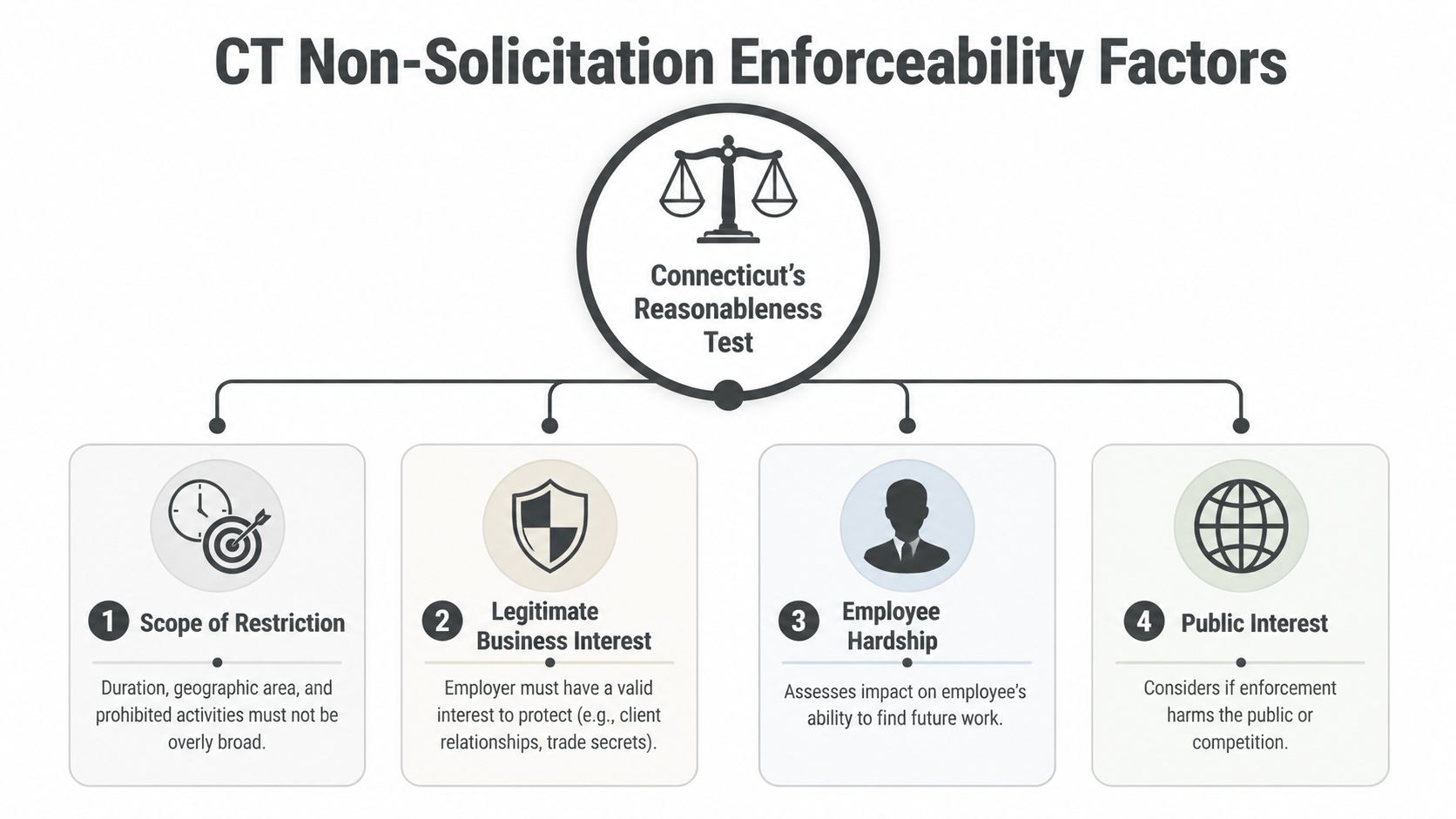
The answer depends on reasonableness. Connecticut courts don’t treat every restriction the same way. They look at what the clause does in practice, who it restrains, what business interest it protects, and whether the language goes further than necessary.
The reasonableness test in practice
Connecticut analysis is fact-sensitive, but the recurring issues are familiar.
| Factor | What courts look for |
|---|---|
| Scope | Is the restriction limited to the activity that actually threatens the business? |
| Duration | Is the time period narrow enough to protect relationships without becoming punitive? |
| Geography or relational reach | Does the clause match the employee’s actual market, accounts, or role? |
| Hardship and public impact | Does enforcement unfairly block work or harm legitimate market competition? |
A court is more likely to enforce a clause tied to customers the employee served than one covering every customer the company has ever touched. The same is true with employee non-solicits. Restricting active recruitment of key staff is easier to defend than banning contact with every employee in every office.
What usually helps enforceability
The strongest agreements are usually narrow in three ways.
- Narrow in who is covered: Clients with whom the employee had material contact, supervised employees, or teams tied to the employee’s role.
- Narrow in what is prohibited: Active solicitation, inducement, or targeted outreach, rather than all contact.
- Narrow in time: Long enough to protect goodwill, but not so long that it looks like a disguised punishment.
Connecticut employers should also make sure the contract tells a coherent story. If the agreement says the business needs sweeping restrictions to protect confidential information, but the company has weak confidentiality practices, the argument loses force. Courts look at conduct, not just recitals.
For a broader look at related restraints, Connecticut non-compete agreements provide useful context because courts often compare the practical effect of different restrictive covenants.
The more a clause looks like a targeted shield for a real business interest, the better its chances. The more it looks like a broad anti-competition device, the more vulnerable it becomes.
Why federal scrutiny matters even in Connecticut
State law doesn’t operate in a vacuum. Federal labor law has added pressure against broad post-employment restrictions.
On June 13, 2024, an NLRB Administrative Law Judge in J.O. Mory, Inc. found that a two-year employee non-solicitation provision was presumptively unlawful because employees could reasonably read it as coercive under Section 7. The employer failed to show a legitimate business interest that couldn’t be met with narrower means, according to Lerch Early’s discussion of the decision.
That ruling doesn’t mean every Connecticut non-solicit is invalid. It does mean judges, agencies, and litigants have another reason to scrutinize broad employee restrictions. If an employer already has confidentiality protections and customer restrictions in place, an added employee non-solicit needs to be justified carefully.
What fails more often than business owners expect
These are common pressure points:
- Overbroad categories: “Any customer,” “any prospective customer,” or “any employee” language.
- Unclear verbs: Words like “interfere,” “participate,” or “be associated with” without definitions.
- Role mismatch: Imposing executive-level restrictions on lower-level employees with limited access.
- Stacked restrictions: Using an NDA, non-solicit, and non-compete together in a way that effectively blocks all future work.
A court may conclude the clause protects more than goodwill. It may conclude the company is trying to suppress ordinary competition. Once that impression takes hold, enforcement gets harder.
The Role of a Lawyer in Your Agreement’s Lifecycle
A non solicitation agreement lawyer does far more than draft a paragraph and move on. The core benefit comes from managing the full life of the restriction, from planning to dispute response.
That starts with understanding the business model. A manufacturer protecting account relationships has different needs than a financial professional concerned about advisor mobility, book-of-business disputes, and regulatory fallout. The agreement should reflect those differences from the first draft.
Drafting that fits the business
A well-drafted agreement begins with questions, not boilerplate.
Who owns the client relationship? Which employees could realistically disrupt operations if recruited away? What systems hold confidential information? How does the employee communicate with customers? Does the business operate only in Connecticut, or across multiple states?
Those facts shape the clause. Good drafting usually includes:
- Defined restricted parties: Not every client or employee, only the groups tied to the legitimate interest.
- Clear restricted conduct: Active solicitation, inducement, or targeted diversion.
- Consistent documents: Offer letters, equity awards, confidentiality terms, and severance documents should not conflict.
- Operational support: Offboarding checklists, return-of-property rules, and access controls that reinforce the contract.
Negotiation before the relationship turns adversarial
Many restrictive covenant disputes are seeded during hiring. The employee signs quickly, the employer uses a template, and no one thinks through what the language means until after a resignation.
Counsel helps avoid that trap by negotiating terms that are firm but realistic. A clause the other side can live with is often better than an aggressive one that creates resentment and later collapses under scrutiny. For senior hires, buyers in a transaction, and businesses with incentive compensation plans, negotiation is often where enforceability is won or lost.
Good drafting is preventive law. It lowers the chance of breach, improves the chance of compliance, and gives a court a cleaner record if litigation follows.
Enforcement when a breach is unfolding
When a former employee starts contacting customers or recruiting staff, speed matters. Delay can signal that the harm wasn’t serious. But rushing without evidence can also hurt the employer.
A lawyer’s role in enforcement often includes:
- Reviewing the contract language and the surrounding employment record.
- Preserving digital evidence such as emails, CRM activity, LinkedIn messaging, and device access logs.
- Sending a demand or cease-and-desist letter calibrated to the facts.
- Assessing whether emergency relief makes sense, including a temporary restraining order or injunction.
- Coordinating business messaging so managers don’t make inconsistent statements to customers or staff.
The legal strategy has to match the business objective. Sometimes the priority is stopping outreach immediately. Sometimes it’s signaling seriousness without escalating. Sometimes a negotiated standstill does more than a rushed filing.
Defense matters too
A non solicitation agreement lawyer also protects businesses on the other side of the dispute.
You may hire someone who signed an overbroad covenant with a former employer. You may receive a demand letter that overstates the law, misreads the contract, or tries to intimidate a new business relationship into freezing. You may be accused of “solicitation” when customers followed the employee on their own.
In those situations, defense requires more than a denial. Counsel may need to isolate passive contact from active solicitation, review communications, protect the new employer from tortious interference allegations, and negotiate practical boundaries while the dispute cools down.
For a broader sense of how business counsel supports companies across disputes, contracts, and transactions, this article on what a business lawyer does offers a useful overview.
Common Clauses Red Flags and Modern Challenges
Most non-solicitation fights turn on wording. The dispute may feel emotional, but the result usually comes back to definitions, scope, and proof.
Template agreements often fail in predictable ways. They try to ban too much, define too little, and ignore how people communicate now. That’s especially true when the agreement says nothing useful about LinkedIn, public announcements, group messages, or digital outreach tools.
Clause language that usually helps and hurts
Below is a practical comparison.
| Clause Element | Enforceable Example (Good) | Red Flag Example (Likely Unenforceable) |
|---|---|---|
| Customer scope | Clients the employee serviced or had material contact with during the last 12 months of employment | Any past, present, or prospective client of the company |
| Employee scope | Employees the departing worker supervised or worked closely with in a defined team | Any employee of the company, in any location |
| Conduct | Directly or indirectly initiating targeted contact to move business or induce departure | Having any contact, involvement, or association with restricted parties |
| Duration | A limited period tied to preserving active relationships | An open-ended or unnecessarily long restraint |
| Definitions | “Solicit” defined with examples of active outreach | “Solicit” left undefined or described vaguely |
| Exceptions | General advertising and passive responses carved out where appropriate | No distinction between active outreach and passive acceptance |
Digital solicitation is where old templates break
The definition of solicitation has become one of the most contested parts of these agreements. A clause written for phone calls and paper rolodexes doesn’t map neatly onto LinkedIn, CRM exports, direct messaging, targeted audience lists, or AI-assisted prospecting.
That gap matters because business communication now happens in public and private channels at the same time. A former employee may post a new job announcement, comment on an industry thread, accept connection requests, and send a handful of direct messages in the same week. Those actions are not legally identical.
According to High Swartz’s discussion of non-solicitation agreements, there has been a 40% rise in LinkedIn-related disputes since 2024, and courts are increasingly distinguishing passive activity from active solicitation. That distinction is critical. An agreement that doesn’t define those terms risks being treated as overbroad.
If your clause says “no direct or indirect solicitation” but never explains what counts in digital channels, you’ve left the hardest part of the case for later.
What should be addressed directly
A modern agreement should consider whether the following conduct is restricted, permitted, or left for case-by-case analysis:
- Public announcements: A general update that someone changed employers.
- Connection activity: Accepting requests versus initiating targeted outreach.
- Direct messages: Personalized communications to clients or staff.
- Mass marketing: Sponsored campaigns or segmented email lists aimed at known accounts.
- Hiring outreach: Contacting former coworkers individually versus posting a general opening.
- Referral contact: Reaching out through intermediaries or mutual contacts.
Not every agreement needs a long technology section. But if your employees build business through social platforms, the contract should address that reality in plain language.
Practical drafting points businesses often miss
Some of the most useful protections are unglamorous.
- Use relational limits: Tie restrictions to accounts, teams, or reporting relationships.
- Define active solicitation: Spell out that targeted outreach, inducement, or use of confidential information is restricted.
- Preserve passive exceptions carefully: General advertising may need a carveout, but not one so broad it swallows the rule.
- Match the employee’s actual role: Sales, advisory, and management roles often justify different language.
- Coordinate with device and data policies: A strong clause is weaker if the company cannot show what information the employee accessed or took.
Broad language may feel safer during drafting. It often creates more risk later. Precision gives you something better than an advantage. It gives you credibility.
The New Legal Landscape After the FTC Non-Compete Rule
The FTC’s 2024 non-compete rule didn’t expressly ban non-solicitation agreements, but it changed the atmosphere around restrictive covenants. Judges and litigants now look more closely at whether a non-solicit operates like a non-compete in disguise.
That shift matters in Connecticut because many older agreements were drafted with a “more is better” mindset. If the clause blocks so many customer relationships, employee contacts, or business opportunities that the former employee can’t realistically continue in their field, a court may view the provision as a de facto non-compete.
Why the rule still matters even when it doesn’t directly apply
The legal effect of the FTC rule has been contested, but the scrutiny it triggered is real. Employers can no longer assume that labeling a clause “non-solicitation” makes it safer by itself. Courts are paying more attention to practical effect.
A narrow customer non-solicit may still look defensible. A sweeping clause that bars contact with nearly anyone relevant to the employee’s prior work may not.
According to HCH Lawyers’ analysis of non-solicitation agreements, preliminary reports from 2025-2026 show a 35% higher rate of injunction denials for non-solicits in some states, and the article explains that courts are scrutinizing them more closely as possible de facto non-competes. For Connecticut businesses, the lesson is straightforward. If the agreement is vague or expansive, emergency enforcement becomes harder.
What this means for Connecticut employers in 2026
Older assumptions don’t hold up well in this climate.
- Labeling isn’t enough: Calling something a non-solicit won’t save it if the effect is broader.
- Hybrid clauses draw attention: Agreements that combine customer restrictions, employee restrictions, and broad confidentiality language need careful review.
- At-will employment alone may not tell the whole fairness story: Employers should think through what supports the restriction and why it exists.
- National templates are risky: Multi-state businesses need language that accounts for state differences and federal pressure points.
Courts are asking a more practical question now. What does this clause actually stop the employee from doing?
That’s the right question for employers to ask before a dispute starts. If the answer is “almost everything,” the agreement may be headed for trouble. If the answer is “only the conduct that threatens our legitimate relationships and workforce,” the company is in a stronger position.
Hiring Your Connecticut Non-Solicitation Agreement Lawyer
Choosing counsel for restrictive covenant work isn’t the same as hiring someone to review a standard vendor contract. You want a lawyer who understands both paper risk and litigation risk. Those are different skills, and they matter at different stages.
A Connecticut business owner should ask direct questions. Has the lawyer handled restrictive covenant disputes in Connecticut courts? Do they understand your industry’s pressure points, especially if your business depends on recurring relationships, regulated professionals, or portable books of business? Can they handle drafting, negotiation, enforcement, and defense, or only one piece of the problem?

A practical hiring checklist
Use this as a screening tool when evaluating a non solicitation agreement lawyer:
- Connecticut focus: The lawyer should understand how Connecticut judges assess reasonableness and how local practice affects enforcement.
- Industry familiarity: Financial services, professional services, manufacturing, and technology businesses often need different drafting choices.
- Evidence awareness: Counsel should think early about emails, CRM data, offboarding records, and social media evidence.
- Balanced drafting style: If every solution sounds maximalist, that’s a warning sign. Overreaching language often creates avoidable disputes.
- Dispute capability: Even if you only want drafting today, the lawyer should draft like a litigator who knows where agreements fail.
What the engagement should look like
The process should feel organized, not mysterious.
A solid lawyer usually starts by reviewing existing agreements, job categories, and where your customer relationships reside. Then they identify who needs a restrictive covenant and who may not. After that, they tailor language by role and help align it with offer letters, confidentiality terms, and exit procedures.
Enforcement work should also come with a realistic discussion of options. Sometimes a letter is enough. Sometimes temporary injunctive relief is appropriate. Sometimes the facts suggest a negotiated business resolution is smarter than a headline-grabbing court fight.
Business owners should also value lawyers who think beyond the immediate dispute. If your company is growing, hiring, or competing for talent, the legal strategy should support reputation as well as protection. Leaders thinking about visibility and client development may also find this piece on B2B growth for law firms useful because it highlights how relationship-driven professional businesses build and protect market presence over time.
The best lawyer for this work won’t promise that every clause will be enforced. They’ll help you build agreements that are more likely to survive scrutiny and more useful when pressure hits.
Cost and timeline should be explained plainly. Drafting and review are usually manageable projects when handled before a dispute. Enforcement is different. It can move quickly, involve emergency filings, and require hard choices about evidence, customer communication, and business objectives.
If you want to discuss your business law matter, contact Kons Law at (860) 920-5181.
If you want to discuss your business law matter, contact Kons Law at (860) 920-5181.
