
At its core, a representation letter is a formal document where one party puts a set of facts in writing for another. It’s most often used in high-stakes business and legal situations. Think of it as a signed, sworn statement confirming that the information provided is true and complete to the best of the signer's knowledge.
But here’s the tricky part: the letter's purpose and contents shift dramatically depending on whether it’s for a legal dispute or a financial audit.
What's the Real Point of a Representation Letter?
Ultimately, a representation letter is all about managing risk and creating a crystal-clear factual record. It’s the business equivalent of putting a critical verbal promise into a formal, written contract. This signed document gives the person receiving it a solid layer of assurance, whether they're an auditor digging through a company's financials or an opposing counsel in a legal case.
The primary goal is to establish accountability. By having a responsible party formally attest to a set of facts, you create a paper trail that’s hard to dispute later on.
The meaning of "what is a representation letter" really splits into two different worlds. Context is everything. In one scenario, it's a public-facing announcement from a lawyer. In another, it's a highly confidential confirmation of financial data between a company and its auditors.
Two Sides of the Same Coin
Let’s break down the two main types. While they share the same name, they serve completely different functions in practice.
Here's a quick look at the key differences between a representation letter in a legal setting versus one used in a financial audit.
Two Types of Representation Letters at a Glance
| Feature | Legal Representation Letter | Audit Representation Letter |
|---|---|---|
| Purpose | To announce legal representation and manage communication. | To confirm the accuracy and completeness of financial information. |
| Who Sends It? | An attorney. | A company's management (e.g., CEO, CFO). |
| Who Receives It? | The opposing party, their attorney, or an insurance company. | The company's external auditors. |
| Common Scenario | A personal injury case or a business dispute. | An annual financial statement audit. |
As you can see, the players and the purpose are completely distinct.
In legal matters, an attorney sends this letter to the other side to put them on notice. It essentially says, "I now officially represent this client. From this point forward, all communication must come through my office." This is a crucial step to protect the client from being contacted directly.
In financial audits, a company’s management—usually the CEO and CFO—provides this letter to their external auditors. It serves as a formal confirmation that the financial statements are accurate, complete, and that management has disclosed everything relevant to the auditors.
This dual nature is why you have to know the context. The promises made in these letters are just as serious as those in other business agreements. You can learn more about the promises made in business deals by reading our guide on what is a representation and warranty. And just as it's crucial to understand the representation letter, a clear accounts payable definition is fundamental for comprehending a company's financial obligations.
A representation letter essentially shifts responsibility. In a legal setting, it shifts communication responsibility to the lawyer. In an audit, it formally places the responsibility for the accuracy of financial data squarely on the shoulders of company management.
Whether it’s a lawyer staking a claim or a CEO verifying financial records, the representation letter is a cornerstone of corporate governance and legal practice. It turns informal understandings into formal, legally significant statements.
If you want to discuss your business law matter, contact Kons Law at (860) 920-5181.
The Two Worlds of Representation Letters: Legal vs. Financial
Though they share the same name, a representation letter in a legal dispute and one in a financial audit are two completely different animals. It’s a bit like the word "draft"—are you talking about a gust of wind, a preliminary version of a document, or pulling a pint at the pub? The context is everything.
Understanding which "world" you’re in is the first, most critical step. One is a shield you raise against an adversary; the other is a sworn statement you give to a trusted partner. For any business owner or executive, knowing the difference isn't just academic—it's essential.
The Legal Letter: A Protective Shield
In the legal arena, the representation letter is a powerful, proactive tool. Let's say your company is heading into a dispute with a vendor. The very first thing your attorney will likely do is fire off a representation letter to the other side.
This letter sends a clear and forceful message: "From now on, you talk to me, not my client."
This isn't just a suggestion; it has immediate legal force. It slams the door on any direct contact, cutting off any attempts at harassment, intimidation, or tricking you into an off-the-cuff admission. All communication gets channeled through your counsel, who can manage it strategically. It establishes firm ground rules right from the start.
The Financial Letter: An Affirmation of Trust
In the world of finance, the representation letter plays a totally different role. Here, it’s an internal document that formalizes the trust between a company’s management and its independent auditors. It's a non-negotiable part of any standard audit.
Imagine the scene: After weeks of poring over your books, the audit is nearly complete. Before the auditors can issue their final opinion, they hand a letter to the CEO and CFO to sign. In signing it, management is formally declaring:
"We swear by the numbers in these financial statements. We have given you everything, hidden nothing, and disclosed all known issues, including any fraud or compliance problems."
This is far more than a simple sign-off. It’s a crucial piece of evidence for the auditors. It officially places the responsibility for the data's accuracy and completeness squarely on management's shoulders. This signed statement gives auditors the assurance they need to finalize their report with confidence. It's a fundamental part of corporate accountability and shares the same spirit of transparency you find when you explore what is due diligence in business.
This flowchart helps visualize the two distinct paths these letters take.
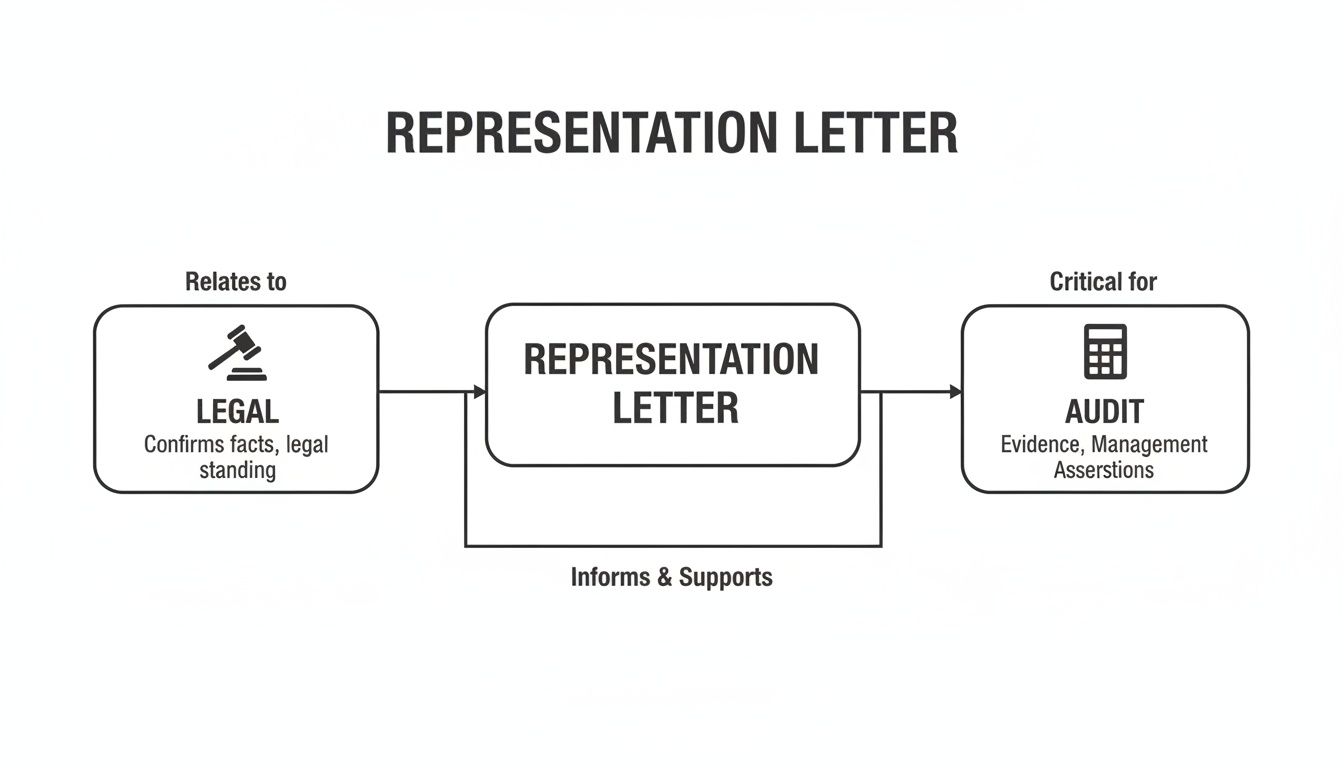
As you can see, the legal letter is all about controlling external communication, while the audit letter is about internal verification that provides external assurance.
So while both are called "representation letters," their purpose and impact couldn't be more different. One is a sword and shield in a conflict. The other is a cornerstone of trust required to validate a company's financial health. Confusing the two can lead to serious misunderstandings and significant legal risk.
If you want to discuss your business law matter, contact Kons Law at (860) 920-5181.
Anatomy of a Legal Representation Letter
So, what exactly goes into a legal representation letter to make it work? It’s far more than a simple announcement; think of it as a carefully crafted legal tool meant to establish control and protect your interests right from the start. When you break it down, you can see how this one document sets the ground rules for the entire dispute.
When your attorney sends this letter, they are drawing a clear line in the sand. Each piece has a specific, strategic job to do, from identifying who’s involved to putting legal duties on the person receiving it.

Core Components of an Effective Letter
A well-drafted legal representation letter isn't just a formality. It’s a strategic document that typically includes several critical elements to make sure it has the intended legal punch. While the exact wording might change, the fundamental structure is always there.
Here are the key parts you should expect to see:
- Clear Client Identification: The letter will state, without a doubt, the client (you or your business) that the law firm is now representing. This leaves no room for confusion.
- Identification of the Matter: It will specify the legal issue, like "the contract dispute dated January 15, 2024," or "the motor vehicle incident of March 5, 2024." This defines the scope of what your attorney is handling.
- Directive for Communication: This is a non-negotiable instruction. The letter will demand that all future communications about the matter must be sent directly to the attorney, not you.
- Preservation of Evidence Clause: This powerful section puts the other side on formal notice that they must keep all potentially relevant evidence safe.
This framework is what turns the letter from a simple piece of mail into a tactical legal instrument.
The Power of the Preservation Clause
Perhaps the most potent part of the letter is the preservation of evidence notice, also known as a litigation hold. This clause is a direct and legally enforceable demand, warning the recipient not to destroy, alter, or get rid of any information related to the case.
This instruction isn't merely a suggestion. Ignoring it can lead to severe legal consequences, including court sanctions for "spoliation of evidence," which can cripple a party's case.
The scope of this demand is broad. It covers everything from emails and text messages to internal memos, financial records, and all sorts of digital data. By including this clause, your attorney is proactively safeguarding the proof you might need down the road.
This is a move that has to be made quickly. In practice, a representation letter is a critical first step, and attorneys often send them within 24 to 48 hours of being hired. Once the opposing party or their insurance company gets the letter, they are legally required to funnel all communication through your attorney and start preserving evidence. This immediately shifts the dynamic of the dispute in your favor. You can explore more about the required elements of these crucial legal notices in personal injury contexts to understand their importance.
Ultimately, every part of a legal representation letter works in concert to build a framework of control. It identifies the players, defines the issue, dictates the rules of communication, and protects the integrity of the evidence. Understanding this anatomy demystifies the process and shows how your counsel begins advocating for you from day one.
If you want to discuss your business law matter, contact Kons Law at (860) 920-5181.
The Critical Role of Representation Letters in Audits
When a company goes through a financial audit, the auditors dig deep. They examine records, test controls, and gather mountains of evidence. But no matter how thorough they are, auditors can't possibly know everything that's happened inside a company's walls. This is where the representation letter comes in. It’s the final, essential bridge that closes this information gap, making it a non-negotiable step in any audit.

Think of it as a formal, written handshake from the company's top brass—usually the CEO and CFO. In this document, they personally confirm the integrity and completeness of all the financial information they’ve provided. This isn't just a piece of administrative paper-pushing; it’s a foundational piece of audit evidence.
Why This Letter Is Mandatory
Auditors don't just ask for this letter—they rely on it as a culminating piece of evidence. Professional auditing standards, like those set by the Public Company Accounting Oversight Board (PCAOB), actually mandate its use. Without a signed representation letter, an auditor generally cannot issue a clean, or "unqualified," opinion on the financial statements.
A refusal to sign is a massive red flag. It signals to the auditor that management might be hiding something or is unwilling to take responsibility for the company's financial reporting. This refusal is considered a "scope limitation," which severely hobbles the auditor's ability to do their job and often leads to a negative audit opinion or even the auditor resigning from the engagement.
Standard Contents and Key Assurances
While the specifics can shift a bit, most audit representation letters contain a standard set of promises. Here’s what management is putting on the line, in writing:
- Responsibility for Financials: Management formally acknowledges it's their job to prepare the financial statements according to the proper accounting framework.
- Completeness of Information: They confirm that every relevant financial record, piece of data, and meeting minute has been handed over to the auditor. No holding back.
- Disclosure of Fraud: Management must state they've disclosed any known or suspected fraud affecting the company, whether it involves executives, employees, or outside parties.
- Compliance with Laws: The letter usually includes a statement confirming the company has followed laws and regulations that could affect the financials. You can learn more about what is regulatory compliance and why it's so critical.
- Unrecorded Transactions: They confirm there are no significant transactions left off the books.
According to the PCAOB's Auditing Standard AS 2805, executives are attesting that every piece of information is accurate and all material facts have been disclosed. It’s a formal transfer of responsibility, verifying compliance and giving auditors the backup they need to finalize their opinion and reduce their own risk.
The Weight of Personal Liability
This is the part that every executive needs to understand cold: the signature on that letter comes with personal liability. When a CEO and CFO sign an audit representation letter, they aren’t just signing for the company. They are personally attesting to the truthfulness of everything in it.
If the financial statements later turn out to be materially misstated because of fraud or an error that should have been disclosed, that signed letter can be used as Exhibit A against management in legal or regulatory actions.
This personal accountability is what gives the document its teeth. It forces executives to do their own due diligence and make sure they have a rock-solid basis for the statements they are making. It's easily one of the most important documents they'll handle all year. And it's not the only one—other formal communications, like a SOC 2 bridge letter, also play a key role in maintaining audit continuity between reporting periods.
If you want to discuss your business law matter, contact Kons Law at (860) 920-5181.
Representation Letter vs. Engagement Letter: What's the Difference?
In the world of business and law, it's easy to get tangled up in similar-sounding terms. "Representation letter" and "engagement letter" are two that frequently cause confusion, but they play completely different roles. Mixing them up can lead to some serious misunderstandings about your legal relationships and what you've actually agreed to.
Let's break it down with a simple analogy. Think of the engagement letter as the private contract between you and your attorney. It's the "we're officially working together" document. This letter stays between you and your law firm, setting the ground rules for your professional relationship before the real work even starts. It's all about your internal agreement.
The representation letter, on the other hand, is the public announcement. It’s the "press release" telling the world you've hired a lawyer. Your attorney sends this out to third parties—like the opposing side's counsel or an insurance company—to formally put them on notice.
The Private Handshake vs. The Public Declaration
An engagement letter is the bedrock of any attorney-client relationship. Its main purpose is to lay everything out on the table from the beginning, so there are no surprises later about fees or what work is being done.
Here’s what you’ll typically find in an engagement letter:
- Scope of Services: A clear breakdown of the exact legal work the firm will be doing for you.
- Fee Structure: An explanation of the billing, whether it’s hourly, a flat fee, or a contingency basis.
- Your Responsibilities: What the firm needs from you to do their job, like providing documents in a timely manner.
- Confidentiality: A firm reminder of the attorney's duty to keep your information private.
This document is all about defining the nuts and bolts of how you and your legal team will operate. It's the blueprint for your partnership.
Notifying the World You Have a Legal Shield
Now, the representation letter is a strategic move made after you've already hired your attorney. It's a formal notice sent to anyone involved in your legal matter—think insurance companies, opposing parties, or government agencies—informing them that you now have legal counsel. To see how this plays out in real-world scenarios, you can explore the details of an attorney letter of representation.
The easiest way to remember the difference is to think about the audience. The engagement letter is for you and your lawyer to agree on the terms. The representation letter is for your lawyer to tell everyone else to back off and talk to them instead.
Getting this distinction right is crucial. The engagement letter protects your working relationship with your own attorney, while the representation letter shields you from direct communication with adversaries. Both are vital, but they operate in completely different arenas.
If you want to discuss your business law matter, contact Kons Law at (860) 920-5181.
Navigating the Legal Risks and Implications
Signing a representation letter is never just a formality. It’s a serious legal act with real-world consequences. Whether you’re closing out an annual audit or in the final stages of a major M&A deal, that signature transforms your statements into legally binding promises. If you’re not careful, it can expose your business—and you personally—to significant risk.
This is particularly true in the audit process. When an executive signs an audit representation letter, they aren't just acting on behalf of the company. They are making a personal attestation, creating a direct line of personal liability that many leaders overlook.
The Personal Risk for Executives
Imagine the financial statements are later found to be misleading because of fraud or a failure to disclose a critical piece of information. That signed letter instantly becomes a star witness against you.
Regulators or plaintiffs can wave it around as proof that management knew, or at least should have known, about the problems. Suddenly, executives could be facing personal lawsuits, steep regulatory fines, and consequences that could derail their careers. Your signature is a personal guarantee, and if that guarantee is broken, the fallout can be severe.
"Reps and Warranties" in Business Deals
In the world of mergers and acquisitions, the "reps and warranties" in a letter or agreement are the bedrock of the entire transaction. These are the seller's solemn promises about the health of the business—its finances, contracts, liabilities, and day-to-day operations.
But what happens after the ink is dry? If the buyer uncovers that one of those promises was false, it can light the fuse for an expensive legal battle.
The representations made during a transaction are not just part of the negotiation; they are legally enforceable promises. A breach of these warranties can unwind the perceived value of a deal and lead to post-closing lawsuits seeking millions in damages.
Herein lies the real danger. A seemingly minor inaccuracy can mushroom into a massive lawsuit months or even years down the road. The buyer will likely sue to claw back financial losses tied to the false statement, a messy process that burns through cash and tarnishes a company’s reputation. Dealing with these disputes requires a sharp legal strategy, and you can learn more by exploring the differences between alternative dispute resolution vs litigation.
How to Manage and Mitigate These Risks
Given what’s at stake, every business leader needs a clear strategy for managing these risks. Just assuming a document is "standard" is a recipe for disaster.
Here’s how to protect yourself and your company:
- Perform Rigorous Internal Due Diligence: Before a pen ever touches paper, do your homework. Verify every single claim in the letter with the people who know best—your department heads. Make sure you have the documents to back up every assertion.
- Involve Legal Counsel Early: Get your attorney involved from the start. They are trained to spot ambiguous language, overly broad statements, and hidden traps that could create massive liabilities later on.
- Negotiate Precise Language: Don't just accept boilerplate text. Push back. Work with your counsel and the other party—be it an auditor or a buyer—to negotiate wording that is both accurate and narrow. Where you can't be 100% certain, qualify statements with phrases like "to the best of our knowledge" to avoid making absolute guarantees.
Ultimately, a representation letter demands your full attention. By doing your due diligence, bringing in expert legal counsel, and carefully negotiating the terms, you can sign with confidence, knowing you’ve protected yourself from future legal headaches.
If you want to discuss your business law matter, contact Kons Law at (860) 920-5181.
Frequently Asked Questions
It's natural to have questions about representation letters, especially since their meaning and function can shift so dramatically from one situation to the next. Let's clear up some of the most common queries we hear from business owners and their leadership teams.
Who Signs a Representation Letter?
That all depends on what it's for. In a legal dispute, it’s the attorney who signs and sends the letter on behalf of their client. Think of it as an official announcement from your legal counsel to the other side—whether that’s opposing counsel, an insurance company, or another party.
For a financial audit, however, the pen is in the hands of the company’s own leadership. It's standard practice for the CEO and CFO to sign the letter addressed to their auditors. They're the ones ultimately on the hook for the accuracy and completeness of the financial statements.
What Happens If Management Refuses to Sign an Audit Letter?
Refusing to sign an audit representation letter is a massive red flag for any auditor. It's what they call a "scope limitation," meaning they were blocked from getting the essential information needed to do their job properly.
When that happens, it’s virtually impossible for them to issue a clean, unqualified opinion on the company's financials. Instead, the auditor will most likely:
- Issue a negative or "adverse" opinion.
- Issue a "disclaimer of opinion," essentially saying they can't form an opinion at all.
- Resign from the audit engagement entirely.
Any of these outcomes can do serious damage to a company's credibility with investors, lenders, and regulators. It's a situation to avoid at all costs.
Is the Wording in a Representation Letter Negotiable?
Absolutely. The language is most flexible in business deals, like a merger or acquisition, where the representations and warranties are a central part of the negotiation. Legal teams on both sides will spend considerable time hammering out the exact wording to shift risk and protect their clients.
Even in an audit—where much of the content is standardized by professional guidelines—there can be room for discussion. Management should always review the letter carefully with their legal counsel. It's often possible to negotiate specific phrases with the auditors to better match the company's unique circumstances, as long as the changes don’t gut the letter's core purpose of providing necessary assurance.
How Quickly Should a Legal Representation Letter Be Sent?
When it comes to legal matters, speed is everything. A legal representation letter should be sent immediately after you hire an attorney. In any active dispute, especially one involving an insurance claim or the threat of a lawsuit, you can't afford to wait.
We typically send these letters out within 24 to 48 hours. Taking that swift action accomplishes several critical things right away: it puts the other side on formal notice, legally prevents them from contacting you or your employees directly, and officially requires them to preserve all relevant evidence. It’s the first step in protecting your legal position and setting the right tone for the entire case.
If you want to discuss your business law matter, contact Kons Law at (860) 920-5181.
