When one party makes a false statement that convinces another to sign on the dotted line, you're dealing with misrepresentation. This isn't just a minor error; it's a crack in the very foundation of the agreement, whether it's an incorrect claim about a product's features, a company's financial stability, or a property's clear title.
The Foundation of Fair Agreements
A contract is much more than words on a page. It’s a promise—a legally binding one—built on a bedrock of trust and good faith. When you enter an agreement, you're operating on the belief that what the other party has told you is the truth.
But what happens when that trust is broken? This is where the concept of misrepresentation in a contract becomes absolutely critical for any business owner.
Let's walk through a real-world scenario. Imagine you’re buying a local manufacturing business. The seller shows you financial records that boast consistent, healthy annual profits. Relying on those numbers, you agree to their asking price and sign the deal.
A few months in, you uncover the truth: the seller deliberately hid significant debts to paint a much rosier picture. The company isn't thriving; it's struggling to stay afloat. The seller's false statement directly pushed you into a bad deal, and now you're facing a serious financial loss. That’s a textbook case of misrepresentation.
Why This Concept Matters
It's vital to understand that not all false statements are created equal in the eyes of the law. The consequences—and your legal options—hinge on the mindset of the person who made the statement. An honest mistake is treated far differently from an outright lie.
The law breaks it down into three main types:
- Innocent Misrepresentation: An unintentional false statement from someone who genuinely believed it was true.
- Negligent Misrepresentation: A false statement made carelessly, without taking reasonable steps to confirm its accuracy.
- Fraudulent Misrepresentation: A deliberate lie told with the specific intent to trick the other party.
Knowing these distinctions is a cornerstone of effective business transaction law, because it dictates whether you can cancel the contract, sue for financial damages, or potentially both. We'll break down what it takes to prove a claim, the remedies available, and the proactive steps you can take to shield your business from falling victim—or accidentally becoming the one at fault.
These issues are complex and carry significant risk. If you want to discuss your business law matter, contact Kons Law at (860) 920-5181 for clear guidance.
Not all false statements are created equal, especially when it comes to business contracts. In the eyes of the law, a simple mistake is worlds apart from a deliberate lie.
When an agreement gets challenged for misrepresentation in a contract, the court’s first job is to figure out the intent behind the bad information. This single factor—the maker's state of mind—is what separates an honest error from a calculated deception, and it dictates what legal remedies are on the table.
The path is usually pretty straightforward: someone makes a false statement, the other party relies on it, and a contract gets signed based on that faulty premise.
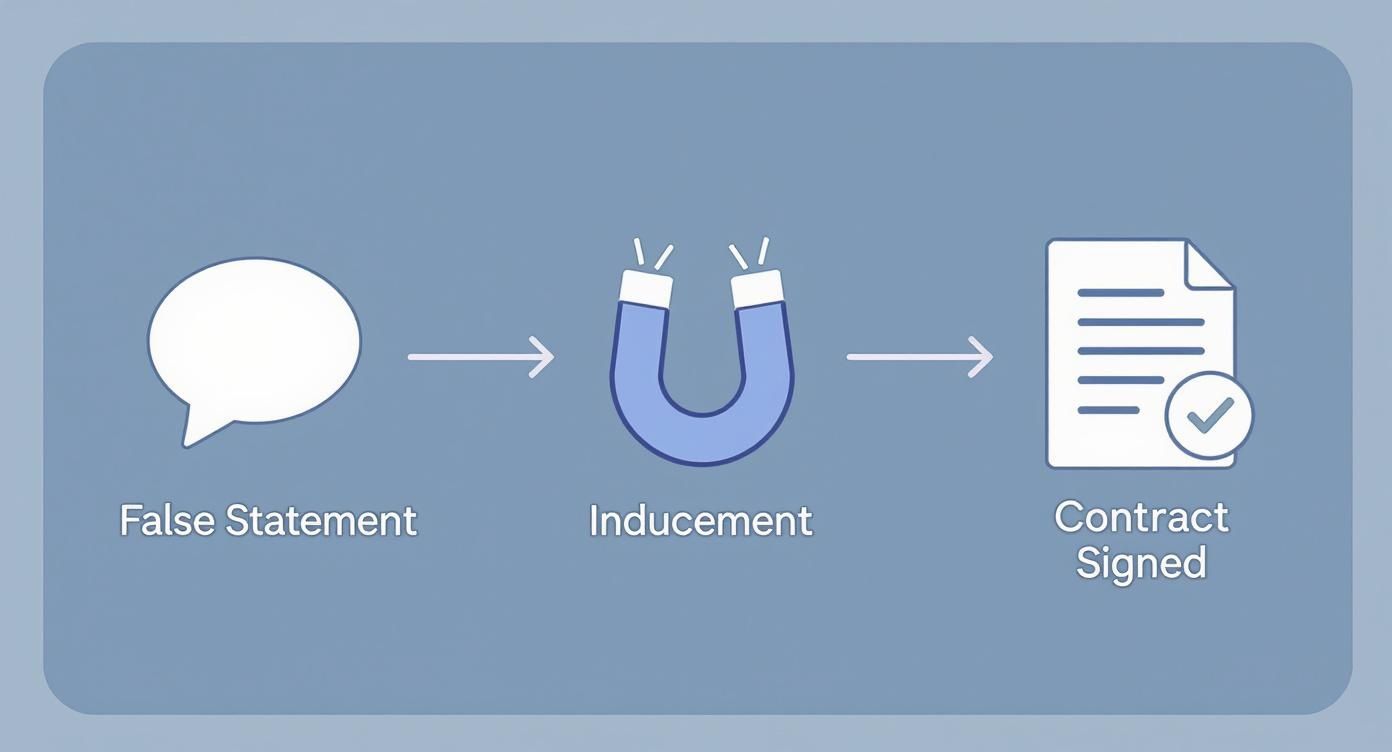
As you can see, the false statement is the first domino to fall. It directly triggers the decision to sign the deal, which is why it becomes the cornerstone of any future dispute.
H3: Innocent Misrepresentation
Let's start with a simple scenario. A business owner is selling a piece of used commercial equipment. They tell a potential buyer it can process 1,000 units per hour, a figure they pulled directly from the original manufacturer's spec sheet. The buyer agrees, and the deal is done.
A month later, the buyer discovers the machine only hits 800 units per hour. It turns out the manufacturer's brochure had a typo.
This is a textbook case of innocent misrepresentation. The seller made a false statement, but they had every reason to believe it was true. There was no intent to mislead anyone. In these situations, the court's goal isn't to punish but to restore fairness. The most common remedy is rescission, where the contract is voided, the machine is returned, and the buyer gets their money back.
H3: Negligent Misrepresentation
Now, let's tweak that story. This time, the seller doesn't have the spec sheet handy. When the buyer asks about the processing capacity, the seller makes a quick guess—"Oh, it's definitely around 1,000 units per hour"—without bothering to verify it. They weren't trying to lie, but they also didn't do their homework.
This is negligent misrepresentation. It happens when someone makes a statement carelessly, without taking reasonable steps to ensure it's accurate. They breached a duty to provide correct information. Because there's a degree of carelessness involved, the remedies can be broader, often including both rescission and potential financial damages to cover any losses the buyer suffered.
H3: Fraudulent Misrepresentation
This is the most serious form, often just called "fraud." Here, the seller knows the machine only processes 800 units per hour but deliberately tells the buyer it does 1,000 to lock in a higher price. The key ingredients are knowledge that the statement is false and a clear intent to deceive.
To win a fraudulent misrepresentation claim, you have to prove the other party knew their statement was false (or was reckless about its truth), intended for you to rely on it, and that your reliance caused you a measurable financial loss.
This is a heavy accusation with significant legal blowback. If fraud is proven, the wronged party can seek rescission, compensation for damages, and even punitive damages, which are designed to punish the offender and deter others from similar conduct.
These issues often trace back to the earliest conversations, long before a final contract is signed. That's why it's so important to understand the weight of every document exchanged, including preliminary ones. To get a better handle on this, you can read our guide on the purpose of a letter of intent.
Don't underestimate the risk here. A recent global disputes forecast found that 44% of organizations view fraudulent misrepresentation as a major litigation threat. It’s a clear sign that businesses are under immense pressure to get their facts straight before anyone signs on the dotted line.
To make it easier to see the differences at a glance, this table breaks down the three types of misrepresentation.
Comparing Types of Misrepresentation
| Type of Misrepresentation | Maker's State of Mind | Common Remedies |
|---|---|---|
| Innocent | Genuinely believed the statement was true. | Rescission (voiding the contract). |
| Negligent | Made the statement carelessly, without a reasonable basis. | Rescission and/or damages for losses. |
| Fraudulent | Knew the statement was false and intended to deceive. | Rescission, damages, and possibly punitive damages. |
As you can see, what the person knew and when they knew it is everything. It's the factor that determines whether you can simply undo the deal or pursue more significant financial penalties.
The Legal Elements of a Misrepresentation Claim
Successfully challenging a contract because you were misled isn't as simple as just pointing a finger. The courts need more than a gut feeling; they require a structured, provable case. To win, you have to connect the dots, showing how a false statement directly caused you to suffer a financial loss.
Think of it as building a legal argument brick by brick. If you're missing even one of these essential bricks, your entire claim can fall apart. The law demands that you prove five specific elements to establish a valid claim for misrepresentation in a contract.
A False Statement of Material Fact
First things first, you have to prove there was a false statement of a material fact. This is the absolute cornerstone of any misrepresentation case. It's critical to unpack what this really means, because not every fib or exaggeration makes the cut.
It must be a statement of fact, not just an opinion or salesy "puffery." A car salesman telling you a vehicle is "the best on the market" is just giving his opinion. But if he tells you it has a clean vehicle history report when it was actually in a major accident, that’s a statement of fact.
Next, that fact has to be material. A material fact is something a reasonable person would lean on when deciding whether to sign the contract. A minor typo on page 12 probably isn't material. A company's fabricated annual revenue figures? Absolutely material.
Here’s a practical example: a commercial landlord tells a prospective restaurant owner that the building’s plumbing was completely overhauled last year. The truth is, it just had a few leaky pipes patched. This is a false statement of a material fact, since the state of the plumbing is a massive factor for any food service business.
Reasonable Reliance on the Statement
Next up, you have to show that you reasonably relied on that false statement. This means you took the statement as truth and it genuinely influenced your decision to move forward. And crucially, your reliance has to be justifiable.
A court will consider whether a savvy person in your shoes would have been right to trust what they were told. If a claim was totally outlandish or you had obvious evidence pointing to the contrary and chose to ignore it, a judge might decide your reliance wasn't reasonable.
The legal test isn't just about whether you did rely on the statement, but whether you should have relied on it. This element prevents parties from turning a blind eye to obvious red flags and then claiming they were misled.
For example, if you're buying a business and the seller hands you professionally prepared financial statements showing consistent profits, it’s generally reasonable to rely on those documents. The whole verification process, often guided by a detailed mergers and acquisitions due diligence checklist, is built on this very idea—you start by relying on the information given, then you confirm it.
Inducement into the Contract
The third element, inducement, goes hand-in-hand with reliance. You must demonstrate that the false statement was a major reason you agreed to the deal. It doesn't need to be the only reason, but it must have been a significant factor that pushed you to sign.
In short, the lie acted as a catalyst. It persuaded you to enter an agreement you otherwise would have walked away from or, at the very least, negotiated differently.
Let's say you're buying a small manufacturing company. The seller assures you that a key piece of machinery is only two years old. Based on that, you sign the deal, assuming you won't face major capital expenses for a while. If you later discover the machine is actually a decade old and on its last legs, that misrepresentation directly induced you into a deal that’s far more costly than you were led to believe.
Resulting Damages
Finally, you must prove you suffered damages—a real, tangible loss, almost always financial—because you relied on the lie. This can't be a "what if" scenario; you need to show exactly how the false statement hurt your bottom line.
You need to draw a straight line from the misrepresentation to your financial harm. Because of the lie, you lost money.
These losses might include:
- The difference in value between what you were promised and what you actually got.
- The cost to repair a defect that was misrepresented.
- Profits you lost out on because of the misrepresentation.
Proving all these elements—a false statement of material fact, your reasonable reliance, inducement, and the resulting damages—is non-negotiable. If you fail to substantiate any one of them, even a seemingly solid claim can fail in court.
If you are concerned about a potential misrepresentation in a contract or want to discuss any business law matter, contact Kons Law at (860) 920-5181 for a consultation.
Available Remedies and Common Legal Defenses
When a court finds that a misrepresentation has poisoned a contract, the conversation shifts from proving what went wrong to making it right. The legal system has specific tools—called remedies—designed to put the wronged party back on their feet. Which tools are available often depends on just how bad the misrepresentation was, whether it was an innocent mistake, a careless oversight, or a deliberate lie.
But it’s not a one-way street. The person accused of making the false statement has ways to fight back. They can raise several well-established legal defenses to challenge the claim. This sets up a two-sided legal battle, and for any business owner caught in a contract dispute, understanding both arguments and counterarguments is key.
Remedies for the Harmed Party
At the end of the day, legal remedies are all about restoring fairness. A court can either hit the reset button on the whole deal or order a financial payment to cover the damage done.
The two main remedies for misrepresentation in a contract are:
- Rescission: Think of this as the legal equivalent of an "undo" button. The court voids the contract completely. Both sides have to give back whatever they got out of the deal—money, goods, property, you name it. The goal is to return everyone to the exact financial position they were in before the ink ever dried. Rescission is a go-to remedy for innocent and negligent misrepresentation.
- Damages: This is a monetary award to compensate the injured party for the financial hit they took because of the false statement. Calculating the exact amount can get tricky, but the objective is to cover the direct harm caused by the lie. Damages are often awarded on top of rescission, especially in fraud cases where a court might also tack on punitive damages to punish the bad actor.
Common Defenses Against a Claim
Just because someone files a misrepresentation claim doesn't mean it's a slam dunk. The accused party has some powerful arguments they can use to defend themselves and poke holes in the claim.
A few of the most common and effective defenses include:
- The Statement Was Puffery: The accused can argue the statement wasn't a hard fact but just over-the-top sales talk or an opinion. Claiming a product is "the best in the world" is classic puffery—it’s not something you can actually prove or disprove.
- No Actual Reliance: Here, the defense argues that the other party didn't actually rely on the statement to make their decision. If the buyer did their own homework and uncovered the truth themselves before signing, they can't turn around later and claim they were duped.
- Reliance Was Unreasonable: This defense basically says, "No reasonable person would have believed that." For instance, relying on a casual verbal promise that directly contradicts a crystal-clear term in the written contract might be considered unreasonable by a court.
Proving a false statement, reliance, and the resulting loss is a high bar. Historical landmark cases have set important legal precedents in this area. For instance, the UK case MDW Holdings Ltd v Norvill & Ors involved misrepresentation about environmental compliance in a business sale, causing significant loss for the buyer and underscoring the critical need for accuracy in pre-contractual statements. As you can discover in more detail about this misrepresentation legal guide, such cases reinforce that fraudulent claims can lead to the harshest penalties, including both rescission and damages.
Understanding these legal avenues is crucial. Whether you're the one seeking a remedy or the one defending against a claim, the details matter immensely. Sometimes, hashing things out with a structured settlement can be a smarter, more efficient path than a full-blown court battle. For more on that, you might find our guide on what a settlement agreement is helpful.
If you want to discuss your business law matter, contact Kons Law at (860) 920-5181.
How to Proactively Avoid Misrepresentation Claims

The best way to deal with a misrepresentation in a contract claim is to make sure it never happens in the first place. While you can turn to legal remedies after the fact, a proactive strategy focused on prevention will save you an incredible amount of time, money, and damage to your reputation.
Building a business framework on transparency and diligence isn’t just good ethics—it's a powerful legal shield. This approach starts long before a contract is even on the table. It’s a commitment to thoroughness, ensuring every statement made during negotiations is rock-solid and can be proven. By baking honesty and clarity into your business practices, you dramatically lower your risk and build stronger, more resilient partnerships.
Conduct Rigorous Due Diligence
Before you lock into any significant agreement, exhaustive due diligence is non-negotiable. Don't just take representations at face value, especially when they involve critical details like financial health, the condition of an asset, or regulatory compliance. A "trust but verify" mindset is your best defense against being misled.
This isn’t just about reviewing the documents the other party hands you. It means independently verifying their claims, getting your own eyes on the assets, and asking the tough questions that uncover potential problems.
Your due diligence checklist should always include:
- Financial Scrutiny: Bring in a professional accountant to analyze financial statements, tax records, and debt schedules.
- Operational Review: Inspect physical assets, get a feel for operational workflows, and assess their tech infrastructure.
- Legal Examination: Look for any skeletons in the closet, like existing lawsuits, liens, or compliance violations that could blow up the deal later.
Fortify Your Contracts with Protective Clauses
A well-drafted contract is a critical line of defense. You can include specific clauses that clearly define the scope of the agreement and limit your exposure to claims based on things said before the contract was signed. These provisions make it clear that the written document is the final word.
Two of the most powerful clauses for this are:
- Entire Agreement Clause: This clause states that the written contract is the entire understanding between everyone involved, overriding any prior discussions, whether spoken or written. It’s a great tool for stopping someone from later claiming they relied on a casual promise made over coffee.
- Non-Reliance Clause: This one is even more direct. It's an explicit acknowledgment from both parties that they haven't relied on any representations outside of what is formally spelled out in the contract itself.
By including these clauses, you are essentially building a contractual fortress. They force all important promises and facts out into the open and into the written agreement, making it much harder for a misrepresentation claim to gain any traction.
Train Your Negotiation and Sales Teams
Your employees are your frontline representatives, and their words carry real weight. A casual, exaggerated claim from a salesperson trying to close a deal can easily spiral into a costly legal mess. It's absolutely essential to implement clear communication rules and provide regular training.
This is especially critical in high-stakes arenas like government contracting. Misrepresentation in government deals is a major focus under the U.S. False Claims Act (FCA), which brings severe financial penalties for companies that misrepresent their eligibility or compliance. As a recent FCA year in review detailed, these cases prove that even unintentional mistakes can have devastating consequences in public procurement.
Set clear guidelines for your teams:
- Stick to the Facts: Train them to avoid speculation, opinions, and promises that can't be guaranteed.
- Document Everything: Make sure all significant communications with the other party are put in writing.
- Know When to Escalate: Create a clear process for employees to get a legal review before making commitments that bind the company.
Taking these preventative steps will significantly lower your risk of facing a misrepresentation lawsuit and ensure your business relationships are built on a solid foundation of trust. If you want to discuss your business law matter, contact Kons Law at (860) 920-5181.
Bringing It All Together: Your Path Forward
We’ve walked through the complex world of misrepresentation, from spotting the key differences between an innocent mistake and outright fraud to understanding the legal hurdles you'd need to clear to prove a claim. The goal was to give you the tools not just to react to problems, but to prevent them from happening in the first place.
The biggest takeaway? Honesty and precision in your contracts aren't just about good ethics—they're your best legal defense. Every statement you make and every document you share during negotiations carries real weight and, if you're not careful, real liability.
Think of it this way: a solid contract isn't just about closing a deal. It's about building a partnership on a foundation of trust and verifiable facts. That's the only way to create agreements that last and can withstand scrutiny down the road.
With this knowledge, you can walk into your next negotiation with more confidence. You know what to look for and what to avoid. Diligence is your shield, and clear communication is your sharpest tool. Make these principles the cornerstone of your business dealings, and you’ll be well on your way to avoiding disputes and building a more secure future.
If you’re facing a potential contract issue and need to discuss your options, call Kons Law at (860) 920-5181.
Common Questions About Misrepresentation in Contracts
Digging into contract law can feel like a maze, especially when a deal seems to have been built on shaky ground. Even after understanding the basics, you're bound to have more specific questions. Let's tackle some of the most common ones that come up when business owners suspect misrepresentation.
What’s the Difference Between Misrepresentation and Breach of Contract?
It’s easy to mix these two up, but they happen at completely different stages of a deal and trigger different legal consequences.
Misrepresentation is all about the "sell." It's a false statement made before the contract is ever signed—something that tricks or convinces one party to agree to the terms in the first place. The entire foundation of the agreement is tainted because it was based on bad information.
Breach of contract, on the other hand, comes after the ink is dry. It’s when a party simply fails to do what they promised to do in the signed agreement. The problem isn't the deal itself, but the failure to live up to it.
Can Silence Count as Misrepresentation?
Absolutely. While you generally don't have to spill every single bean during negotiations, there are specific situations where staying quiet is just as misleading as telling a lie.
The law says you have a "duty to speak" in a few key scenarios:
- When there's a relationship of trust. If you're in a fiduciary relationship—think lawyer-client or trustee-beneficiary—you can't hold back material facts.
- When you only tell half the story. Making a statement that’s technically true but leaves out a critical piece of the puzzle is a classic example. The omission makes the whole statement deceptive.
- When you learn a past statement is no longer true. If you said something you believed was accurate, but find out it's wrong before the deal closes, you have an obligation to correct it.
In short, the law steps in when silence is clearly used to create a false impression that the other side relies on. It recognizes that what you don't say can be just as powerful as what you do.
What Should I Do If I Think I've Been Misled in a Contract?
If your gut tells you that a false statement lured you into a contract, how you react next is crucial. Moving too fast or doing the wrong thing can weaken your legal position.
First, round up all your documentation. This isn't just the contract. It’s every email, marketing flyer, text message, or scribbled note from a meeting that relates to the false statement. Solid evidence is the bedrock of any misrepresentation claim.
Second, and this is a big one, do not "affirm" the contract. If you discover the lie but keep acting like everything is fine—making scheduled payments, for example—the court might decide you’ve accepted the deal, flaws and all. You could lose your right to challenge it.
Finally, and most importantly, call a business law attorney right away. An experienced lawyer can look at the facts, tell you if you have a legitimate case for misrepresentation, and lay out your options. They'll help you decide if fighting to rescind the contract, seeking damages, or taking another path is the right move for your business. Quick, informed action is your best defense.
If you want to discuss your business law matter, contact Kons Law at (860) 920-5181.
