
Business transaction law is essentially the rulebook for how companies do deals. It covers everything from buying and selling to merging and forming partnerships. Think of it as the legal architecture that makes sure every agreement—whether it's a simple vendor contract or a complex merger—is fair, clear, and legally sound. It provides the sturdy framework businesses need to grow, manage risks, and hit their strategic targets.

The Foundations of Business Transaction Law
At its core, business transaction law exists to create a predictable and orderly commercial environment. Without it, every deal would be a high-stakes gamble riddled with uncertainty. This body of law gives everyone the rules of engagement, making sure all parties know their rights, their obligations, and the consequences of not holding up their end of the bargain.
This isn't just one single law. It’s a blend of different legal disciplines, pulling heavily from contract law, corporate law, and industry-specific regulations. For any business owner, having a basic grasp of these principles is non-negotiable for making smart, informed decisions.
Why This Legal Framework Matters
A solid understanding of business transaction law gives you the confidence to navigate deals, protect your company’s assets, and sidestep expensive legal battles down the road. It’s about more than just signing on the dotted line; it's about structuring agreements strategically to fuel your long-term vision. The right legal approach can be the difference between a thriving partnership and a failed venture.
This legal field provides a structured process for critical business moves, including:
- Buying or selling a business: Ensuring a clean transfer of ownership, assets, and liabilities.
- Merging with another company: Combining two separate entities into one stronger, unified organization.
- Forming strategic partnerships or joint ventures: Crafting collaborative agreements that clearly define roles, responsibilities, and how profits are shared.
- Securing financing or investment: Setting clear terms for loans or equity deals that protect both the investor and the company.
In essence, business transaction law is what turns a handshake deal into a legally enforceable commitment. It provides the certainty and security businesses need to invest, innovate, and grow without being haunted by ambiguity or legal surprises.
Core Principles in Action
Let’s say two companies are planning a merger. Business transaction law governs that entire process, from the initial talks and due diligence all the way to the final integration. It ensures shareholders are treated fairly, all necessary information is disclosed, and the newly formed company complies with every relevant regulation.
This proactive legal approach helps prevent future conflicts by tackling potential issues head-on. To see how these principles play out in the real world, you can explore updates in corporate and business law. By setting clear, legally binding terms from the start, this framework lets businesses focus on what they do best: creating value.
If you want to discuss your business law matter, contact Kons Law at (860) 920-5181.
The Core Components of Every Business Deal
Every business transaction, whether it's a simple handshake deal or a multi-million dollar acquisition, stands on a few fundamental legal pillars. Think of them as the foundation of a house—if any part is weak, the entire structure is at risk. Getting these core components right gives you a solid framework for navigating any deal your business will ever make.
At the very center of it all is contract law. A contract isn't just a piece of paper; it’s a legally enforceable promise. It’s the engine that drives nearly every exchange in the business world, from hiring a new employee to buying out a competitor. For that engine to run, a few key parts must be in place.
The Anatomy of a Binding Agreement
The whole process kicks off with an offer. This is a clear, direct proposal from one party to another that lays out the terms of the deal. It's the moment someone says, "I will sell you 100 widgets for $1,000." The offer needs to be specific enough that the other person knows exactly what they're agreeing to.
Next up is acceptance. The other party has to agree to the exact terms presented. If their response is, "I'll take them for $900," that's not an acceptance. It's a counteroffer, which essentially scraps the original offer and starts the negotiation all over again.
Finally, you need consideration. This is the legal term for what each side gives up. It’s the value that gets exchanged—the widgets for the cash. Consideration doesn't have to be perfectly equal, but both parties must part with something of value for the contract to be valid.
It's a common myth that a contract has to be a long, formal document stuffed with legalese. While complex deals certainly need that, something as simple as an email exchange can form a binding contract if it contains these three core elements: offer, acceptance, and consideration.
The Authority to Act and the Right to Transfer
While contract law defines the "what" and "how" of a deal, corporate law handles the "who." This area of law determines who has the legal authority to sign on the dotted line for a company. A sales manager might be able to sign off on a new vendor agreement, but they almost certainly can’t sign a deal to sell the entire business.
Corporate law makes sure the right people—usually officers or board members—are making the big decisions, all in line with the company's own rules, like its bylaws or operating agreement. This is what protects owners and shareholders from someone going rogue and making a bad deal.
The final pillar is property law, which governs the actual transfer of assets. It doesn't matter if you're dealing with physical inventory, intellectual property like a patent, or a piece of real estate. Property law provides the rulebook for transferring ownership from one party to another, cleanly and legally. It ensures that when you buy something, you get a clear title without any hidden claims attached.
Setting the Stage for the Deal
Before anyone gets locked into a formal, binding contract, many deals begin with a preliminary document. This is where a Letter of Intent (LOI) comes in. An LOI outlines the basic terms of a potential deal and shows that both sides are serious about moving forward. To see how it works, you can learn more about what a Letter of Intent is and the role it plays in kicking off negotiations.
These three components—contract law, corporate law, and property law—all work together. They ensure an agreement is valid, the right people are approving it, and the assets are transferred correctly. Mastering these basics is the first real step toward successful, legally sound business deals.
If you want to discuss your business law matter, contact Kons Law at (860) 920-5181.
Getting a Handle on the Major Types of Business Transactions
The world of business transactions is vast, covering all sorts of deal structures designed for very specific strategic goals. Getting a handle on the differences isn't just an exercise for lawyers; it’s a must for any business owner serious about growth, making a strategic pivot, or planning an exit. Picking the right transaction type can be the difference between a seamless integration and a legal nightmare that costs you a fortune.
The deals that grab most of the headlines fall under the broad category of Mergers & Acquisitions (M&A). People often use the terms interchangeably, but legally, they're quite different. A merger is like two streams converging into a new, larger river—two separate companies combine to form a brand new legal entity. An acquisition, however, is more like one company simply buying and absorbing another. The acquiring company is the one that remains standing.
This isn't just semantics. The distinction shapes everything from whether you need shareholder approval to how the new, combined company will be governed. The M&A market is always buzzing, serving as a real-time barometer of economic shifts and strategic thinking across every industry.
The Big Decision: Asset Purchase vs. Stock Purchase
When it comes to acquisitions, the single most important decision you'll face is whether to structure the deal as an asset purchase or a stock purchase. This choice has massive consequences for liability, taxes, and how smoothly the businesses can integrate. It’s one of the most critical conversations you will ever have with your legal team.
Think of it like buying a used car. You’ve got two ways to go about it:
- Asset Purchase: This is like buying just the engine, the tires, and the seats. You leave the rusty frame and any of the seller's old parking tickets behind. In the business world, this means the buyer hand-picks the specific assets they want—like equipment, customer lists, and patents—and can choose which liabilities, if any, to take on.
- Stock Purchase: This is like buying the whole car—title, rust, tickets, and that forgotten gym bag in the trunk. When you do a stock purchase, you’re acquiring the seller's shares and taking ownership of the entire company. That means you get all the assets, but you also inherit all the liabilities, both the ones you know about and the ones you don't.
This choice is a cornerstone of transaction law because it's all about managing risk. An asset purchase usually gives the buyer more protection by letting them sidestep hidden liabilities. On the flip side, a stock purchase is often simpler and more tax-friendly for the seller, but it pushes all the risk onto the buyer.
The decision between an asset and stock purchase is never black and white. It’s a delicate balancing act, weighing the buyer’s need to limit liability against the seller’s desire for a clean exit and a better tax outcome. This is exactly where sharp legal guidance is indispensable.
Beyond the Big M&A Deals
While M&A tends to dominate the conversation, business transaction law also covers many other ways for companies to team up. These arrangements allow businesses to pursue shared goals without the permanence of a full-blown merger or acquisition.
- Joint Ventures: Think of this as two companies co-authoring a book. They form a brand new, separate business to tackle a specific project or opportunity. Both parent companies chip in resources and share in the control, profits, and losses of the new entity.
- Strategic Alliances: This is a less formal arrangement. Instead of creating a new company, a strategic alliance is a contract to work together. It's more like two businesses agreeing to cross-promote each other's services. The whole relationship is defined by the contract, making it much more flexible than a joint venture.
- Commercial Real Estate Deals: This is a highly specialized area covering the purchase, sale, or lease of property for business use. It involves navigating a minefield of zoning laws, environmental assessments, and incredibly complex financing agreements.
The global M&A market is a fantastic indicator of economic confidence. For instance, in the first half of 2025, global M&A deal values hit $1.5 trillion, a 15% jump from the previous year. This surge, fueled by large strategic deals, shows just how vital these transactions continue to be. You can dive deeper into these global deal trends on pwc.com.
Comparison of Common Business Transactions
To help clarify these options, here's a quick look at how these different transaction types stack up against each other. Each one serves a distinct purpose and comes with its own set of legal hurdles.
| Transaction Type | Primary Goal | Key Legal Consideration | Common Use Case |
|---|---|---|---|
| Asset Purchase | Acquire specific assets while limiting liability | Which liabilities, if any, are being assumed by the buyer | Buying a division of a larger company or avoiding historical risks |
| Stock Purchase | Acquire the entire business entity, including all its history | The buyer inherits all liabilities, known and unknown | A desire for a simpler transaction or preserving key contracts |
| Merger | Combine two companies into a new, single legal entity | Requires formal shareholder approval from both companies | Two companies of similar size combining to create a market leader |
| Joint Venture | Collaborate on a specific project by forming a new entity | The governance structure and exit strategy for the new venture | Entering a new market or developing a new technology together |
Ultimately, whether you're buying assets, forming a partnership, or acquiring property, a solid grasp of the relevant business transaction law is essential. It’s what protects your interests and helps you actually achieve your strategic goals.
If you want to discuss your business law matter, contact Kons Law at (860) 920-5181.
The Transaction Lifecycle from Due Diligence to Closing
Think of a business transaction not as a single event, but as a journey with several critical stops along the way. Each phase builds on the one before it, taking a potential deal from a simple handshake to a legally binding reality. This roadmap protects everyone involved and ensures there are no costly surprises down the line.
It all starts with a Letter of Intent (LOI). This is the formal "we're serious about this" document. It outlines the broad strokes of the deal—think purchase price and major conditions—without locking anyone into a final agreement. While it’s usually non-binding, the LOI gets the ball rolling and sets a framework for the real work ahead.
The Critical Due Diligence Phase
Once an LOI is in place, the deal moves into its most important stage: due diligence. This is where the buyer gets to pop the hood and see what the seller's business is really made of. It's an exhaustive investigation designed to confirm everything the seller has claimed and, more importantly, to uncover any hidden risks or liabilities before money changes hands.
The process is a deep dive into several key areas:
- Financial Diligence: Combing through financial statements, tax records, and debt obligations to get a true picture of the company's financial health.
- Legal Diligence: Reviewing every contract, corporate record, and pending lawsuit to spot potential legal landmines.
- Operational Diligence: Assessing how the business actually runs day-to-day, from its supply chain to its management team.
This isn't a quick once-over. It's a meticulous, systematic review. To get a feel for just how detailed it is, our mergers and acquisitions due diligence checklist breaks down the scope of what’s involved.
Drafting the Definitive Agreement
If due diligence checks out, it's time to draft the definitive purchase agreement. This is the main event. It's the legally binding contract that spells out every single detail of the transaction. Forget the high-level terms of the LOI; this document gets into the nitty-gritty of the final price, warranties, and all conditions that must be met to close the deal.
This infographic breaks down the two main ways a purchase agreement can be structured, which dramatically affects how assets and liabilities are handled.
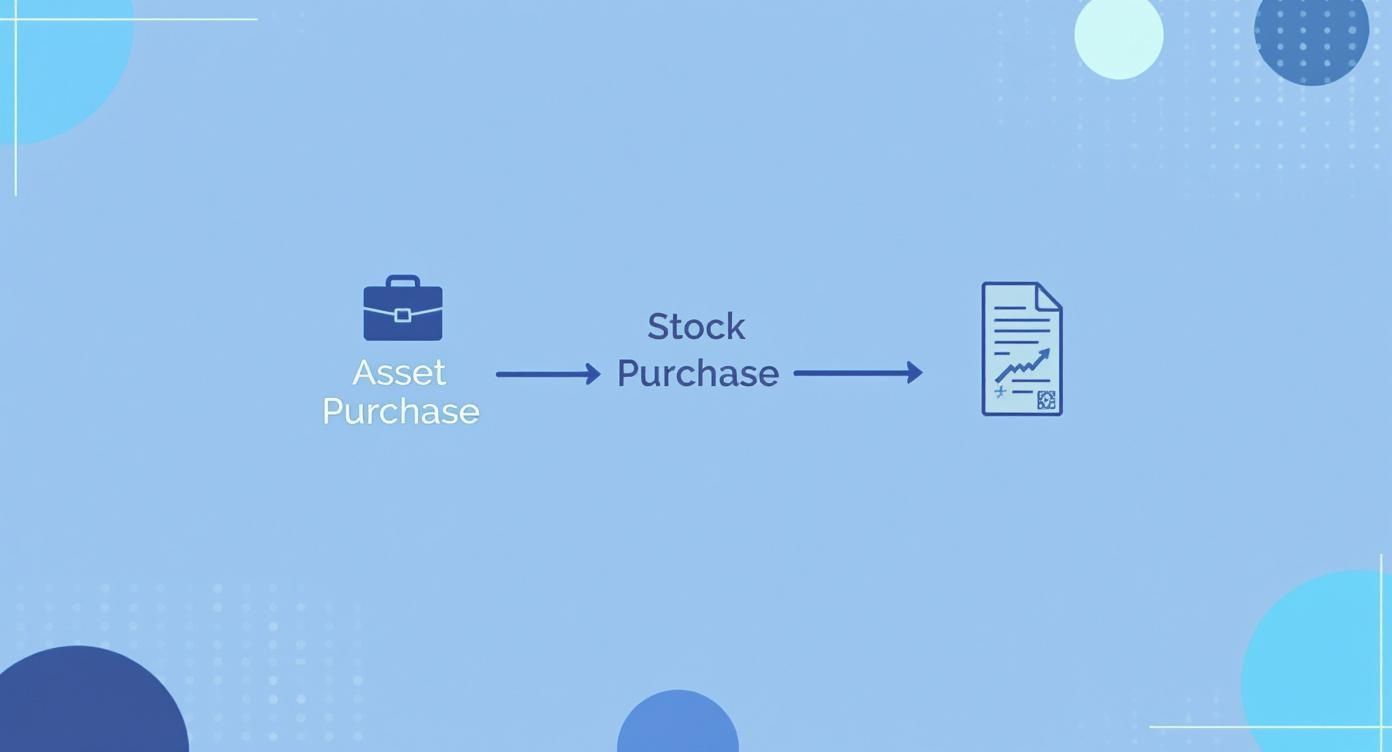
As you can see, the choice between an Asset Purchase and a Stock Purchase is a fundamental decision that shapes the entire legal framework of the deal.
The purchase agreement is the single most important document in the entire transaction. It’s where all the negotiations, discoveries from due diligence, and risk allocations come together in a legally enforceable format. Getting this document right is paramount.
Reaching the Finish Line at Closing
The final stage is the closing. This is the formal ceremony where ownership officially transfers from seller to buyer. Documents are signed, funds are delivered, and assets or stock certificates are handed over. While it can feel like a formality, the closing requires intense coordination to ensure every condition from the purchase agreement has been satisfied.
But the work doesn't stop when the papers are signed. Post-closing integration is where the real challenge often begins. The buyer now has to merge the new business into its own operations, which can mean anything from combining IT systems to blending company cultures. A smooth integration is what ultimately determines whether the transaction delivers on its strategic promise.
If you want to discuss your business law matter, contact Kons Law at (860) 920-5181.
Managing Compliance and Regulatory Hurdles
No business transaction ever happens in a vacuum. Every single deal, from a simple asset purchase to a major merger, is shaped by a dense network of regulations that can easily trip up an otherwise solid agreement. Getting a handle on these compliance hurdles is a non-negotiable part of business transaction law, and it requires a sharp eye for detail and a proactive game plan.
One of the first—and biggest—regulatory checkpoints you’ll encounter, especially in larger deals, is antitrust law. These laws exist to prevent monopolies and keep the marketplace competitive. If a merger or acquisition is big enough, it can trigger mandatory filings, forcing the companies involved to get the green light from government agencies before they can legally move forward.
Forget to get that approval, and the entire transaction could be blocked or even undone after the fact. That's why a thorough antitrust analysis is one of the very first steps in any significant M&A deal.
Navigating Industry-Specific Rules
Beyond the broad-stroke competition laws, many deals are tangled in rules unique to their specific industry. These sector-specific regulations are often much stricter and can add serious complexity to both the due diligence phase and the closing process.
- Healthcare: Any transaction in the healthcare world has to contend with ironclad laws around patient privacy (think HIPAA) and anti-kickback statutes that police financial relationships between providers.
- Finance: The financial services sector is one of the most heavily regulated, period. Deals involving banks, investment firms, or insurance companies must follow a mountain of rules from agencies like the SEC and FINRA, which dictate everything from capital requirements to consumer protection.
These industry-specific tripwires mean that a strategy that works perfectly for a manufacturing deal could be a complete non-starter in a regulated field. Knowing this landscape is absolutely critical. For a deeper look into this topic, explore our article on what is regulatory compliance.
The Growing Importance of Data Privacy
In our modern economy, data is often a company's most prized asset. As a result, data privacy laws have moved front and center in business transaction law. Regulations like Europe’s General Data Protection Regulation (GDPR) and a patchwork of U.S. state laws have laid down strict rules for how customer information can be gathered, stored, and transferred.
If the company you’re looking to acquire holds a lot of customer data, your due diligence has to include a deep dive into their data handling practices. Any misstep here could mean you’re inheriting massive fines and a PR nightmare right out of the gate.
A company’s data practices are no longer a background IT issue; they are a core component of its legal and financial risk profile. Any transaction involving the transfer of personal information must treat data privacy compliance as a top-tier priority.

The Rise of RegTech in Due Diligence
To manage this complicated web of rules, businesses are increasingly leaning on technology. Regulatory Technology, or RegTech, is now playing a massive role in modern due diligence, especially for Anti-Money Laundering (AML) and Know-Your-Customer (KYC) checks. These tech-driven processes have become standard procedure for verifying identities and making sure a transaction isn't being used for illicit purposes.
The global RegTech market is on track to blow past $22 billion by mid-2025, a surge fueled by tougher regulations like the EU’s 6th Anti-Money Laundering Directive (6AMLD). This explosive growth just goes to show how essential technology has become for keeping every deal on the right side of the law.
If you want to discuss your business law matter, contact Kons Law at (860) 920-5181.
Protecting Your Interests in Any Transaction
While this guide gives you a solid starting point, the real world of deal-making is full of twists and turns that demand expert guidance. A good grasp of business transaction law is your first line of defense—it's what allows you to protect your interests, manage risk, and hit your strategic targets. The whole point is to get ahead of problems, not just react to them.
By taking a few deliberate steps, you can build a framework to ensure your deals are not just successful, but fundamentally secure. It all starts with bringing in your legal counsel early on, long before you sign anything binding. This makes sure your strategy is sound from day one.
Key Practices for Transaction Security
Keeping your company's records organized and meticulous throughout its life is another game-changer. When it's time for the other side to do their due diligence, having clean, easy-to-access documents speeds everything up and builds a massive amount of trust. It shows you're professional and have nothing to hide.
Finally, never, ever treat due diligence as just a box-checking exercise. This is your one real chance to dig in, find any hidden liabilities, and confirm you're actually getting what you paid for. A thorough review protects you from those nasty, expensive surprises that can pop up after a deal closes.
These proactive measures are the bedrock of smart transaction management:
- Engage Legal Counsel Early: Get your attorney involved at the Letter of Intent stage. They can help structure the deal in your favor and lock in your rights from the very beginning.
- Maintain Meticulous Records: Keep all your corporate, financial, and contract documents up-to-date and in order. It will make due diligence and negotiations much smoother.
- Never Skip Due Diligence: Conduct a deep dive into the other party's financial, legal, and operational health. This is how you shut down future risks before they become your problem.
Ultimately, the goal of applying business transaction law principles is to move forward with confidence. It transforms a potentially risky venture into a well-managed process, where your company’s interests are safeguarded at every step, creating a secure foundation for future growth and success.
When you make these practices a standard part of how you operate, you stop hoping for a good outcome and start engineering one.
If you want to discuss your business law matter, contact Kons Law at (860) 920-5181.
Frequently Asked Questions
When you're navigating the complexities of a business transaction, questions are bound to come up. With so much on the line, it's natural to want clear answers. Here’s a look at some of the most common things business owners ask us.
What Is the Most Common Mistake in Transactions?
By far, the most frequent and damaging mistake is rushing the due diligence process. It's easy to get caught up in the excitement of a deal and rely on surface-level information, but that's a recipe for disaster. We've seen businesses close a deal only to discover crippling liabilities, hidden financial problems, or legal skeletons in the closet. Proper due diligence isn't just a box to check—it's your single most important tool for managing risk.
When Should I Involve a Lawyer?
Get your attorney involved as early as you possibly can. The ideal time is when you're first thinking about a Letter of Intent (LOI), either drafting one or reviewing one you've received. Bringing in legal counsel from the start ensures your interests are baked into the deal's framework from day one. This proactive approach helps structure everything in your favor and can save you from incredibly expensive headaches down the road.
What Is the Difference Between an Asset and Stock Purchase?
This is a critical distinction that has massive implications for tax and liability.
Think of it this way: In an asset purchase, you are essentially going into the seller's business with a shopping cart and picking out the specific things you want to buy—equipment, client lists, inventory—and you can often choose which liabilities you're willing to take on. You're buying pieces of the company, not the company itself.
In a stock purchase, you buy the whole company, lock, stock, and barrel. You acquire the seller’s shares and take ownership of the entire legal entity. That means you get all the assets, but you also inherit all of its liabilities, whether you know about them or not.
If you want to discuss your business law matter, contact Kons Law at (860) 920-5181.
