
A lot of selling away matters start the same way. An advisor helps a long-time client with an opportunity that seems personal, informal, and outside the ordinary product menu. Then compliance calls. The email is short. The meeting invite is marked urgent. By the end of the week, the advisor realizes this isn't a misunderstanding. It's a potential career event.
That's why financial professionals need a practical answer to what is selling away. The legal definition matters, but the accusation matters just as much. Once a firm starts asking questions, the issue quickly expands beyond the investment itself. It touches supervision, outside business activity, compensation, customer communications, Form U5 language, and often the advisor's future employability.
An Introduction to Selling Away Allegations
An advisor doesn't need to think of himself as a rule-breaker to end up in a selling away investigation. A client asks about a local startup. A family friend is raising capital for a real estate venture. Someone mentions a promissory note that seems straightforward. The advisor makes an introduction, passes along documents, or answers questions because he thinks he's helping. That's often enough to trigger scrutiny.
The problem is that regulators and firms don't analyze these situations the way advisors often do in real time. Advisors focus on the relationship and the opportunity. Compliance focuses on whether the investment was firm-approved, whether notice was given, whether compensation was involved, and whether the transaction belonged on the firm's books and records.
Practical rule: If a transaction happened outside firm channels, assume the firm will examine it as a supervision problem first and a customer-protection problem second.
Once the allegation surfaces, the consequences can move fast. Firms may freeze internal support, interview branch staff, review emails and texts, and ask whether any client funds moved into an outside deal. If the advisor resigns or is terminated, Form U5 issues follow. If clients complain or lose money, arbitration often follows too.
Selling away cases are serious because they rarely stay confined to one issue. They become a package of allegations, and every document you created before the investigation starts will matter more than anything you say after it begins.
Defining Selling Away Under FINRA Rules
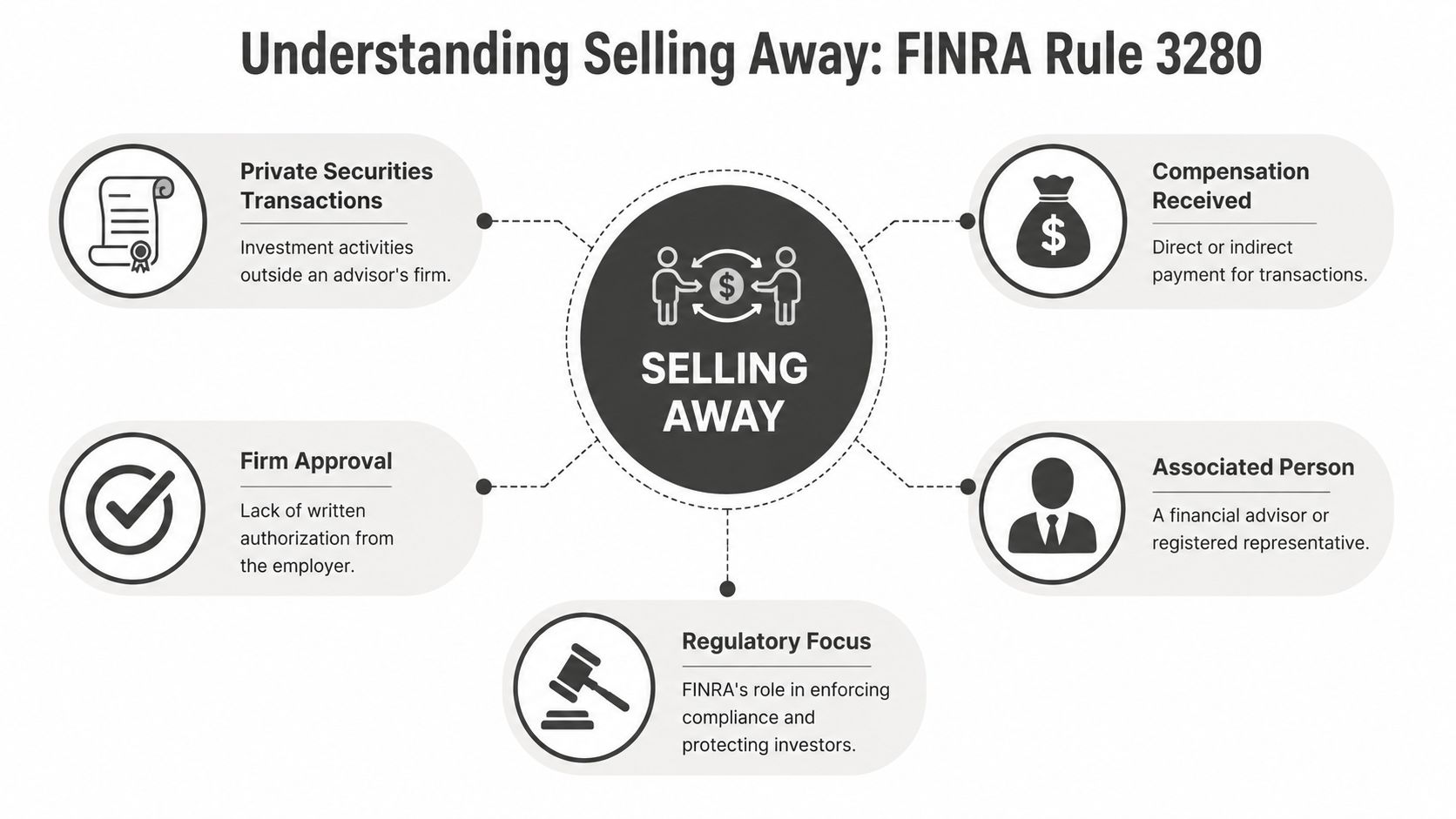
Selling away is not an informal compliance label. It has a specific regulatory meaning tied to FINRA Rule 3280. The core principle is simple. A registered person can't participate in a private securities transaction unless he first gives written notice to the member firm and obtains approval when required.
Under the rule, a private securities transaction involves the sale of securities not held, offered, or approved by the employing brokerage firm. That can include private placements, promissory notes, or investments in a business the advisor created or controls, as explained in CFI's summary of selling away under FINRA Rule 3280.
What counts as participation
Many advisors think selling away only happens if they personally sell the investment and collect a commission. That's too narrow. In practice, regulators and firms often look at the total conduct.
Participation can include conduct such as:
- Making the introduction: Connecting a client with the issuer or promoter can become a focal point.
- Passing along materials: Forwarding offering documents or subscription paperwork can look like involvement in the sale.
- Encouraging the investment: Even informal statements can be framed as solicitation.
- Receiving benefit: Direct or indirect compensation creates a much harder case to defend.
- Using client trust built at the firm: If the relationship existed because of your role as an associated person, the firm may argue you used firm goodwill.
The key issue usually isn't whether the advisor thought the investment was promising. It's whether the advisor participated without proper internal disclosure and approval.
Outside business activity is not the same thing
Advisors often encounter trouble. They assume a disclosed side business solves the problem. It often doesn't.
An outside business activity might be permissible if the firm knows about it and permits it. But a private securities transaction is a separate and more dangerous category. An advisor can disclose a business generally and still violate the rules if he participates in securities transactions tied to that business without the required notice and approval.
A firm's written supervisory procedures often become central here. If the procedures require advance written approval, attestation, or product review, a casual verbal mention to a manager won't usually save the advisor.
The defense often rises or falls on paperwork. Advisors remember conversations. Firms produce forms, logs, and attestations.
The red flags firms look for
In actual investigations, firms usually start with operational clues, not legal theory. They ask what moved off-platform and why. They compare customer complaints, correspondence, and account records.
A short table shows how that works:
| Issue | Why it matters |
|---|---|
| Investment isn't on firm platform | Suggests the product was outside approved channels |
| No compliance file | Suggests no pre-approval process occurred |
| Personal email or text usage | Suggests activity may have bypassed supervision |
| Off-platform payment path | Raises concern about books and records and compensation |
| Client confusion about firm involvement | Supports a claim that the advisor blurred personal and professional roles |
Advisors who want to reduce risk before an issue arises should pay attention to communication controls, attestation practices, and escalation habits. Resources on Voicedial AI compliance best practices can be useful in thinking through how firms monitor communications and document compliance workflows. That doesn't replace legal advice, but it does show how modern supervision increasingly catches conduct that used to stay informal.
The Career-Altering Consequences of a Violation
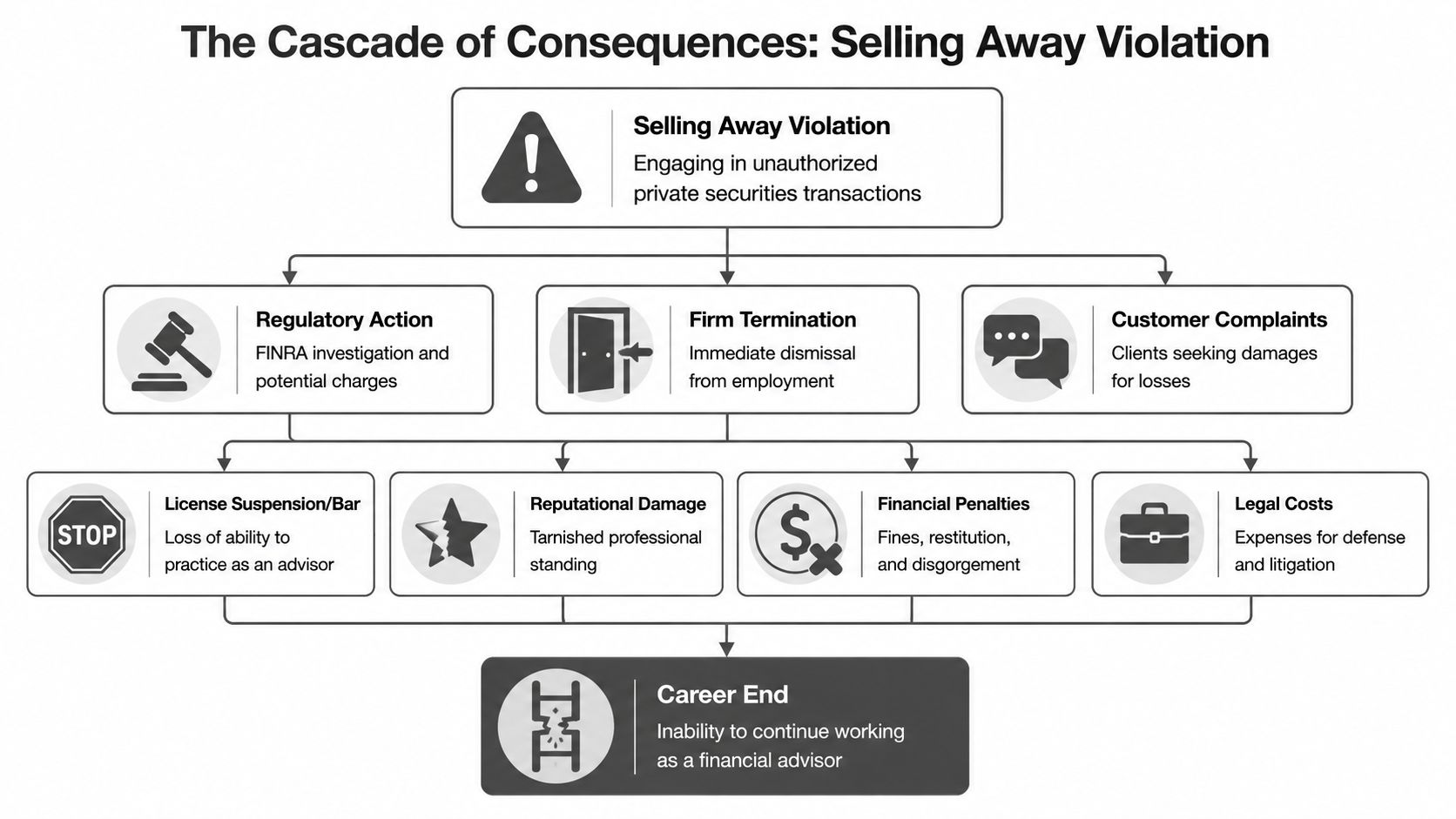
Selling away allegations don't stay in the compliance department for long. They spill into employment, licensing, customer disputes, and reputation. For many advisors, the first shock isn't regulatory action. It's the firm's internal response.
A firm that believes an advisor engaged in unauthorized private securities transactions may terminate first and investigate the rest later. Once that happens, the next major issue is disclosure. The language used on Form U5 can shape how future firms, regulators, and opposing counsel view the advisor.
Why the paper trail gets ugly fast
One reason these cases become so damaging is that the evidence often looks bad before anyone hears the advisor's explanation. A major red flag is when the investment doesn't appear on the customer's monthly brokerage statement, because transactions are supposed to be recorded on the firm's books and records. That absence also prevents the firm from monitoring outside business activities that should be reported, as discussed in Wolper Law Firm's overview of selling away violations.
Once a firm sees that disconnect, it will often ask a blunt series of questions:
- Who knew about the transaction
- How the client was introduced
- Whether money changed hands
- What was said in texts, emails, or meetings
- Whether other clients were approached
Those inquiries can uncover additional issues that were not obvious at the start, including undisclosed compensation, inaccurate annual compliance questionnaires, or side arrangements with third parties.
How Form U5 changes the fight
A U5 disclosure can be more damaging than the initial accusation. That's because the advisor now has to defend the past while trying to preserve the future. Any prospective firm reviewing the record will ask whether the advisor presents a supervision risk.
That's why disputes over Form U5 disclosures and FINRA reporting matter so much. In practice, advisors often face two related problems at once:
| Problem | Immediate effect | Longer-term effect |
|---|---|---|
| Termination for cause | Loss of income and platform | Harder transition to another firm |
| U5 disclosure | Regulatory visibility | Recruiting resistance |
| Customer complaint | Defense costs begin | Potential arbitration exposure |
| Internal compensation clawback | Financial pressure | Leverage in settlement talks |
The employment side often follows
When an advisor is terminated, the case may expand into promissory note repayment or bonus clawback disputes. That's not a side issue. It alters the dynamic.
Intra-industry FINRA arbitration filings in the first two months of 2025 were led by breach of contract claims with 57 cases, followed by promissory note disputes with 25 cases, according to Judex Law's review of early 2025 FINRA arbitration filings. Those promissory note cases often arise when an advisor leaves a firm or is terminated and the firm seeks repayment.
A selling away case rarely stays a single-front dispute. It often becomes a termination case, a U5 case, a regulatory case, and a money case at the same time.
That's why waiting to “see how it develops” is usually a mistake. By the time the advisor realizes the matter is serious, the firm has already drafted the narrative it plans to use.
Selling Away in Practice Through Case Examples
The fastest way to understand what selling away looks like is to compare the borderline case with the obvious one. Both create risk. The difference is usually in how the evidence develops, not whether the firm takes the issue seriously.
The well-intentioned advisor
A veteran advisor had a long-standing client who trusted him on almost everything financial. The client asked about investing in a family member's real estate venture. The advisor didn't think of it as a securities issue. He saw it as a private business deal between experienced adults.
He reviewed the pitch deck, introduced the client to the sponsor, and answered questions about timing and structure. He didn't submit anything to compliance because he believed he was acting informally and wasn't placing the deal through the firm.
When the project ran into trouble, the client stopped viewing the advisor as a helpful connector and started viewing him as the person who recommended the deal. The firm reviewed texts, found off-platform communications, and focused on the advisor's role in bringing the parties together. The advisor's intent wasn't fraudulent, but intent didn't end the inquiry.
Good faith helps with credibility. It doesn't erase a failure to disclose or obtain approval.
This kind of case often turns on narrow evidence. What exactly did the advisor say. Did he characterize the deal as safe. Did he receive any indirect benefit. Did he use firm email, office space, or firm prestige to support the transaction. Those details shape whether the matter becomes an internal discipline issue, a regulatory referral, or both.
The advisor who crossed the line on purpose
A different case looks very different. Here, the advisor actively solicits multiple clients to buy high-yield promissory notes from an outside enterprise. He tells them the opportunity is limited, emphasizes income, and routes documents outside firm systems. The notes later prove to be fraudulent.
That scenario is easier for firms and regulators to charge because the pattern is broader and the sales effort is clearer. Multiple customers. Repeated solicitations. Off-books transactions. Missing documentation. Possible compensation.
The customer claims that follow often include fiduciary themes, misrepresentation themes, and supervision themes. Conduct like that also creates obvious exposure discussed in broader analyses of breach of fiduciary duty examples, especially where the advisor used client trust to steer money into unapproved products.
The same rules can hit very different facts
These examples show why advisors should stop asking only one question, which is whether they meant well. The more useful questions are:
- Was this a security
- Did the firm approve it in writing
- Did I participate in the transaction
- Could a client reasonably say I recommended it
- Is there a clean paper trail supporting my version
A well-intentioned advisor may have arguments that a deliberate fraudster doesn't. But both can still face the same initial allegation. In actual defense work, the early objective is usually to separate negligence, misunderstanding, and informal involvement from intentional off-books solicitation.
Common Defenses and Evidentiary Considerations
When an advisor is accused of selling away, the defense shouldn't start with broad denials. It should start with classification and evidence. The first question is not moral. It is legal and factual. What exactly was the product, what exactly did the advisor do, and what can the documents prove.

Defenses that may matter
Not every argument fits every case. Some are stronger as mitigation than as a complete defense. Still, several issues routinely matter.
- The product may not have been a security: If the underlying arrangement doesn't qualify as a security under applicable law, the selling away framework may not fit neatly.
- The advisor may not have participated in a sale: Mere awareness is different from solicitation. The line isn't always clean, but it matters.
- No compensation was received: Lack of compensation doesn't automatically end the case, but it can affect how participation is characterized.
- The firm knew more than it admits: If managers or supervisors had actual knowledge and failed to act, that can reshape both liability and credibility.
- The communications were ambiguous: A client may describe something as a recommendation that the documents show was only an introduction or referral.
These aren't magic words. They only work if the record supports them.
Evidence usually decides the case
Advisors often underestimate how much their own communications matter. The text sent late at night. The forwarded subscription packet. The calendar invite. The personal email. The note saying “this is outside the firm.” Each of those can help or hurt depending on context.
The strongest defense files usually include:
| Evidence type | Why it matters |
|---|---|
| Emails with compliance or supervisors | May show disclosure, notice, or firm awareness |
| Text messages with clients | May show whether there was a recommendation or just an introduction |
| Compensation records | May rebut allegations of transaction-based payment |
| Notes or calendars | May clarify timing and sequence |
| OBA forms and annual attestations | May show what was disclosed and when |
Preserve first. Explain second. Once documents disappear, the defense becomes far harder and the suspicion becomes greater.
What doesn't work well
Some responses almost always make things worse.
- Reconstructing communications from memory: If the documents contradict you, credibility erodes quickly.
- Editing or deleting messages: That can become as serious as the underlying allegation.
- Calling clients to align stories: Firms and regulators may view that as interference.
- Assuming a verbal conversation with a manager counts as approval: Without records, that argument is usually fragile.
A proactive advisor keeps records before trouble starts. A defended advisor preserves them the moment trouble appears. In these cases, meticulous documentation is not administrative overhead. It is often the difference between a manageable dispute and a regulatory disaster.
A Practical Guide to Facing a Selling Away Allegation
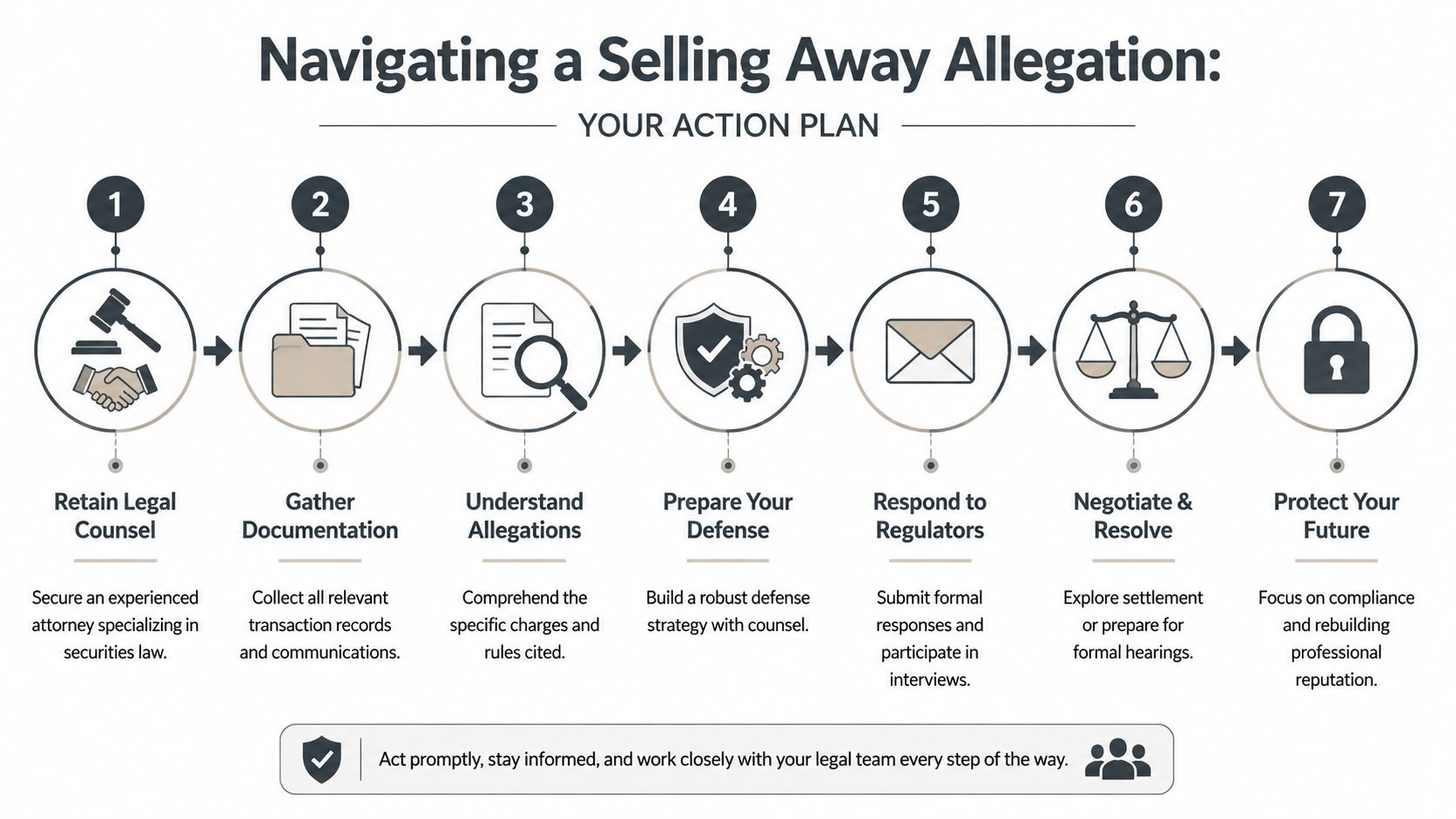
Once you know your firm is looking at possible selling away, your first job is to slow down and stop freelancing your response. Advisors often damage their defense in the first few days by over-explaining, forwarding half-complete information, or trying to persuade compliance informally. That usually backfires.
Retain experienced counsel before responding in substance to your firm or to FINRA. You need to know what the allegation is, what documents exist, and what collateral issues may be coming. Those may include a U5 disclosure, a compensation dispute, an internal promissory note claim, or a customer arbitration demand.
What to do immediately
Start with containment. You need facts, not spin.
- Hire counsel first. Don't attend an interview or submit a written statement without advice.
- Preserve everything. Save emails, texts, notes, calendars, offering materials, and payment records.
- Stop discussing the matter casually. Don't call clients, colleagues, or recruiters to “clear things up.”
- Pull your compliance history. OBA disclosures, annual attestations, and prior approvals may become central.
- Map the timeline. Build a chronology of who said what, when, and through which channel.
If the firm asks for immediate cooperation, that doesn't mean you should respond hastily. It means you should respond carefully.
What the investigation may look like
The internal review often comes first. Then a regulatory request may follow, including a Rule 8210 request for documents or testimony. At that point, precision matters.
A disciplined approach usually includes:
- Reviewing the exact wording of the request
- Identifying what categories of documents exist
- Separating facts you know from assumptions you've made
- Preparing for on-the-record testimony
- Evaluating whether parallel disputes are developing
For many advisors, the process doesn't end with the investigation. It moves into arbitration, either because the firm files an intra-industry claim or because a customer pursues losses. A typical FINRA arbitration proceeding runs approximately 12 to 18 months, with the evidentiary hearing usually scheduled 9 to 12 months from filing, according to this overview of the FINRA arbitration timeline.
That timeline matters for planning. You may be dealing with months of document production, pleadings, witness preparation, and employment uncertainty. Understanding the FINRA arbitration process helps advisors make smarter decisions about settlement, defense costs, and future business planning.
The best early move is usually boring. Preserve records, limit statements, and let counsel shape the response.
What to avoid while the case is active
A few decisions consistently create avoidable damage:
| Mistake | Why it hurts |
|---|---|
| Sending a long defensive email to compliance | Locks you into language before facts are fully reviewed |
| Deleting personal-device communications | Creates a separate credibility and preservation problem |
| Contacting customers to influence recollection | Can be characterized as witness interference |
| Resigning without strategy | May worsen U5, employment, and arbitration issues |
| Treating the case as only a compliance issue | Misses the employment and reputational components |
The practical objective
The objective isn't always total exoneration. Sometimes it is narrower and just as important. Limit the allegations. Improve the U5 language. Avoid a bar. Reduce customer exposure. Resolve a promissory note claim on workable terms. Preserve the ability to keep working.
That requires strategy from the beginning. If you're a financial professional facing an inquiry, an 8210 request, a U5 problem, or a related employment dispute, act early and act with counsel. Delay usually benefits the firm, not the advisor.
If you want to discuss your business law matter, contact Kons Law at (860) 920-5181.
