You're several months into a business dispute. Discovery has produced contracts, emails, deposition transcripts, and financial records, but the case still appears headed toward trial. Legal fees are rising, employees are spending time answering questions, and everyone is asking the same practical question: does a jury really need to decide this case?
A summary judgment motion can provide an off-ramp when the evidence shows that no genuine dispute requires a trial. It can also expose weaknesses in the other side's proof, narrow the claims that remain, and change the balance of power before anyone enters a courtroom. For business owners and junior counsel, the challenge is understanding that success depends on more than reciting the legal standard. Timing, record citations, admissibility, local rules, and disciplined fact management all matter.
Connecticut businesses often face disputes involving contracts, partnerships, ownership rights, employment relationships, commercial payment obligations, and business torts. A practical overview of civil cases in Connecticut helps place summary judgment within the larger litigation process. This guide builds the analysis step by step, from the basic meaning of the motion to the structure of a persuasive filing and the decisions that follow a ruling.
Introduction Why Summary Judgment Matters Before Trial
A distributor sues a manufacturer, claiming the manufacturer breached an exclusive supply agreement. The manufacturer responds that the contract allowed termination, and both sides have exchanged the same written agreement. Depositions confirm that the relevant notice was sent on a particular date, and neither party disputes what the notice says. The disagreement concerns the legal meaning of the contract, not a missing witness or a contested event.
That case may still involve substantial preparation, but a trial may add little value if the material facts are established and the governing law resolves the dispute. A summary judgment motion asks the court to decide the issue before trial because the record leaves no genuine factual question for a reasonable jury.
The motion can work in a more complicated setting, too. Suppose a former business partner claims that company funds were diverted, while the defendant points to accounting records, board minutes, and written approvals. The court may grant judgment on a particular claim if the plaintiff lacks evidence for an essential element, while allowing another claim to proceed because witness credibility remains disputed.
The business decisions begin before filing
Summary judgment isn't only a litigation event. It affects how a company budgets for the case, evaluates settlement, prepares witnesses, and decides which discovery requests deserve priority. A party that understands the eventual motion early can collect documents with the legal elements in mind instead of storing a large, unorganized record.
The process also changes trial risk. A full grant may end the case or dispose of a claim. A partial grant may reduce the issues, eliminate defenses, or clarify what a jury will hear. A denial may still reveal how the judge views the record and which factual disputes require attention.
Practical rule: Treat every important document, admission, and deposition answer as a possible trial exhibit and summary judgment citation from the moment you receive it.
The rest of the analysis focuses on the federal Rule 56 framework, Connecticut practice, and the local procedural details that can determine whether a carefully researched motion is heard at all. The central lesson is straightforward: a summary judgment motion is won by connecting legal elements to admissible, precisely cited evidence under the court's actual schedule.
What a Summary Judgment Motion Really Means
Think of a referee reviewing a game after the final play, with no need for overtime because the decisive facts aren't in dispute. The referee doesn't decide which player seemed more believable in a close exchange. Instead, the referee asks whether the established facts leave any legitimate path to a different result under the rules.
A court uses a similar approach on summary judgment. The judge reviews the pleadings, discovery, affidavits or declarations, deposition testimony, documents, and other record materials. The question isn't whether the parties disagree in general. The question is whether their disagreement concerns a fact that matters under the law and whether the evidence could allow a reasonable jury to decide for the nonmoving party.
Two words control the analysis
A material fact is a fact that could affect the outcome under the governing legal rule. In a contract case, whether the parties signed the agreement may be material. A minor disagreement about who attended a meeting may not be material if the signed contract and undisputed communications resolve the issue.
A genuine dispute exists when the evidence would permit a reasonable jury to return a verdict for the party opposing the motion. A party can't avoid judgment merely by saying, “I disagree.” The party must point to evidence that creates a real jury question.
The Federal Judicial Center's explanation of Rule 56 emphasizes that a dispute matters only when it must be decided to resolve the substantive claim or defense. The court may deny summary judgment when the evidence could support a reasonable jury's decision for the nonmoving party.
Why Rule 56 exists
The modern federal summary judgment motion traces to the Federal Rules of Civil Procedure, which took effect in 1938. Rule 56 was later amended on December 27, 1946, January 21, 1963, and March 2, 1987, reflecting a long history of procedural refinement in federal civil litigation. The Cornell Legal Information Institute's Rule 56 history and text also describes earlier common-law practice, including New York County records reporting 5,600 summary judgment applications during the first nine years after the procedure was adopted there.
That history matters because summary judgment wasn't created to replace trials whenever a defendant wants one. It developed as a way to separate disputes requiring fact-finding from disputes that can be resolved through the existing record and the law.
For business disputes, the motion commonly appears in claims involving contract interpretation, payment obligations, partnership rights, restrictive covenants, ownership interests, and commercial tort theories. The name of the claim doesn't decide whether summary judgment is appropriate. The quality of the factual record does.
The Legal Standard and How Burden Shifting Works
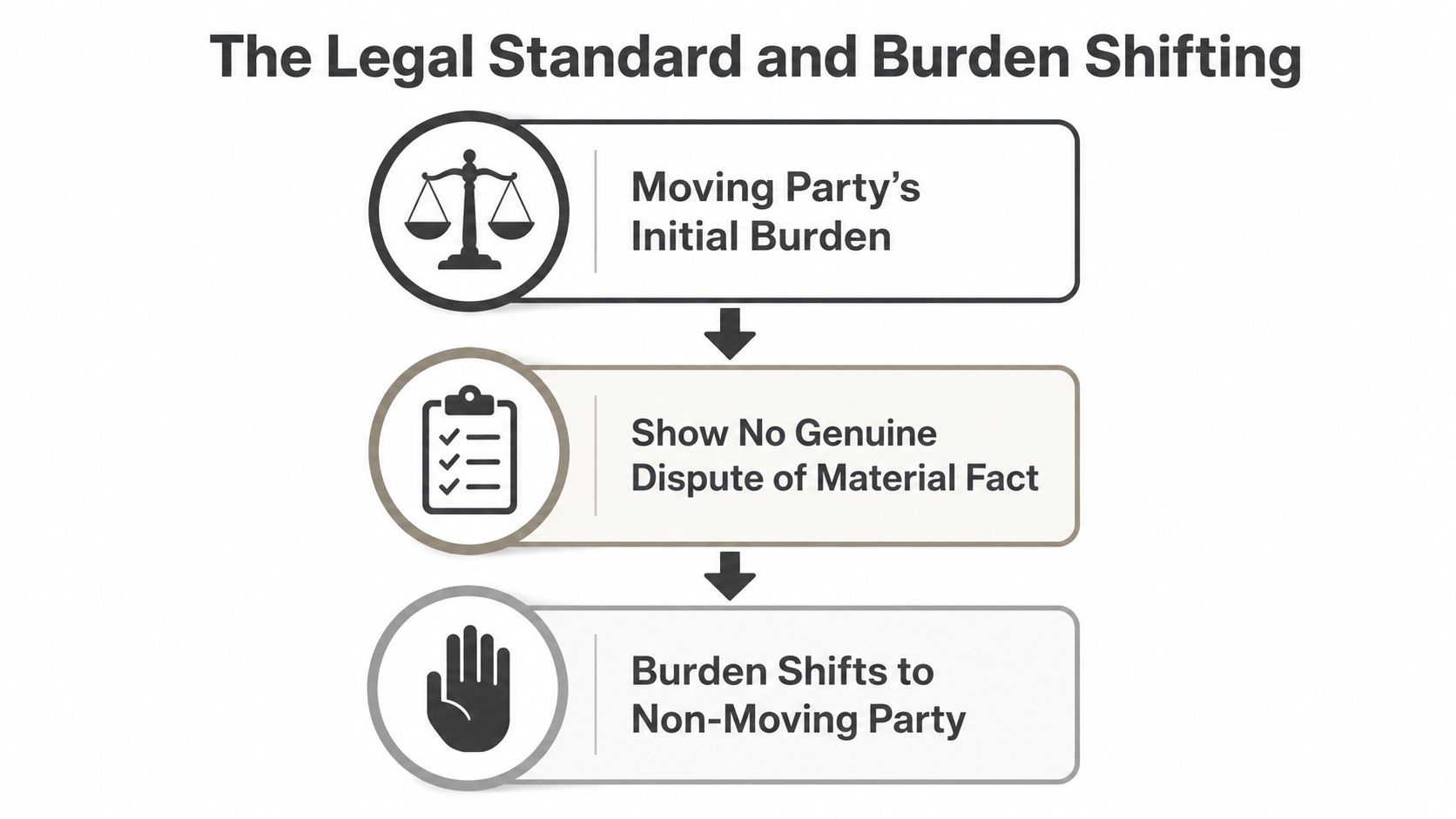
The moving party starts with the burden. Under Rule 56, the movant must show that there is no genuine dispute as to any material fact and that the movant is entitled to judgment as a matter of law. That requires more than a persuasive narrative. It requires a record that addresses each element of the claim or defense.
The movant may rely on admissions, contract language, deposition testimony, business records, discovery responses, declarations, or other materials permitted by the applicable rules. The filing should identify the facts that matter, cite the exact supporting material, and explain why those facts satisfy the legal standard.
The burden shifts, but the standard doesn't disappear
Once the movant makes the required showing, the nonmoving party must identify evidence that creates a genuine dispute. The response can't rest on allegations in a complaint or on an unsupported assertion that a witness might testify differently later. The nonmovant needs to show where the record supports a reasonable jury finding.
That doesn't mean the nonmoving party must prove the entire case at summary judgment. It must, however, identify evidence connected to a material issue. A deposition answer may create a factual dispute about notice. An authenticated email may undermine a claim that no written warning was given. A business record may establish a payment that contradicts an allegation of nonpayment.
The Supreme Court's modern framework explains that a dispute is genuine only when the evidence is such that a reasonable jury could return a verdict for the nonmoving party, and a material fact is one that might affect the outcome under the governing law. The federal court publication applying that framework illustrates why a factual disagreement alone isn't enough.
Federal and Connecticut practice require local attention
Federal Rule 56 supplies the broad standard, but Connecticut cases proceed under state rules, court orders, and procedural requirements that must be checked independently. The parties should confirm the assigned court's filing rules, scheduling order, briefing requirements, and evidence conventions before preparing the motion.
The same business dispute may produce different practical risks depending on whether it is pending in federal court, Connecticut Superior Court, arbitration, or another forum. A lawyer who copies a federal filing into a Connecticut case without checking the applicable procedure may overlook a required form, deadline, or response format.
Use this decision test:
- Identify the legal element. What must the claimant or defendant prove?
- Name the supporting fact. Which fact establishes or defeats that element?
- Locate the evidence. Where exactly does the record prove the fact?
- Test the dispute. Could a reasonable jury find for the other side on that fact?
- Assess materiality. Would that fact change the result under the law?
The test is simple to describe but demanding to execute. The strongest motion makes the judge's path from evidence to legal conclusion easy to follow.
Evidence and Filings That Make or Break the Motion
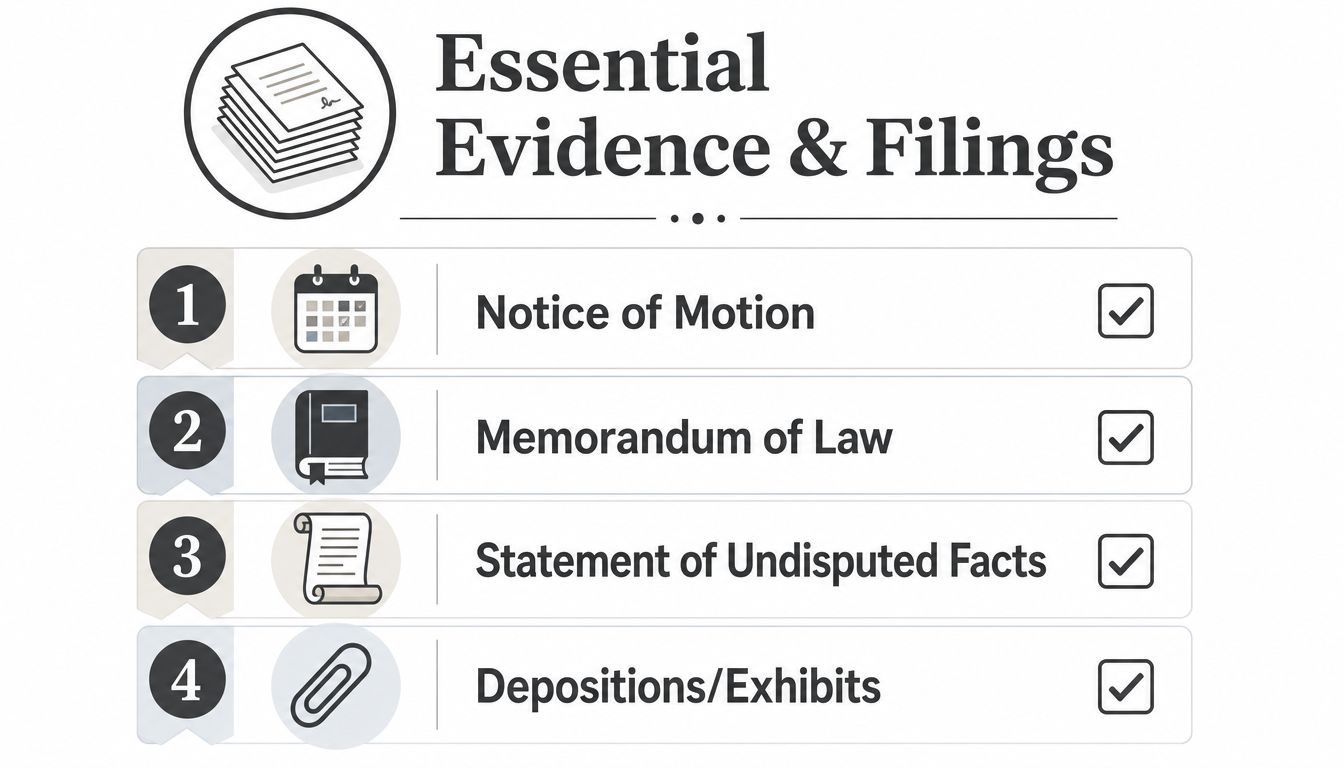
A summary judgment record is assembled from evidence blocks. Each block should perform a defined job. The motion identifies the relief sought, the memorandum explains the law, the statement of facts organizes the record, and the exhibits provide the underlying proof.
A typical filing package may include:
- Notice of motion: Identifies the requested relief and the procedural event.
- Memorandum of law: Explains the legal standard and applies it to the cited facts.
- Statement of undisputed facts: Presents numbered factual propositions with record support.
- Affidavits or declarations: Supplies testimony based on personal knowledge.
- Deposition excerpts: Shows admissions, contradictions, and testimony tied to specific issues.
- Documentary exhibits: Includes contracts, invoices, correspondence, policies, account records, and other relevant materials.
The exact filing requirements depend on the forum and the assigned judge. Page limits, exhibit labeling, citation format, and deadlines can matter as much as the prose.
Build a fact-by-fact evidentiary matrix
A useful working tool is a matrix with columns for the legal element, proposed fact, supporting evidence, opposing evidence, citation, and admissibility concern. It prevents a common mistake: writing a compelling factual story without proving every proposition in the story.
Texas procedure offers a clear example of why this discipline matters. The movant must file separately numbered proposed facts, and the opponent must identify genuine issues tied to specific record evidence. A material fact that isn't adequately disputed may be deemed established for the motion under the procedure described in the U.S. Code Rule 56 materials.
That procedural consequence turns record mapping into strategy. If the motion states, “The parties signed the agreement on a particular date,” the citation should lead directly to the signed agreement. If the opposition says only, “The parties dispute the agreement,” it may fail to controvert the fact.
Evidence must support the conclusion
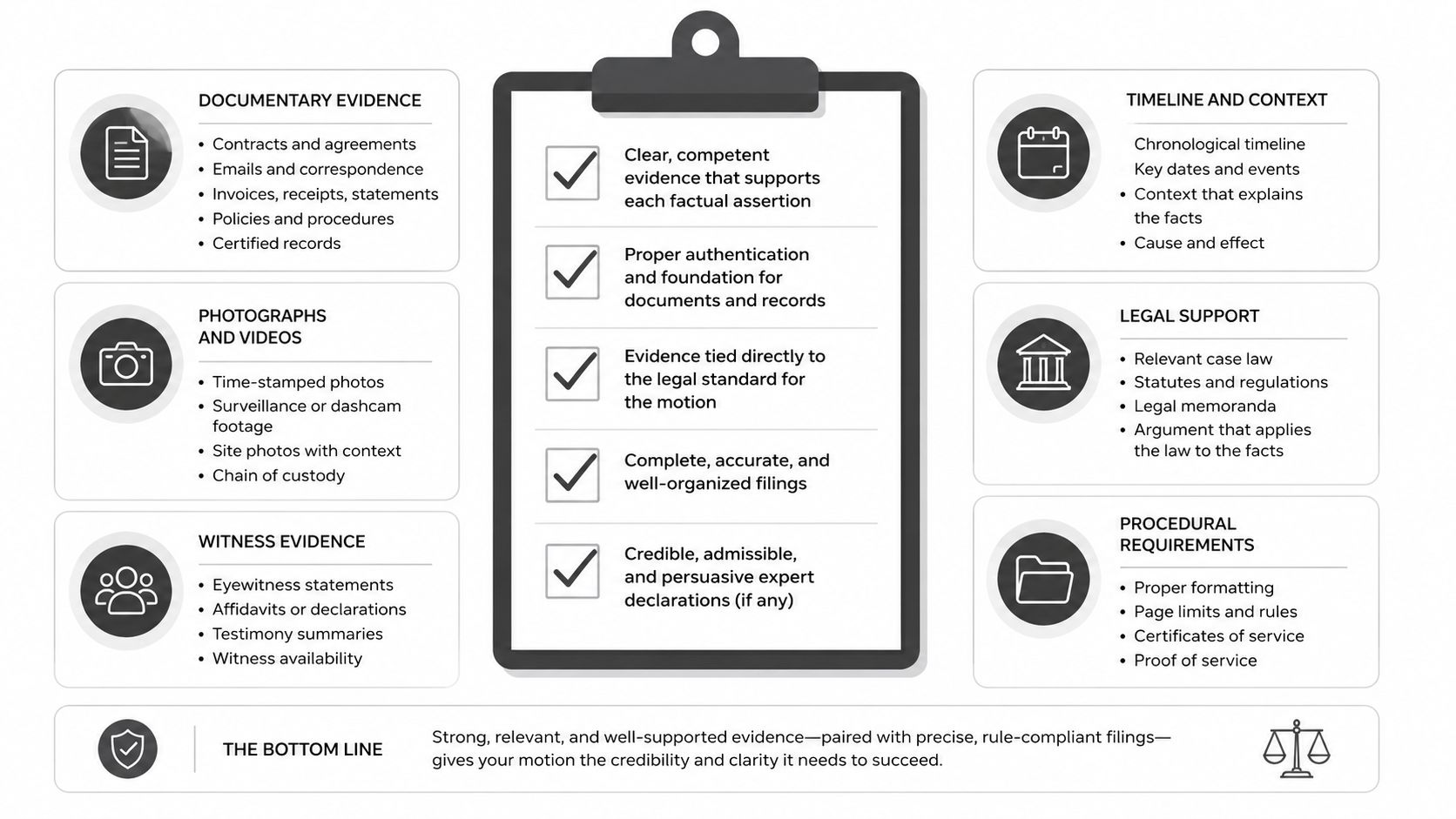
An allegation isn't evidence. A lawyer should ask whether the witness has personal knowledge, whether the document can be authenticated, whether the testimony contains a legal conclusion, and whether the material could be presented in an admissible form at trial.
Deposition preparation is part of this process, not a separate exercise. Counsel reviewing how to prepare for a deposition should identify the admissions needed for later motion practice, while also preparing the witness to explain documents accurately and avoid speculation.
Record discipline: Every important sentence in the statement of facts should answer three questions, what proves it, where is that proof, and why does it matter?
In high-document disputes, the summary judgment record may function as the practical substitute for live testimony on issues that aren't disputed. The side with the clearer, better-supported record often gains a meaningful procedural advantage before trial.
Timing Local Rules and Strategic Choices for Both Sides
Timing can determine whether a court reaches the merits. Federal guidance and practitioner materials recognize that a motion may be filed through 30 days after discovery closes, subject to the governing rule and scheduling order, as explained in Bloomberg Law's summary judgment filing guidance. Older federal rule text also required service at least 10 days before the hearing, and permitted a party to move after 20 days from the start of the action or after service of the opponent's motion, as shown in the historical U.S. Code Appendix text.
Those historical mechanics don't replace the current scheduling order. They demonstrate why counsel must check the rule version, local rules, judge-specific procedures, and case management order rather than relying on a generic deadline.
California changed summary judgment timing in 2025 by lengthening notice periods and limiting parties to one motion absent permission. Texas adopted new summary judgment reporting and compliance requirements effective March 1, 2026, with clerks tracking timeframes from filing until a ruling or a missed deadline, according to the Texas courts reporting FAQ. These changes illustrate the broader point, jurisdiction-specific mechanics can decide whether a motion is heard at all.
The strategic choice depends on the side
| Decision Factor | Movant Strategy | Nonmovant Strategy |
|---|---|---|
| Settlement leverage | File when the record presents a clean path to judgment and the filing may clarify risk. | Use the opposition to show why trial remains necessary and identify the cost of continued uncertainty. |
| Discovery position | Confirm that the record is developed enough to support each element and comply with the scheduling order. | Identify missing discovery that genuinely affects the motion and explain why the court shouldn't decide the issue yet. |
| Cost control | Narrow claims or defenses before trial when the evidence supports doing so. | Focus resources on material disputes instead of contesting every background fact. |
| Procedural risk | Check notice, filing, hearing, page, and local reporting requirements before filing. | Track response deadlines and controvert each numbered fact with a specific citation. |
Empirical research provides useful context without replacing case-specific analysis. A study of 15,000 docket sheets across six federal district courts found that cases with at least one summary judgment motion rose from about 12% in 1975 to 17% in 1986, then stabilized around 19% afterward; over the 25-year period from 1975 to 2000, motions increased by more than half overall and cases terminated by summary judgment doubled, according to the federal courts report. The same report summarized a filing rate of roughly 16% of civil cases and noted appeals of grants in 13% to 17% of eligible cases.
Those figures support caution, not confidence. A motion is a risk-management decision, and mediation strategy should account for the possibility of a full grant, partial grant, or denial. Parties can also review how to prepare for mediation while evaluating whether the motion will sharpen settlement discussions.
Inside a Winning Motion and Opposition With Common Pitfalls
A strong motion reads like a proof, not a narrative dump. It begins with the relief requested, identifies the controlling legal rule, states only the facts that matter, and connects each fact to a record citation.
A practical motion skeleton
- Caption and notice: Identify the court, parties, motion, and relief sought.
- Introduction: State the decisive issue in a few focused paragraphs.
- Statement of facts: Use numbered facts, neutral wording, and precise citations.
- Legal standard: Explain the genuine-dispute and materiality requirements.
- Argument: Organize by claim or element, applying the law to the record.
- Conclusion: State exactly what judgment or partial judgment the court should enter.
The opposition should mirror the structure without merely repeating it. It should identify which facts are disputed, cite evidence supporting those disputes, explain why each dispute is material, and raise targeted objections to evidence that can't be presented in an admissible form at trial.
The errors that change outcomes
A party may lose ground by failing to controvert a numbered fact, citing a deposition page that doesn't say what the brief claims, relying on hearsay without addressing its trial form, or filing after the scheduling-order deadline. Another common error is objecting that evidence is merely “self-serving.” That label usually attacks credibility, and credibility questions generally belong to the factfinder rather than the summary judgment judge.
Counsel should instead identify a concrete defect, such as lack of personal knowledge, conclusory testimony, vagueness, lack of foundation, or an inability to present the material in an admissible form at trial. A document that isn't currently in trial-ready form may still support the motion if the proponent can explain how it will become admissible.
A factual dispute survives only when the record supports it and the dispute could change the legal result.
Before filing, run a final audit:
- Check every element: Is there a record citation for each required proposition?
- Check every response: Has each opposing fact been admitted, denied, or properly qualified?
- Check the evidence: Can each important item be authenticated or presented through a competent witness?
- Check the calendar: Does the filing comply with the scheduling order and local procedures?
- Check the requested relief: Does the conclusion match the claims and defenses addressed?
This structure helps junior counsel see the relationship between briefing and proof. A polished memorandum cannot repair an empty evidentiary record, and a strong document cannot overcome a missed procedural deadline.
What Happens Next After the Court Rules
A full grant may dispose of the case or a claim before trial. A partial grant may remove particular theories, defenses, or damages issues while leaving factual questions for a jury. A denial doesn't mean the moving party had a weak legal argument, and it doesn't mean the nonmoving party will ultimately prevail. It means the court sees a factual or legal reason that the issue should not be resolved on the summary judgment record.
The next move depends on the ruling. The parties may prepare for trial on the surviving issues, revisit settlement with a narrower risk profile, or consider a motion for reconsideration where the applicable rules permit it. Interlocutory appeal options are limited and depend on the jurisdiction and order, while a final judgment may create a more conventional appellate path.
Preserve the record immediately. Identify the evidence the court accepted or rejected, review whether objections were ruled upon, calendar appellate and post-judgment deadlines, and update the witness and exhibit plan. If the court entered judgment, enforcement may become the next practical problem, and judgment enforcement guidance addresses the distinct process of pursuing payment after judgment.
A summary judgment ruling is also a business decision point. Management should understand what claims remain, what discovery and trial preparation will cost, whether insurance or indemnification issues change the exposure, and whether continued litigation serves the company's objectives.
If you want to discuss your business law matter, contact Kons Law at (860) 920-5181.
Kons Law advises companies, business owners, and financial professionals on commercial disputes, employment and compensation claims, contract matters, partnership conflicts, and litigation strategy, including the evidence and timing issues that shape a summary judgment motion. To discuss your matter with counsel, visit Kons Law.
