
You've delivered the work, the client has gone quiet, and the invoice is sitting unpaid while you dig through email for a signed agreement you're not even sure exists. Or you do find it, only to realize it says payment is due on "satisfactory completion" and names a notice address nobody checks. That's the moment most owners learn a hard lesson. A business contract agreement isn't protection because it looks formal at signing. It's protection only if you can prove what was promised, show who agreed to it, and act on a breach without first litigating what the words meant.
What Makes a Business Contract Agreement Enforceable
A business contract agreement is a binding exchange of promises in which each party takes on defined obligations and receives defined rights in return. Say a marketing agency promises a launch campaign by a fixed date and a retailer promises to pay in two installments tied to delivery. If either side can't prove that exchange, the rest of the document won't save it.
Before any clause matters, a court looks for the basics. You need an offer, an acceptance, consideration in the form of something of value exchanged, mutual intent to be bound, and capacity, including a signer with authority to bind the company. Miss one and you're arguing about whether a deal existed at all, not whether it was breached.

Think of the contract as the map and enforcement as the road. A clear map is worthless if nobody can drive it, and a signed document alone doesn't guarantee you can collect, terminate, or stop misuse of your work. You need a route from promise to proof.
Electronic Signing Still Needs Proof
Electronic formation doesn't change that logic. The UNCITRAL Model Law on Electronic Commerce, adopted on 12 June 1996, established that a record or contract cannot be denied legal effect, validity, or enforceability solely because it is in electronic form, and UNCITRAL reports its electronic-commerce texts have been adopted in more than 100 States. Validity isn't the hard part. You still need reliable records showing who signed, which version they accepted, and when.
That recordkeeping starts at execution, not after a dispute. Save the final signed copy, the audit trail, and any email confirming receipt in one place, and follow contract signing guidance for legal professionals on execution mechanics so authority and version control don't become threshold fights later.
A signature proves someone signed something. It doesn't by itself prove authority, acceptance of the final version, or performance.
Before drafting, run three checks. Confirm authority by verifying the signatory can bind the named entity. Decide the governing form so your proposal, their purchase order, and a later invoice don't point to three different sets of terms. Write down the business outcome the contract must protect, whether that's getting paid, keeping client data, or exiting cleanly, and draft backward from that outcome.
Essential Clauses and What Each Must Specify
Start with this checklist, then test your draft against the gaps in the right-hand column. Most expensive disputes don't come from exotic clauses. They come from ordinary clauses that name no owner, no deadline, and no consequence.
| Clause | What it must specify | Common gap |
|---|---|---|
| Parties | Full legal names, entity type, signing authority | Signed by someone without authority to bind the company |
| Scope and deliverables | Exact services or goods, quantities, specifications, written acceptance test | Vague scope that invites change-order disputes |
| Price and payment | Amount, invoicing schedule, due dates, late-payment interest | Payment tied to 'satisfactory' work with no test |
| Term and renewal | Start date, end date, auto-renewal, cancellation notice window | Missed notice window locks in renewal |
| Termination | Grounds, notice method, cure period, post-termination duties | No cure period, or notice sent to the wrong address |
| Liability and indemnity | Liability cap, excluded damages, indemnified claims | Uncapped liability by default |
| Confidentiality and data | Scope of confidential information, duration, return or deletion duty | No deletion duty after the relationship ends |
| Intellectual property | Ownership of deliverables and pre-existing materials | Unclear ownership of work product |
| Governing law and disputes | Governing law, forum or arbitration seat, rules, fee allocation | Dispute clause conflicts with mandatory forum rules |
| Notices | Addresses, email rules, when notice is deemed received | Notice relied on an address no one monitors |
Parties, Scope and Payment
Get the parties clause wrong and everything else wobbles. Use full legal names, not trade names, and confirm the signer holds authority for that entity. A valid-looking contract with the wrong entity or an unauthorized signer gives you little to enforce against the business you dealt with.
Scope is where margin leaks. List exact services or goods, quantities, and specifications, then add a written acceptance test that a stranger could apply. If payment turns on acceptance, that test is your payment trigger, so don't leave it as a feeling.
Payment terms need amount, invoicing schedule, due dates, and a late-payment consequence you can calculate. "Net 30" without an invoice trigger invites argument about when the clock started. Tie the due date to invoice date or delivery confirmation, and say what interest or fee applies after it passes.
Term, Exit and Risk Allocation
Term and renewal clauses punish inattention. A missed cancellation window can lock you into another year of services you no longer want, so calendar the notice deadline the day you sign. Termination language should state grounds, notice method, cure period, and what each side must return, pay, or stop using after exit.
Liability, indemnity, confidentiality, and intellectual property allocate losses that dwarf the contract price. Cap liability deliberately or you'll accept uncapped exposure by default, define which third-party claims trigger indemnity, and require return or deletion of confidential material at the end. Separate ownership of final deliverables from pre-existing tools and materials so neither side claims the other's assets by accident.
Governing law, dispute forum, and notices look like boilerplate until you need them. They decide where you fight, under which rules, and whether your default notice counted. Check every clause with three questions:
- Who acts: Is a named party or role responsible?
- By when: Is there a date or measurable deadline?
- What happens if they don't: Is the remedy stated in the contract?
Common Contract Types and When Each Fits
For most small businesses, the workhorse is the services agreement. Consultants, agencies, and IT providers live inside it, and its central fight is predictable: the provider says the work is done, the client says it isn't what they bought. That's why acceptance criteria and change-order pricing matter more there than elegant recitals.
The contract type drives which clauses carry the risk. A sales agreement worries about quantity and delivery, a license worries about scope of use, and a partnership agreement worries about deadlock when co-owners disagree. Pick the wrong form and you'll negotiate hard on terms that don't protect the actual exposure.
The Goods Rule You Cannot Handwave
Sales of goods carry a specific record rule. Under UCC § 2-201, for a sale of goods priced at $500 or more, there generally must be a record sufficient to show a contract was made, signed by the party against whom enforcement is sought or that party's authorized agent or broker. Between merchants, a written confirmation can satisfy the rule against the recipient unless that recipient sends a written objection within 10 days.
That changes daily practice. Your confirmation should state quantity clearly because enforcement is limited to the quantity identified in the record, and your team needs a habit of objecting in writing, fast, when a confirmation adds terms you never accepted. Silence can become your contract.
| Contract type | Typical use | Core risk to address |
|---|---|---|
| Sales or supply agreement | Goods sold to a buyer, often on repeat orders | Quantity, delivery risk, rejection, and the 10-day objection rule between merchants |
| Services agreement | Consultants, agencies, IT and professional work | Acceptance criteria and change-order pricing |
| Non-disclosure agreement | Sharing information before a deal or hire | Definition of confidential information, duration, return or destruction |
| License agreement | Granting rights to use software, brands, or content | Scope of use, exclusivity, royalties, and audit rights |
| Independent contractor agreement | Engaging a non-employee worker | Classification, intellectual property assignment, and payment terms |
| Partnership or shareholder agreement | Co-owners running a business | Governance, deadlock resolution, and buyout triggers |
| Promissory note | Loan or deferred payment obligation | Repayment schedule, default triggers, and offset terms |
A non-disclosure agreement fits before you share pricing, client lists, or a product roadmap, but it only works if confidential information is defined tightly enough to prove a breach. An independent contractor agreement should assign work product and support worker classification, not just state an hourly rate. Our overview of types of commercial contracts can help you match the form to the deal before you borrow a template built for a different risk.
Drafting Terms That Hold Up When Performance Fails
Compare two sentences. "Client will pay when satisfied with the website" invites a credibility contest. "Work is accepted if no written objection is sent within 10 business days after delivery" creates a test, a deadline, and a record. I would take the second sentence over three pages of general promises every time.
Draft a business contract agreement as an enforcement system, not a statement of intent. The World Bank contract-enforcement methodology measures the full dispute lifecycle from filing and service through trial, judgment, and enforcement, and in the United States 2020 benchmark, enforcing a standardized commercial claim was estimated to cost 30.5% of the claim value, with filing and service requiring 30 days and judgment enforcement requiring 100 days. When enforcement is that expensive, reducing factual ambiguity before filing is not drafting style. It's economics.

Replace Feelings With Tests
Swap "satisfactory" for a written acceptance test plus a deemed-acceptance date. Define the payment trigger precisely, whether that's invoice date, delivery confirmation, or milestone sign-off. If a deliverable can be rejected, say on what grounds, in what form, and how quickly the other side must fix it.
Force majeure deserves the same treatment. List covered events, notice duties, mitigation, and when delay turns into a termination right, and compare your language with contract wording examples from AurenWell to see how specific drafting changes who bears the loss. A generic excuse clause helps whoever wants out, rarely whoever performed.
Build the Record While You Perform
Specify notice method and address, then use them even for routine breach letters. Set cure periods that fit the breach, typically 10 to 30 days for monetary defaults in a negotiated draft, shorter where continued non-payment should stop work quickly. Don't promise a cure opportunity you aren't willing to honor, because skipping it can undermine termination.
Require each party to keep specified records, such as emails approving scope, signed change orders, delivery logs, time entries, and acceptance messages. Allocate who owns those records and how long they're retained. In financial-services agreements, go further and address compensation calculations, production-credit statements, deferred-payment conditions, promissory-note offsets, and regulatory cooperation, because those are the documents a later dispute will turn on.
Drafting test: Every operative provision should identify the trigger, the responsible party, the deadline, the calculation method, and the remedy.
Limit remedies to what you want. If you want payment plus interest and collection costs, say so. If you want the right to suspend services, reclaim materials, or terminate and claim unpaid milestone amounts, write each step in order so your team doesn't improvise under pressure.
Negotiation Priorities and the Dispute Clause
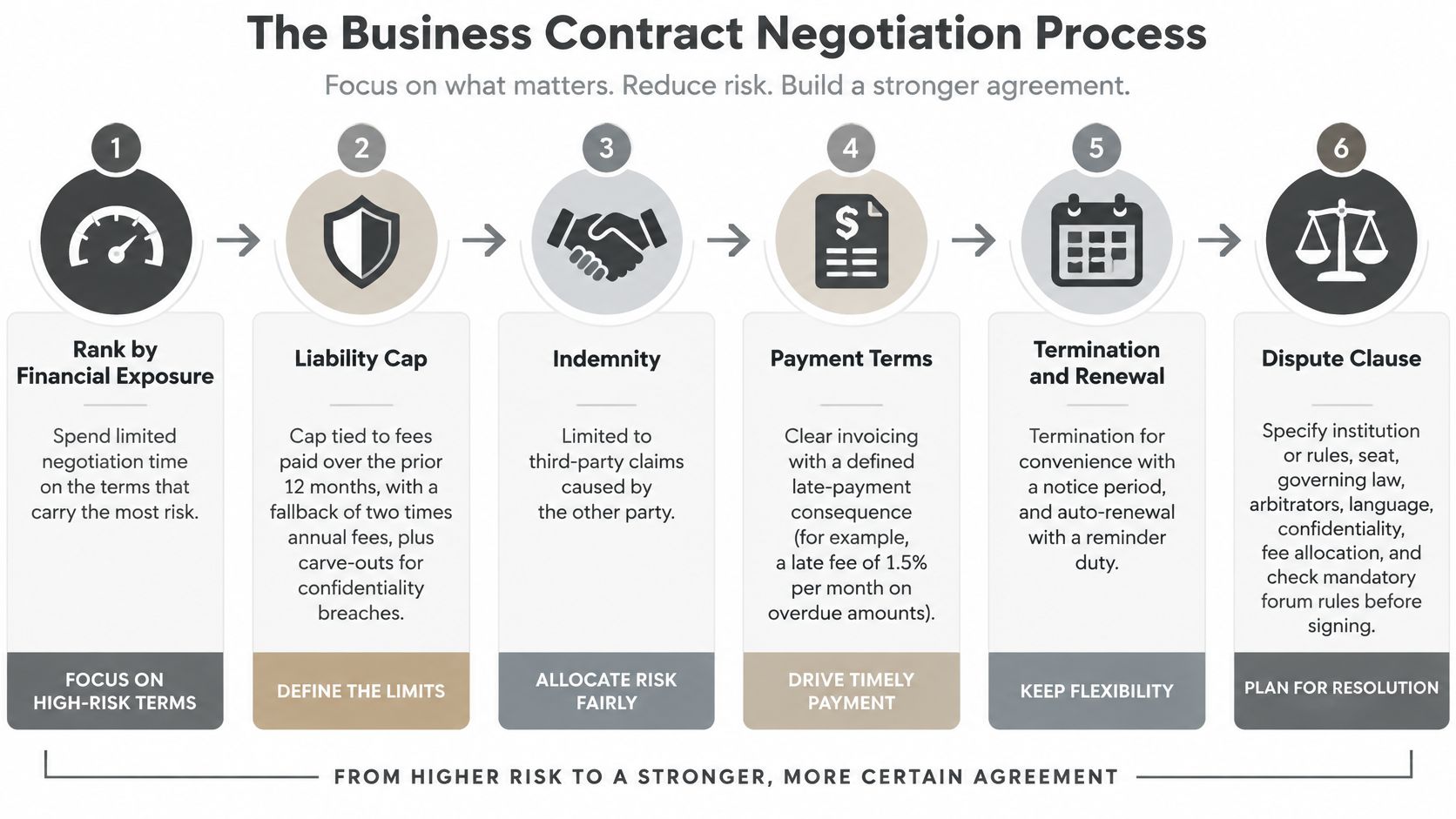
You won't win every term, so rank by financial exposure and focus effort where a bad outcome hurts most. Parties often burn goodwill on formatting, governing law they barely care about, or unlimited confidentiality, then concede an uncapped indemnity in the final hour. Reverse that order.
Start with the liability cap. A cap tied to fees paid over the prior 12 months gives both sides a number tied to the deal's real value. If the other side rejects that, a workable fallback is a cap equal to two times annual fees with carve-outs for confidentiality breaches, willful misconduct, or amounts covered by insurance. Don't accept silence, because silence often means uncapped exposure.
Next, narrow indemnity to third-party claims caused by the other party's acts, products, or breach, with prompt notice and control of defense spelled out. Then tighten payment terms with a defined late-payment consequence and a suspension right. Ask for termination for convenience on a stated notice period, and if auto-renewal stays, add a reminder duty before the cancellation window closes.
Engineer the Dispute Clause
"Disputes shall be arbitrated" is not a plan. The UNCITRAL Model Law on International Commercial Arbitration recognizes that an arbitration agreement may appear as a clause within the contract or as a separate agreement, and addresses tribunal composition, jurisdiction, court intervention, and recognition and enforcement of awards. Draft to that level of detail.
A usable clause specifies:
- Institution or rules: Who administers the case and how arbitrators are appointed
- Seat and governing law: Which courts supervise and which substantive law applies
- Arbitrators and language: How many, what qualifications, and in what language
- Process limits: Confidentiality, interim relief, discovery scope, and fee allocation
- Judicial review: How narrow the permitted court challenge will be
The seat matters because it drives procedural law and supervision, while the institution drives appointment, emergency relief, and scheduling. For advisors, broker-dealers, investors, or firms operating across states, reconcile the clause with mandatory forum and industry arbitration rules before signing. Our comparison of alternative dispute resolution versus litigation is a useful gut check when the other side presents arbitration as automatically cheaper.
Turning a Signed Contract into Collectible Revenue
Non-payment isn't a rare edge case. A 2025 Rocket Lawyer survey of small and midsize businesses found that 43% of small and midsize businesses experienced non-payment during the prior year, and 31% of respondents were responsible for enforcing contracts. Enforcement often falls to owners and managers, not a dedicated legal team, so the process has to be simple enough to run from the file.
A polished agreement still fails commercially if nobody tracks renewal dates, preserves delivery records, or sends a compliant default notice. Treat signature as the start of contract-to-cash, not the finish.

Run the Enforcement Steps in Order
- Pull the signed contract: Mark every notice, cure, payment, and deadline clause before you contact the other side, so your first letter doesn't create a waiver argument.
- Preserve proof: Collect emails, invoices, change orders, delivery logs, and acceptance records in chronological order while staff still remember where they are.
- Send a compliant default notice: Use the contract's exact method and address, state the breach and amount, and keep delivery proof.
- Let the cure period run: Document every response and partial payment, and don't accept new terms by casual email without deciding you're amending the deal.
- Calculate only what the contract allows: Add interest, fees, and collection costs the agreement authorizes, and show the math rather than rounding up in anger.
- Choose the forum deliberately: Weigh negotiated settlement, arbitration under your clause, or litigation against amount at stake, speed, confidentiality, and collectibility. Practical guidance on choosing the right commercial dispute forum highlights why filing mechanics matter before merits are heard.
- Plan collection early: Identify bank accounts, receivables, property, or ongoing business relationships before judgment, because winning and collecting are separate projects.
For overdue amounts, our guide on how to collect unpaid invoices walks through demand through enforcement in practical sequence. In financial advisory relationships, apply the same discipline to compensation statements, transition obligations, promissory-note offsets, and client-ownership records after termination. Those disputes are won on statements and timestamps.
Could a stranger verify your claim from the documents alone, without calling you for background? If not, your file isn't ready.
Decide When a Business Lawyer Should Review Your Agreement
Don't wait for a breach to ask whether review was worth it. Involve counsel before signing when any of these triggers appear:
- Loss exposure: The amount or downside exceeds what you're comfortable losing
- Cross-border facts: Parties, performance, or governing law cross state lines
- Regulated activity: Securities, financial services, healthcare, or another regulated industry is involved
- Asset transfer: Intellectual property, client relationships, or confidential data change hands
- Forum commitment: The agreement contains an arbitration clause or restrictive forum selection
- Debt or compensation: The deal uses a promissory note, deferred compensation, commissions, or production credits
After a breach, bring counsel in when the amount justifies the cost, when a default notice could affect termination rights, or when the other side has lawyered up and every email may become evidence. Early review is cheaper when it prevents a notice defect or an accidental amendment.
If you want to discuss your business law matter, contact Kons Law at (860) 920-5181, or email info@konslaw.com during business hours, Monday to Friday, 9:00 am to 5:00 pm ET. We draft and review contracts and advise on sales agreements, represent businesses throughout Connecticut, and handle contract disputes from negotiation to trial. You can also review whether a small business contract lawyer fits the size and stage of the matter before you call.
Don't send confidential or sensitive information until you've talked to an attorney and a written engagement letter establishing an attorney-client relationship is in place. Information sent through the website doesn't create that relationship.
If your next business contract agreement needs to do more than record good intentions, Kons Law can draft, review, and negotiate terms built around proof, payment, and enforceable remedies, and pursue disputes when performance fails. Visit Kons Law to discuss your agreement before you sign it, renew it, or try to collect on it.
