
Changing financial advisors doesn't create tax by itself. The taxable event is a sale, cash payout, or retirement distribution during the move, and an eligible retirement payout generally must be redeposited within 60 days to preserve tax-deferred treatment.
That's why the familiar assurance that a transfer is tax-free isn't enough. Your new advisor may accept the account but reject particular investments, or transfer everything intact and then sell appreciated holdings to fit a model portfolio. The tax implications of switching financial advisors must be evaluated holding by holding, with separate approval for the transfer and any trades that follow.
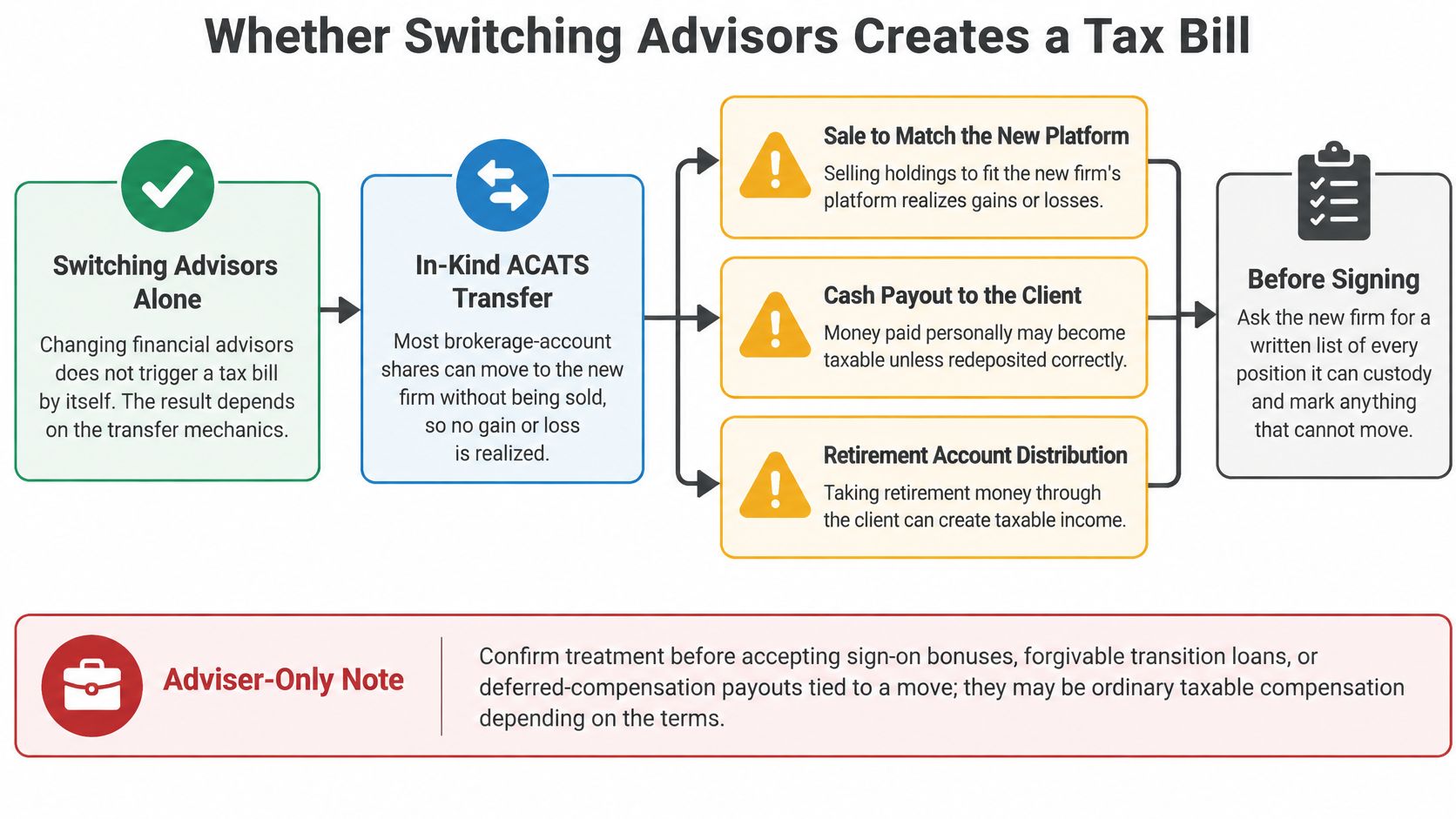
Whether Switching Advisors Creates a Tax Bill
A transfer isn't universally tax-free. It's generally tax-neutral when your securities move unsold, but that answer changes when either firm liquidates holdings or sends retirement money through you personally.
Transfer methods and their tax results
| Transfer Method | Taxable When Moved? | Main Tax Risk | What to Confirm |
|---|---|---|---|
| In-kind transfer through ACATS | No, shares move unsold | Holdings the new firm cannot custody may be sold | Written list of every position and whether it moves |
| Forced liquidation before transfer | Sales realize gains or losses in taxable accounts | Gains can land in the year of the advisor change | Expected proceeds and estimated gain per lot |
| Payout to the client personally | Retirement payouts can become taxable if not rolled over correctly | Retirement funds may become taxable income | Deposit deadline and eligible rollover path |
| IRA trustee-to-trustee transfer | No, not treated as a distribution | Incorrect payment instructions may result in a distribution | Funds paid directly to the new custodian |
For brokerage accounts, an in-kind transfer through the Automated Customer Account Transfer Service, or ACATS, moves securities without selling them. But the receiving firm must accept each position. FINRA's guidance on investment professionals changing firms specifically tells investors to identify non-transferable investments and consider liquidation taxes, transfer fees, and account-termination charges.
Separate Custody From Investment Changes
Ask for a written portability list before signing. Mark every holding as accepted unchanged, requiring liquidation, or requiring another custodian. Proprietary funds, certain annuities, and alternative investments deserve particular scrutiny.
Accepting custody doesn't mean the new advisor intends to retain the investment. Ask separately whether the proposed investment strategy requires sales after arrival, and require tax estimates before approving them. Understanding a financial planner's fiduciary duty also helps you question whose interests a rapid portfolio overhaul serves.
Practical rule: Authorizing an account transfer and approving a portfolio liquidation should be separate decisions.
Transfer incentives need their own review. Fee reimbursements and cash bonuses shouldn't automatically be described as tax-free because treatment can turn on account type, payment structure, and payer reporting, alongside the transfer concerns identified in the SEC's investor bulletin on switching firms.
For departing advisors, client-transfer taxes are separate from compensation taxes. Sign-on bonuses, forgivable transition loans, and deferred-compensation payouts can constitute ordinary taxable compensation under their terms. Have a tax professional review the package before accepting it, rather than assuming a loan label settles the tax treatment.
What Gets Sold and Taxed in a Brokerage Account
The basic calculation is sale proceeds minus adjusted cost basis. Reinvesting the proceeds with a new advisor doesn't erase the sale.
For a hypothetical example, suppose you bought 200 shares at $40 and sell them at $65. Ignoring transaction adjustments, proceeds of $13,000 minus basis of $8,000 produce a $5,000 gain. These are illustrative amounts, not a forecast of your tax bill.
The SEC's account-transfer bulletin warns that moving firms may require selling investments; holdings kept more than one year generally receive long-term rather than short-term capital-gain treatment. Long-term gains generally receive preferential federal treatment, while short-term gains generally face ordinary income rates.

Holding types and their likely tax result if sold
| Holding Type | Usually Moves In Kind? | Typical Tax Result if Sold | Check Before Transfer |
|---|---|---|---|
| Common stock and ETFs | Usually yes | Capital gain or loss, with holding period determining classification | Confirm support for each ticker |
| Mutual funds from the advisor's own fund family | Often restricted | Gain or loss on redemption; reinvested distributions affect basis | Ask whether shares transfer or must be redeemed |
| Annuities | Often require special handling | Taxable gain may receive ordinary income treatment | Confirm surrender charges, ownership, and tax-deferral status |
| Fractional shares and small lots | Whole shares may transfer; fractions may be cashed out | Small gains or losses that are easy to overlook | Identify automatic cash-outs |
| Limited partnerships and alternatives | Often restricted | Asset-specific gain and partnership reporting, potentially including Schedule K-1 | Request valuation and expected tax forms |
Reduce Unnecessary Sales Before Optimizing Taxes
Proprietary mutual funds and annuities are important portability trouble spots, but don't assume either must be sold. A compatible custodian or retained account may avoid an unnecessary disposition. Small whole-share lots also shouldn't be confused with fractional shares, which may receive different transfer treatment.
For partnership holdings, review the investment's structure rather than treating it like ordinary stock. This explanation of investing in an MLP provides useful context for that conversation.
Possible alternatives include staged liquidation across tax years, harvesting available losses, or contributing appreciated shares to charity instead of selling. Each requires analysis of basis, holding period, jurisdiction, account type, and investment risk. For planning context, Blue Sage Tax's capital gains guide from Blue Sage Tax & Accounting Inc. can help frame the questions for your tax professional.
Before authorizing a trade, ask:
- Custody: Which specific positions won't you hold?
- Execution: When would each sale occur and settle?
- Tax estimate: Can you provide estimated gain or loss by lot before placing the order?
Cost Basis Problems That Surface After the Move
A successful asset transfer can still leave you with defective tax records. Missing purchase history may not matter on transfer day, but it can distort the gain reported when you eventually sell.
The IRS's Publication 551 explains that basis determines gain or loss and generally starts with acquisition cost for purchased securities. Inherited and gifted property have special rules, so a blank basis field shouldn't be replaced with a guess.

Reconcile Before the First Sale
Download the old records. Save statements, trade confirmations, and historical tax forms before account access changes. Preserve lot-level purchase dates and prices, not just the final account balance.
Flag complicated lots. Inherited shares generally use a date-of-death fair market value framework, subject to applicable exceptions; gifted shares generally carry donor basis for gain calculations, with special loss rules. Employee stock, reinvested dividends, and mutual-fund average-basis positions also need supporting documentation.
Compare old and new records. Match quantities, acquisition dates, adjusted basis, and holding periods lot by lot. A matching account value doesn't prove the tax records arrived correctly.
Correct discrepancies in writing. Send evidence through the custodian's correction process and retain confirmation. Don't let an advisor sell a disputed lot merely because the position appears ready to trade.
Retain the supporting file. Keep legacy documentation through disposition and the applicable tax-record retention period. Don't discard it just because the receiving firm displays a basis figure.
Reconcile tax reporting. Compare year-end broker forms with your transaction records and the return your preparer files. Document any adjustments rather than assuming the broker's figure controls.
Records and forms that prove basis and gain
| Form or Record | Who Issues It | What It Shows | What to Check After a Move |
|---|---|---|---|
| Form 1099-B | Your broker | Sale proceeds and applicable basis and holding-period information | Basis matches supporting records |
| Legacy statements and trade confirmations | Prior firm | Purchase dates, prices, and transactions | Preserve records supporting every remaining lot |
| Form 8949 | You or your preparer | Reported sales and applicable adjustments | Basis and adjustment codes are correct |
| Schedule D | You or your preparer | Summarized capital gains and losses | Totals reconcile with supporting reporting |
| Form 1099-R | Plan or IRA custodian | Retirement distributions and distribution codes | Reporting matches the transaction; direct IRA transfers generally aren't reported as distributions |
You remain responsible for the correct return. Covered securities generally have broker-reported basis, but older or noncovered positions may lack complete history. FINRA's guidance on account and cost-basis transfers also explains why moving assets through ACATS doesn't itself guarantee that basis information travels with them.
Retirement Accounts and the Rollover Trap
For an IRA move, the cleanest route is usually a direct trustee-to-trustee transfer between compatible accounts. The IRS's IRA FAQs explain that this isn't a distribution to you or a rollover, and it doesn't count toward the one-rollover-per-year limitation.
A personal payout creates additional work and risk. You must establish that the distribution is eligible for rollover, meet the deadline, and account for withholding. A transfer also shouldn't accidentally change the intended tax character, such as moving pretax money into a Roth account without evaluating conversion consequences.

Direct transfer versus payout to you
| Feature | Direct trustee-to-trustee | Paid to you personally |
|---|---|---|
| Treated as a distribution? | No | Yes, though an eligible completed rollover can preserve tax deferral |
| Counts toward the IRA rollover frequency limit? | No | Generally yes for an indirect IRA-to-IRA rollover |
| Federal withholding | Avoided | IRA withholding rules apply; eligible employer-plan payouts have mandatory withholding |
| Redeposit deadline | None needed | A deadline applies to an eligible rollover |
| Early-distribution additional tax | Not triggered by the transfer | May apply to taxable amounts unless an exception applies |
Execute the Instructions, Not Just the Intent
Open the receiving IRA first and confirm the registration. Then obtain payment instructions naming the receiving custodian for your benefit, rather than directing payment to you personally. Keep copies of the transfer request and acceptance.
Under the IRS's retirement rollover guidance, eligible distributions generally must be rolled over within 60 days; eligible employer-plan distributions paid to you generally face 20% federal withholding, and taxable early distributions before age 59½ may incur a 10% additional tax unless an exception applies. To roll over the full eligible employer-plan distribution, you must replace the withheld portion using other funds.
Indirect IRA-to-IRA rollovers are generally limited to one within a 12-month period, unlike direct IRA transfers. Don't assume opening another IRA resets that restriction, and don't confuse an employer-plan direct rollover with an IRA trustee-to-trustee transfer.
A check isn't automatically a personal payout. The payee and transaction instructions matter more than who physically receives the envelope.
For a second explanation of the terminology before reviewing custodial paperwork, consult the Allied Tax Advisors IRA rollover guide. Then ask the receiving custodian to confirm your specific transaction classification in writing.
Don't rely on a possible waiver to fix a missed deadline. If funds have already been paid incorrectly, contact the custodian and your tax professional immediately, before spending the money or assuming a later deposit will solve the problem.
Timing the Move Around Year-End and Wash Sales
The transfer date and the sale date aren't interchangeable. A move can span several business days, while pending trades, dividends, and residual cash continue through separate processing steps.
Ask both firms for the expected transfer date, trading freeze, and treatment of unsettled transactions. A trade entered before the freeze may finish at the old firm, and a dividend may initially arrive there even after the main positions move. Save statements from both firms rather than assuming the receiving account contains the complete year-end record.
Coordinate the Tax Calendar
A December loss sale may be useful against gains in that tax year, while a forced December gain may increase that year's taxable income. Moving the account in January doesn't undo a sale already completed in December.
The IRS's Form 1099-B instructions address wash-sale reporting: buying the same or substantially identical securities within 30 days before or after a loss sale can disallow the current deduction. With replacement shares in a taxable account, the disallowed loss generally adjusts replacement-share basis; an IRA replacement purchase can instead make the loss effectively permanent.
Consider a hypothetical timeline:
- March 3: A client sells 500 fund shares in a taxable account at a $4,000 loss.
- March 20: The new advisor buys the same fund in the client's IRA.
- Result: The purchase falls inside the wash-sale window. The loss is disallowed, and the IRA purchase doesn't provide a replacement-basis adjustment that recovers it.
Those dates and amounts illustrate the rule, not an actual client transaction.
Give the incoming advisor a household trading history, not merely the account being transferred.
Include relevant spouse accounts, IRAs, automatic reinvestments, and recurring purchases in the review. Your new firm may not see transactions elsewhere, even when they affect your deduction.
Illiquid investments require additional calendar planning. If a proposed transition involves real-estate alternatives, understand the structure, including what a DST is, before accepting a year-end completion promise. Custody acceptance, redemption availability, and tax suitability are separate questions.
Worked Examples from Four Client Moves
These hypothetical moves isolate the effect of the transfer path. Actual rates and results depend on the client's bracket, state, other transactions, and account characteristics. The assumed tax rate below is illustrative, not a statement that every investor qualifies for it.
An Appreciated Position Must Be Sold
A client holds a taxable position worth $120,000, with $70,000 basis, purchased three years earlier. The receiving platform won't hold it, and the client approves liquidation without choosing another custodian.
The sale creates a $50,000 long-term gain. At an assumed 15% federal rate, the illustrative federal tax is $7,500, before state tax and any other applicable taxes. The client wanted a different advisor, but the sale, not that preference, produces the gain.
The Same Position Moves Intact
Another client has the same hypothetical holding and chooses a firm that accepts it unchanged. The advisor also agrees not to sell it automatically when implementing the new investment strategy.
The transfer itself produces no current capital-gains tax. The embedded $50,000 gain remains unrealized, with its existing basis history, unless a later transaction changes the result. That's deferral, not a permanent exemption.
An IRA Moves Directly
A client moves a hypothetical $300,000 IRA to another compatible IRA through a direct trustee-to-trustee transfer. The sending custodian pays the receiving custodian under the approved instructions.
The transfer produces no current tax, no withholding, and no indirect rollover to count. The account's investment allocation can still change, but the custody move hasn't routed retirement money through the client.
An Employer Plan Pays the Client
A different client requests a hypothetical $300,000 401(k) distribution payable personally. Applying the employer-plan withholding rule, the plan withholds $60,000, leaving a $240,000 payment.
If the client timely rolls over only that payment, the $60,000 withheld remains outside the rollover and is generally taxable income. If an early-distribution additional tax applies, the illustrative additional tax on that amount is $6,000, unless an exception applies. The withheld money is credited toward taxes; it isn't automatically lost, but it also doesn't count as rolled over.
| Choice in These Examples | Immediate Consequence |
|---|---|
| Sell appreciated taxable holdings | Recognize the gain |
| Transfer those holdings unsold | Preserve unrealized gain and basis history |
| Move compatible IRA assets directly | Avoid a personal distribution |
| Roll over only the net employer-plan payment | Leave the withheld portion outside the rollover |
The lesson is procedural: an account's value doesn't determine whether a move creates tax. The payment instructions, trading decisions, and completed paperwork do.
Confirm the Transfer Plan Before You Sign
A transfer is not tax-free merely because the account moves intact. The tax result depends on what happens to each holding and on the instructions used for each transaction. Before you sign, require a written plan that identifies the assets, any expected sales, and who will resolve discrepancies.
Use these questions to ask a broker to get specific written answers. If the plan depends on input from operations, the custodian, or your accountant, obtain that input before authorizing the move. A general assurance about the account does not establish how individual positions will be handled.
Stop When the Answers Aren't Specific
Pause if an advisor says every move is tax-free, pressures you to sign before year-end, refuses a written portability review, or recommends selling everything without a lot-level estimate. An investment reason for selling may be sound, but you still need to understand the expected tax cost before approving the trade.
Keep the difference between an unfavorable tax outcome and potential misconduct clear. Retain recommendations, disclosures, authorizations, and the version of the transition plan you approved. Those records can help show what was proposed and who authorized it if a dispute later develops.
Close Each Gate Before Proceeding
Before paperwork, obtain the portability list. Mark each position as moving in kind, scheduled for sale, or unacceptable to the receiving firm. For rejected assets, specify whether they will remain with the current custodian or be sold.
Before any sale, approve the lot-level estimate. Request expected proceeds, adjusted basis, estimated gain or loss, and the intended tax year. If the proposed transaction changes materially, ask for an updated estimate and approve it before trading.
Before the transfer date, coordinate operations. Confirm the freeze window, pending settlements, dividend handling, and household wash-sale review. Name a contact at each firm to address residual assets and exceptions.
Before post-transfer trading, validate basis. Compare the receiving firm's records with your retained evidence. Resolve discrepancies in writing before relying on the displayed basis to make a sale decision. A completed asset transfer does not complete tax-record reconciliation.
Before retirement funds leave, verify the payee. Confirm that the receiving custodian, rather than you personally, is the intended recipient. Have the custodian identify the transaction as a direct transfer or direct rollover, as appropriate.
For a legal issue involving a financial advisor or a disputed transition, Kons Law represents investors and financial advisors in securities industry disputes. Sending information through the firm's website does not create an attorney-client relationship, and information sent before one is established is not privileged. Do not send confidential financial records until you have spoken with an attorney and a written agreement letter establishing that relationship is in place.
To request a confidential consultation, contact Kons Law at info@konslaw.com or fill out the form on the firm's contact page.
