
Nearly 50% of currently registered persons reported one or more outside businesses in the Form U4 information discussed in FINRA's Regulatory Notice 25-05. Those disclosures covered almost 98% of FINRA members. Outside commercial interests aren't unusual. The compliance problem is assuming that an activity disclosed once can keep changing without another conversation with compliance.
For an outside business activity, FINRA compliance starts with written notice before you act. It continues when your title, compensation, ownership, customers, or public description changes. Prior approval covers the activity you described, not every business you later build around it.
What Counts as an Outside Business Activity
A side business can trigger FINRA notice duties before it earns a dollar. Under FINRA Rule 3270, a registered person must give the firm prior written notice before acting as an employee, independent contractor, sole proprietor, officer, director, or partner of another person. The rule took effect on December 15, 2010, and required firms to review pre-existing activities by June 15, 2011.

Expected compensation counts. Fees, profit distributions, equity compensation, and finder payments should be considered before you accept an arrangement, not after the first payment arrives. An unpaid officer or director role can also require notice because the role itself matters.
Classify the activity before accepting it
Focus on your duties, not the label on the entity documents. A family business, consulting practice, teaching position, or restaurant partnership may involve outside business duties even if it has little connection to your financial-services work.
Rule 3270 excludes passive investments and activities governed by Rule 3280. The practical distinction is whether you merely hold an investment or take part in managing the business. Negotiating contracts, supervising employees, recruiting customers, or directing operations are signs of active involvement.
What Rule 3270 covers and what it leaves out
| Activity | Notice before you act | What the firm must do | Controlling rule |
|---|---|---|---|
| Employee, contractor, or sole proprietor of another business | Yes | Assess interference with firm or customer duties and possible customer confusion | Rule 3270 |
| Officer, director, or partner of another person | Yes, whether compensation is immediate, deferred, or absent | Assess the role and its potential effects | Rule 3270 |
| Compensation received or reasonably expected from a non-firm business | Yes; do not wait for the first payment | Review the proposed activity after written notice | Rule 3270 |
| Passive investment with no management role | Generally no, solely for holding the investment | No Rule 3270 review is triggered by a truly passive holding | Rule 3270 exclusion |
| Private securities transaction away from the firm | Yes, under a separate rule | Review the prior notice; if compensated and approved, the firm must record and supervise the transaction | Rule 3280 |
Why your firm needs the details
Compliance must assess whether an outside activity could interfere with your work for the firm or its customers, or cause customers to mistake the outside business for part of the brokerage. The public-facing details matter: a business biography listing your brokerage affiliation, a shared email signature, or meetings with brokerage customers can blur that line.
Customer confusion can affect investor decisions. Read more about how outside activities can affect investors.
Practical rule: Identify your duties, expected compensation, and customer connections before deciding a venture is too small to disclose.
Weekend hours or a separate limited liability company do not, by themselves, remove an activity from Rule 3270. Classify the role before accepting it, signing a compensation agreement, or beginning customer-facing work.
How Firms Review a Written OBA Notice
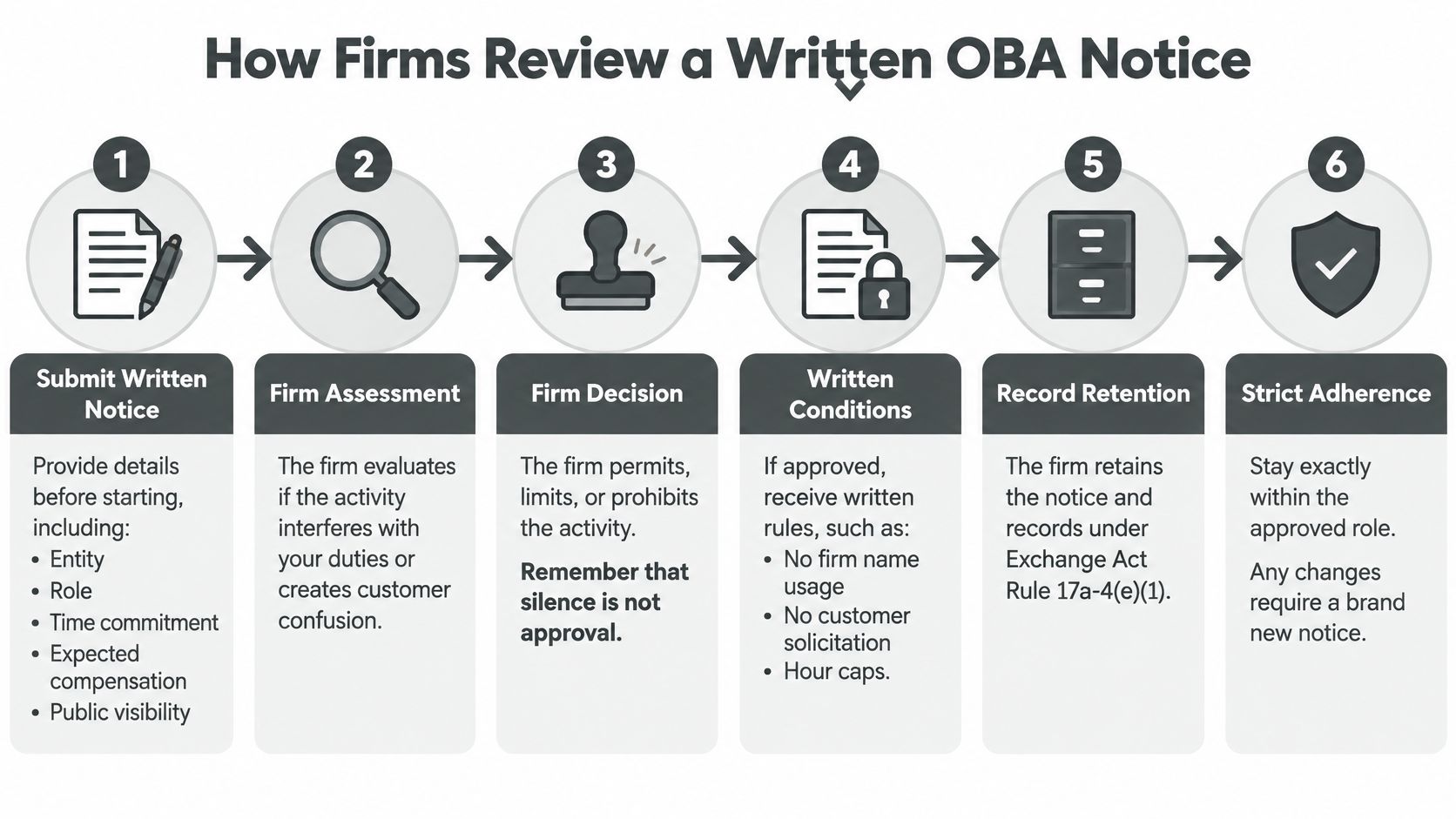
A written notice gives compliance the facts needed to assess an outside activity and set clear limits. Submit it through the firm's designated disclosure system, and keep the submission separate from the firm's decision.
Follow the firm's review process
Submit written notice before starting. Identify the person or entity, the business purpose, your proposed duties, time commitment, and any compensation received or expected. Disclose ownership interests and explain whether customers or the public will see your brokerage affiliation.
Give compliance facts it can assess. Describe customer overlap, scheduling demands, marketing channels, and any use of firm resources. Specify when you will perform the outside duties and who its customers will be.
Obtain a clear decision. The firm may permit, limit, or prohibit the activity. A manager's casual encouragement does not replace the formal review, and silence is not approval.
Get conditions in writing. Restrictions may cover use of the firm's name, solicitation of firm customers, or time spent on the venture. Resolve unclear conditions before signing a contract that could make compliance difficult.
Preserve the review record. Firms must keep notice records for regulatory review, so ask compliance how long your copy and the firm's records will be retained. Keep your authorized copies of the submission, its transmission date, supporting materials, and written response. Do not remove confidential firm or customer information.
Stay within the approved boundaries. Permission for a limited consulting role does not automatically cover recruiting customers, changing compensation, or taking on management duties. Submit proposed changes for review before putting them into effect.
Make the written answer usable
Follow the firm's written supervisory procedures to determine where to send the notice, who reviews it, and how the decision is documented. A branch manager's awareness does not replace the required process.
A useful approval record names the permitted activity and its limits. If the firm approves consulting but does not say whether referrals are included, ask compliance to clarify before acting.
Keep the version the firm received, along with proof of when it was sent. A saved draft does not show what the firm reviewed.
If compliance asks for more information, answer directly and keep the response with the original notice. Wait for a clear decision before starting. An unanswered question may determine whether the firm permits the activity.
Outside Business Activity Compared with Selling Away
A paid teaching position or an operating role in a non-securities restaurant business generally points toward ordinary outside-business review. Helping that restaurant raise money through a private securities offering presents a different issue. The business name may stay the same while your regulatory obligations change.

FINRA's oversight guidance on OBAs and private securities transactions treats the categories as related but distinct: disclosing a compensated securities transaction as an outside business doesn't satisfy the separate requirements governing participation in that transaction. Don't assume the compliance department will infer a securities offering from a generic business description.
Compare the duties, not the business labels
Outside business activity versus a private securities transaction
| Question | Outside business activity | Private securities transaction |
|---|---|---|
| Who is covered | Registered person | Associated person |
| What triggers the duty | A listed role, or pay received or reasonably expected, outside the firm | Participation in a securities transaction away from the firm |
| What notice must say | Written notice to the member before acting | Written notice before participating, with the transaction and the person's role described in detail |
| What the firm may do | Assess interference and customer impression; permit, limit, or prohibit | Prohibit, limit, or permit |
| If a compensated activity is approved | Proceed only within the firm's written conditions | Record it on the firm's books and supervise it as a firm transaction |
| Common mistake | Treating a securities deal as an ordinary side business | Treating disclosure alone as permission to sell away |
The SEC document describing Rule 3280's requirements explains that prior written notice must describe the proposed transaction in detail and your proposed role; when a compensated transaction is approved, the firm must record and supervise it as though executed through the firm. That is a materially different obligation from reviewing outside employment.
Recognize when the venture changes categories
Say you initially disclose responsibility for a restaurant's staffing and purchasing. Later, an owner asks you to introduce potential investors and offers compensation if they invest. Your original notice doesn't resolve the new transaction.
Capital raising, promissory notes, and finder arrangements require careful securities analysis. Not every business loan or introduction is automatically a securities transaction, but you shouldn't make that classification from the document's title alone.
An uncompensated private securities transaction still requires prior notice, and lack of compensation doesn't eliminate the firm's ability to prohibit participation. Consult the firm's procedures before making introductions or circulating offering materials.
For a fuller explanation of the conduct involved, review what selling away means. If a security is involved, use the private-securities-transaction review path even when the underlying venture already has OBA approval.
Form U4 and Form U5 Consequences for Advisors
Form U4 disclosure and an OBA notice perform different jobs. The outside-business question on the registration form doesn't align perfectly with the activity rule. Answering the form doesn't replace submitting notice to the member firm, and an ambiguity in the form isn't a reason to leave compliance uninformed.
Treat your registration disclosure, internal notice, and approval record as documents that must describe a consistent set of facts. If each tells a different story about your position, the resulting problem isn't solved by showing that one document was accurate.
Build a consistent registration record
Prepare the information compliance needs to complete or update the outside-business response accurately. Use the entity's correct name rather than a trading nickname, and distinguish ownership from operational responsibility.
- Business identity and nature. State what the entity does and whether the activity is investment-related.
- Position and duties. Identify your title and actual work, including management, solicitation, or referral responsibilities.
- Dates and status. Distinguish formation, ownership, and the start of active work when those events differ.
- Compensation and commitment. Explain the arrangement consistently with the internal notice, including expected pay and time devoted to the activity.
Work with compliance on an amendment when relevant facts change. Don't wait for an annual questionnaire to reveal that your disclosure no longer describes your role.
A concise description can still be complete. The objective isn't to attach every business document to a registration filing, but to avoid a vague answer that conceals the activity's nature.
Treat departure disclosures as a separate risk
Form U5 is the firm's termination disclosure. An explanation involving an undisclosed, expanded, or prohibited outside activity can affect how a prospective employer evaluates your departure. Don't assume a disagreement becomes irrelevant once you've left the firm.
Departure check: Separate the underlying business facts from the firm's characterization of your conduct. Preserve evidence of both.
An overstated termination explanation can raise employment or defamation issues; missing or inaccurate information can create a different disclosure problem. Review the actual language rather than relying on a supervisor's description of what the firm intends to file.
Kons Law's explanation of Form U5 and FINRA termination disclosures outlines why the wording matters. Before responding to a disputed account, assemble the notices, decisions, and contemporaneous communications that establish what the firm knew. Avoid sending an emotional narrative that mixes verifiable facts with assumptions about motive.
Changes That Require a Fresh Disclosure
An old approval isn't permanent permission for a changing business. The relevant question is whether today's activity still matches the facts the firm reviewed. A different title, payment arrangement, customer base, or public description can require a fresh submission under the firm's procedures.
FINRA's 2025 Annual Regulatory Oversight Report recommends onboarding and periodic diligence involving social media, professional-networking sites, public websites, legal databases, and court records, together with questionnaires and recurring attestations addressing ownership, employment, fundraising, finder activity, and non-firm payments.

Submit changes before implementing them
Use these events as prompts to contact compliance, not as reasons to wait until the next certification:
- You become active. A passive ownership interest turns into management, or a dormant limited liability company begins accepting customers.
- Your authority changes. You become an officer, director, managing member, or partner, or begin performing duties beyond your disclosed position.
- Your compensation changes. You add fees, increase compensation, receive equity for services, or accept a finder or referral arrangement.
- The entity changes. A new business entity, ownership transfer, or reorganization changes who controls or pays for your work.
- Your audience changes. You begin approaching brokerage customers or promoting the venture through professional contacts.
- Your online description changes. A personal website, LinkedIn biography, or podcast presents a broader role or suggests brokerage involvement.
A public biography can contradict a carefully worded internal disclosure. If you tell compliance that you provide limited administrative assistance but advertise yourself as the venture's investment strategist, expect questions about the difference.
Review conflicts-of-interest disclosure with the actual relationship in mind. A disclaimer won't necessarily resolve customer overlap, referral incentives, or use of the brokerage's reputation.
Keep evidence of the change and the response
Maintain an authorized proof file containing the dated notice, the firm's reply, recurring attestations, and dated copies of corrected public biographies. Preserve the earlier version too, where permitted, so the sequence is understandable. Deleting a misleading description doesn't establish when it appeared or what you did to correct it.
Failure to notify the firm or obtain required approval can lead to heightened supervision, fines, or termination. If you've already expanded an activity, stop the unapproved expansion and obtain advice about an accurate corrective disclosure rather than backdating a notice.
A departing advisor shouldn't assume approval travels to the next firm. Reconcile the public footprint with the documented departure facts, then make the new firm's submission on its own terms. If asked tomorrow, could you show what you disclosed and when the activity changed?
Stay Compliant Before You Act
Run an outside-activity audit before signing a new agreement, accepting a position, or changing how a venture pays you. The purpose isn't to collect more paperwork. It's to find commitments that your existing disclosures don't cover while you can still change them.
Audit the whole arrangement
- Inventory roles, entities, and payments. Include unpaid officer or director seats, ownership interests, expected compensation, and ventures you consider dormant. Record actual duties alongside formal titles.
- Separate ownership from participation. Mark passive holdings distinctly and flag possible securities transactions for the appropriate review. Don't hide active work inside an investment category.
- Verify the decision record. Match each active venture to its submitted notice and the firm's written response. An approval email for a different role isn't sufficient evidence for the current arrangement.
- Reconcile registration information. Compare the business description used for registration with the internal documents. Ask compliance to address discrepancies while the facts are clear.
- Schedule public-profile checks. Revisit LinkedIn, personal websites, podcast descriptions, and recurring attestations. Keep dated records of material corrections.
- Escalate formal inquiries. If you receive a regulatory inquiry, a Rule 8210 request, or a disputed termination explanation, preserve the relevant records and promptly involve counsel.
Know when to stop drafting alone
Don't guess at a regulatory response or send a detailed account before obtaining legal advice. Counsel can help separate the requested facts from speculation, identify missing records, and coordinate a response with applicable deadlines. Seeking counsel doesn't suspend a response deadline.
Preserve relevant messages, agreements, compensation records, and disclosure submissions. Don't delete unfavorable material, rewrite historical records, or move confidential customer files to a personal account. A defensible response depends on an accurate chronology, not a cleaner-looking archive.
You can schedule a confidential consultation by calling the firm or using its online form. Don't send activity details or sensitive documents before speaking with an attorney and receiving a written agreement establishing the attorney-client relationship. Information sent beforehand isn't privileged.
The strongest position is straightforward: know what you're doing, describe it accurately, obtain the required review, and retain evidence. When the business changes, treat compliance as part of the decision rather than a task to finish afterward.
Kons Law defends financial advisors facing regulatory inquiries, investigations, and disciplinary actions, and handles securities industry employment disputes and Form U5 defamation matters. If you want to discuss your business law matter, contact Kons Law at (860) 920-5181, or visit Kons Law to arrange a consultation about an outside-activity disclosure or related dispute.
