
You're sitting in your third board meeting since your appointment. Management has just walked through a polished deck, everyone nodded, and the chair is about to call a vote on a major contract. You haven't seen the downside numbers, you're not sure who checked pricing, and the minutes from last month said "approved." If a shareholder, regulator, or plaintiff's lawyer asked a year from now why you voted yes, what record would you point to?
That's the practical question behind corporate governance duties. They aren't abstract labels. They're standards your decisions will be judged against later, usually by looking at what you asked, what you reviewed, and what got written down.
Core Duties Directors Owe at a Glance
Think of board duties like a preflight checklist that's also used after the flight to judge how it was flown. The board answers to the company and its shareholders, and each director's conduct gets measured against these standards, not against good intentions alone.

The G20/OECD Principles of Corporate Governance 2023 set the global benchmark. The board should provide strategic guidance, monitor management, prevent conflicts of interest, evaluate managerial performance, oversee financial operations, and ensure systems are in place for risk management and legal compliance. Directors must also exercise objective and independent judgment rather than defer to management.
Five Duties, Five Records
| Duty | What It Requires | Where It Appears |
|---|---|---|
| Duty of care | Act on a fully informed basis, in good faith, with due diligence | Board packs, questions asked and minutes |
| Duty of loyalty | Put the company and shareholders first and manage conflicts | Conflict certifications, recusals and approvals |
| Duty of oversight | Maintain reporting and monitoring systems for legal and financial risk | Risk dashboards, escalation logs and committee reports |
| Duty of independent judgment | Make the decision personally; advice does not replace it | Minutes showing questions and the reasons for the vote |
| Duty to promote success | Weigh long-term effects, employees, suppliers, community and reputation | Minutes recording the factors considered |
The table matters because a duty you can't evidence is hard to defend. Care shows up in the materials you requested before voting. Loyalty shows up when a conflicted director leaves the room and the minutes say so. Oversight shows up in dashboards that reach the board on a schedule, not only after a problem erupts.
Independent judgment is the duty new directors most often underestimate. You can rely on officers and advisers, but you can't rent out your vote to the CEO, a controlling shareholder, or a confident presenter. The record should show your questions, not just management's answers.
A Quick Self-Test
Apply these five questions to a decision you made last month:
- Did I know enough: Could I explain the main risks and the downside case without the deck?
- Did I put the company first: Was any personal or related interest disclosed before discussion started?
- Did I monitor the risk: Is there a reporting line that would surface trouble between meetings?
- Did I decide myself: Did I form my own view, even if I relied on advice to get there?
- Did I weigh long-term effects: Did we consider employees, suppliers, reputation, and fairness, not just this quarter?
If you can't answer one of those questions from the board record, that's the gap to fix before the next vote.
How the Duty of Care Works in Practice
The G20/OECD Principles of Corporate Governance 2023 identify the board's central responsibilities as setting corporate strategy, monitoring managerial performance, overseeing financial operations, and preventing conflicts of interest. They state directors should act on a fully informed basis, in good faith, with due diligence and care, and in the best interests of the company and its shareholders.
That standard sounds lofty until you turn it into a routine. Here's a sequence that works for most significant decisions.
Seven Steps Before You Vote
- Define the decision: Name what's being approved, the deadline, and the options, including doing nothing. A vague motion produces a vague record.
- Request the missing information: Ask for the financial model, risk assessment, legal view, and downside case. If a summary omits key numbers, say so on the record and ask for them.
- Question the assumptions: Push on growth rates, customer concentration, regulatory exposure, and what breaks first if conditions worsen. Tough questions aren't disloyal. They're the job.
- Use outside experts when needed: Bring in advisers when a question exceeds the board's knowledge, and minute why you relied on them and what they were asked. An expert report nobody discussed helps no one.
- Deliberate as a full board: Make sure dissent gets heard, not managed away in side conversations. Note material disagreement and how it was resolved.
- Minute the reasoning: Record what was reviewed, what was asked, how conflicts were handled, and why the board chose this course. "Approved unanimously" tells a future reader almost nothing.
- Revisit when facts change: Set a date or trigger to return to the decision if results, markets, or risks move materially.
Time is the hidden constraint here. A director serving on too many boards can't do steps two through five well, which is why tools for capacity planning for portfolio board careers can help you test whether you have the hours a seat demands before you accept another one.
Where Boards Slip
The common failures are mundane. Directors approve on a one-page summary for a multimillion-dollar commitment. Minutes record outcomes with no reasoning. A valuation arrives the night before and nobody asks who instructed the valuer. None of these look dramatic at the time, and all of them look careless later.
The business judgment rule generally protects a director whose decision was informed, made in good faith, and free of undisclosed conflict. It doesn't protect a guess. Your minutes are the evidence that the protection was earned.
The regulator test: Could you explain this decision a year later using only the minutes? If not, the minutes aren't finished.
Loyalty, Conflicts and Related-Party Deals
A referee can't hold shares in either team. The duty of loyalty works the same way. When you have an interest in a deal before the board, you don't get to call the play, and the board needs a process that works without you in the room.

The G20/OECD Principles on related-party transactions recommend requiring directors and key executives to disclose any direct, indirect, or third-party material interest in a transaction affecting the corporation. They also call for timely disclosure of the relationship, transaction value, number of transactions, material terms, and whether the deal occurred at arm's length.
Controls That Catch Conflicts Early
- Annual conflict certifications: Every director and key executive confirms interests in writing, every year, even when the answer is none.
- Transaction-specific disclosure: A new interest gets declared when a deal appears, not at year end.
- Preapproval thresholds: Deals above a set value go to the board or a committee before anyone signs.
- Recusal protocols: The conflicted director leaves for discussion and vote, and the minutes record the departure and return.
- Independent pricing evidence: Use market comparisons, an independent valuation, or a fairness analysis where the amount or sensitivity justifies it.
A Worked Example
Say a director's family company supplies parts to your company, and a buyer notices prices running above two competing quotes. The chair refers the contract to the audit committee. The director files a written disclosure, leaves the room, and doesn't receive the pricing pack. Independent directors review the quotes, question whether service levels justify any premium, and approve a shorter renewal at renegotiated prices. The minutes record the disclosure, the abstention, the evidence reviewed, and the reasoning.
That record does two jobs. It improves the deal, and it shows shareholders the decision was made by disinterested directors. Without it, an unhappy shareholder may explore remedies such as a derivative lawsuit brought on the company's behalf, where the board's own paperwork becomes central evidence.
The sign your control works is simple. The conflict surfaced before the vote, not after someone complained.
Oversight Duty and Caremark Red Flags
You sit on the board of a food manufacturer. Plant safety reports have flagged repeated contamination warnings for months. Management says nothing. The board gets one annual compliance summary saying systems are in place, and no director asks for incident data. Then a recall hits. After a recall, the claim that follows will center on whether the board was watching the one risk that could sink the company.

That is the ground Delaware's Caremark doctrine covers. As explained in Delaware Supreme Court oral-argument materials on board oversight, directors have a continuing duty to monitor operational viability, legal compliance, and financial performance, not merely to approve strategy. Handing compliance to management does not by itself satisfy that duty. The board still needs a path for bad news to reach it and a record showing what it did with the news.
Two Ways Oversight Fails
A Caremark claim usually follows one of two theories:
- No system at all: The board built no reporting or monitoring structure, so material information had no reliable route upward.
- A system the board did not use: A structure existed, red flags appeared, and the board did not monitor, question, or respond.
Courts applying Caremark have emphasized mission-critical risks. A reasonably designed system must address the risks central to the business. Food safety for a food maker, lending controls for a bank, and data security for a company holding sensitive customer data are not generic agenda items. They are the risks the board must be able to prove it tracked. A dashboard works like a smoke alarm: it has to be wired to the right rooms and tested often enough that nobody sleeps through the alarm.
What a Defensible System Looks Like
- Name the mission-critical risks: Identify them for your business and industry, not as a generic risk category.
- Assign a reporting owner: One named officer reports on each risk, and a committee oversees that report.
- Set escalation thresholds: Define the severity, frequency, or financial impact that triggers immediate notice to the board.
- Receive regular dashboard information: Short, consistent metrics beat occasional thick reports that cannot be compared over time.
- Document deliberation and remediation: Minute the questions asked, the action ordered, the owner, and the follow-up date.
Then test the record against a red-flag checklist. Are warnings reaching the board between scheduled meetings? Do dashboards show trends and exceptions, or only reassuring averages? When an adverse event repeats, do the minutes show escalation? Can you point to a remedial step and evidence it happened? For each mission-critical risk, the board record should answer three questions: what did we ask, what did we minute, and who owns the next step.
A hard truth: Sporadic reports, ignored warnings, and fuzzy committee responsibility are what plaintiffs describe as bad faith inaction.
Oversight does not require directors to run operations. It requires a system that reliably brings bad news to the board, plus evidence the board acted on it.
How Statutes Turn Duties into Checklists
"Bake well" tells a cook almost nothing. A recipe card with temperature, timing, and ingredients shows what good looks like. Statutes sometimes do the same for directors, and the United Kingdom offers the clearest example.
Section 172 of the Companies Act 2006 general duties requires a director to act in the way the director considers, in good faith, most likely to promote the company's success for the benefit of its members as a whole. In doing so, the director must consider six listed factors: long-term consequences, employees' interests, relationships with suppliers and customers, community and environmental impacts, reputation for high standards of business conduct, and fairness among members.
Section 173 in the Companies Act 2006 chapter on general duties adds a duty of independent judgment, with two limits: acting under a valid company agreement restricting future discretion, or as authorized by the company's constitution. Government guidance explains directors may seek advice but must make the final decision themselves, with the expected standard rising according to qualifications and experience.
The Plant Closure Test
Say management proposes closing a plant. A checklist-driven board works through each factor on the record. Directors review long-term savings against one-time costs, employee impact and consultation duties, supplier contracts and customer supply risk, effects on the local community and site remediation, reputational fallout, and whether any shareholder group bears an unfair burden. They take employment and environmental advice, question it, then vote themselves.
The minutes then read like a completed recipe card. Each factor appears, the advice relied on is named, and the reasoning connects evidence to outcome. That's far stronger than "the board considered all relevant matters."
United States directors usually work under state law and doctrines such as Caremark instead of this statutory list. The habit still transfers. Whatever your jurisdiction, structured factors belong in your governance paperwork and in a functioning corporate compliance program that supports board reporting, not in directors' memories.
Committee Roles and Who Owns Each Risk
Legal and regulatory compliance was an oversight responsibility for 73% of committees, yet only 16% of boards were reallocating risk-oversight responsibilities among committees, according to KPMG's 2025 audit-committee survey. That contrast explains a familiar failure. A risk discussed everywhere is often owned nowhere.
The audit committee remains the anchor. Under Sarbanes-Oxley, it appoints, compensates, and oversees the outside auditor, and its members must be independent of management. But modern agendas now stretch well beyond financial reporting into cybersecurity, AI, supply-chain disruption, workforce issues, geopolitical risk, and economic risk.
| Oversight Area | Reported Share | Action to Take |
|---|---|---|
| Legal and regulatory compliance | 73% of committees | Name one owning committee in its charter |
| Data governance | 53% of committees | Confirm the owner and the reporting frequency |
| Boards reallocating risk oversight | 16% of boards | Test for overlaps between committee remits |
Read the middle row carefully. If data governance sits with just over half of committees, plenty of boards can't say quickly who owns it. Multiply that ambiguity across AI and cybersecurity, and you get gaps each group assumes another group covers.
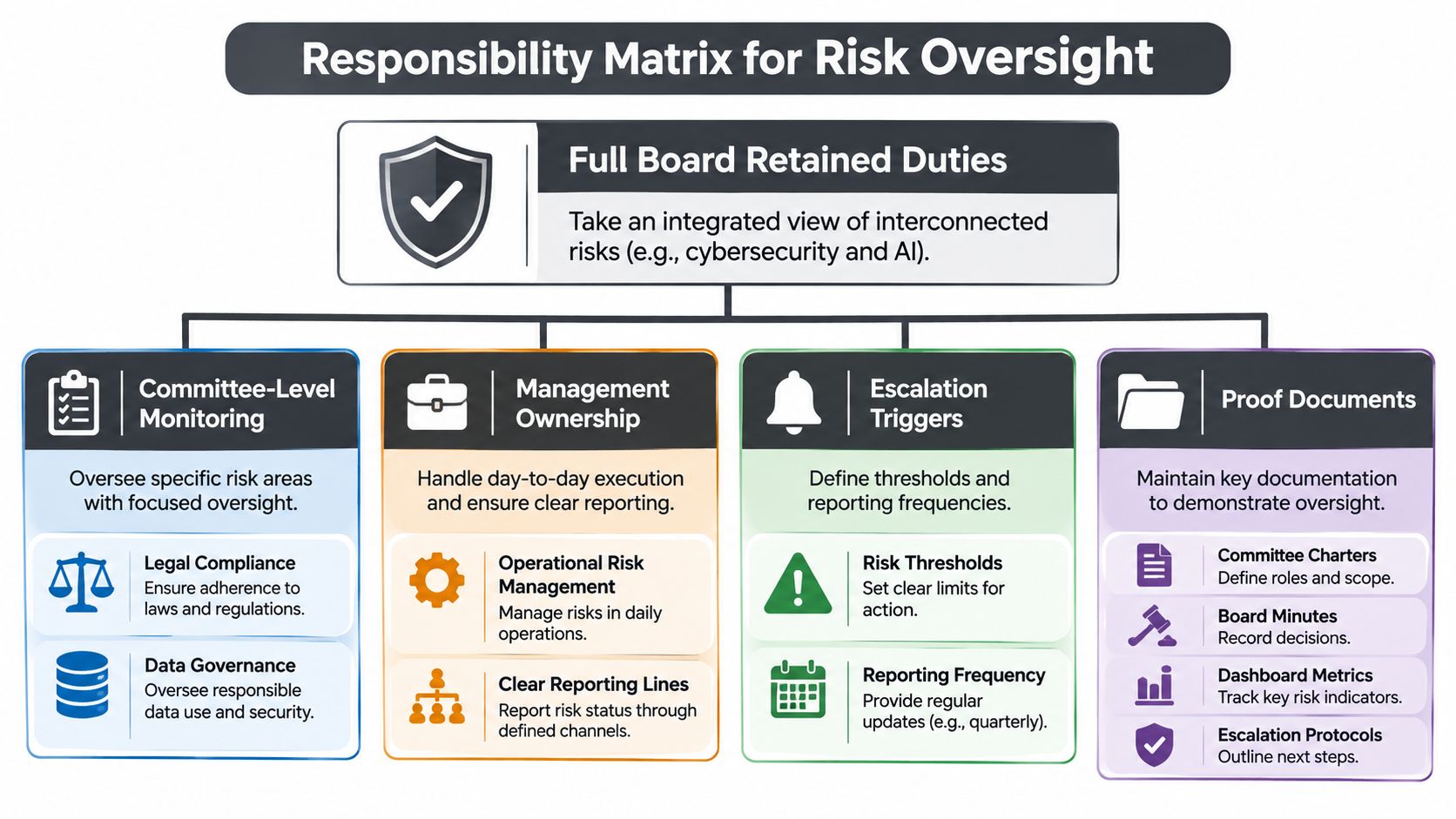
Build a Responsibility Matrix
- Full board retained duties: Strategy, risk appetite, CEO oversight, and any risk that crosses committee lines.
- Committee-level monitoring: One named committee per major risk, with its remit written into the charter.
- Management ownership: One accountable executive who produces the reporting and executes remediation.
- Escalation triggers and frequency: The thresholds that move an issue upward, and how often dashboards arrive.
Prove the structure with documents people can inspect: committee charters, reporting lines, minutes, dashboard metrics, and escalation protocols. Those records belong with your core corporate governance documents, reviewed when risks or personnel change.
Splitting oversight improves expertise, but it weakens accountability if the full board loses the integrated picture. Cybersecurity, AI deployment, and data governance feed into each other. Your matrix should show where those threads come back together at board level.
Confirm Your Board Duty Record This Quarter
Start with the paper trail. Pull the minutes from your last four meetings and test each significant decision against the record the board created.
- Audit the minutes: For every major vote, confirm the record shows the information reviewed, the questions asked, how conflicts were handled, and the reasons given. Capture a formal approval in a corporate resolution document recording the board's action. If the entry says only "approved," the board has a result without a defense.
- Check conflict paperwork: Confirm every director and key executive has a current certification, and every open related-party deal shows a recorded disclosure and recusal. A board that approves a related-party lease should see the lease summary, the director's disclosure, the recusal, and the independent comparison used to set terms. Missing any one leaves a gap.
- Compare charters with your matrix: Each mission-critical risk needs one committee and one named management owner, with no unexplained overlaps. The record should show the charter language, the reporting line, and the dashboard that proves the committee received the information.
- Test escalation: Confirm thresholds exist, dashboards arrive on a fixed cycle, and last quarter's warnings produced documented follow-up. Ask who owns the trigger and where the board sees the response.
- Give emerging risks a standing slot: Decide whether cybersecurity and AI appear on every agenda or only after incidents. Put the answer in the agenda calendar and the minutes, not in a verbal understanding.
Board agendas are catching up to that pressure. In 2025, 41% of surveyed directors ranked cybersecurity threats among the top trends expected to affect their organizations, according to the National Association of Corporate Directors Trends and Priorities Survey. In 2025, 62% of surveyed public-company boards set aside agenda time for full-board discussion of artificial intelligence, according to the Society for Corporate Governance Public Company Directors Speak survey.
If your check turns up thin minutes, stale certifications, or unowned risks, fix the template, the charter, or the owner now while nothing is on fire. If you want to discuss your business law matter, contact Kons Law through its website. Kons Law is a Hartford-based business law firm that helps companies with entity formation, governance, contract drafting, and ongoing compliance, and it serves businesses throughout Connecticut.
Kons Law's Corporate & Business Law practice helps clients form and structure their businesses, draft and negotiate contracts, manage mergers and acquisitions, and ensure ongoing compliance with complex regulations, including the board records and governance processes covered here. If your quarterly check exposed gaps in minutes, committee charters, or conflict controls, visit Kons Law to discuss how the firm can help you put a defensible record in place.
