You may be in that familiar spot right now. The workday ended hours ago, but you still answered Slack messages, finished reports from home, handled customer calls on your phone, or stayed late because the job had to get done. Your paycheck looked the same as always. No overtime line. No extra compensation. Just the assumption that this is part of being “reliable” or “salaried.”
Sometimes it is. Often it isn't.
When overtime is not being paid, the first question isn't whether you worked hard. It's whether the law required your employer to pay for that time. In Connecticut, that analysis usually runs on two tracks at once: federal law under the Fair Labor Standards Act, and state wage-and-hour rules that may create separate rights, remedies, and procedures. The practical path depends on classification, recordkeeping, your pay structure, and how the employer controlled the work.
Employees often wait too long because they think one of three things must be true: they're salaried so they can't recover overtime, the hours were never “approved,” or there's no point pursuing a claim without perfect timesheets. None of those assumptions is safely relied on. The stronger approach is to assess the facts, preserve the evidence, and choose the enforcement route that fits the claim.
The Growing Problem of Unpaid Overtime
Overtime disputes usually don't begin with a dramatic event. They begin with routine. A manager asks you to “just keep an eye on email tonight.” A project deadline turns one late evening into a normal pattern. A company uses a scheduling app for shifts but expects work before login or after clock-out. Over time, unpaid labor gets baked into the job.
That pattern matters because overtime law is built around compensable time, not just scheduled time. If an employer knows or should know that nonexempt work is being performed, the legal issue doesn't disappear because the hours were inconvenient, informal, or performed remotely.
Why more workers are exposed
Nationally, overtime protections for salaried workers have narrowed sharply. In 1975, over 60% of salaried workers were covered by FLSA overtime protections, but by 2026 only 15% retain those protections, according to this overtime protections analysis. That decline reflects decades of expanded exemptions and classification practices.
The practical effect is easy to see in day-to-day disputes. More workers carry salaried titles, broader job descriptions, and vague expectations about after-hours availability. Employers often assume that salary equals exemption. It doesn't. But the confusion benefits the employer unless someone tests the classification against the actual legal standard.
A title on an org chart doesn't decide overtime eligibility. Actual duties do.
For Connecticut businesses, this issue also sits inside a broader compliance framework. Wage-and-hour exposure usually appears alongside recordkeeping, handbook, scheduling, and manager-training problems. A company reviewing its practices should treat overtime risk as part of a larger small business compliance checklist, not as an isolated payroll glitch.
What unpaid overtime often looks like
Common examples include:
- Off-the-clock startup work such as opening systems, reviewing overnight emails, or preparing equipment before the official shift.
- End-of-day wrap-up tasks including closing out tickets, locking up, reconciling cash, or submitting reports after clocking out.
- Remote work that leaves a digital trail through Teams, Outlook, Slack, VPN access, CRM updates, or help-desk platforms.
- Meal breaks that aren't real breaks because the employee keeps answering calls or handling customer issues.
- Salary-based assumptions where the employer treats a worker as exempt without a defensible duties analysis.
When clients ask whether overtime not being paid is “worth pursuing,” the answer usually turns on proof and classification, not on whether the employer intended to violate the law. Good-faith confusion can still produce liability. So can a system that depends on extra unpaid hours.
Identifying and Calculating Your Unpaid Overtime
The first practical task is to stop guessing. You need to determine whether you were nonexempt and, if so, what your unpaid overtime is worth under a week-by-week analysis.

Salary is not the end of the analysis
Being paid a salary doesn't automatically remove overtime rights. The legal question usually focuses on whether the employee meets exemption requirements tied to compensation structure and actual job duties. Employers often rely on the executive, administrative, or professional exemptions. Those categories are technical and regularly disputed.
At the federal level, a useful starting benchmark is this: nonexempt employees are generally entitled to 1.5 times their regular rate for hours over 40 in a workweek, while many salaried workers are excluded because of duties and salary-basis tests, as discussed in this unpaid overtime analysis. That same analysis notes that the average employee working unpaid overtime puts in roughly nine extra hours per week, which can translate to more than $17,000 in annual lost income at the full-time median wage.
If your employer classified you as exempt, review the job itself, not just the offer letter. A careful employment agreement review can help identify where the written role and the actual role diverge.
How to calculate the claim
Start with the workweek. Overtime liability is generally measured week by week, not by averaging two weeks together and not by looking only at annual salary.
A practical formula looks like this:
Determine your regular rate
This may involve more than your stated hourly wage. Depending on the pay structure, it can require reviewing salary allocations, nondiscretionary bonuses, and other compensation that affects the regular rate.Identify all compensable hours worked in each week
Include recorded time plus off-the-clock work, pre-shift tasks, post-shift tasks, remote work, and work performed while supposedly “waiting for approval.”Subtract 40 hours from total weekly hours
The remainder is the overtime bucket for federal analysis.Apply the overtime premium
Overtime is generally paid at 1.5 times the regular rate for those hours.
A practical example
Suppose an employee is treated as salaried, but the role is nonexempt. The employee regularly works beyond the posted schedule by handling email, logging into a ticketing system at night, and finishing paperwork on weekends. If those added hours push the weekly total over 40, each overtime hour should be priced at the proper regular rate, not ignored because “the salary covers it.”
Practical rule: Reconstruct the week from systems, messages, and workflow records if the employer's timesheets are incomplete.
The most common errors I see are simple. People use annual salary alone, they ignore off-the-clock tasks that plainly benefited the employer, or they assume unauthorized overtime is unpaid overtime. Unauthorized work can still be compensable if the employer knew or should have known it was happening.
Building Your Case with Strong Documentation
An overtime claim gets stronger when the record is built before the dispute hardens. Waiting until after termination or after a confrontation with management usually means key evidence has vanished, access has been cut off, or memories have shifted.
What to collect first
Build a file that shows three things: when you worked, what work you performed, and what the employer knew.
- Pay records including pay stubs, direct-deposit records, payroll summaries, bonus statements, and any handbook or policy language about overtime.
- Time records such as punch reports, scheduling app screenshots, shift changes, and your own calendar entries.
- Digital activity records from Outlook, Slack, Microsoft Teams, Zoom, VPN logs, customer support tools, project platforms, or ticketing systems.
- Manager communications including texts, emails, voicemails, and chat messages directing after-hours work or discouraging time entry.
- Personal reconstruction logs that identify the date, start time, end time, task performed, and who assigned or observed the work.
The best records are contemporaneous. A note created the same day is usually more credible than a reconstruction made months later.
The file should tell a story
Raw screenshots aren't enough. Organize them by week. Match messages to work performed. If you received a text at night asking for a report, pair that with the email sending time, the file metadata if available, and the next day's payroll entry showing no overtime.
A simple spreadsheet often works better than a stack of PDFs. Use columns for date, start and end times, unpaid minutes or hours, task description, manager involved, and supporting document.
If you're trying to tighten your own recordkeeping habits, especially in remote or hybrid settings, DynamicsHub's time management guide is a useful operational resource because it focuses on attendance systems and the practical controls that create or prevent payroll disputes.
Evidence that often gets overlooked
Some of the best overtime evidence isn't labeled “timesheet.”
Badge swipes, calendar invites, delivery logs, system access records, and version histories can all support the hours claim.
Consider collecting:
- Access data from building-entry systems or remote login records.
- Work product timestamps on reports, spreadsheets, CRM notes, and customer updates.
- Witness support from coworkers who saw the routine or worked the same unpaid pattern.
- Policy contradictions where the employer required output that couldn't realistically be completed within scheduled hours.
Documentation should be preserved lawfully. Don't take privileged material, trade secrets, or customer data you have no right to remove. But do preserve wage-and-hour evidence tied to your own work and compensation.
Filing a Claim with Federal and Connecticut Agencies
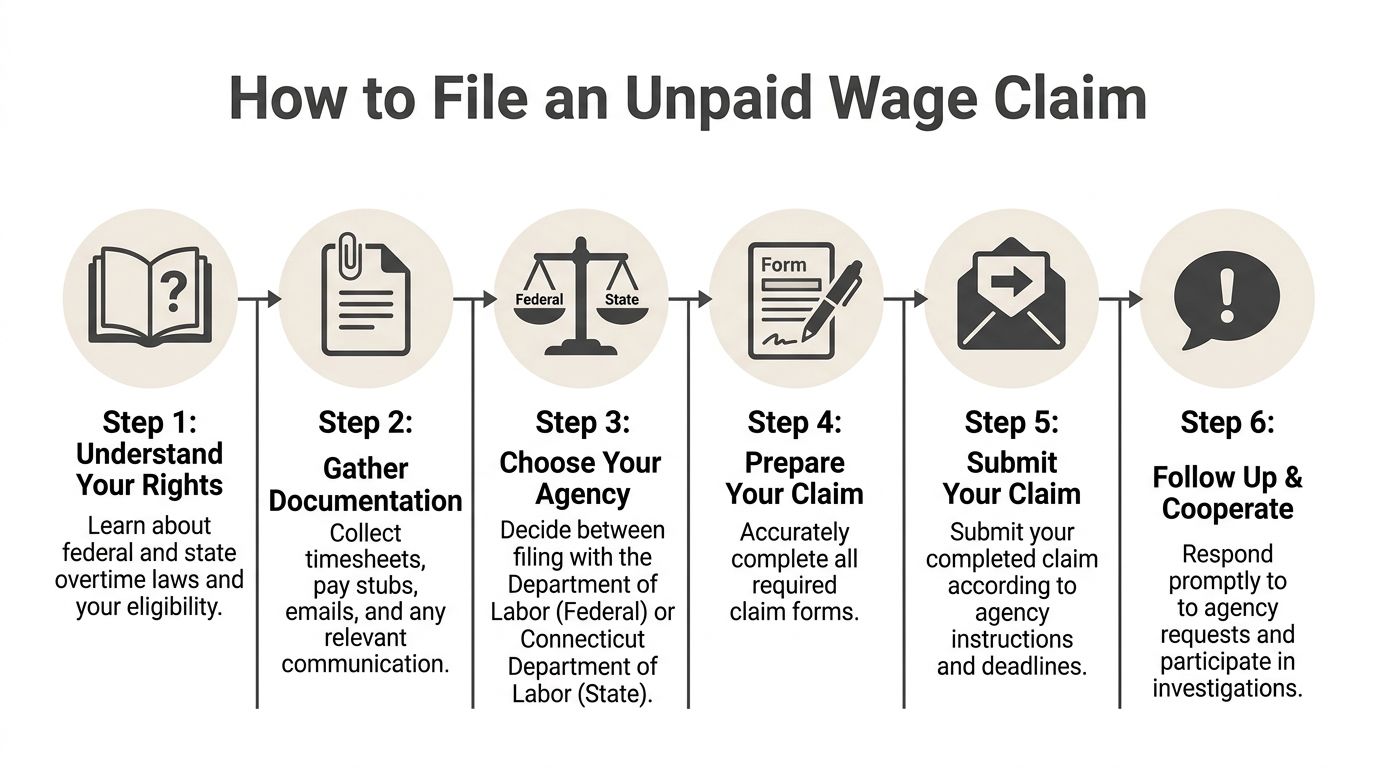
A private lawsuit isn't the only route. Many workers begin with an administrative complaint, and in some cases that's the most efficient move. The choice between federal and state channels depends on the scope of the claim, the employer's structure, the records available, and whether the dispute includes broader Connecticut wage issues.
Federal and Connecticut paths compared
The U.S. Department of Labor's Wage and Hour Division can investigate unpaid overtime under federal law. Connecticut also has state-level enforcement mechanisms for wage claims. Both routes can pressure an employer to produce records, explain classification decisions, and resolve unpaid wage issues without immediate court litigation.
Here is the practical comparison:
| Path | Best use case | What usually happens |
|---|---|---|
| Federal DOL | Multi-employee issues, broad FLSA violations, interstate employers, classification disputes with federal significance | Complaint, intake, investigation, records request, interviews, possible back wage recovery |
| Connecticut agency route | Claims tied closely to Connecticut employment practices and wage enforcement concerns | State review, employer response, records review, possible administrative action or referral |
The federal route has real enforcement value. In fiscal year 2024, the U.S. Department of Labor's Wage and Hour Division recovered more than $273 million in back wages for 152,871 workers, as reported on the Department of Labor overtime page.
What helps an agency claim move
Agencies respond better to organized claims than emotional summaries. A strong submission usually includes a chronology, pay records, your estimate of unpaid hours by week, and a concise explanation of why the employer's exemption position is wrong or why the off-the-clock work was known to management.
A practical filing package often includes:
- A one-page narrative summarizing the role, pay method, schedule, and unpaid overtime pattern.
- A week-by-week estimate of hours worked beyond 40.
- Key exhibits like pay stubs, screenshots, texts, and email timestamps.
- Names of supervisors and witnesses who can confirm expectations or practices.
Cooperate fully, but don't ramble. Agencies need facts they can verify quickly.
Strategic considerations for Connecticut workers
Choosing an agency route doesn't mean abandoning other options. It does, however, require attention to timing. Before filing anywhere, review timing issues carefully because claim deadlines can affect influence and available remedies. A good starting point is this overview of Connecticut statutes of limitations.
For some employees, an agency claim works because it reduces upfront cost and shifts investigatory pressure onto the government. For others, especially where damages are significant or the facts are contested, a private lawsuit may offer more control.
Pursuing a Private Lawsuit for Unpaid Wages
Sometimes administrative filing is too slow, too narrow, or too uncertain. A private lawsuit may be the better path when the unpaid overtime is substantial, the employer disputes classification aggressively, or the claim also involves retaliation, unpaid straight wages, or broader payroll violations.

What a lawsuit changes
Litigation changes the balance of power. It allows formal discovery, depositions, document demands, and direct judicial involvement. That matters when the employer says records don't exist, insists the worker was exempt, or reframes the job after the dispute begins.
In practice, private claims often begin with counsel reviewing the pay structure, duties, and evidence, then sending a demand that outlines the legal basis for liability and proposes a resolution. Some cases settle there. Others move into court because the employer overestimates its exemption defense or underestimates what the records will show.
If you're considering a broader claims strategy against a company, this overview on working with an attorney for suing a company gives a practical sense of what pre-suit and litigation planning usually involve.
What your lawyer will evaluate
A serious wage case is built around detail. Expect counsel to ask for the following:
- How you were paid each period, including salary, hourly amounts, bonuses, commissions, or shift differentials.
- The work you performed each day rather than what the job description says.
- Who knew about the extra work and how that knowledge can be proven.
- Whether the employer altered time records or discouraged accurate timekeeping.
- Whether other employees were treated the same way, which can affect strategy and potential group claims.
A lawyer may also compare federal and Connecticut remedies to determine where the strongest pressure points are. The best route isn't always the loudest one. It's the one that best fits the available proof and the employer's likely defenses.
Litigation realities
Private lawsuits require patience and discipline. Employers usually defend these claims by narrowing the hours at issue, attacking the worker's memory, or insisting the employee exercised enough discretion to qualify as exempt. That means your proof has to be specific.
Don't wait for perfect records before speaking with counsel. In wage cases, courts and agencies often evaluate reasonable reconstructions when the employer's records are lacking.
Many claims also turn on timing. Delay can cost more than momentum. Messages disappear, systems overwrite logs, and witnesses leave. If the claim is viable, early review usually improves settlement value because it preserves the advantage before the factual record thins out.
Common Employer Defenses and Strategic Next Steps
The most common defense is misclassification in reverse. The employer says you were properly treated as exempt because your title sounded managerial, your work involved judgment, or you were paid on a salary basis. That defense can succeed, but it often collapses under a close review of the actual job.
Where employers usually push back
Expect arguments like these:
- You were exempt because you supervised others even if your real work was mostly routine production, service, or operational tasks.
- You never reported the hours even though managers texted after hours, assigned weekend work, or discouraged overtime entry.
- The overtime wasn't approved even though the company accepted the benefit of the work.
- You were paid salary as if salary alone answered the legal question.
The salary threshold issue also remains fluid. The U.S. Department of Labor issued rules that would raise the exemption salary threshold, with a planned increase to $58,656 on Jan. 1, 2025, as noted in the California DLSE overtime exemptions discussion. That kind of movement shows why classification isn't static. It can create liability for employers that rely on old assumptions.
The strategic decision point
The right next step depends on the record and the employer.
If the problem looks like isolated payroll error, a targeted written demand may resolve it. If the employer is dug in on classification, an agency filing or lawsuit may be stronger. If a professional employer organization is involved, responsibility can become more layered. For that issue, this article on understanding PEO wage claims is useful because it highlights how wage-claim responsibility may be disputed between the operating company and the PEO.
For businesses reviewing risk or employees evaluating counsel, one option is to speak with Kons Law, a Hartford-based firm that handles business disputes and related employment matters as part of a broader commercial practice. If you want to discuss your business law matter, contact Kons Law at (860) 920-5181.
Frequently Asked Questions About Unpaid Overtime
Can I recover overtime if my employer told me not to record it
Usually, that fact helps rather than hurts the claim. Employers can require overtime approval as a workplace rule, but they generally can't accept the work and refuse to pay for it if the employee was nonexempt and the time was worked. The legal issue becomes employer knowledge and compensable time, not whether the policy was followed perfectly.
What if I worked from home and never used a time clock
Remote work claims are common because digital evidence often substitutes for a punch system. Email timestamps, Teams messages, VPN activity, CRM entries, ticket closures, phone logs, and calendar records can all help reconstruct time. The stronger the pattern, the harder it is for an employer to argue the work was unknown or de minimis.
For employers trying to reduce this exposure, managing overtime risks for exempt workers is a useful operational read because it focuses on classification and overtime management from the business side.
Do Connecticut employees need a lawyer before doing anything
Not always. Some workers start by organizing records and filing with an agency. That can make sense where the facts are straightforward and the claim is modest. But legal advice becomes much more valuable when classification is disputed, the pay structure is complicated, the employer has counsel, multiple employees are affected, or retaliation is in the picture.
A short consultation can also prevent tactical mistakes. People often send emotional accusations, rely on rough estimates without support, or pick the wrong forum too early. A disciplined approach usually produces better outcomes than an immediate confrontation with payroll or management.
If you need guidance on overtime not being paid, wage claims, classification disputes, or related business law issues in Connecticut, contact Kons Law at (860) 920-5181.
