
You sign a business deal, confident you have all the facts. But what if the information that convinced you to sign was flat-out wrong? That's the heart of misrepresentation in contract law: a false statement of fact induces someone to enter an agreement, potentially blowing up the entire contract. Not every little inaccuracy counts, though. The law draws a clear line between an innocent mistake, a careless error, and deliberate deception.
Unpacking Misrepresentation in Business Agreements
Think of misrepresentation law as a safety net. It’s there to protect you from being locked into a deal you only agreed to because you were fed bad information.
Let's say you're buying a piece of commercial real estate. The seller tells you the property is zoned for industrial use, which is exactly what you need for your manufacturing business. Based on that key assurance, you sign the purchase agreement and start planning your expansion.
Soon after, you discover the property is actually zoned for retail only. The seller's statement wasn't just a minor detail; it was a fundamental falsehood that led directly to your decision to buy. This is precisely the kind of problem misrepresentation law is designed to fix.
The Foundation of a Fair Deal
A contract is supposed to be a "meeting of the minds." For that to happen, everyone needs to be on the same page, working from an accurate set of facts. When misrepresentation enters the picture, it poisons that foundation. It creates a false reality for one party, completely undermining the genuine consent required for a legally binding agreement.
The fallout from these false statements can be huge, going way beyond a simple contract dispute. In fact, contractual misrepresentation is one of the main reasons for fraud investigations and government enforcement actions.
You can see this clearly with the U.S. False Claims Act (FCA), which goes after anyone who makes false statements to get government money. In the 2023 fiscal year alone, the Department of Justice recovered over $2.68 billion in FCA cases, originating from a record-breaking 543 separate lawsuits. These numbers show just how quickly a false statement in a contract can escalate into a major fraud case. You can read more about these judgments on the Department of Justice website.
Why This Matters for Your Business
For any business owner in Connecticut, getting a handle on misrepresentation is non-negotiable. Whether you're buying another company, signing a commercial lease, or hiring a critical vendor, the statements made during negotiations have real legal weight. Knowing what counts as an actionable misrepresentation helps you:
- Spot the Red Flags: You'll become much better at identifying potentially misleading claims before you sign.
- Protect Your Bottom Line: It gives you the power to seek legal remedies when you've been wronged.
- Dodge a Bullet: It reminds you to be scrupulous about the accuracy of your own company's statements, so you don't end up on the receiving end of a claim.
If you suspect misrepresentation has soured one of your business contracts and want to discuss your options, contact Kons Law at (860) 920-5181.
Exploring The Three Types Of Misrepresentation
In the eyes of the law, not all false statements are created equal. When a misrepresentation surfaces during contract negotiations, the legal fallout almost always comes down to the state of mind of the person who made the statement. For any business owner, it's critical to understand the difference between a deliberate lie, a careless mistake, and a genuine error.
The intent—or lack of it—behind the inaccurate statement directly dictates the available remedies. The consequences can range from simply calling off the deal to pursuing significant financial damages. Let’s break down the three distinct categories of misrepresentation, using a consistent scenario: a business looking to lease a commercial property.
This flowchart shows how a simple false statement can build into an actionable legal claim when it causes someone to enter a deal and suffer harm as a result.
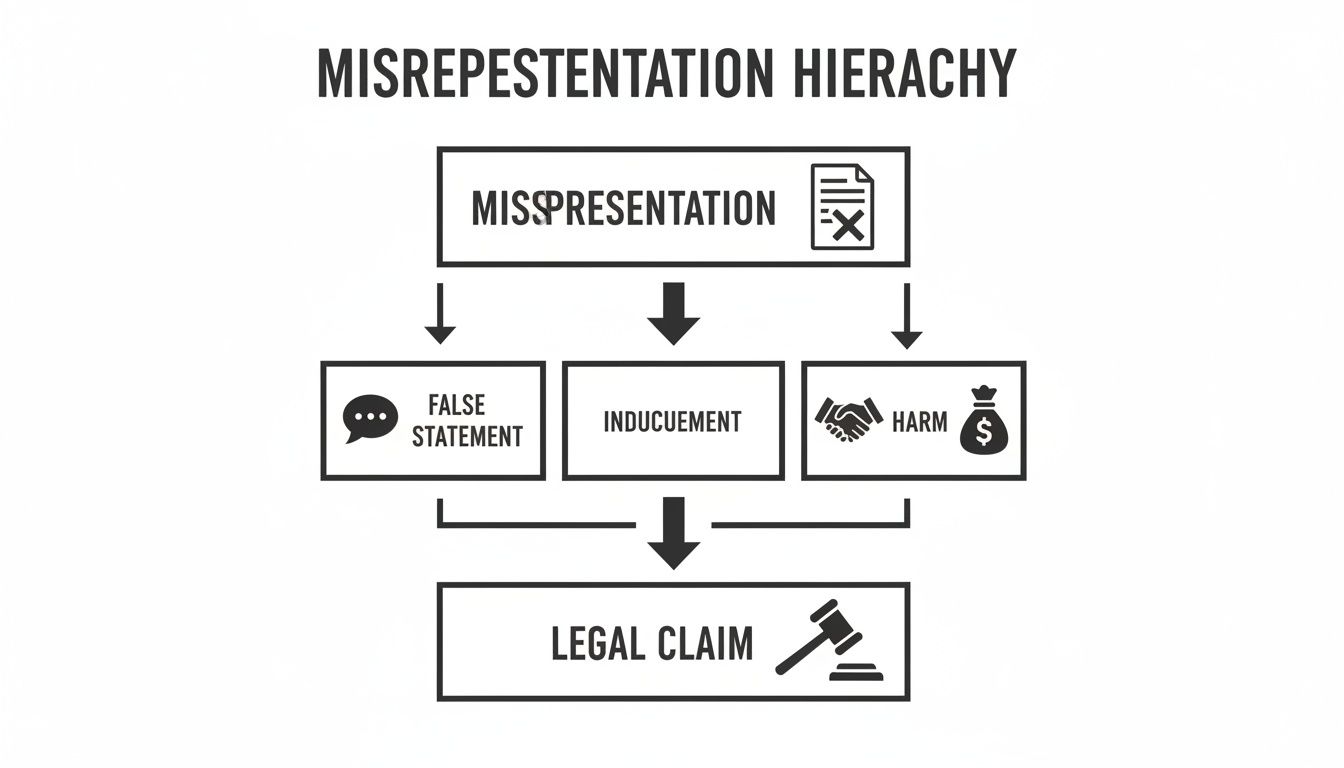
As you can see, the false statement is just the starting point. It only becomes a legal problem when it actually convinces a party to sign a contract and they end up worse off because of it.
Fraudulent Misrepresentation: The Most Serious Form
Fraudulent misrepresentation is the worst of the bunch because it involves a deliberate lie. This happens when someone makes a statement they know is false, or they say it with reckless disregard for the truth. The core element here is the intent to deceive the other party to get them to sign on the dotted line.
Think back to our commercial lease example. The landlord knows the building has a severe, recurring mold problem hidden behind a fresh coat of paint. When the prospective tenant asks about the property’s condition, the landlord says, "It's in perfect shape, no issues whatsoever." This is a classic case of fraudulent misrepresentation. The landlord knew the truth and lied to lock in the deal.
Because this involves outright deception, the remedies are the most severe. The wronged party can usually:
- Rescind the contract (meaning, cancel it and put everyone back in their original financial position).
- Claim damages to compensate for any losses they suffered.
- In some egregious cases, seek punitive damages, which are designed to punish the wrongdoer and deter others from similar behavior.
Negligent Misrepresentation: Carelessness With Consequences
Negligent misrepresentation sits in the middle. It occurs when a party makes a false statement because they didn't take reasonable care to check if it was accurate. There's no intent to deceive, but there is a breach of the duty to provide correct information.
Let's go back to the commercial property. A potential tenant asks the landlord if the location is zoned for light industrial use. The landlord, vaguely remembering an old conversation, confidently says, "Yes, it is." But they never bothered to check the current city zoning records, which changed last year.
Here, the landlord didn't lie on purpose, but they had a duty to give accurate information and failed to do so out of carelessness. Their assurance was a key part of the early discussions, much like how parties hash out critical terms in preliminary documents. To learn more about how these foundational agreements are structured, check out our guide on what is a letter of intent. In this scenario, the tenant can typically rescind the contract and sue for damages directly caused by the landlord's negligence.
Innocent Misrepresentation: An Honest Mistake
Finally, we have innocent misrepresentation. This happens when someone makes a false statement they genuinely believe is true and had good reason for that belief. There’s no fraud and no negligence—just an honest-to-goodness mistake about a material fact.
Consider our landlord one last time. The tenant asks about the building's total square footage. The landlord provides a number they got from a recent survey done by a reputable architectural firm. Unbeknownst to the landlord, the architect made a calculation error, and the actual space is 15% smaller.
The landlord passed on bad information, but they did it in good faith, reasonably trusting an expert’s report.
Since there's no fault, the remedies for innocent misrepresentation are much more limited. The main remedy is rescission of the contract. The goal is simply to undo the deal and put the parties back where they started, not to punish someone for an honest mistake.
To help clarify the differences, this table breaks down the three types side-by-side.
Comparing Types Of Misrepresentation
| Type of Misrepresentation | State of Mind (Culpability) | Common Remedies |
|---|---|---|
| Fraudulent | Intentional deceit; knew the statement was false or was reckless about the truth. | Rescission, compensatory damages, and potentially punitive damages. |
| Negligent | Carelessness; failed to exercise reasonable care to verify the statement's accuracy. | Rescission and damages directly caused by the negligence. |
| Innocent | Honest mistake; had reasonable grounds to believe the statement was true. | Primarily rescission; putting parties back to their starting positions. |
As you can see, the intent behind the false statement is what really drives the legal outcome.
Understanding these distinctions is the first step in assessing your rights and obligations. If you believe a misrepresentation has impacted your business agreement and you want to discuss your business law matter, contact Kons Law at (860) 920-5181.
The Legal Elements of a Misrepresentation Claim
Simply feeling like you were misled into a contract isn’t enough to win in court. To successfully prove a misrepresentation in contract claim, you have to build a case by establishing several key components. Think of it like a four-legged stool—if even one leg is missing, the whole claim falls apart.
A court will require the wronged party (the plaintiff) to prove a specific set of facts. Knowing what these are helps you gauge the strength of your own case and underscores why keeping meticulous records during negotiations is so critical. Let's walk through the essential legal checklist.
A False Statement of a Material Fact
The bedrock of any misrepresentation claim is a false statement. But not just any fib will do. The statement must be about a material fact, which is something important enough that it would influence a reasonable person's decision to sign the contract.
This is the key difference between an actionable lie and simple sales talk.
- Material Fact: "This piece of machinery has been serviced every six months for the last five years, and we have the records to prove it."
- Sales Puffery: "This is the most reliable machine you'll ever own!"
The first is a specific, verifiable claim that can be proven true or false. The second is just a subjective opinion. "Puffery" is legally acceptable bluster, but a false statement of material fact is not.
Inducement to Enter the Contract
Next, you have to show the false statement wasn't just an offhand comment—it was a major reason you agreed to the deal in the first place. This is the element of inducement. The misrepresentation must have played a real, substantial part in persuading you to sign on the dotted line.
Imagine a business buys a software package after the vendor explicitly states it's fully encrypted and meets specific industry security standards. If the buyer can show that this specific compliance was a non-negotiable factor in their decision, they can establish inducement.
Justifiable Reliance on the Statement
It’s not enough to show you were induced. You also have to prove that your reliance on the statement was justifiable. This means a reasonable person in your shoes would have also trusted the statement without launching a full-scale, independent investigation into every single claim.
The court looks at the context. If an expert presents a certified appraisal for a piece of art, it’s generally reasonable for a buyer to rely on it. On the other hand, if a seller makes a wild claim that seems too good to be true and the buyer ignores obvious red flags, a court might decide their reliance wasn't justified.
The core legal question is whether the defendant’s words or actions caused the claimant to act on an assumption they would naturally make. The claimant doesn't need to consciously analyze every representation at the moment of signing; the law recognizes that a false belief, produced by a misrepresentation, can operate on someone's mind without them being actively aware of it.
Resulting Harm or Financial Loss
Finally, you must prove that relying on the false statement actually caused you harm, usually in the form of a financial loss. This is what connects the lie directly to a negative outcome. If a false statement was made but you didn't lose anything because of it, there's no basis for a legal claim.
This has become a major issue in the digital age, especially with cybersecurity promises in contracts. In October 2021, the Department of Justice launched its Civil Cyber-Fraud Initiative to go after government contractors who lie about their cybersecurity practices. By fiscal year 2023, the DOJ was settling cases where companies allegedly exaggerated their security compliance, showing a serious push to penalize misleading statements that put U.S. information at risk. You can read more about the DOJ's False Claims Act enforcement actions.
If you believe these elements apply to your situation and want to discuss your business law matter, contact Kons Law at (860) 920-5181.
Legal Remedies and Common Defenses
Once a court is convinced that a contract was built on a lie, the focus shifts. It's no longer about proving the misrepresentation; it's about making things right. But the solution isn't a simple, one-size-fits-all fix. The right remedy—and the defenses available—all comes down to the specifics of the case, especially which type of misrepresentation took place.
For anyone caught in a contract dispute, understanding what comes next is crucial. The law generally offers two main ways to correct the wrong: either wipe the slate clean or pay up for the damages caused.
Primary Legal Remedies
The most direct remedy is called rescission. Think of it as hitting a giant "undo" button on the entire contract. The court voids the agreement, and both sides have to return whatever they received—money, property, you name it. The goal is to put everyone back in the exact financial spot they were in before the deal was ever made. This powerful tool is on the table for all three kinds of misrepresentation: fraudulent, negligent, and even innocent.
The other path is damages, which means a court orders a monetary payment to the person who was harmed. How much money, however, depends entirely on the severity of the lie.
- Fraudulent Misrepresentation: Here, the wronged party can go after compensation for all losses that stemmed from the fraud. If the deception was particularly outrageous, a court might even award punitive damages—extra money meant not to repay the victim, but to punish the wrongdoer and send a clear message.
- Negligent Misrepresentation: For careless mistakes, damages are usually capped at the direct, out-of-pocket losses the person suffered because of the false statement.
- Innocent Misrepresentation: Financial damages are almost never an option. Since the mistake was honest, the court’s main goal is simply to undo the deal with rescission, not to penalize someone who acted in good faith.
This sharp contrast shows why proving fraud is such a big deal in court. It opens the door to a much larger financial recovery. Sometimes, a misrepresentation is so fundamental it poisons the entire agreement, which can also be grounds for a major contract violation. For a deeper look at when a contractual failure is serious enough to take legal action, check out our guide on what is a material breach of contract.
Common Defenses Against Misrepresentation Claims
Of course, every story has two sides. The person accused of misrepresentation has every right to fight back, and a solid defense can completely dismantle the claim.
A classic defense is to argue the statement wasn't a fact at all, but just an opinion or "puffery." Think of a salesperson calling their product "the best on the market." That’s a subjective boast, not a hard fact you can verify. If a judge agrees it was just sales talk, the case often falls apart right there.
Another powerful defense targets the idea of reliance. The defendant can argue that the other party’s trust in the statement was unreasonable or unjustified. For instance, if a buyer was handed a report full of red flags but chose to ignore it and trust the seller's rosy claims instead, a court might rule that they shouldn't have been so quick to believe them.
The crucial question is whether the claimant acted on an assumption that they would naturally be expected to make based on the defendant’s words or actions. It is an everyday part of human experience that people form and act on beliefs without conscious, moment-by-moment analysis.
Finally, a defendant might prove the statement didn't actually induce the contract. They could show evidence that the plaintiff was going to sign the deal no matter what. If the misrepresentation didn't truly influence the final decision, it can’t be the legal reason for undoing the contract.
Navigating a dispute like this—whether you're seeking a remedy or building a defense—demands experienced legal insight. If you need to discuss your business law matter, contact Kons Law at (860) 920-5181.
Navigating Misrepresentation Disputes in Connecticut
When you’re facing a misrepresentation in contract dispute, the game is played on home turf. For any business operating in Connecticut, knowing the local rules isn't just helpful—it's a critical strategic advantage. The outcome of your case can hinge entirely on state-specific laws, from filing deadlines to powerful local statutes.
In Connecticut, the clock is always ticking. The law sets a strict deadline, known as a statute of limitations, for bringing a misrepresentation claim. For most fraud-based claims, you have just three years from the day you discovered the false statement to file a lawsuit. Miss that window, and your right to a remedy could be gone for good, no matter how strong your case is.
The Power of CUTPA in Misrepresentation Cases
One of the most formidable weapons in a Connecticut contract dispute is the Connecticut Unfair Trade Practices Act (CUTPA). This isn't just another piece of legislation; it's a powerful law that prohibits any unfair or deceptive acts in commerce. A clear case of misrepresentation can easily double as a CUTPA violation, giving your claim serious teeth.
So, what makes a CUTPA claim such a big deal?
- Attorney's Fees: Normally, even if you win a contract dispute, you're stuck paying your own legal bills. Win under CUTPA, and the court can order the other side to pay your attorney’s fees.
- Punitive Damages: If the other party's conduct was particularly outrageous, the court has the power to award punitive damages, designed to punish them and deter others from similar behavior.
This potential to recover legal costs and secure extra damages turns a standard dispute into something the other side can't afford to ignore. An experienced commercial litigation attorney near me can analyze the facts of your situation to see if a CUTPA claim is a viable option.
Resolving Disputes Beyond the Courtroom
While a courtroom battle is always a possibility, many high-stakes commercial disputes in Connecticut never see a public trial. Confidential methods like arbitration and mediation are often the preferred route, especially when a company's sensitive information or reputation is on the line. These alternative dispute resolution (ADR) options offer a faster, more private, and more flexible way to find a solution.
This isn't just a local trend. Global data shows that misrepresentation is a common and high-value issue often resolved through ADR. The International Chamber of Commerce (ICC), for example, registered 1,959 new arbitration cases in 2023 alone. Reports from practitioners consistently point to misrepresentation and non-disclosure as key triggers in major transactions, with these claims frequently being handled in forums like the ICC, AAA, or JAMS. You can see more on these global trends on the ICC's official website.
Understanding these local nuances—from the leverage of CUTPA to the practical advantages of ADR—is absolutely essential for managing risk and protecting your company’s interests here in Connecticut.
If you want to discuss your business law matter, contact Kons Law at (860) 920-5181.
Preventing Misrepresentation Before It Starts
The best way to deal with a misrepresentation in contract dispute is to make sure it never happens in the first place. Legal remedies are a good safety net, but a smart, proactive approach during drafting and negotiation is your strongest defense. By putting solid internal processes in place, you can drastically cut your risk and build clearer, more honest agreements from the start.
This isn't just about good intentions. It's about adopting a verifiable, fact-based approach to every statement made while hashing out a deal. Treat every claim and promise as a potential cornerstone of the final agreement, because it just might be scrutinized later on.

Building a Stronger Contracting Process
To really protect your business, build a preventative checklist right into your deal-making process. Think of it as a framework to ensure everyone is on the same page and accountable before any ink hits the paper.
A few key measures will make a world of difference:
- Do Your Homework: Never take verbal assurances at face value. Independently verify the critical facts, financials, and operational claims the other party is making. And document everything you find.
- Check Your Own Facts: Before anyone on your team makes a statement, make sure it’s accurate and that you have the proof to back it up. It’s wise to create an internal review process for any key representation that will end up in the contract.
- Train Your Team: Your sales and negotiation staff need to know the legal line between acceptable sales "puffery" and a binding statement of fact. They have to understand that their words can create real legal obligations.
Essential Contract Clauses and Documentation
Your contract is your primary shield. Certain clauses are absolutely critical for managing the risk of misrepresentation claims. For a deeper dive into structuring solid agreements, our article on how to write a business contract is a great place to start.
One of the most powerful tools in your arsenal is the "entire agreement" clause, sometimes called a merger or integration clause.
An entire agreement clause states that the written contract is the complete and final deal between the parties. Its purpose is to stop either party from later claiming they relied on verbal promises or discussions that didn't make it into the final document.
On top of that, keeping a clean record of all important communications—emails, meeting notes, drafts—is crucial. This paper trail creates a factual timeline of who said what and when, which can be invaluable if a dispute ever pops up. At the end of the day, a meticulously drafted contract, combined with expert legal advice, offers the most robust protection against the headaches of a misrepresentation claim.
If you want to discuss your business law matter, contact Kons Law at (860) 920-5181.
Frequently Asked Questions About Contract Misrepresentation
When you’re grappling with a potential misrepresentation in a contract, a lot of practical questions come to mind. Here are some straightforward answers to the questions we hear most often from business owners, designed to bring some clarity to the key ideas we've covered.
Can Silence Be a Form of Misrepresentation?
Absolutely. While you’re not usually required to volunteer every single piece of information during a negotiation, there are times when saying nothing is the same as lying. This is especially true when there's a duty to speak up.
This duty often comes into play when there's a relationship of trust (a fiduciary relationship) or when one side knows about a critical, hidden problem the other party couldn't possibly find on their own. Think about a seller who knows a commercial building has a serious foundation crack but papers it over. That’s not just keeping quiet; it’s concealment. We often call this "misrepresentation by non-disclosure," and it's a big deal if the hidden fact was important enough to change the buyer's mind about signing the deal.
Distinguishing Misrepresentation from a Contract Breach
It's easy to mix these two up, but they happen at completely different stages of a business deal. The timeline is everything.
- Misrepresentation is about the before. It's a false statement made during negotiations that tricks someone into signing the contract in the first place. The damage is being lured into a deal under false pretenses.
- Breach of Contract is about the after. This happens when one party fails to do what they promised to do under the signed, legally binding agreement. The damage is the failure to get what was promised in the contract.
Simply put, misrepresentation is about how the contract was formed; a breach is about the failure to perform it.
A claimant can act on an assumption founded unconsciously on a representation and in reliance on that representation. The important question is “whether the claimant has acted on an assumption…which the claimant would naturally be expected to make in response to the defendant’s words or actions.”
This underscores that even subtle comments made before a contract is signed can have serious legal weight if they create a false belief that leads to a deal.
First Steps After Suspecting Misrepresentation
If you have a sinking feeling you've been misled into a contract, it's critical to act deliberately, not emotionally. What you do right now can make or break your potential legal claim down the road.
First, your top priority is to gather every shred of paper and every digital file related to the deal. This means the contract itself, all emails, notes from meetings, marketing brochures—anything and everything from the negotiation phase. This is your evidence, and it’s what you’ll use to build a timeline and prove what was said.
Next, resist the urge to fire off angry emails or publicly declare the contract void. The single most important step you can take is to get professional legal advice. An experienced business litigation attorney can dig into the specifics of your situation, tell you if you have a strong case, and map out the smartest, safest way forward.
If you want to discuss your business law matter, contact Kons Law at (860) 920-5181.
