When a business dispute flares up, the first casualty is almost always communication. Partnerships strain, projects stall, and what was once a productive relationship can quickly turn adversarial. This is where a mediator in business steps in—not to declare a winner, but to act as a neutral guide, helping both sides find their way back to a workable solution.
It's a strategic, confidential first step before ever thinking about a courtroom.
What Is a Mediator and Why Do You Need One?
Think of two founding partners, once perfectly aligned, who are now at a complete impasse over the company’s future. The tension is so thick that daily operations are grinding to a halt, and the trust they built their business on is gone. This is the classic scenario where a skilled business mediator can turn things around.

Unlike a judge or an arbitrator, a mediator doesn't have the power to impose a decision. Their job isn’t to rule on who is right or wrong. Instead, they are trained facilitators who create a structured, safe environment for a difficult conversation. They know how to de-escalate conflict, help each party see past their stated positions to their core interests, and brainstorm creative outcomes a lawsuit could never produce.
Common Disputes Solved Through Mediation
Mediation is an incredibly practical tool for a huge range of commercial conflicts. Businesses rely on it to resolve problems quickly, quietly, and cost-effectively. Some of the most common disputes we see head to mediation include:
- Shareholder and Partnership Disagreements: When co-owners clash over management, profit splits, or buyout terms, the entire company is at risk. Mediation creates a private forum to hash out these sensitive issues.
- Breach of Contract Claims: A deal has gone sideways. Instead of filing an expensive lawsuit, mediation can help both parties negotiate a practical fix, like adjusted payment terms or revised deadlines.
- Vendor and Supplier Conflicts: Disputes over product quality, missed deliveries, or payments can cripple your supply chain. A mediator helps find a solution that can often salvage a vital business relationship.
- Employment Disputes: Sensitive issues like severance packages or non-compete agreements can be resolved confidentially, protecting the reputation of both the business and the former employee.
The real power of mediation is its ability to preserve relationships. Litigation is designed to be adversarial; it creates a winner and a loser, and it burns bridges. Mediation, on the other hand, fosters cooperation, allowing both parties to find a fair outcome they can live with.
Empowering Businesses to Control the Outcome
Ultimately, the single greatest benefit of using a mediator is control. When you go to court, you hand over decision-making power to a judge or jury who understands little about your business or your industry. The outcome is a gamble, the proceedings are public, and the legal bills can become astronomical.
Mediation completely flips that dynamic. It keeps you and the other party in charge, empowering you to craft an agreement that is custom-fit to your specific needs. That level of control, combined with the process's confidentiality and efficiency, makes mediation a powerful tool for any business leader. Of course, having the right legal advice is just as critical; you can learn more about what a business lawyer does in our related article.
If you want to discuss your business law matter, contact Kons Law at (860) 920-5181.
Mediation vs. Litigation vs. Arbitration: Choosing the Right Path
When a business dispute erupts, it’s easy to think your only option is a costly, public battle in court. But that’s rarely the best strategic move. The path you take to resolve a conflict has enormous consequences for your bottom line, your timeline, and even the survival of your professional relationships.
Understanding your options is the first step. For most businesses, the choice comes down to three distinct paths: litigation, arbitration, or mediation.

Think of litigation as the traditional courtroom showdown. It's a formal, public process where a judge or jury hears evidence and imposes a legally binding decision. The rules are rigid, the process can drag on for years, and the final outcome is completely out of your hands.
Arbitration is like a private trial. You and the other party select a neutral arbitrator to act as a private judge. While less formal than court, the arbitrator’s decision is almost always final and legally binding, with very limited options for an appeal. You’ve simply moved the fight from a public courthouse to a private conference room.
The Power of Control: How Mediation Differs
Mediation flips the entire script. It is a voluntary, confidential, and collaborative negotiation guided by a neutral professional. A business mediator doesn’t issue rulings or force a solution on anyone. Their job is to open lines of communication, help each side see the other’s perspective, and empower you to find a mutually agreeable solution.
This structure puts the power and control right back where it belongs—with the business owners. You decide the outcome. Because it’s a cooperative process, mediation excels at preserving valuable business relationships that would otherwise be destroyed in an adversarial fight.
It’s no surprise that mediation has become the go-to method for savvy businesses. According to a 2026 industry survey, 87% of legal professionals now report mediation as their most-used form of dispute resolution, driven by faster results and cost savings that average 50-70% over litigation.
Dispute Resolution Methods at a Glance
To see the differences clearly, it helps to put the core features of each method side-by-side. This table shows why so many business owners and their counsel now look to mediation first when a conflict arises.
| Feature | Mediation | Arbitration | Litigation |
|---|---|---|---|
| Process | Collaborative Negotiation | Private Adversarial Hearing | Public Adversarial Trial |
| Decision-Maker | The Parties Themselves | Neutral Arbitrator(s) | Judge or Jury |
| Outcome | Mutually Agreed Settlement | Binding Award | Binding Judgment |
| Confidentiality | Fully Confidential | Private but may be public | Public Record |
| Cost | Lowest | Moderate to High | Highest |
| Timeline | Weeks to Months | Months to a Year+ | Years |
| Control | High | Low | Low |
When you see it laid out like this, the strategic advantages of mediation become undeniable. It provides a path that’s faster, more affordable, and completely private, all while giving you the final word on the outcome. For more details, see our full guide on alternative dispute resolution versus litigation.
Choosing mediation is about choosing control. It's the decision to resolve your dispute on your own terms, in a private setting, without surrendering your fate to an outside decision-maker.
While litigation and arbitration certainly have their place, they are often best reserved as a last resort. Starting with a business mediator gives your company the best possible chance to resolve the issue efficiently, protect your bottom line, and get back to business.
If you want to discuss your business law matter, contact Kons Law at (860) 920-5181.
Breaking Down the Business Mediation Process
For many business owners, the idea of mediation brings up images of a tense, formal confrontation. The reality is quite different. It's not a courtroom battle; it’s a structured, confidential process designed to guide two parties from a point of conflict to a workable resolution.
To see how it works, imagine two partners in a tech startup who are at a stalemate over the company's future. Communication has failed, and they agree to bring in a mediator in business to help them find a way forward. Their path shows just how effective this process can be.
Stage 1: Agreement and Preparation
First, both sides have to voluntarily agree to mediate. This mutual commitment is the foundation of the entire process. Once they're on board, they will work together, usually with their attorneys, to choose a neutral mediator whose background fits their industry and the specifics of their dispute.
With a mediator selected, the preparation phase begins. This is where the real work starts.
- Confidential Submissions: Each party submits a private brief to the mediator. This document outlines their view of the facts, their position, and what they hope to achieve. It is not shared with the other side and gives the mediator a complete, 360-degree view of the conflict from the outset.
- Pre-Mediation Calls: The mediator will almost always hold separate, confidential calls with each party and their counsel. This is a critical step for building trust, clarifying the core issues, and understanding the business and personal interests driving each side's position.
Stage 2: The Mediation Session
The mediation day typically opens with a joint session where everyone is in the same room. After explaining the rules and the confidential nature of the day, the mediator gives each party the chance to make a brief opening statement. The goal isn't to argue, but to make sure each side feels their perspective has been heard.
After the joint session, the process breaks into a series of private meetings, or caucuses.
The caucus is the heart of the mediation. It's a confidential meeting between the mediator and just one of the parties. This is where you can be candid about your priorities, concerns, and where you might be willing to compromise, all without the other party in the room.
The mediator moves between these private caucuses, acting as a go-between. They carry offers and counter-offers, but more importantly, they reality-test proposals with each side. They might ask tough questions like, "What are the real-world costs if this dispute ends up in litigation?" or "Is there another way to get what you need?" This pushes the parties to think beyond their entrenched positions and explore creative solutions.
Stage 3: Reaching an Agreement
When the parties begin to find common ground, the mediator helps them nail down the precise terms of a deal. This is where abstract ideas are translated into concrete, enforceable actions, clarifying everything from payment terms to future obligations.
Once a verbal agreement is reached, it must be put in writing. This document, drafted by the attorneys with the mediator's input, becomes the final settlement agreement—a legally binding contract that officially resolves the dispute. To better understand the mechanics of this final step, see our guide on what is a settlement agreement. This document turns a day of negotiation into a lasting solution.
If you want to discuss your business law matter, contact Kons Law at (860) 920-5181.
How to Choose the Right Mediator for Your Dispute
Picking the right mediator isn't just a box to check—it’s often the single most important decision you'll make in resolving a business dispute. The right person can find common ground between parties who are miles apart, while the wrong one can stall progress and waste everyone’s time.
Think of it less like a procedural step and more like hiring a specialized guide for a treacherous journey. You need someone who not only knows the map but understands the terrain and can manage the personalities involved. The person guiding the negotiation has an immense impact on the final outcome.
To make the right choice, focus on three key areas: their industry expertise, their neutrality, and their ability to manage the process.
Evaluating Subject Matter Expertise
For a simple disagreement, a generalist mediator might do just fine. But when you’re dealing with a complex business conflict, you need someone who speaks your language. If your dispute is over a failed software development contract, a mediator who understands intellectual property and agile project management will be infinitely more effective.
They’ll grasp the core issues faster and can help brainstorm practical solutions that actually work in your industry.
When you’re vetting candidates, be direct. Ask them:
- Have you mediated disputes in the software, construction, or manufacturing industry before?
- Do you understand the financial or operational realities of our business?
- Will we have to spend the first hour explaining basic industry terms to you?
The entire mediation process, from preparation to the final agreement, runs more smoothly when the mediator already has a firm grasp of the subject matter.
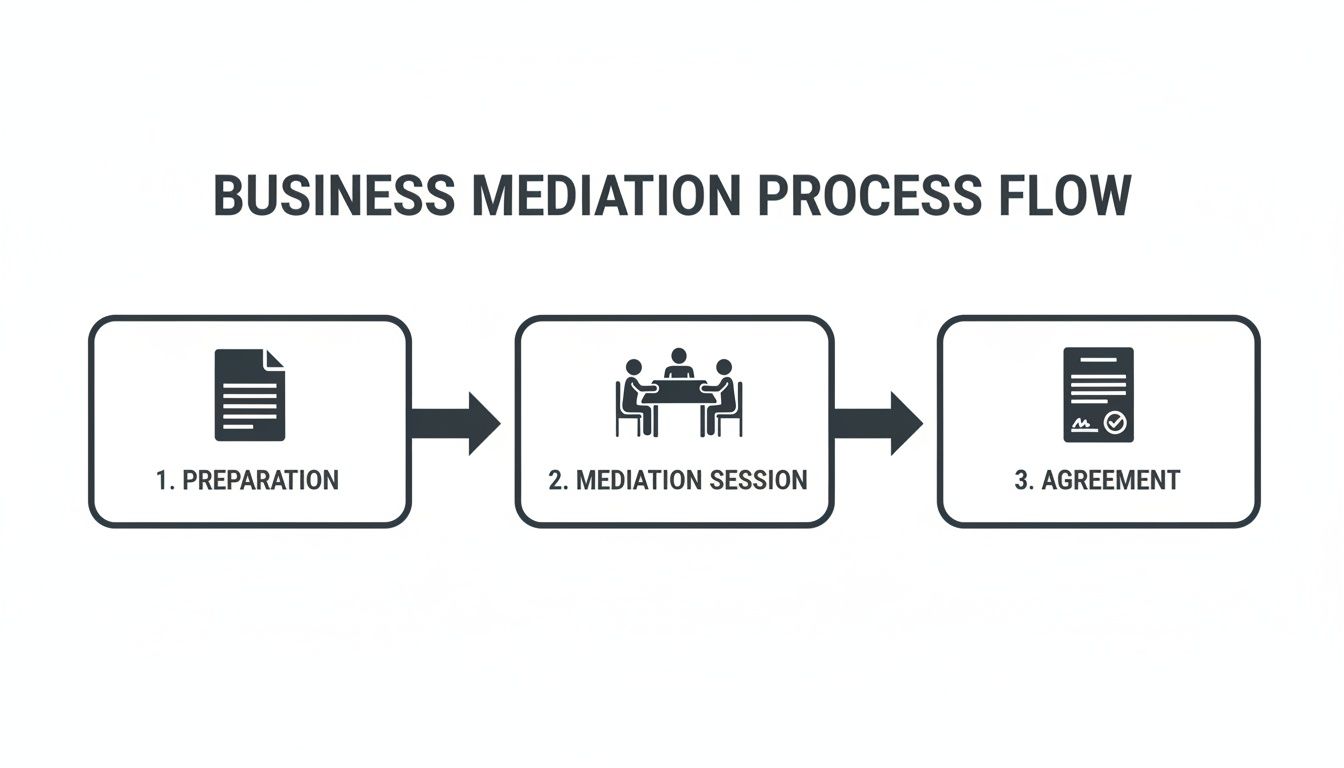
An experienced mediator streamlines every step shown here, from understanding the documents you provide to guiding a productive session focused on relevant issues.
Ensuring True Neutrality and Impartiality
This is non-negotiable. The mediator’s absolute neutrality is the bedrock of the entire process. They cannot have any prior relationship, financial stake, or personal bias that would lean them toward one side. Without complete impartiality, trust is impossible.
A mediator’s credibility is their most valuable asset. Both sides must fully believe that the mediator is there to find a fair resolution, not to advocate for one party’s agenda.
Any reputable mediator in business will have a formal process for checking conflicts of interest before they ever agree to take your case. Make sure you ask about their conflict-check procedure. It’s a critical part of due diligence.
Assessing Process Management and People Skills
Finally, a great mediator is a master of managing both the process and the people. They need to command the room, keep the conversation productive, and know exactly how to de-escalate tension when emotions inevitably run high. This is less about their technical knowledge and more about temperament, experience, and skill.
The value of these professionals is becoming more widely recognized. The U.S. Bureau of Labor Statistics projects that employment for arbitrators, mediators, and conciliators will grow by 4% through 2034, driven by the need to resolve increasingly complex business issues. You can learn more about these employment trends and projections on their official site.
Choosing the right person for this role is essential. A mediator with the right blend of industry knowledge, unwavering neutrality, and strong facilitation skills gives you the best possible chance of reaching a successful, lasting agreement.
If you want to discuss your business law matter, contact Kons Law at (860) 920-5181.
Your Blueprint for a Successful Mediation
Success in mediation isn’t just about what happens in the room; it’s won long before you sit down at the table. Showing up unprepared is a recipe for a poor outcome. The party that does its homework is always more confident, more credible, and far more likely to walk away with a favorable agreement.
Think of this as your roadmap. Following these steps will help you and your counsel turn an uncertain process into a strategic opportunity for your business.

Assembling Your Key Documents
Every strong argument is built on a foundation of facts. Before the mediation date, you need to gather and organize every document that tells the story of the dispute and supports your position. This isn't just about making a pile of paper; it’s about constructing a clear, fact-based narrative.
Your document checklist should include:
- Contracts and Amendments: The original agreement at the center of the dispute, plus any related addendums or subsequent contracts that are relevant.
- Financial Records: Get the numbers in order. This means invoices, payment ledgers, profit and loss statements, or any other data that clearly quantifies your damages.
- Critical Communications: Collect the emails, letters, and meeting notes that create a timeline. These conversations often reveal the core of the disagreement and each party’s understanding of the situation.
- Other Supporting Evidence: Think about project plans, performance reviews, third-party reports, or anything else that backs up your claims.
Having these materials organized allows you to ground every point in solid evidence, which is always more powerful than relying on memory alone.
Defining Your Goals and Settlement Authority
With your evidence organized, the next crucial step is defining what a "win" actually looks like. It’s rarely just about a single dollar amount. You need to understand your Best Alternative to a Negotiated Agreement (BATNA). What will you do if you can’t make a deal?
Your BATNA is your plan B—the point at which you’re better off walking away. Knowing it clearly gives you incredible leverage. It lets you evaluate offers not in a vacuum, but against the real-world risks, costs, and potential outcomes of going to court.
Just as important is making sure the right person is at the table. A mediation will grind to a halt if your representative has to constantly "check with the boss" to approve a term. The decision-maker—the person with full authority to settle—must be present. It signals to the other side that you’re serious about finding a resolution right then and there.
Developing a Smart Negotiation Strategy
Finally, you need a flexible game plan. A good strategy is about more than just listing your demands; it involves anticipating the other party’s moves and being ready for a real conversation.
A solid approach includes:
- Thinking Like the Other Side: Put yourself in their shoes for a moment. What are their business pressures? What do they truly want? Understanding their likely arguments helps you prepare much stronger responses.
- Knowing Where You Can Bend: A successful mediation is almost never a total victory for one side. Figure out ahead of time where you have flexibility. Identifying potential trade-offs can be the key to breaking an impasse.
- Brainstorming Creative Solutions: Look beyond the money. Could you offer a future business deal, a return of goods, or a joint public statement? A skilled mediator in business excels at helping both parties explore these kinds of creative options that a judge could never order.
When you prepare your documents, clarify your BATNA, and map out a negotiation strategy, you shift from a reactive stance to a proactive one. You walk into that room ready to achieve the best possible result for your business.
If you want to discuss your business law matter, contact Kons Law at (860) 920-5181.
Mediation Costs and Confidentiality in Connecticut
For any business owner or executive weighing their options, two questions always come to the forefront: "How much will mediation cost?" and "Can we keep this dispute out of the public eye?"
These aren't just details; they get to the heart of why mediation has become such a smart alternative to traditional litigation. The answers reveal a process that is not only more affordable but also fundamentally more private.
The Financial Advantage of Mediation
Let's talk numbers. Unlike a lawsuit, which can drag on for years with mounting legal bills and unpredictable court costs, mediation offers a much more controlled and foreseeable financial commitment.
Most business mediators in Connecticut operate on one of two fee structures:
- Hourly Rates: This is the most common approach. The mediator bills for their time, including pre-mediation calls, document review, and the session itself. You only pay for the time used.
- Flat Fees: Many mediators offer a flat rate for a half-day or full-day session. This gives you absolute cost certainty from the beginning, which is a huge advantage for budgeting.
In nearly all cases, the parties split the mediator's fee. When you compare this to the tens or even hundreds of thousands of dollars a complex lawsuit can cost, the savings are clear. This cost-effectiveness is driving major market shifts; the U.S. mediation industry is projected to hit a market size of $566.7 million by 2026, with a notable 3.6% revenue jump in 2024 as more businesses turn away from the courthouse. You can see more data on the mediation industry's growth on IBISWorld.
Keeping Your Business, Your Business
Just as important as the cost is the confidentiality. A lawsuit creates a public record. Pleadings, motions, and testimony can be accessed by anyone—competitors, customers, the media. Mediation, on the other hand, happens entirely behind closed doors.
In Connecticut, communications made during mediation are legally privileged. This means what you say in a mediation session generally cannot be used as evidence against you if the case later goes to court. The mediator can’t be forced to testify about the negotiations.
This isn't a handshake agreement; it's a legal shield. At the start of the process, all participants—the parties, their attorneys, and the mediator—sign a formal mediation agreement. This is a binding contract that legally obligates everyone to secrecy.
It's this agreement that ensures your sensitive financial information, trade secrets, and internal strategies remain private. To get a better sense of how these protections are structured, you can read our guide to understanding a confidentiality agreement.
By pairing predictable, manageable costs with ironclad privacy, mediation gives businesses a powerful forum to resolve disputes without the massive financial exposure and reputational damage of a public court fight.
If you want to discuss your business law matter, contact Kons Law at (860) 920-5181.
It’s Time to Take Control of Your Business Dispute
The takeaway is clear: a mediator in business isn’t just a referee for disputes. They offer a strategic advantage, giving you a way to protect your assets, preserve critical relationships, and keep your company moving forward without the public spectacle and uncertainty of a courtroom battle. Mediation puts the power to decide the outcome back in your hands, all within a confidential and cost-effective framework.
Now, the goal is to turn that understanding into a concrete plan. When it comes to business conflicts, proactive strategy always beats reactive damage control.
From Understanding to Action
Don't let a small disagreement fester into a full-blown crisis. Whether you're dealing with a specific issue right now or looking to shield your business from future conflicts, the principles of structured, good-faith negotiation are indispensable.
In fact, many internal issues can be resolved long before you need a formal mediator if you have the right framework in place. Learning how to create an effective escalation process template can empower your team to handle conflicts internally, setting the stage for a more controlled resolution if a larger dispute ever does arise.
Taking decisive action early on prevents minor disagreements from spiraling into costly, time-consuming legal battles. The most successful businesses are those that manage risk proactively, not those that just react to problems.
Ultimately, whether you are embedding mediation clauses into new contracts or navigating a heated partnership dispute, getting expert legal guidance is crucial. An experienced business attorney can help you use mediation to its fullest potential and protect your interests every step of the way.
Your business is far too important to leave its fate to chance. If you are facing a business dispute or want to proactively manage your legal risk, it's time to take the next step.
If you want to discuss your business law matter, contact Kons Law at (860) 920-5181.
