
When it comes to business law, negligence claims aren't about someone intentionally trying to cause harm. Instead, they usually pop up from an accidental failure to be careful enough, leading to someone else getting hurt or suffering a loss.
Think of it less as a malicious act and more like a critical mistake with serious consequences. This kind of oversight is a major risk for any company, making it a common source of legal disputes.
Understanding the Four Pillars of Negligence
For a customer, client, or even an employee to win a negligence case against your business, they have to prove four specific things. These four elements are the foundation of every single negligence claim.
If they can't prove even one of them, their case falls apart. That's why getting a handle on these pillars is the first step toward protecting your business and building a smart defense.
The Core Elements of a Claim
To successfully bring a claim, a plaintiff has to establish each of the following components. Let's break them down in a business context.
Here’s a quick summary of what a plaintiff needs to prove:
The Four Elements of a Negligence Claim
| Element | What It Means for Your Business | A Practical Example |
|---|---|---|
| Duty of Care | You have a legal responsibility to act with a reasonable level of caution to keep others safe from foreseeable harm. | A retail store has a duty to keep its floors free of spills to prevent customers from slipping. |
| Breach of Duty | Your business failed to live up to that legal responsibility or meet the expected standard of care. | An employee sees a puddle of water on the floor but doesn't clean it up or put out a "wet floor" sign. |
| Causation | The plaintiff must show a direct link between your failure (the breach) and their injury. | A customer slips on that exact puddle of water and breaks their wrist. The injury happened because of the wet floor. |
| Damages | The plaintiff must prove they suffered actual, quantifiable harm as a result of the injury. | The customer has medical bills, lost wages from missing work, and can demonstrate physical pain and suffering. |
These four pillars—Duty, Breach, Causation, and Damages—are the essential building blocks. Without all four, there is no case.
A great way to think about causation is the "but-for" test. The injury would not have happened but for the business's careless act. If the injury would have happened anyway, or if something else broke the chain of events, causation can be tough to prove.
Understanding these concepts isn't just for lawyers; it's a crucial part of running a responsible and secure business. You can learn more about what a business lawyer does to help companies navigate these exact challenges and put preventative measures in place.
If you want to discuss your business law matter, contact Kons Law at (860) 920-5181.
How a Negligence Lawsuit Unfolds
Getting sued for negligence can feel overwhelming. When that formal notice arrives, the path forward can seem murky and intimidating. But understanding how the process works, step-by-step, helps demystify the experience and turns that uncertainty into a clear roadmap.
The journey of a lawsuit actually begins long before anyone sets foot in a courtroom. It starts the moment an incident happens and someone believes your business's carelessness caused them harm. That single event is what kicks off a series of formal legal steps designed to bring the dispute to a resolution.
The Initial Complaint and Response
The first official move is the filing of a formal complaint. This is the legal document the plaintiff (the injured party) files with the court to start the lawsuit. It lays out their side of the story and explains how they believe your business met the four elements of negligence: that you owed them a duty, you breached it, that breach caused their injuries, and they suffered real damages as a result.
Once your business is served with the complaint, the clock starts ticking. You have a limited time—usually 21 to 30 days—to file a formal "answer." This is your opportunity to respond to every single allegation, either admitting or denying the claims, and to raise any initial defenses you might have. Missing this deadline is serious; it can lead to a default judgment against you, so you have to act fast.
This flowchart breaks down the fundamental four-step framework a plaintiff has to prove to win their case.
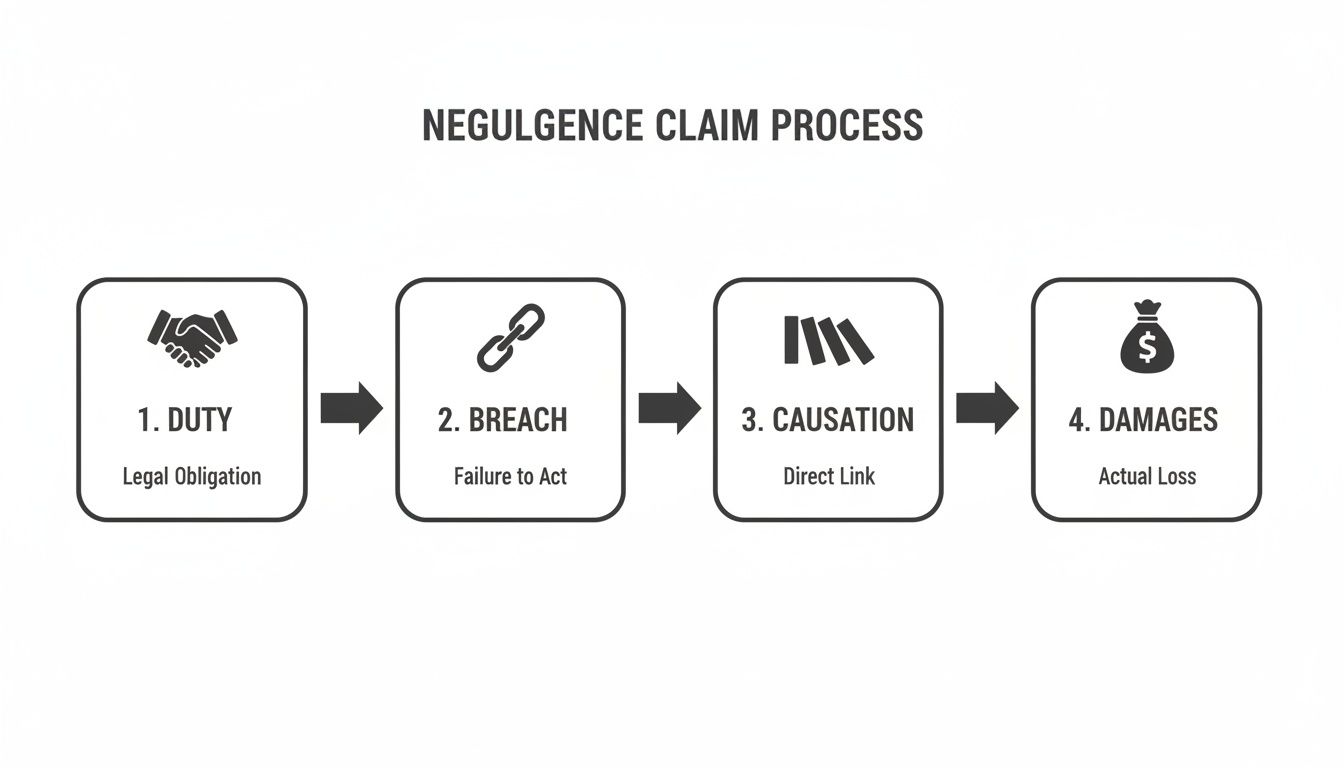
As you can see, the claim is built like a chain. Each element—Duty, Breach, Causation, and Damages—is a necessary link. If even one link is missing, the whole claim falls apart.
Discovery and Pre-Trial Motions
After the initial complaint and answer are filed, the case moves into the discovery phase. Get ready, because this is often the longest and most work-intensive part of the entire lawsuit. It's where both sides exchange information and gather the evidence they need to build their arguments.
Discovery involves a few key activities:
- Interrogatories: These are written questions sent to the other side, which they must answer in writing and under oath.
- Requests for Production: Think of this as a formal demand for documents. We’re talking internal reports, maintenance logs, emails, security footage—anything relevant to the case.
- Depositions: This is out-of-court testimony. Witnesses, employees, and experts are questioned under oath by the opposing attorney, with a court reporter transcribing everything that’s said.
During or after discovery, either side can file pre-trial motions to ask the judge to rule on certain issues. A common one is a motion for summary judgment, where one party basically argues, "Your Honor, the key facts aren't in dispute, and based on those facts, the law is so clearly on our side that you should rule for us now and save everyone the trouble of a trial."
The discovery process is where the rubber meets the road. It’s where the true strengths and weaknesses of a case come to light. This is why meticulous record-keeping and preserving evidence aren't just good business practices—they become your most powerful assets in building a strong defense.
Settlement, Mediation, or Trial
With all the cards on the table after discovery, most negligence cases actually get resolved before ever reaching a trial. Armed with a clearer picture of the evidence, many business owners prefer to explore negotiation or mediation to find a resolution. You can learn more about the pros and cons of alternative dispute resolution vs litigation to see what might make sense for your situation.
Of course, if a settlement can’t be reached, the case moves on to trial. At that point, a judge or jury will hear all the evidence, listen to the arguments, and deliver a final verdict.
If you want to discuss your business law matter, contact Kons Law at (860) 920-5181.
Real-World Negligence Cases and What They Teach Us

Legal theories can feel a bit abstract, floating around in textbooks and law school classrooms. But when they get tested in a real courtroom, those abstract ideas suddenly become very real, with very real consequences. Taking a look at influential law cases negligence helps translate legal principles into practical lessons for any business owner.
These aren't just old stories; they are powerful examples of how the four elements of negligence—duty, breach, causation, and damages—play out in everyday situations. By digging into these cases, we get a much clearer picture of what judges and juries consider "reasonable care" and, more importantly, when a business has dropped the ball. To really get a handle on this, it's helpful to review some landmark tort court cases.
The Classic Case of Foreseeability
One of the most famous cases in American negligence law is Palsgraf v. Long Island Railroad Co. from way back in 1928. The situation itself sounds almost made up: a man carrying a package of fireworks was being helped onto a moving train by railroad employees. He dropped the package, it exploded, and the blast knocked over some heavy scales at the other end of the platform, which then fell and injured a woman named Mrs. Palsgraf.
The court had a tricky question to answer: Was the railroad responsible for her injuries? The final decision gave us a concept that every single business owner needs to understand: foreseeability. The court ruled that the railroad couldn't be held liable because its employees could not have reasonably foreseen that pushing a man onto a train would lead to an injury to someone standing so far away.
The core lesson from Palsgraf is that your duty of care only extends to harms that are a reasonably foreseeable consequence of your actions. You aren't expected to be a psychic who can prevent every bizarre accident, but you are responsible for anticipating and preventing the predictable risks tied to how you run your business.
Connecticut Law Cases Negligence In Action
While the big, famous cases set the stage, it’s the local state rulings that give us the most direct guidance. Connecticut's courts have applied these broad negligence principles in ways that directly affect businesses operating right here.
A key example is Jagger v. Mohawk Mountain Ski Area, Inc. (2004), which involved a skier injured in a collision with another skier. The Connecticut Supreme Court took on the "assumption of risk" doctrine. They clarified that while skiers assume the risks that are inherent to skiing, they don't assume the risk of someone else being negligent.
This ruling teaches a vital lesson for recreational businesses. It also highlights how a Limited Liability Company structure can be a key part of your risk management plan. Understanding the details of liability in an LLC is crucial for protecting your personal assets if your business gets sued.
The Practical Takeaway for Your Business
These cases are more than just interesting legal history. They offer clear, actionable insights you can use to protect your own business.
- Palsgraf and Risk Assessment: Look at your business operations through the lens of foreseeability. Could something an employee does have a ripple effect that hurts a customer or even a random bystander? Thinking through these "what if" scenarios is the heart of proactive risk management.
- Jagger and Clear Communication: Your waivers, signs, and customer agreements need to clearly spell out the inherent risks of an activity. But remember, a waiver isn't a get-out-of-jail-free card for your own negligence. You still have a duty to maintain a safe environment and follow your own safety rules.
By learning from these examples, you can shift from putting out fires to preventing them in the first place. Every decision, from how you train your staff to how you maintain your property, can be viewed through the lens of reasonable care. It's a mindset that can help you avoid a costly, stressful legal battle down the road.
If you want to discuss your business law matter, contact Kons Law at (860) 920-5181.
Building a Strong Defense Against Negligence Claims
Just because someone files a negligence claim against your business doesn't mean it’s the end of the story. Facing a lawsuit is undeniably stressful, but it’s critical to remember that you aren’t defenseless. The law provides a powerful toolkit for challenging allegations, reducing liability, or even having a case dismissed entirely.
Successfully navigating these law cases negligence almost always comes down to building a smart, evidence-based defense strategy from the very beginning. Let's break down some of the most effective defenses available.
Shifting Responsibility: Comparative Negligence
One of the most common and powerful defenses here in Connecticut is comparative negligence. This legal concept gets straight to the point: accidents are rarely one person’s fault entirely. It acknowledges that the injured person might have played a role in their own misfortune.
Connecticut uses what’s called a "modified" comparative negligence rule. In simple terms, if the person suing you (the plaintiff) is found to be partially to blame for what happened, any money they are awarded gets reduced by their percentage of fault. So, if a jury awards $100,000 but decides the plaintiff was 30% responsible, the actual payout drops to $70,000.
Here’s the most important part: if the plaintiff is found to be 51% or more at fault, they get nothing. Zero. This 51% bar acts as a complete shield, making it a cornerstone of many defense strategies in business litigation.
This is why your team must dig into the plaintiff's actions. Did they blow past obvious warning signs? Were they using your product in a way it was never intended? Uncovering evidence of their contribution can completely change a case’s outcome.
Assumption of Risk and Other Key Defenses
Another crucial defense is the assumption of risk. This applies when a person willingly and knowingly steps into a situation with obvious, inherent dangers. Think about someone attending a baseball game—they know there's a chance a foul ball could fly into the stands. Or someone signing up for a physically intense obstacle course.
To use this defense effectively, you typically have to prove two things:
- The plaintiff genuinely understood the specific risk they were taking.
- They voluntarily decided to proceed anyway.
Beyond these, a few other defenses can be just as potent.
- Statute of Limitations: Time is not on the plaintiff's side. In Connecticut, there’s a strict two-year deadline to file most negligence lawsuits from the date of the injury. If they miss that window, their case can be thrown out, no matter how strong it might have been.
- Lack of Causation: A sharp defense will often work to break the "chain of causation." The argument here is that even if your business made a mistake, that specific mistake wasn't the direct, primary cause of the plaintiff’s actual injuries.
It's important to know that the odds can vary. Defense success rates in negligence cases differ based on the situation. For instance, medical malpractice cases see a defense success rate of 81%, while premises liability cases are closer to 61%.
The Power of Documentation and Evidence
Ultimately, a strong defense is built on a foundation of solid evidence. This is where meticulous record-keeping becomes your greatest asset. Things like incident reports, maintenance logs, employee training records, and clear safety protocols aren't just paperwork—they are the very building blocks of your legal protection.
Understanding every angle is key. For example, knowing the details of security guard liability and having the documentation to back up your security program can be vital. An experienced business litigation lawyer can help you pinpoint and preserve the exact evidence you need to shield your company.
If you want to discuss your business law matter, contact Kons Law at (860) 920-5181.
Proactive Strategies to Prevent Negligence Lawsuits
The best way to handle the complexities of a negligence lawsuit is to stop it from ever happening. While having a strong legal defense is essential if you're sued, a proactive offense—built on a foundation of safety, solid training, and foresight—is always the better strategy. Implementing practical, common-sense measures can dramatically reduce your risk and protect your company's future.
Shifting your company culture from reactive to proactive is the single most important step you can take. This isn't just about a new slogan; it's about viewing every operational decision through the lens of risk management. It means creating an environment where preventing harm is a shared responsibility, not just another rule in a handbook.

Fortifying Your First Line of Defense
Your day-to-day operations are where most vulnerabilities lie, but they're also where you have the most control. Developing robust safety protocols and making sure they are followed every single time is non-negotiable. This doesn’t mean creating overly complex rules, but rather establishing clear, understandable standards for every task your team performs.
Consistent employee training is the engine that drives this culture forward. It’s not enough to hand an employee a manual on their first day and hope for the best. Regular, documented training sessions ensure that safety stays top-of-mind and that your team is ready to handle foreseeable risks.
A well-documented training program does more than just educate your staff; it becomes a powerful piece of evidence in your favor. It demonstrates that your business took reasonable steps to prevent harm, a critical factor in defending against a negligence claim.
The Power of Paperwork and Policies
Diligent record-keeping is one of the most cost-effective risk management tools you have. Maintaining detailed logs for maintenance, inspections, and employee training creates a verifiable history of your commitment to safety and responsibility.
Just as important are the legal documents that define your relationships with customers. Carefully drafted contracts, waivers, and disclaimers can help manage liability from the very beginning. These documents should clearly outline responsibilities, acknowledge any inherent risks, and set clear expectations for everyone involved.
Securing the Right Insurance Coverage
Even with the best prevention strategies in place, accidents can still happen. This is where a comprehensive insurance portfolio becomes your financial safety net. Understanding the different types of coverage is absolutely essential.
- General Liability Insurance: This is your foundational coverage. It protects your business against claims of bodily injury or property damage that happen on your premises or as a result of your operations.
- Professional Liability Insurance: Often called Errors & Omissions (E&O) insurance, this is critical for any service-based business. It covers claims of negligence related to professional mistakes, failures to perform, or even bad advice.
- Product Liability Insurance: If your business manufactures, distributes, or sells products, this coverage is vital. It protects against claims arising from defects in your products that cause injury or harm to a consumer.
Think of insurance not as an expense, but as a critical investment in your business’s long-term stability. The right policies ensure that one unfortunate incident doesn’t spiral into financial ruin. By combining a proactive safety culture with smart legal and financial protections, you build a formidable shield against potential negligence lawsuits.
If you want to discuss your business law matter, contact Kons Law at (860) 920-5181.
How to Respond When Facing a Negligence Claim
Nothing quite prepares you for the moment you receive a legal notice claiming your business was negligent. It's a jarring, stressful experience, and it’s easy to feel completely overwhelmed. But what you do in these first few hours and days is absolutely critical. Acting decisively and correctly from the start can dramatically change the outcome of the case.
The single most important first step is to seek professional legal guidance immediately. In these situations, time is not on your side. Lawsuits come with strict deadlines for responding, and missing one can lead to a default judgment against your company—meaning you lose without ever getting to tell your side of the story. Whatever you do, don't try to contact the plaintiff or their lawyer on your own. Anything you say can and will be used against you.
Your Immediate Action Plan
Once you receive that complaint, your focus needs to shift to two things: preservation and preparation. Do not wait.
- Contact Legal Counsel: Your first call should be to an experienced business litigation attorney. They can dig into the law cases negligence details, explain your rights and obligations, and start putting together a defense strategy.
- Notify Your Insurance Carrier: Let your general or professional liability insurance provider know about the claim right away. Your policy almost certainly requires you to give prompt notification, and failing to do so could put your coverage at risk.
- Preserve All Evidence: Put a "litigation hold" in place for your entire team. This is a formal directive that means no one can alter, delete, or destroy any documents, emails, video footage, or records even remotely related to the incident. This isn't just a good idea—it's a legal duty.
Protecting your business requires swift, informed action. The initial response sets the tone for the entire legal proceeding and is your best opportunity to build a strong defense from a solid foundation.
How you respond to a negligence claim is a defining moment for your business. This is no time for guesswork or delay. If you want to discuss your business law matter and ensure your company is properly defended, contact Kons Law at (860) 920-5181 to get the experienced legal counsel you need.
Got Questions About Business Negligence? We’ve Got Answers.
When it comes to the world of business negligence, a lot of specific questions can pop up. Getting your head around these details is the key to protecting your company and making smart decisions if you ever find yourself staring down a potential lawsuit. This section cuts through the legal jargon to give you clear, straightforward answers to the questions we hear most often from business owners about law cases negligence.
Our goal here is to trade uncertainty for confidence. These aren't just academic answers; they address the practical, real-world concerns that directly impact how you should prepare for and respond to liability risks.
What's the Real Difference Between Negligence and Gross Negligence?
Think of negligence as a form of carelessness. It's the failure to use a reasonable level of care, leading to someone getting hurt. It’s an accidental oversight—like an employee forgetting to mop up a spill in an aisle. It wasn't malicious, but it was a lapse in duty.
Gross negligence, on the other hand, is a whole different beast. This isn't just a mistake. It’s a conscious and reckless disregard for the safety of others. It’s seeing a very obvious and serious risk and willfully ignoring it. While a standard negligence claim usually results in compensation for the victim's actual losses, a finding of gross negligence can open the door to punitive damages, which are designed to punish the defendant.
Am I on the Hook if My Employee Messes Up?
Yes, in most cases, your business is responsible. This is a legal concept called "respondeat superior," which is Latin for "let the master answer." Essentially, this rule holds you, the employer, liable for the negligent things your employees do while they're on the clock and acting within the scope of their job.
For example, if your company’s delivery driver causes a car accident while running their route, your business can be sued for the damages. This is exactly why thorough employee vetting, solid training programs, and clear supervision aren't just "good management"—they are absolutely essential risk-mitigation strategies.
How Does Connecticut’s "Comparative Negligence" Rule Affect My Business?
This is a big one for any business facing a lawsuit in this state. Connecticut uses a "modified comparative negligence" rule. In simple terms, it means that if the person suing you (the plaintiff) is found to be partially at fault for their own injury, the money they can recover from you is reduced by their percentage of fault.
But here’s the most important part: the 51% threshold. If the plaintiff is found to be 51% or more responsible for what happened, they are completely barred from recovering any damages. For your business, this means proving the plaintiff’s own carelessness contributed to their injury can dramatically limit—or even completely wipe out—your financial liability.
How Long Does Someone Have to Sue for Negligence in Connecticut?
That deadline is set by the statute of limitations. For most general negligence and personal injury cases here in Connecticut, a lawsuit must be filed within two years from the date the injury happened or was reasonably discovered.
If someone misses that two-year window, their case is typically gone for good. It doesn't matter how strong their claim might have been; the deadline provides a complete and final defense for your business.
If you want to discuss your business law matter, contact Kons Law at (860) 920-5181.
