You’re likely reading this because a termination decision is sitting on your desk right now.
An employee isn’t performing, the team is frustrated, and management wants to move quickly. In Connecticut, that instinct can create avoidable legal exposure if the file, the timing, or the explanation doesn’t hold up. The law gives employers room to act, but that room is narrower than many business owners assume.
A practical guide to wrongful termination laws ct starts with one reality. Most termination cases don’t turn on whether the employer had business reasons. They turn on whether those reasons were documented, consistently applied, and free from unlawful motive. That’s where businesses win or lose.
Understanding Connecticut's At-Will Employment Doctrine
Connecticut follows at-will employment. In plain terms, an employer can usually end the employment relationship at any time, and an employee can leave at any time. But that rule has never meant “anything goes.”
Connecticut recognizes that a termination becomes legally risky when it collides with a statute, a contract, or public policy. That principle was reinforced by Sheets v. Teddy's Frosted Foods, Inc. (1980), which recognized wrongful discharge claims when a firing violates a clear mandate of public policy, as explained in Baker Donelson’s Connecticut employment guide.

What at-will actually protects
At-will status protects ordinary business decisions. A company can usually terminate for restructuring, poor fit, unsatisfactory performance, attendance issues, or a breakdown in working relationships.
That’s the part managers know.
The part they often miss is that the same decision becomes harder to defend when it happens right after a protected complaint, a leave request, or a workplace report. At that point, the issue usually isn’t whether the employer had concerns. The issue is whether those concerns were the actual reason.
Practical rule: Treat every termination as if an outside investigator will later ask for the paper trail, the timeline, and the decision maker’s explanation.
Why business owners misread the doctrine
The phrase “at-will” sounds broader than it is. It encourages speed, and speed is where mistakes happen. A rushed firing often exposes unrelated problems that were sitting in the background all along, such as a sloppy handbook, inconsistent discipline, or a supervisor who made careless comments.
This is also where employment contracts matter. A written agreement can narrow termination rights, and even internal documents can create expectations that complicate the analysis. Businesses that want a clearer baseline should understand how employment contracts shape termination rights.
The real question before termination
Before any discharge, ask a more useful question than “Can we fire this person?”
Ask this instead:
- Business reason: Is there a legitimate operational basis for the decision?
- Protected activity: Has the employee recently engaged in conduct that could trigger legal protection?
- Consistency: Have other employees been treated the same way for similar conduct?
- Documents: Does the file show the problem before the termination decision?
- Messaging: Can management explain the reason clearly and consistently, without improvising?
If those answers are weak, the at-will doctrine won’t rescue the decision. It only provides the default rule. The litigation risk lives in the exceptions.
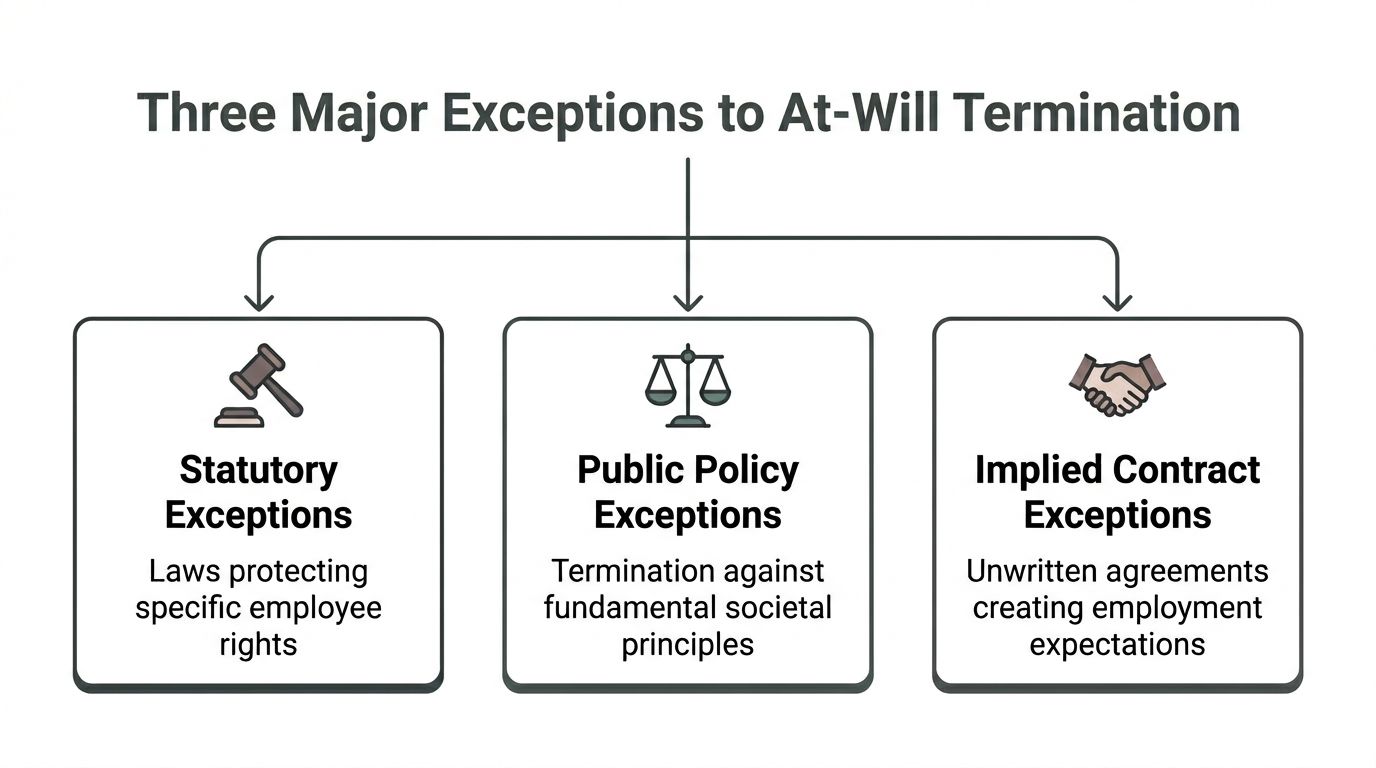
The Three Major Exceptions to At-Will Termination
For employers, most Connecticut termination risk falls into three buckets. Connecticut’s framework recognizes violations of CFEPA, retaliation for protected activities, and breach of implied employment contracts derived from handbooks or company policies, as summarized by WorkforceHub’s overview of Connecticut termination law.
That structure is useful because it gives management a working checklist. Before ending employment, determine whether the facts fit one of these categories.
Statutory claims
The first category is statutory protection. In Connecticut, CFEPA applies to employers with three or more employees. That matters because many small business owners assume discrimination laws only become relevant at a larger size. That assumption can be expensive.
Statutory claims often arise from terminations tied to protected characteristics or legally protected rights. Common pressure points include disability issues, pregnancy, age, religion, sex, gender identity, sexual orientation, and other protected classifications under state law.
A leave-related termination deserves special caution. If the employee recently requested or used protected leave, the company should pause and review the record carefully. Leave law and termination law often intersect in ways managers underestimate, especially when attendance, medical restrictions, and accommodations all appear in the same file. Businesses dealing with that overlap should understand Connecticut FMLA eligibility rules before acting.
Retaliation and public policy claims
The second category is retaliation, which often overlaps with public policy concerns.
These cases tend to frustrate employers because the underlying employee may have performance problems. But a weak employee can still bring a strong retaliation claim if the timing is poor and the documents are thin. If someone complained about discrimination, reported wage issues, sought leave, filed a workers’ compensation claim, or raised safety concerns, management should assume any later discharge will receive closer scrutiny.
A retaliation claim usually gains traction through the sequence of events. The employer says performance drove the decision. The employee points to the complaint, the leave request, or the report that happened shortly before the termination. If the file doesn’t show a clear history, the employer’s stated reason can look manufactured.
A good business reason won’t carry the day if your records make it look like the reason was chosen after the fact.
Implied contract claims
The third category surprises business owners most. Employers think they have no contract because they never signed a formal employment agreement. Connecticut law is less simple than that.
Handbooks, offer letters, policy language, and repeated managerial promises can all create risk. If your documents suggest employees will only be terminated for cause, or only after certain steps, a discharged employee may argue that the company limited its own discretion.
A short comparison helps:
| Risk source | What creates it | Common employer mistake |
|---|---|---|
| Formal contract | Written employment terms | Assuming outdated agreements no longer matter |
| Implied contract | Handbook language, policy statements, consistent practices | Calling employment “at will” in one section but promising mandatory discipline in another |
| Public policy conflict | Firing linked to protected conduct or legal obligations | Focusing only on performance and ignoring recent complaints or reports |
What works and what doesn’t
Some approaches reduce risk. Others make it worse.
- What works: Review the file before the final decision, confirm policy consistency, and identify any recent protected activity.
- What works: Separate frustration from legal analysis. Managers often want to fire for many understandable reasons that still require a slower process.
- What doesn’t work: Relying on “we’re an at-will state” as the full analysis.
- What doesn’t work: Changing the stated reason over time.
- What doesn’t work: Assuming unsigned handbooks or informal promises have no legal effect.
Most defensible terminations are built before the meeting happens. Most problematic ones are built by neglect.
Recognizing Common Wrongful Termination Claims
Wrongful termination claims usually don’t arrive labeled in plain English. They show up as allegations that a discharge was really about disability, leave, whistleblowing, sex, age, or retaliation. For business owners, the important point isn’t only the theory. It’s the cost and distraction that follow.
Connecticut case results show that these matters can become expensive. Attorney James Sabatini reports a $235,000 settlement including reinstatement, back pay, benefits, and seniority restoration for a Hartford police officer in an FMLA and ADA wrongful termination matter, and a $120,000 settlement in another FMLA and ADA disability discrimination case. The same case results page also notes a $1.5 million award in a systemic gender discrimination matter and $500,000 in a whistleblower retaliation case. That same source states that actual incidents may be 5 to 10 times higher than reported because of underreporting. See the documented examples in Sabatini Employment Law’s case results.

Leave and disability claims
A common business mistake is treating leave as a performance issue. The problem often starts with legitimate operational strain. A supervisor needs coverage. The employee’s attendance is inconsistent. Deadlines are slipping.
Then the file turns dangerous because the employee also requested medical leave, disclosed a disability, or sought an accommodation. If management documents only the disruption and ignores the legal overlay, the eventual termination can look retaliatory or discriminatory.
These cases are rarely about one email. They’re about patterns. Did the company engage appropriately? Did it separate attendance frustration from legal obligations? Did the manager’s comments suggest impatience with the leave itself?
Retaliation claims after complaints
Another frequent claim starts when an employee raises a concern internally. Maybe it’s a discrimination complaint, a wage concern, or a report about safety or compliance. If termination follows, the company must be able to show that the decision was underway for independent reasons and supported by records created before the complaint.
Relying on memory often harms employers. A manager may believe performance has been poor for months, but if the only written criticism appears after the complaint, the employee’s narrative becomes easier to sell.
The most persuasive defense usually isn’t a dramatic rebuttal. It’s a quiet, consistent record showing the same problem before and after the protected event.
Claims that grow beyond one issue
Many termination disputes begin with one accusation and expand during review or litigation. A business may think it’s defending a simple performance discharge, then face overlapping allegations involving leave, accommodation, retaliation, handbook language, or inconsistent discipline.
That’s why these claims aren’t just an HR problem. They affect leadership time, internal morale, and how future personnel decisions get made. One poorly handled firing can make every later termination harder because employees compare treatment and look for inconsistency.
A useful internal test is straightforward:
- If the employee recently complained, requested leave, or disclosed a medical issue, slow down
- If managers disagree on the reason for discharge, stop and reconcile the story before acting
- If the file contains praise followed by sudden termination language, expect a pretext argument
- If your handbook promises steps you skipped, reassess before proceeding
The law doesn’t require perfect employers. It does punish employers who can’t explain their own decisions.
Navigating Critical Timelines and Filing Deadlines
Timing drives advantage in employment disputes. Many employers know there’s a short window for discrimination-related filings, then assume the risk disappears once that period closes. That’s a mistake.
Some Connecticut termination claims move on an administrative track. Others don’t. The filing path depends on the legal theory, and each theory creates a different exposure period.
The short window employers usually know
For discrimination and many retaliation claims, the administrative deadline is often the first major issue. Connecticut sources commonly focus on the CHRO and EEOC timeline because it forces employees to act quickly.
That short deadline matters for employers too. It affects document preservation, witness preparation, and how early the company should involve counsel. A sloppy response during the opening phase can shape the case for the rest of the dispute.
The longer windows employers often miss
The more overlooked problem is that some claims live much longer. According to this discussion of Connecticut wrongful termination limitation periods, breach of a written contract has a six-year limit, implied contract claims have a three-year limit, and the source also discusses 2026 legislative changes introducing a two-year statute for certain retaliation claims tied to new family leave reporting.
That means a business can’t think in terms of one deadline. A discrimination filing window may pass, but contract-based claims may remain. The practical lesson is simple. Preserve the record as though a claim may emerge later under a different theory.
A broader understanding of Connecticut statutes of limitations also helps management avoid false comfort about what has or hasn’t expired.
A practical timeline framework
Use this framework when assessing risk after a termination:
Identify the claim type first
Don’t ask only whether the employee could file with an agency. Ask whether the facts also suggest contract, policy, or retaliation theories.Lock down records immediately
Preserve personnel files, emails, investigation notes, leave records, and any drafts related to the termination decision.Map the decision chronology
Build the timeline from first performance concern to final discharge. Timing often determines whether the employer looks disciplined or reactive.Review post-termination communications
Severance discussions, unemployment responses, reference checks, and internal messaging can all create later inconsistencies.
Deadline insight: The expiration of one filing route doesn’t mean the matter is over. It may only mean the employee needs a different theory.
Where businesses create unnecessary exposure
Several avoidable habits show up repeatedly:
- Overwriting the file after termination: Adding backdated summaries or “clean-up” memos usually creates more trouble than it solves.
- Ignoring handbook language: Contract-style claims often arise from documents managers forgot existed.
- Treating leave retaliation as a niche issue: It isn’t. Leave disputes frequently overlap with termination decisions.
- Assuming silence means safety: Some employees don’t act immediately. That doesn’t mean the risk is gone.
The best response to these deadlines isn’t panic. It’s discipline. Once a termination happens, the company should think like a future fact witness and protect the record accordingly.
Proactive Compliance to Mitigate Termination Risks
Most businesses don’t lose termination cases because they lacked authority to act. They lose because the record suggests the stated reason wasn’t the actual one. In wrongful termination laws ct disputes, pretext is often the central fight.
For smaller employers, that’s where compliance becomes operational, not theoretical. Cicchiello Law Firm’s discussion of wrongful termination notes that only 15 to 20% of complaints result in probable cause findings, and it ties defensibility to detailed documentation of progressive discipline and the employer’s ability to present a legitimate business reason.

Build a file that makes sense to an outsider
A defensible personnel file should tell a coherent story without help from memory. If a manager says performance has been poor for months, the file should show that. If the company says it gave the employee chances to improve, the record should reflect those chances.
That doesn’t require bloated paperwork. It requires consistent paperwork.
Useful documentation usually includes:
- Contemporaneous notes: Short, dated records of coaching conversations beat long reconstructed narratives created after the dispute starts.
- Specific examples: “Missed reporting deadlines on these projects” is stronger than “bad attitude” or “not a team player.”
- Clear expectations: Employees should know what must improve, by when, and who is evaluating the improvement.
- Follow-up records: If management says it will reassess in two weeks, someone should document the reassessment.
Progressive discipline works when it’s real
Progressive discipline isn’t magic, and it isn’t mandatory in every case. Serious misconduct may justify immediate action. But in the broad middle range of performance problems, progressive discipline gives employers a more credible record.
It also exposes weak management practices. A supervisor who avoids feedback for months and then pushes for sudden termination creates a pretext problem. The employee may have deserved discipline, but the process still looks reactive.
A practical compliance system often includes these parts:
| Compliance tool | Why it matters | Common failure |
|---|---|---|
| Handbook language | Sets expectations and defines procedures | Promising mandatory steps the company doesn’t actually follow |
| Performance reviews | Creates a regular record outside conflict periods | Inflated praise that contradicts later termination reasons |
| Discipline forms | Shows notice and opportunity to improve | Using generic wording with no facts |
| Manager training | Improves consistency in responses | Letting each supervisor invent their own process |
Policy drafting deserves more care than most companies give it
Many implied contract disputes start with well-intended language drafted casually. Handbooks should be reviewed for mixed signals. If one page says employment is at will, but another says employees will be terminated only after certain required steps, the business has created an argument it didn’t need.
Behavior policies matter too. A simple, well-written workplace standard can do more than a stack of legalese. If you’re revisiting expectations around reporting, conduct, conflicts, and respectful workplace behavior, a practical overview of a Code of Conduct can help frame what strong policy architecture looks like before counsel customizes it for your business.
For day-to-day operations, a broader small business compliance checklist can also help management identify gaps before they become litigation exhibits.
Good compliance doesn’t eliminate hard termination decisions. It makes those decisions easier to defend because the business can show method, consistency, and notice.
What usually doesn’t work
Several habits repeatedly undermine employers:
- Saving criticism for the termination meeting
- Using vague labels instead of facts
- Letting one supervisor promise exceptions outside policy
- Treating similar misconduct differently without explanation
- Rewriting history once a complaint appears
Businesses that approach termination risk proactively usually spend less time in crisis mode. They also make better management decisions because the discipline process forces clarity before emotion takes over.
Conducting a Legally Defensible Termination
The termination meeting is the end of the process, not the beginning. If the legal analysis starts when the employee is called into the room, the company is late.
A defensible discharge usually comes from a calm review, a controlled meeting, and disciplined follow-through afterward. The goal isn’t to “win” the conversation. It’s to complete the separation with clarity and without creating fresh evidence problems.
Before the meeting
Start with a final file review. Look at the discipline history, performance reviews, prior complaints, leave issues, accommodation discussions, and any recent protected activity. If there’s a mismatch between the written record and the reason management plans to give, stop there and resolve it.
A pre-termination checklist should include:
- Decision maker review: Confirm who made the decision and why
- Policy check: Verify the company followed its own handbook and practices
- Comparator check: Consider whether others were treated differently for similar conduct
- Protected activity review: Identify any recent complaint, leave request, injury report, or investigation involvement
- Exit logistics: Prepare final pay information, benefits notices, device return procedures, and access shutdown
If serious red flags are present, management should consult counsel before moving forward. That’s especially true where multiple legal issues overlap.
During the meeting
Keep the meeting brief, respectful, and direct. Usually, two employer representatives should attend. One should lead the conversation. The other should serve as a witness and help keep the discussion on track.
What works in the room:
- State that employment is ending.
- Give the core reason in a concise, consistent way.
- Explain immediate logistics.
- Avoid arguments.
- Avoid editorial comments about personality, loyalty, or future employability.
What doesn’t work:
- Debating every past incident
- Expanding the reason beyond what the file supports
- Ad-libbing legal conclusions
- Making promises about references, severance, or reconsideration that haven’t been approved
A termination meeting should sound measured, not emotional. The employer is delivering a decision, not litigating the entire employment history.
After the meeting
Post-termination handling matters more than many employers realize. Internal communications should be controlled and minimal. Unemployment responses should align with the stated termination reason. Reference practices should follow company policy.
Severance can also be useful in the right case. A carefully drafted severance agreement may reduce litigation risk, but only if it fits the facts, uses proper release language, and is presented correctly. Severance should never be treated as a template exercise.
The same is true for records. Preserve everything relevant and assume the file may later be reviewed by a regulator, agency investigator, arbitrator, or trial lawyer. A clean process after discharge often prevents a manageable dispute from becoming a larger one.
Protect Your Business with Proactive Legal Counsel
The practical lesson in wrongful termination laws ct isn’t that employers should avoid difficult personnel decisions. It’s that they should make those decisions with structure.
Connecticut’s at-will doctrine gives businesses flexibility, but the exceptions carry real weight. Statutory claims, retaliation claims, and implied contract arguments all turn ordinary management frustrations into legal disputes when the process is loose. The businesses that manage this risk best don’t wait for a claim letter. They audit handbooks, train supervisors, document performance consistently, and slow down when timing creates suspicion.
That approach also helps if a dispute moves into litigation or arbitration. Employment cases often hinge on what was said, what was written, and how the record was preserved. For teams that want a clearer sense of how sworn testimony later gets evaluated, this explanation of understanding the role of deposition transcripts in legal testimony is a useful primer on why precise statements and clean documentation matter long before anyone sits for a deposition.
Legal counsel is most effective before the termination, not after the complaint. A lawyer can help spot the issue that management is too close to see, whether that’s a leave problem, a handbook contradiction, a retaliation risk, or a severance opportunity. That kind of review isn’t a sign your business is in trouble. It’s a sign you’re managing the business like a business.
If a termination feels straightforward, that may be true. But straightforward facts can still produce complicated claims when the paperwork, policy language, or timing sends the wrong message. Careful review on the front end is almost always cheaper than defending a preventable dispute later.
If you want to discuss your business law matter, contact Kons Law at (860) 920-5181.
