
You've accepted a role at a broker-dealer, your start date is approaching, and someone in compliance has told you that passing the Series 7 is only one part of becoming fully registered. You may be wondering whether you can just sign up, how sponsorship works, what information your employer will file, and what happens if a disclosure on your record creates a problem.
The practical answer to how to get your Series 7 begins with eligibility, not studying. The process combines the Securities Industry Essentials exam, firm sponsorship, a Form U4 filing, and the Series 7 examination itself. After you pass, registration brings continuing compliance responsibilities that can affect your employment, outside activities, personal trading, and future moves between firms.
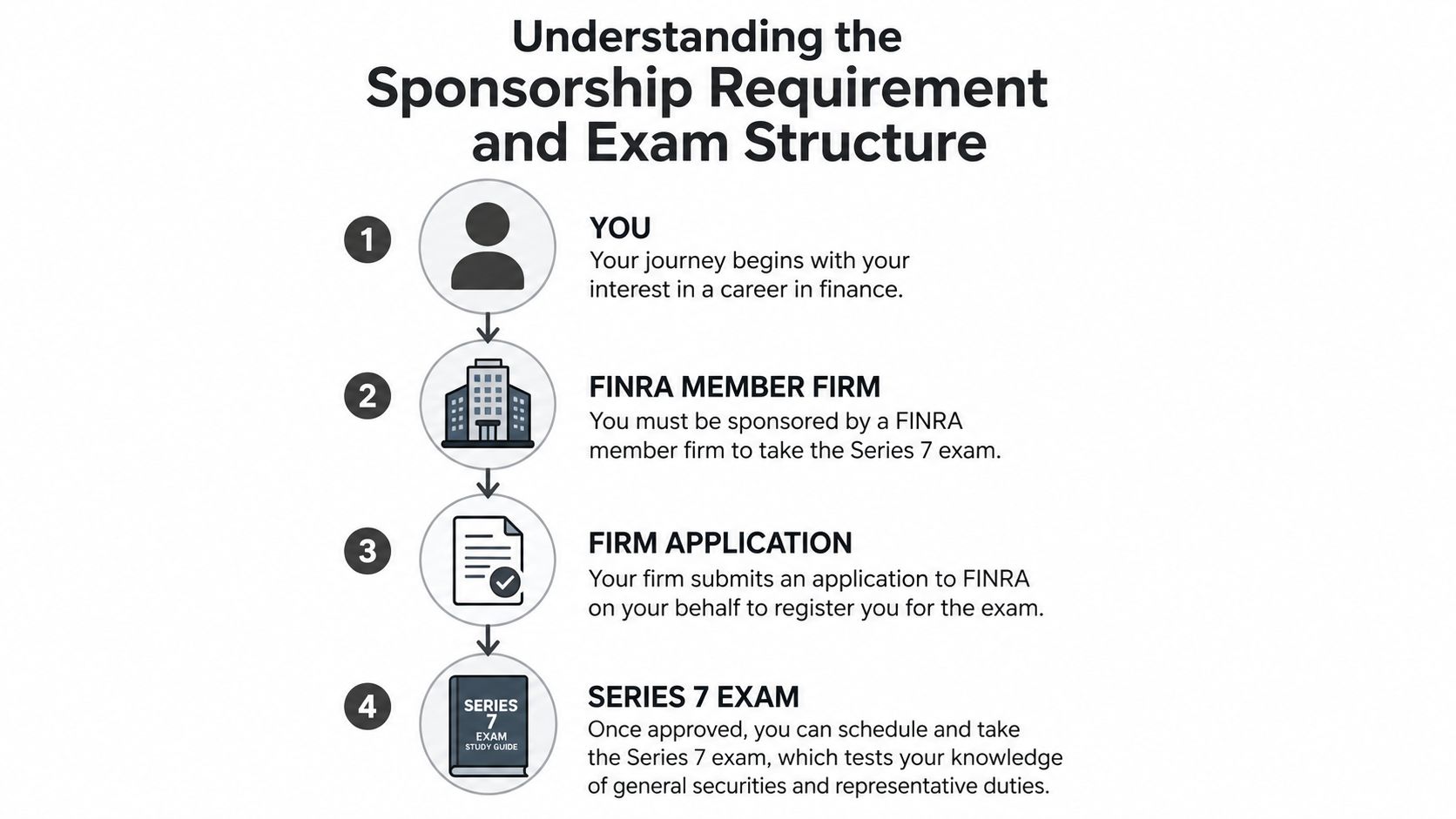
Understanding the Sponsorship Requirement and Exam Structure
The first gate is sponsorship. Candidates must be associated with and sponsored by a FINRA member firm or another eligible self-regulatory organization member firm before they can take the Series 7, according to FINRA's Series 7 qualification information. You can't register for the Series 7 as a member of the general public taking an independent professional exam.
That requirement changes your planning. A sponsoring firm typically decides whether your role requires the registration, submits the necessary registration information, and places you within its supervisory and compliance structure. Sponsorship isn't merely an administrative courtesy. It connects the exam to an actual securities-industry role and gives the firm responsibility for your registration.
The two-exam pathway
Since October 1, 2018, candidates seeking General Securities registration must pass both the SIE exam and the Series 7 exam, as reflected in FINRA's qualification framework. The SIE establishes foundational knowledge, while the Series 7 tests the broader responsibilities associated with a general securities representative.
The SIE can be taken without firm sponsorship. The Series 7 cannot. Passing the SIE therefore lets you complete part of the licensing pathway independently, but it doesn't give you authority to perform activities requiring General Securities registration.
Once the firm sponsors you, the Series 7 registration moves through the firm's process. If you change firms before testing, ask both firms and their compliance departments how the registration will be handled. A new employer may need to submit or update filings, and your exam authorization may depend on the status of the original sponsorship. Don't assume that an offer letter automatically transfers an active registration process.
Practical rule: Confirm in writing which entity is sponsoring you, who is responsible for the filing, and what happens if your employment changes before the exam date.
The Series 7 is a 3-hour-and-45-minute computer-administered exam with 125 scored questions, and FINRA lists a $395 fee on its qualification page. Candidates must also complete the SIE requirement to obtain General Securities registration. Before accepting sponsorship, review the firm's role expectations, training conditions, repayment provisions, and supervision requirements. Questions about a broker-dealer's structure may also benefit from reviewing questions to ask a broker.
Decoding the Exam Blueprint and Scoring Threshold
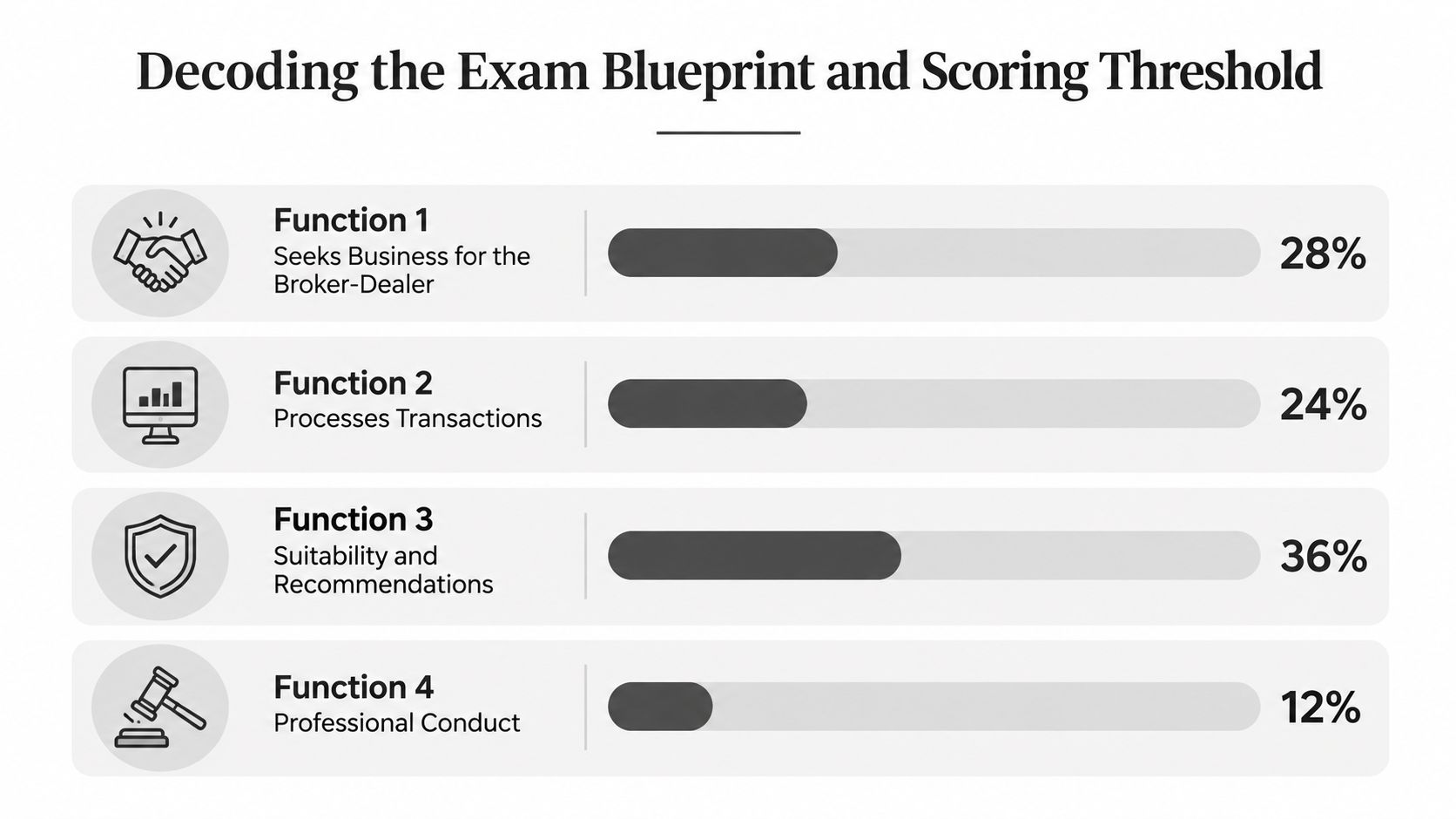
A passing score isn't the same as broad familiarity with every topic. The Series 7 rewards preparation that tracks FINRA's blueprint, particularly the function covering customer information, recommendations, suitability, asset transfers, and records.
The exam requires 72% correct, or 90 correct answers out of 125 scored questions, according to FINRA's Series 7 study outline. Candidates also answer 5 unscored pretest questions, so the testing experience includes 130 total questions, although only 125 scored items determine the result.
Weight matters more than comfort
FINRA's content outline assigns 73% of the scored content to Function 3, making it the highest-yield area for study time. That section addresses recommendations, customer profiles, investment information, transfers, and records. The official Series 7 content outline is the controlling document for understanding the exam's tested functions.
The other functions still matter. Candidates must understand business development, account opening, transaction processing, trading and settlement, professional conduct, and the securities products identified in FINRA materials. The blueprint doesn't authorize you to ignore lower-weighted material. It tells you where weak preparation creates the greatest exposure.
A useful study allocation looks like this:
- Function 3 first: Build strong command of suitability, recommendations, customer objectives, risk considerations, and product application.
- Operational mechanics next: Work through order handling, settlement, margin, options, and account procedures rather than memorizing isolated definitions.
- Conduct throughout: Treat communications, supervision, and ethical obligations as recurring topics, not a final review category.
- Question review as a separate skill: Identify whether you missed a rule, misunderstood the facts, rushed, or selected an answer that was technically plausible but unsuitable.
FINRA states that there's no penalty for guessing, so unanswered questions create avoidable risk. If you can't resolve an item, eliminate clearly incorrect choices, select the strongest answer, and continue. Don't spend disproportionate time trying to achieve certainty on one question while leaving later questions unanswered.
Industry preparation providers commonly estimate first-time pass rates in the 65% to 70% or 65% to 72% range, while noting that FINRA doesn't publicly publish an official pass-rate figure, as summarized by ExamFX's Series 7 passing-score discussion. Treat those estimates as context, not a guarantee. A disciplined blueprint-based method is more useful than relying on an informal pass-rate prediction. For broader licensing comparisons, you can also review Series 63 versus Series 7.
Building a Realistic Study Plan for Working Professionals
A working candidate doesn't need an idealized plan. You need a schedule that survives client meetings, mandatory training, commuting, family responsibilities, and the mental fatigue that follows a full workday.
Start by obtaining the current FINRA outline and the study materials approved or recommended by your sponsoring firm. Create a calendar that assigns heavier attention to Function 3, then distribute time across the remaining functions and product categories. FINRA identifies equity securities, debt securities, municipal securities, options, packaged products, retirement plans, margin accounts, and trading and settlement procedures among the tested areas, as reflected in FINRA's Series 7 examination materials.
Use a staged plan, not a cram session
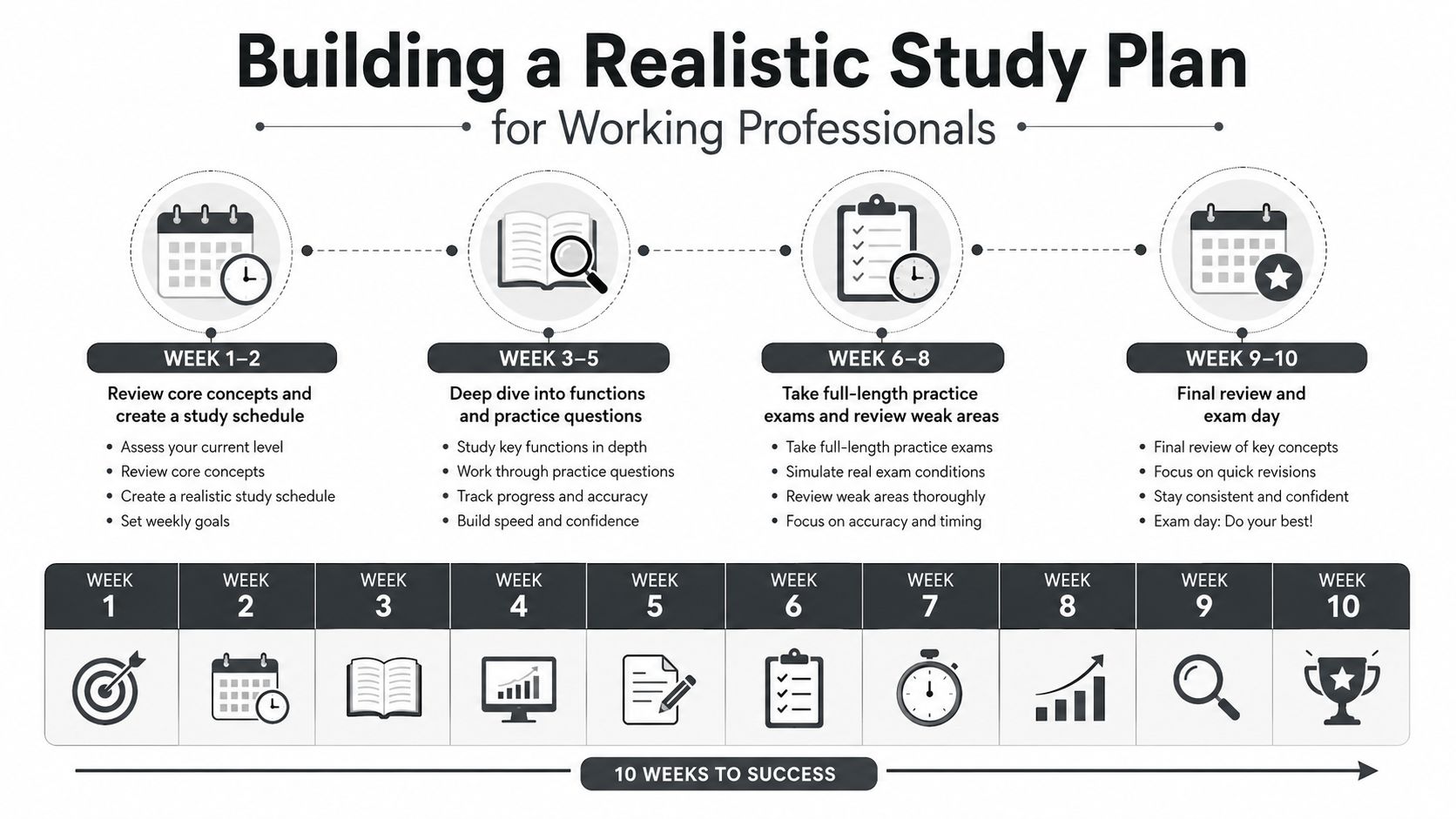
A practical sequence can follow four phases:
- Build the foundation. Learn the vocabulary, product structure, customer accounts, and regulatory concepts. Don't rush to full-length practice exams before you understand the subject matter.
- Study by function. Work through Function 3 in depth, then connect the other functions to actual account and transaction scenarios.
- Practice diagnostically. After each practice set, classify errors. A wrong answer caused by a forgotten rule requires different remediation from one caused by reading too quickly.
- Simulate the exam. Use timed sessions that reflect the actual 225-minute testing period. Practice deciding when to move on, when to guess, and when to return to a difficult question. The exam format and timing are summarized in this Series 7 exam format guide.
The point of practice exams isn't to collect impressive scores. It's to expose recurring weaknesses while there's still time to correct them. Keep an error log with the rule, the fact pattern, your selected answer, the correct reasoning, and the reason your original choice failed.
Avoid materials that offer volume without explanation. A large question bank can reinforce bad reasoning if you memorize answer patterns. Choose resources that explain why each option is right or wrong, and use step-by-step strategies to study smarter when you need help turning scattered preparation into a repeatable schedule.
Schedule the exam only after your practice work shows stable command across the blueprint, not because a calendar target feels motivating. Momentum matters, but an arbitrary date can turn ordinary gaps into a failed attempt.
Navigating Form U4 and the Registration Filing Process
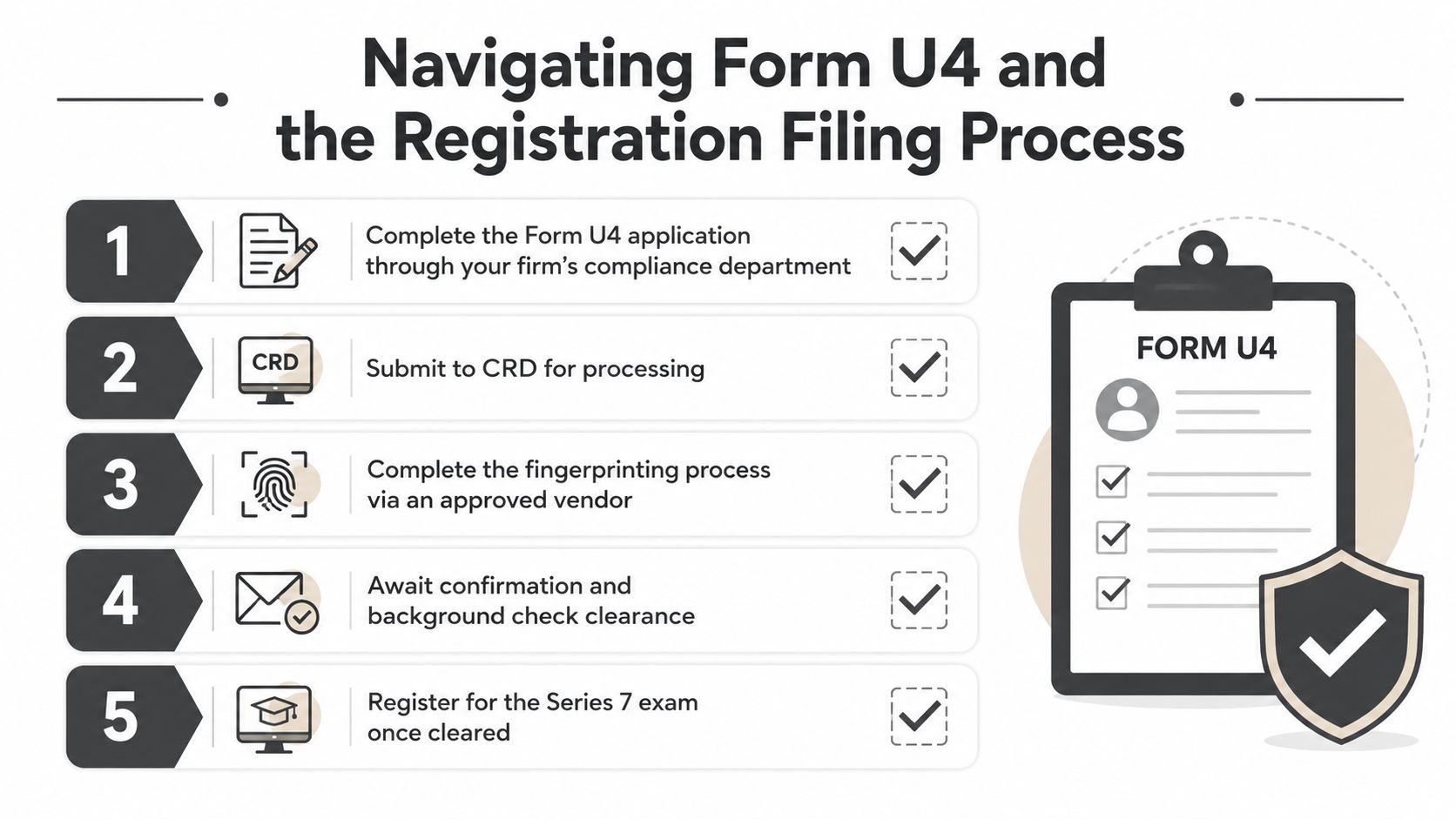
Form U4 deserves the same attention as the study guide. Your firm uses it to submit registration information, and the information becomes part of your regulatory record. An incomplete or inaccurate filing can create problems that outlast the exam date.
Your compliance department will direct the filing process, but you remain responsible for reviewing what the firm submits. Read every disclosure question carefully. Gather employment history, residential history, legal documents, financial records, and other background information before completing the form. If a question is unclear, don't guess and don't rely on memory where records are available.
Treat disclosure questions as legal questions
Candidates often focus on whether an event feels serious instead of whether it falls within the wording of the question. That approach is dangerous. A prior criminal matter, regulatory event, civil judgment, bankruptcy, termination, or financial issue may require disclosure even when you believe it was resolved or unrelated to securities work.
Use a deliberate process:
- Collect source documents: Obtain court dispositions, settlement papers, termination notices, and other records before answering.
- Create a chronology: Write down dates, employers, agencies, allegations, outcomes, and relevant participants.
- Ask compliance for clarification: Request that the firm identify the specific question and information it needs, rather than asking for a general opinion.
- Review the final submission: Compare the filed information with your records and correct errors promptly.
- Update when circumstances change: Registration disclosures can require amendments when reportable events occur.
Fingerprinting and background review may be part of the firm's registration process. The precise handling depends on the firm and applicable requirements. Your employer's compliance team should tell you which vendor and procedures apply, and you should keep confirmation of completion.
The sponsoring firm submits registration information through the industry's registration system and manages the exam authorization process. A delay may result from missing information, an unresolved disclosure, fingerprinting issues, or an internal filing problem. If the firm made an error, notify compliance in writing, preserve the relevant documents, and ask how it will correct the record.
The firm's status matters because only eligible firms can sponsor candidates. Understanding FINRA member firms can help you assess whether the organization offering sponsorship fits the regulatory pathway you need.
Retake Rules and Post-Pass Compliance Obligations
Failing the first attempt is disappointing, but it shouldn't trigger an improvised response. Review the score report, identify the functions and topics that caused difficulty, and change the study method before scheduling another attempt. Repeating the same question sets without correcting the underlying reasoning usually produces false confidence.
FINRA imposes waiting periods between attempts, and the applicable retake process can also depend on how much time has passed since the prior examination or registration event. Industry materials commonly describe a 120-day window associated with exam authorization and a longer interruption that may require a candidate to restart parts of the process, but candidates should confirm the current rule and their individual status with the sponsoring firm and FINRA before relying on a deadline.
Your firm may also have policies about attempts, reimbursement, continued employment, or reassignment. Ask for those policies before testing. A failed exam can become an employment issue even when it isn't a regulatory violation.
Passing the exam is a licensing milestone. It isn't permission to operate outside your firm's supervisory system.
Registration creates continuing duties
After passing, your work remains subject to firm supervision, product approvals, communications controls, recordkeeping, and applicable continuing education. Your firm may require annual compliance training or meetings, and you'll need to follow its procedures for advertising, recommendations, gifts, outside activities, private securities transactions, and customer complaints.
Personal trading accounts also deserve attention. A new registered representative should disclose relevant accounts and follow the firm's approval, reporting, and restricted-list procedures. Moving an account, opening an outside account, or investing in a private opportunity without clearance can create a compliance problem even if the transaction seems personal.
Outside business activities create a similar risk. Don't assume an activity is permissible because it doesn't involve securities. Disclose it through the firm's process, wait for the required review, and keep the approval or denial in your records.
If you leave the firm, the registration and disclosure consequences require care. Your Form U5 and any transition documentation can affect future employment and regulatory review. Keep copies of employment agreements, compensation plans, written warnings, investigation notices, and separation documents, and seek advice before signing a disputed statement.
Protecting Your Career with Proactive Legal Guidance
The Series 7 can open a professional path, but it also places your conduct inside a regulated employment environment. Your firm controls supervision, product access, approvals, and many of the records that later shape how regulators and prospective employers understand your work.
Legal guidance becomes especially important when the facts are disputed. A Form U5 may characterize the reason for departure in language you believe is inaccurate. A firm may demand repayment of a promissory note, withhold deferred compensation, or dispute production credits after a transition. A regulatory inquiry may begin with a document request and develop into a matter that threatens your registration or reputation.
Know when to pause before responding
Do not treat every compliance communication as an accusation, but don't answer important requests casually. Preserve relevant emails, calendar entries, client communications, notes, and compensation documents. Avoid deleting or altering records, and ask counsel to help you understand the scope of a request before giving an expansive narrative that creates unnecessary inconsistencies.
Common matters requiring focused review include:
- Form U5 disputes: Challenge inaccurate or incomplete separation language through the appropriate process.
- Compensation conflicts: Examine deferred bonuses, incentive compensation, production credits, and repayment provisions.
- Regulatory inquiries: Respond accurately, preserve procedural rights, and coordinate with counsel.
- Termination claims: Evaluate employment agreements, discrimination issues, retaliation concerns, and contractual obligations.
- Transition disputes: Review client movement, restrictive covenants, promissory notes, and firm property requirements.
A clear professional record also helps. If you're updating a résumé after earning a license, practical guidance on presenting education and certification information can help you describe the credential accurately without overstating what the registration authorizes.
Kons Law represents financial professionals and business clients in regulatory compliance matters, securities arbitration, Form U5 disputes, compensation conflicts, employment disputes, and related commercial litigation. The firm's regulatory compliance attorney can help evaluate the legal and regulatory consequences of a disputed filing, investigation, termination, or compensation demand.
The most effective time to obtain advice is before a problem becomes part of your permanent professional record. Review the documents, understand the firm's position, and protect your response before deadlines or negotiations narrow your options.
If you want to discuss your business law matter, contact Kons Law at (860) 920-5181. Kons Law can help financial professionals evaluate Form U4 or Form U5 issues, regulatory inquiries, compensation disputes, employment claims, and related business conflicts. Visit Kons Law to connect with the firm.
