
A lot of firms run into Rule 4530 trouble the same way. A complaint lands on someone's desk, an internal review starts, everyone wants more facts, and the team assumes the reporting decision can wait until the investigation feels finished. That instinct is understandable. It's also where avoidable regulatory risk starts.
For a new broker-dealer, FINRA Rule 4530 isn't just a filing rule. It's a judgment rule. Some triggers are obvious, such as a qualifying settlement or a regulatory action. The harder problems come from deciding when your own internal fact-gathering has crossed the line into a conclusion that must be reported.
Why FINRA Rule 4530 Demands Your Attention
A common scenario looks like this. A registered representative tells compliance that a customer complaint may settle, operations finds irregular account activity, or an internal audit memo raises a possible supervision failure. The first question is usually whether the firm has enough information to act. Under Rule 4530, the more important question is often whether the reporting clock has already started.

FINRA Rule 4530(a) requires member firms to report specified external events, including regulatory violations, fraud-based customer complaints, or criminal charges, within 30 calendar days after the member knows or should have known of the triggering event, and that clock starts from knowledge of the event even if an internal investigation hasn't concluded, as FINRA explains in its Rule 4530 reporting requirements.
That timing point matters because many firms still treat Rule 4530 as a back-end administrative task. It isn't. It's part of the firm's live supervisory system and should sit alongside escalation, documentation, and legal review. If your team treats reporting as something that happens after the “real” investigation, your process is backwards.
For newer firms building controls from scratch, it helps to view Rule 4530 as one piece of a broader regulatory compliance framework for financial businesses. The rule exists because FINRA wants timely visibility into events that may affect customers, firms, and market integrity.
Practical rule: If the event is already serious enough to trigger an internal email chain among compliance, supervision, legal, and senior management, it may already be serious enough to require a Rule 4530 analysis.
Two reporting lanes dominate the rule:
- External event reporting: Regulatory actions, certain customer complaints, criminal matters, and other specified events.
- Internal conclusion reporting: Situations where the firm concludes, or reasonably should have concluded, that a violation occurred.
Most firms understand the first lane. The second is where mistakes happen.
Decoding Reportable Events and Financial Thresholds
The easiest Rule 4530 problems are the ones with objective triggers. If a matter falls into a listed category and meets the required threshold, the reporting analysis becomes much more concrete. The challenge is making sure the firm identifies those events quickly and doesn't let them get buried inside ordinary claims handling.
External events that should trigger immediate review
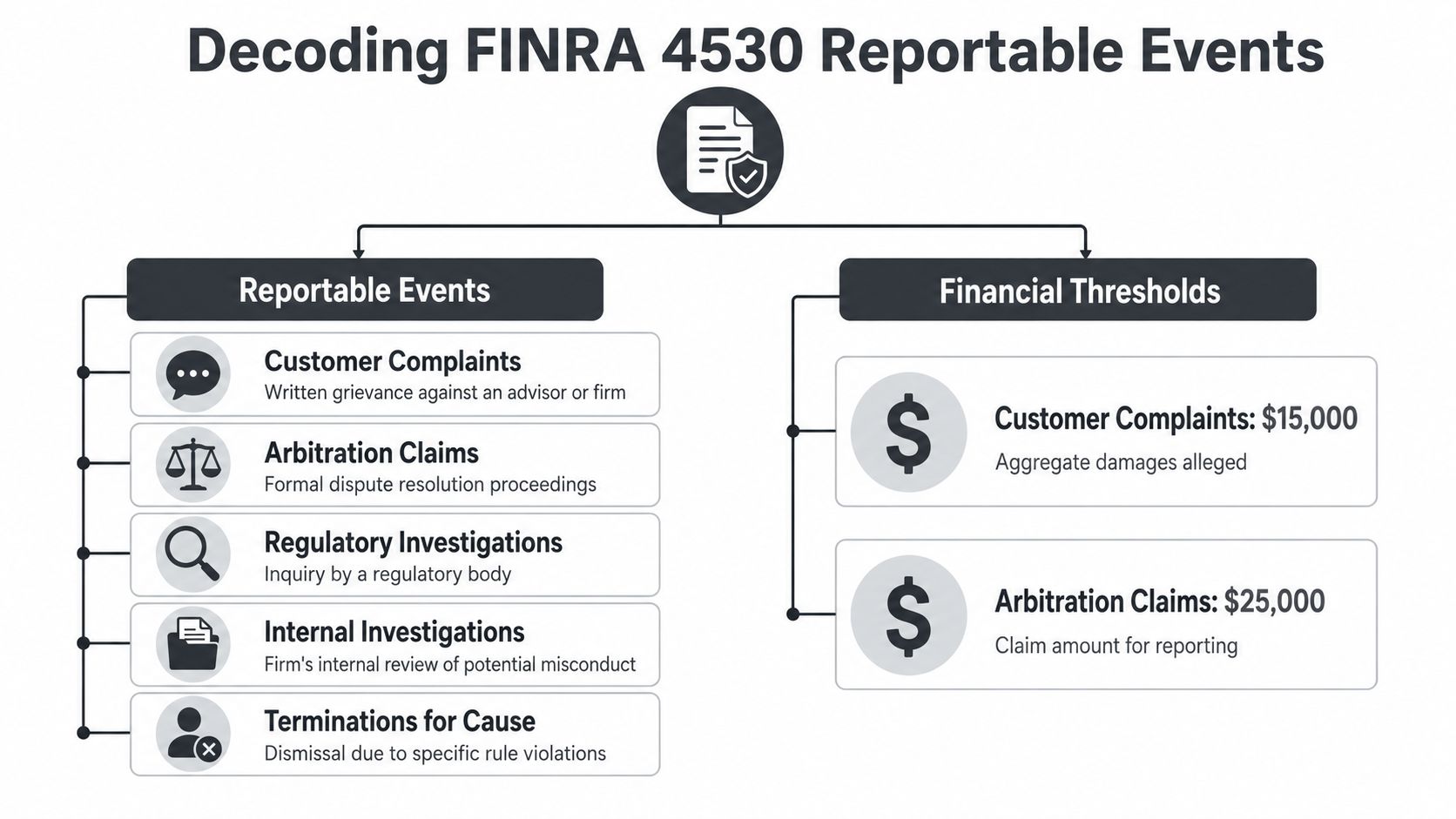
Rule 4530 covers more than one kind of misconduct signal. In practice, firms should train supervisors and operations personnel to flag at least these categories for same-day review:
- Customer complaints with fraud allegations: Written complaints involving theft, misappropriation, or forgery need immediate attention.
- Civil litigation outcomes: Judgments, awards, and settlements can trigger reporting obligations depending on the allegations and amount involved.
- Regulatory actions: A foreign or domestic regulator's action can create an independent reporting duty.
- Criminal charges: If the event falls within the rule's scope, the filing analysis can't wait for the criminal case to finish.
- Employment-related findings tied to misconduct: Internal action against a representative may overlap with other disclosure duties, including U4 or U5 issues.
The practical lesson is simple. Don't silo these facts. Complaints may sit with legal, settlements with finance, and personnel actions with HR. Rule 4530 fails when no one owns the cross-functional view.
The threshold amounts you need to know
One of the few places where the rule gives hard edges is the damages threshold for certain claims. FINRA Rule 4530(a)(1)(G) requires reporting of claims disposed of by judgment, award, or settlement when damages exceed $15,000 for an associated person or $25,000 for the firm, within 30 calendar days of when the member knew or should have known of the event, as stated in FINRA's Rule 4530 FAQ on reportable claims thresholds.
A short reference table helps:
| Trigger type | Reporting point |
|---|---|
| Claim involving an associated person | Report if disposed of above $15,000 |
| Claim involving the firm | Report if disposed of above $25,000 |
| Timing | File within 30 calendar days of knowledge or when the firm should have known |
Those amounts sound straightforward, but firms still get this wrong in two ways. First, they focus only on final liability and ignore the nature of the underlying allegations. Second, they assume someone else is tracking the amount threshold.
The reporting analysis often starts before anyone has a final view on merit. A weak claim can still create a reporting duty if it fits the rule and crosses the threshold.
What works and what doesn't
What works is a central intake process. Every complaint, claim, award, settlement, and regulator letter should route through one reporting triage function, even if the final answer is “not reportable.”
What doesn't work is relying on memory, inbox searches, or informal handoffs. Rule 4530 issues usually don't arise because the event was hidden. They arise because the event was known by one team and never framed correctly for the person responsible for disclosure.
The Internal Conclusion Reporting Trap
The most misunderstood part of Rule 4530 isn't the customer complaint threshold. It's Rule 4530(b) and the idea that a firm may have to report its own internal conclusion that a violation occurred. That standard creates real pressure because it doesn't wait for a regulator, an arbitration panel, or a court to tell you what happened.
Why the gray area is so risky
Rule 4530(b) requires a member to report within 30 calendar days after it concludes, or reasonably should have concluded, that the firm or an associated person violated securities, insurance, commodities, financial, or investment-related laws, rules, regulations, or standards of conduct of a domestic or foreign regulatory body, as described in this overview of Rule 4530 reporting requirements.
That phrase, “reasonably should have concluded,” is where defensible process matters. Firms often assume they can delay the reporting decision until every fact is pinned down. That's a bad assumption. If your internal review has already identified conduct, rule breaches, affected customers, and failed controls, waiting for a polished closing memo may not save you.
Written escalation standards are critical. If your firm hasn't built them into its written supervisory procedures, your reporting timeline becomes vulnerable to hindsight criticism.
The mistake firms keep making
Many compliance teams treat internal audit findings as preliminary by default. Sometimes they are. Sometimes they aren't. If an audit, surveillance review, or branch examination has already reached a substantive finding, calling it “draft” won't necessarily change the Rule 4530 analysis.
FINRA's own current oversight focus makes that point impossible to ignore. FINRA's 2024 Annual Regulatory Oversight Report says Rule 4530 disclosure timeliness remains a top enforcement focus, and 28% of 4530 enforcement actions in 2024 stemmed from delayed reporting of internal conclusions, according to FINRA's regulatory events reporting guidance in the 2024 oversight report.
A lot of firms still build their process around external triggers because those are easier to recognize. But the enforcement risk here comes from the opposite problem. The firm already had enough information internally and didn't escalate it fast enough.
If your review team is debating remediation, customer impact, supervision changes, or representative discipline, you may already be past the point where “we're still investigating” is a comfortable answer.
How to make the judgment call
There's no magic sentence that marks the exact moment an internal conclusion exists. The better approach is to evaluate the record through a practical decision lens:
- Has someone identified a specific rule or standard? General discomfort isn't enough, but a defined violation analysis pushes the issue closer.
- Do the known facts support the conclusion without waiting for one missing detail? A single unresolved point doesn't always stop the clock.
- Has the firm started remediation based on an assumed violation? Corrective action can reveal what the firm really believes.
- Would an examiner looking at the file say the conclusion was already obvious? That's the hindsight test you need to apply before FINRA does.
What works is documenting the firm's reasoning in real time. If the matter isn't reportable yet, say why. If the matter becomes reportable later, memorialize what changed.
What doesn't work is a silent file. In a close case, a documented rationale can help show thoughtful compliance judgment. No rationale at all usually looks like drift.
Mastering the 30-Day Reporting Process
A good Rule 4530 process is operational, not theoretical. Once a trigger appears, the firm needs a repeatable workflow that moves from identification to submission without confusion about ownership or timing.
A practical workflow for compliance teams
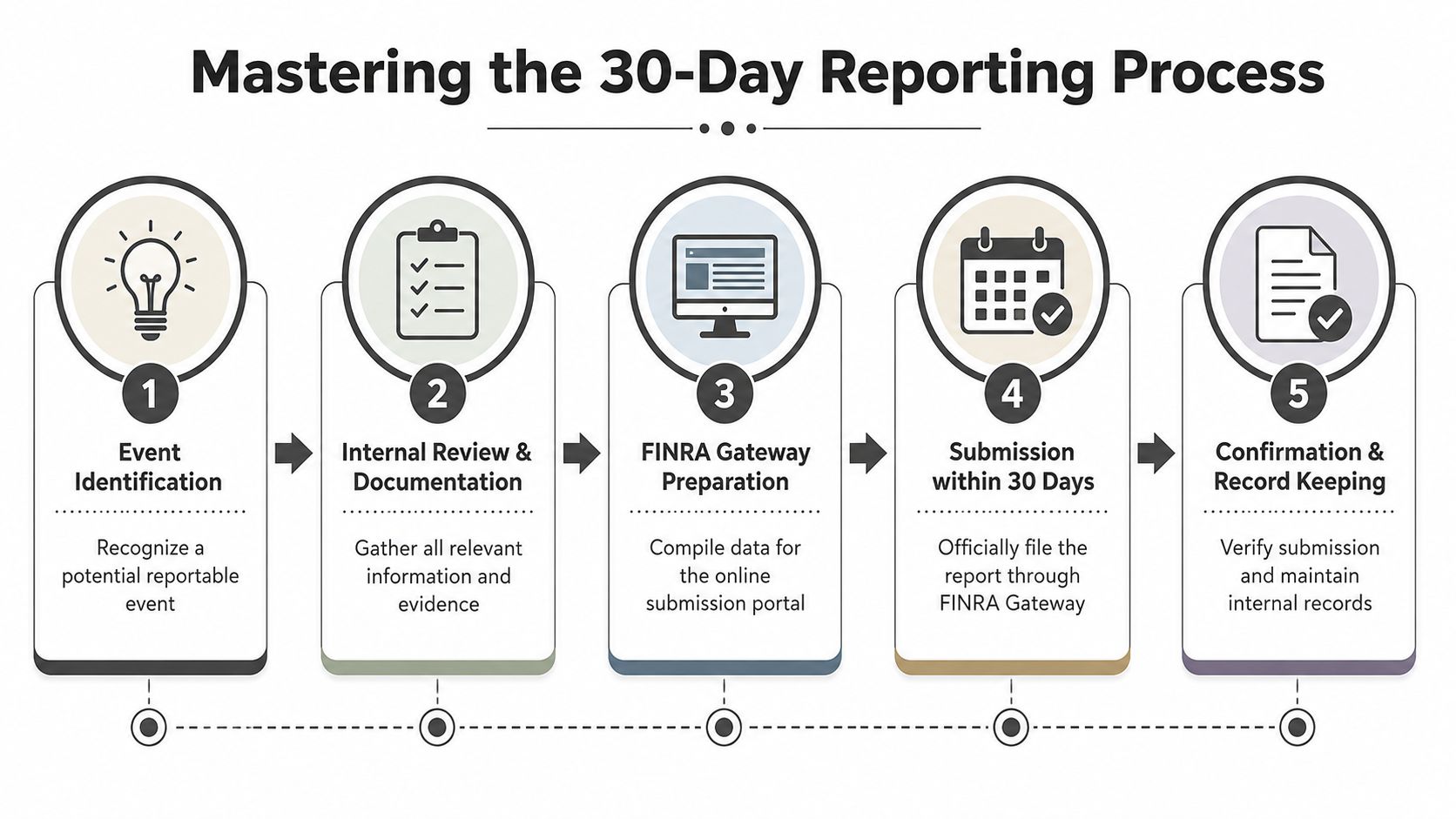
Use a simple five-step process:
Identify the triggering event early
Train branch managers, complaint handlers, HR, operations, legal, and supervision to escalate possible triggers immediately.Open a reporting file
Create one matter file that includes the event date, date of firm knowledge, key documents, internal communications, and the assigned decision-maker.Decide reportability on a short clock
Don't let the file sit while everyone waits for perfect information. Set an internal deadline well before the regulatory deadline.Prepare the FINRA Gateway submission carefully
Draft the disclosure with enough detail to be accurate, but don't add unnecessary speculation or advocacy.Preserve the record after filing
Keep the submission, support memo, and related materials together so the firm can defend the timing and substance of the disclosure later.
Where firms lose time
Most delay happens in the middle, not the end. The event gets recognized, but no one decides who owns the analysis. Legal thinks compliance is handling it. Compliance assumes business leadership is still investigating. Meanwhile the days keep running.
A separate issue is over-editing. Firms sometimes spend too long refining language for a filing that should have been submitted earlier. Precision matters, but timeliness matters too.
For firms that also face customer disputes, employment fallout, or termination issues, understanding the broader FINRA arbitration process and how records can later be examined helps frame why disclosure language and documentation need to be handled carefully from the start.
Extensions are rare
The timing rule is strict. As summarized in Global Relay's guide to FINRA Rule 4530, firms must report specified events within 30 days of knowledge, and extensions are generally limited to exceptional circumstances such as natural disasters, with a detailed justification required.
That means ordinary internal delays won't help. Staff vacations, crowded calendars, open factual questions, and slow internal approvals aren't the kind of reasons a firm should count on.
Build your internal timetable backward from the deadline. If the regulatory filing is due on day 30, your real internal decision deadline should come much earlier.
Enforcement Risks and the Link to Form U5
Rule 4530 problems rarely stay confined to one filing issue. They tend to branch into examination findings, follow-up inquiries, representative discipline issues, and employment record disputes. For advisors and firms alike, that's why this rule belongs in the category of career-risk management, not just compliance administration.
Why a late or incomplete filing matters
A weak Rule 4530 process creates two separate exposures.
First, the firm faces scrutiny for the reporting failure itself. That can happen even when the underlying conduct issue is already remediated. In other words, solving the customer or supervision problem doesn't erase the disclosure problem.
Second, the representative involved may face longer-term consequences if the matter later appears in other records or becomes part of a separation event. Once the facts move into termination, internal discipline, or regulatory inquiry territory, disclosure language becomes highly sensitive.
The Form U5 connection
A lot of advisors first appreciate Rule 4530's importance when they leave a firm. Conduct that generated an internal review, an escalation memo, or a reporting debate can later shape how the departure is characterized. That's where Form U5 issues carry significant consequences.
If the firm reports an event under Rule 4530 and later terminates or permits the resignation of a representative during related scrutiny, the internal record can influence what is said, how it is said, and whether the language later becomes disputed in arbitration or expungement-related proceedings. Advisors dealing with that overlap should understand how Form U5 disclosures can affect employment transitions and future regulatory scrutiny.
This is one reason firms should avoid casual language in emails and draft memos. Internal shorthand often becomes external evidence. “Obvious violation,” “sales practice issue,” or “he should be gone” may feel like informal commentary in the moment. Later, those phrases can be read as proof that the firm had reached a conclusion long before it filed or before it described the separation.
What disciplined firms do differently
Disciplined firms separate three functions clearly:
- Fact development: What happened.
- Reporting analysis: Whether Rule 4530 applies and when the clock began.
- Employment action: Whether discipline, supervision changes, or termination are appropriate.
Blending those functions causes trouble. The HR decision may move on one timetable, while the Rule 4530 filing operates on another. If the firm lets personnel discussions drive the reporting timeline, the disclosure may be late.
A better approach is to treat every significant internal conduct review as potentially affecting multiple records at once. The reporting file, personnel file, and supervisory file shouldn't conflict with each other.
Clean documentation protects both the firm and the individual. Sloppy documentation usually hurts both.
A Proactive 4530 Compliance Checklist
The strongest Rule 4530 programs don't depend on one experienced person remembering how to handle edge cases. They build a system that catches events early, routes them correctly, and creates a record of judgment.
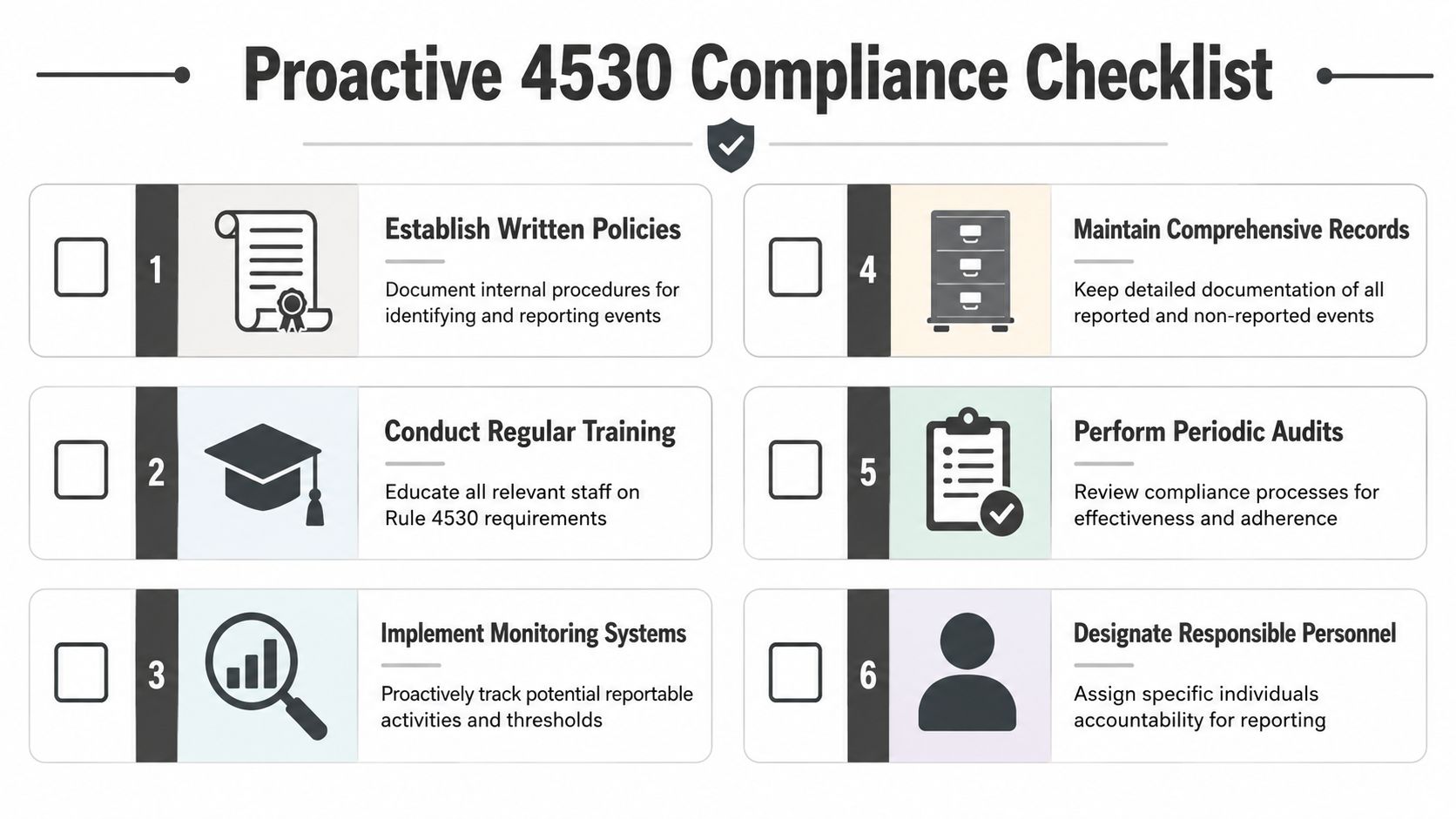
Use this as a working checklist
Establish written policies
Your procedures should identify who receives complaints, settlements, regulatory notices, internal audit findings, and personnel escalation memos. They should also state who decides reportability and who signs off.Define the internal conclusion standard
Don't leave this phrase at the rule-text level. Give supervisors and reviewers examples of when a concern remains preliminary and when the firm has effectively concluded a violation occurred.Create one intake path for all trigger events
Complaints, litigation developments, audit findings, terminations for cause, and regulator contact shouldn't move through separate unconnected channels.Maintain a dated decision log
For every close call, document the event date, knowledge date, what facts were known, who reviewed them, the reasoning, and whether the event was reported.
Controls that usually make the difference
A checklist only works if it is tied to recurring controls. The best programs usually include:
| Control | Why it matters |
|---|---|
| Training for supervisors and complaint handlers | They often see the trigger first |
| Periodic review of non-reported matters | Close calls reveal process weaknesses |
| Legal or senior compliance review for internal conclusions | Gray-area decisions need consistency |
| File retention of drafts, memos, and supporting materials | Timing judgments may need to be defended later |
What to audit internally
Don't just test whether reports were filed. Test whether events were escalated fast enough to allow a timely decision.
Ask a few hard questions:
- Did any internal audit or surveillance finding sit too long before legal or compliance review?
- Were settlement amounts tracked accurately against reportable thresholds?
- Did any termination or resignation occur before the Rule 4530 analysis was finished?
- Can the firm prove when it first knew enough to make the reporting call?
A workable Rule 4530 process isn't glamorous. It's disciplined, documented, and repeatable. That's what keeps a manageable event from turning into a preventable enforcement problem.
Conclusion Protecting Your Practice and Career
FINRA Rule 4530 looks simple until a real event lands in front of your firm. The external triggers are manageable if your intake process is sound. The harder exposure sits in the internal conclusion standard, where timing, judgment, and documentation all matter at once.
That's why firms shouldn't reduce Rule 4530 to a checklist alone. They need a decision process. They need escalation standards. They need records that show when the firm knew what it knew, and why it acted when it did. Advisors should think the same way, especially when a complaint, internal review, or separation event could affect their record and future opportunities.
For firms that market in regulated environments, it also helps to stay current on broader compliance themes, including expert advice on regulated financial marketing from Advisor Momentum, because supervisory discipline is strongest when business development and compliance expectations align.
If you're facing a possible Rule 4530 issue, a Form U5 concern, or a FINRA inquiry, early legal review usually costs less than repairing a bad record later.
If you want to discuss your business law matter, contact Kons Law at (860) 920-5181.
