
A sale gets favorable tax treatment only after the later of two years from the offering date and one year from the purchase date. You've probably just received a purchase statement, checked the balance in your brokerage account, and wondered whether you can sell now or whether waiting a few more months changes the tax bill.
That question is harder than it sounds because three separate deadlines can apply to the same lot of shares. The federal tax clock decides whether your sale is qualifying or disqualifying, your employer's transfer restriction decides whether the plan allows a sale at all, and your own investment horizon decides whether holding employer stock is wise. Treating those clocks as one date is the most common source of costly mistakes with the ESPP holding period.
Holding Period Rules and Qualifying Sales
An employee can hold ESPP shares for seventeen months and still end up with a disqualifying sale. The reason is that federal law measures the holding period from two different starting lines, and the slower one decides the result.
Under a tax-qualified Section 423 plan, shares must be held at least two years from the beginning of the offering period and at least one year from the purchase date, and ordinary income on a qualifying sale is generally limited to the lesser of the gain realized or 15% of the stock's fair market value on the first day of the offering period, per SEC-filed ESPP materials. Both dates must pass before a sale can be qualifying. Even then, a separate restriction written into the plan can still block the sale.
The Three Clocks Side by Side
ESPP holding clocks and what each one controls
| Clock | Requirement | What It Controls |
|---|---|---|
| Federal offering clock | Two years from the offering date | Qualifying disposition test |
| Federal purchase clock | One year from the purchase date | Qualifying disposition test |
| Qualifying disposition | Later of the two federal clocks | Ordinary income capped, remainder capital gain |
| Disqualifying disposition | Any sale before the later federal date | Purchase-date spread taxed as ordinary income |
| Employer transfer restriction | Set by the plan, such as six months, one year or 18 months after purchase | Blocks the sale even when the tax test is met |
The first four rows control tax character. The last row controls permission to sell. A date that satisfies one purpose does nothing for the other.
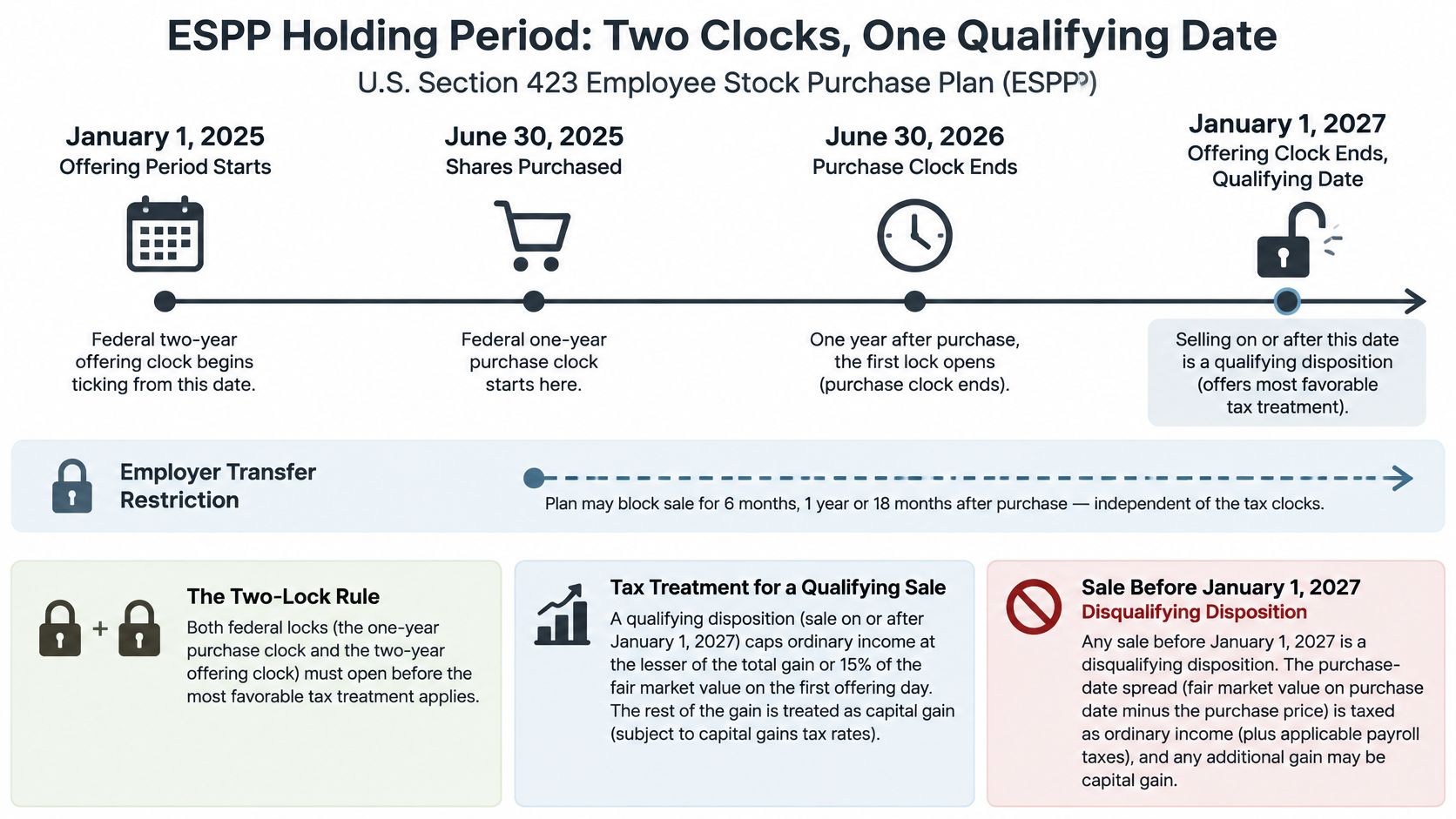
A Concrete Date Example
Take an offering that began January 1, 2022, with shares purchased on June 30, 2022. The purchase clock ran out on June 30, 2023. The offering clock ran until January 1, 2024.
January 1, 2024 controlled. A sale on July 15, 2023 would have come more than a year after purchase, yet still counted as disqualifying. The purchase clock had run out; the offering clock still had nearly six months to go.
Each federal clock works like a separate lock on the same door. Both must open before the favorable treatment applies, and whichever lock opens last sets the schedule.
Qualifying and Disqualifying Defined
A qualifying disposition is a sale after both periods have ended. Ordinary income is generally capped at the lesser of your total gain or 15% of fair market value on the first day of the offering period, and the remainder is generally capital gain.
Read that 15% as a cap on the amount counted as ordinary income, rather than as a rate. The capped portion is still taxed at your ordinary income rates.
A disqualifying disposition is any sale before either period has ended. In that case, the spread between your purchase price and the stock's fair market value on the purchase date is generally treated as ordinary income, even if the stock later falls.
The federal clocks also run independently of the plan's own rules. Meeting the tax test doesn't lift an employer's transfer restriction, and clearing that restriction doesn't satisfy the tax test. An employee who buys near the end of an offering period can face a particularly long wait, because the two-year offering clock may finish well after the one-year purchase clock.
Remember one rule. Find both federal dates, take the later one, and don't expect qualifying treatment before it passes.
How the Gain Splits Between Ordinary Income and Capital Gain
Numbers make the split clearer than labels do. Use one simplified lot and hold the purchase facts constant while the sale price and timing change.
The Assumptions
- Grant-date fair market value: $100 per share
- Purchase price: $85 per share, reflecting a 15% discount
- Purchase-date fair market value: $110 per share
You paid $85 for stock worth $110 at purchase, so the purchase-date spread is $25. The cap for a qualifying sale is $15, which is 15% of the $100 grant-date value. Those two figures drive every row in the table.
Ordinary income and capital gain by sale scenario
| Scenario | Ordinary Income | Capital Gain or Loss | Holding Result |
|---|---|---|---|
| Qualifying sale at $130 | $15 | $30 gain | Both clocks met, long-term |
| Qualifying sale at $95 | $10 | $0 | Both clocks met, no capital gain |
| Disqualifying sale at $130 | $25 | $20 gain | Sold before both clocks ended |
| Disqualifying sale at $95 | $25 | $15 loss | Sold before both clocks ended |
Reading the Four Outcomes
At $130 after both clocks, your total gain is $45. Only $15 is ordinary income, so $30 remains as capital gain. That's the clearest benefit of waiting.
At $95 after both clocks, your total gain is only $10. The cap is the lesser of $15 and your actual gain, so all $10 is ordinary income and there's no capital gain. Waiting didn't create a capital gain where the economics didn't produce one.
At $130 before both clocks, the $25 purchase-date spread becomes ordinary income. The remaining $20 of appreciation is capital gain. Compared with the qualifying sale at the same price, $10 more is taxed as ordinary income.
At $95 before both clocks, you still report $25 of ordinary income, even though your total economic gain is only $10 over what you paid. You also absorb a $15 capital loss. That mismatch surprises people because the ordinary income reflects value at purchase, not value at sale.
The painful case: A disqualifying sale at $95 can leave you reporting $25 of ordinary income and a $15 capital loss on the same shares.
Timing questions often sit beside other compensation and investment tax questions, such as understanding deferred compensation arrangements or reviewing AMT rules for muni investors when you're deciding where sale proceeds go next. Keep each tax regime separate, because rules from one type of compensation or investment don't carry over to an ESPP.
This example is simplified. Your actual reporting depends on Form 3922, your broker's cost basis reporting, and your full tax picture. Don't copy the table onto a return without checking those documents.
Employer Restrictions That Override the Tax Clock
You've waited past both federal dates. You log in to sell, and the account won't let you transfer the shares. Nothing is broken. Your employer has imposed its own clock.

Employer restrictions vary substantially and can be stricter than federal tax rules. Examples in SEC-filed plan documents include shares that must remain in the participant's account for at least six months after the purchase date, a one-year post-purchase holding period, and an 18-month post-purchase account restriction.
Why a Shorter Plan Lock Doesn't Help Your Taxes
A six-month plan restriction may stop an immediate sale, but it doesn't satisfy the one-year purchase test. Once that six months ends, you can sell, yet the sale remains disqualifying for tax purposes. Permission and favorable treatment arrive on different dates.
The reverse also happens. Satisfying both federal periods doesn't eliminate a longer contractual lockup. If your plan imposes 18 months and that date falls after your qualifying date, the plan date controls when you can sell.
These restrictions may also apply after you leave the company. Changing jobs doesn't necessarily free the shares, which is one reason an employment agreement review matters when equity, notice duties, and post-employment restrictions intersect.
Notice Duties Are Easy to Miss
Some plans impose administrative work even when a sale is allowed. A plan may require prompt notice of a disposition made within two years after the offering enrollment date or within one year after purchase. An administrator may also impose a mandatory period during which participants can't transfer or dispose of shares.
Before you treat shares as freely saleable, check three things.
- Plan document: Confirm the exact transfer restriction and whether it survives termination.
- Brokerage account: Ask whether a transfer block is coded on the lot.
- Notice obligation: Identify who must be told, by when, and in what form.
Weighing the Tax Benefit Against Concentration Risk
Waiting for a qualifying sale doesn't turn all appreciation into capital gain. Ordinary income is still recognized, generally based on the lesser of the purchase-date discount measured against the grant-date value or the actual gain at sale, with appreciation beyond that amount generally treated as capital gain, as explained in an IRS guide to ESPP taxation.

That means you're trading a known tax difference for an unknown price move. If the stock falls while you wait, the expected capital gain advantage can disappear. Using the earlier hypothetical, a qualifying sale at $95 produces $10 of ordinary income and no capital gain, so there's little rate benefit left to protect.
Concentration Changes the Math
Tax savings are measured on the gain. Market losses are measured on the whole position. If employer stock makes up a large share of your net worth, a single-company decline can cost far more than the difference between ordinary income and capital gain treatment.
Your salary already depends on the same company. Holding a large ESPP position adds investment exposure to employment exposure. A disciplined sale that creates a disqualifying disposition can still be the better financial decision if it reduces that combined risk.
A sale before the statutory period also brings the purchase-date spread into income now rather than later. That's a timing cost, but it may be acceptable when the alternative is holding an oversized position through earnings, a restructuring, or a job change.
A Decision Checklist
- Share of net worth: What percentage sits in employer stock today?
- Cash need: Will you need this money within the next year?
- Price range: What loss could you tolerate while waiting?
- Tax bracket: Are you in an unusually high or low bracket this year?
- Time remaining: Are you weeks from the qualifying date or many months away?
- Plan restriction: Does the plan allow the sale you're considering?
Your answer depends on those inputs, not on a generic rule that qualifying is always better. For a large sale, get a written analysis from a tax adviser that compares selling now with holding to the qualifying date under several price outcomes.
Cross-Border Employees Face a Different Clock
The two-year and one-year tests describe U.S. federal treatment. They don't travel automatically when you move.

A country where you live or work may tax the discount at purchase, at sale, or at another event. It may use payroll withholding, and it may not recognize any distinction between qualifying and disqualifying sales. Guidance on ESPP taxes for employees notes that qualifying-disposition compensation can still be reported to a current or former employee on Form W-2, while federal withholding generally is not required for that income.
A Relocation Example
Say an advisor buys shares while working in the United States, then relocates abroad before selling. She waits until both U.S. dates pass and expects qualifying treatment. Her new country of residence may still tax some or all of the discount as employment income sourced to her work period there, or it may tax the full gain under its own capital rules.
The U.S. result doesn't cancel the foreign result. She may have two reporting systems, two currencies, and two different taxable events for the same lot. A sale through a non-U.S. brokerage account adds another layer of reporting and recordkeeping.
Information to Gather Before a Cross-Border Sale
- Residence taxation: How does your current country tax the discount and the gain?
- Income sourcing: How is employment income allocated across the offering and purchase periods?
- Treaty position: Does a tax treaty change which country taxes which portion?
- Foreign reporting: Must the account, shares, or gain be reported locally?
- Currency conversion: Which exchange rates apply at purchase and sale?
- Employer reporting: What will the employer report after a move or termination?
Each work location during the offering period can matter. Keep travel calendars, payroll records, and residency documents with your purchase records, not in a separate file you'll reconstruct years later.
Meeting the U.S. periods doesn't guarantee favorable treatment abroad. Get coordinated employment tax, securities, and payroll advice before a cross-border sale, especially when a move, a foreign affiliate, or a former employer is involved.
Reporting a Sale on Your Tax Return
Start with Form 3922. Your employer uses it to record the transfer of shares, and it supports holding period and basis tracking when a purchase and sale fall in different tax years. Compare its grant-date and purchase-date values with your purchase statement before you rely on the broker's cost basis.
Your broker's records show the sale date, sale price, and reported basis. They may not capture the full tax calculation by themselves, particularly when part of the gain is ordinary income already connected to compensation reporting.
A Five-Step Reporting Procedure
- Gather records: Collect Form 3922 and the purchase statement for the lot.
- Confirm the sale: Take the sale date and sale price from the broker's confirmation.
- Classify the disposition: Apply both federal dates to decide whether it's qualifying or disqualifying.
- Separate ordinary income: Use the purchase-date spread for a disqualifying sale or the capped amount for a qualifying sale.
- Report the remainder: Treat any remaining amount as capital gain or loss.
Your employer may report the ordinary income portion on Form W-2. A qualifying sale can still produce W-2 reporting even though federal withholding generally doesn't apply to that income, so don't assume no withholding means no taxable compensation. A change of firms can scatter these records, which is why the broader tax implications of switching financial advisors should be on your checklist too.
Confirm the figures with a tax adviser before filing. The simplified procedure explains the sequence, but your full return controls the final result.
Earliest Sale Date and Pre-Sale Checks
Three separate clocks decide when you can sell an ESPP lot: two federal tax dates, one employer transfer restriction, and your own investment horizon layered on top. Each lot needs its own calculation, because each offering period and purchase date creates its own pair of federal milestones.
Federal rules treat a disposition as qualifying only when you hold until the later of two years after the option grant date and one year after the shares are transferred to you, as explained in IRS Publication 525. Meeting that test settles the tax question. It says nothing about whether your plan permits the sale, which is why the plan check earns its own step below.
Seven Steps to Your Earliest Date
- Find the offering start date: Look at the enrollment confirmation or plan summary. The two-year clock runs from this date, not from purchase.
- Add two years: Mark the end of the offering clock for this specific lot.
- Find the purchase date: Use the statement of purchase, not the date payroll deductions began.
- Add one year: Mark the end of the purchase clock.
- Take the later date: The later of the two milestones is your earliest qualifying sale date under the federal test.
- Check plan restrictions: Look for a transfer restriction, blackout period, or notice duty for a sale within two years of enrollment or one year of purchase, and confirm the first eligible date with the plan administrator.
- Confirm Form 3922: Match its transfer date to your records and keep the form with the lot history.
Selling shortly after purchase usually produces a disqualifying disposition. Waiting for both federal milestones can shift part of the economic gain from compensation income to capital gain, and the plan restriction check plus your own horizon decide whether waiting makes sense at all. A sale can pass the tax test and still be a bad trade for other reasons.
Your Pre-Sale Checklist
- Offering start date: Confirmed from plan records
- Purchase date: Confirmed from the purchase statement
- Both federal dates: Calculated separately for this lot
- Later controlling date: Confirmed against your records
- Plan restriction: Checked with the administrator for lockups, blackouts, and notice duties
- Form 3922 transfer date: Matched and filed with the lot
- Work and residence history: Reviewed for the whole holding period
Don't rely on a brokerage screen that labels shares as long-term. That label reflects time since purchase. It cannot answer the offering-period question or show whether a plan restriction applies.
Three Common Mistakes
The first mistake is using the purchase date for both clocks. That error makes the offering clock disappear and produces a qualifying date that arrives too early.
The second mistake is treating the federal test as the whole answer. A sale that clears both tax anniversaries can still collide with a plan transfer restriction, a blackout window, or a notice requirement. Confirm the trade with the administrator before placing the order.
The third mistake is assuming a longer offering period works in your favor. A purchase late in a long offering can push the two-year date well beyond the one-year purchase anniversary, extending the ESPP holding period beyond what you expected.
Before you sell: One lot, two federal dates, one plan restriction check. Skip any of the three and your answer may be wrong.
Financial advisors face an added professional dimension when equity compensation, employment records, and regulatory scrutiny overlap. Kons Law's Securities Regulatory practice defends financial advisors facing regulatory inquiries, investigations, and disciplinary actions, and guides financial advisor clients through responding to regulatory inquiries, preparing for on-the-record interviews, and addressing compliance issues. Keep your personal tax analysis separate from any regulatory matter, and don't let either proceed on assumptions.
If an ESPP sale is connected to a job change, compensation dispute, regulatory inquiry, or another business law matter, Kons Law can help you assess the legal issues before you act. If you want to discuss your business law matter, contact Kons Law at (860) 920-5181.
