
If your firm has a compliance manual but can't show who tested its procedures, what would you give an examiner tomorrow? That gap between having a policy and proving it works is where regulatory compliance consulting earns its value.
For financial advisers and brokerage professionals, an unresolved weakness can become more than an examination finding. Missing supervisory evidence may complicate an information request, and poorly preserved communications can become central to an advisor departure or Form U5 dispute. The practical question isn't whether you need more paperwork. It's whether your firm can identify a problem, correct it, and explain what happened with reliable records.
Regulatory Compliance Consulting at a Glance
Regulatory compliance consulting means an outside expert helps a firm identify applicable rules, build controls that address those rules, and demonstrate that employees follow them. The work connects legal obligations to everyday decisions, such as approving advertising, reviewing outside activities, and retaining client messages.
Think of a compliance program as a building's fire system. A fire-code binder doesn't detect smoke, train occupants, or document an inspection. Likewise, a policy manual doesn't review transactions or stop employees from using unapproved messaging channels.

Core compliance consulting services and what each delivers
| Service | What the client receives |
|---|---|
| Risk assessment | Map of material risks by business line, product and client type, with ranked priorities |
| Policy and procedure drafting | Written policies tied to each applicable rule, with assigned owners |
| Employee training | Role-based sessions with attendance and comprehension records |
| Compliance audit and testing | Documented sample testing showing whether controls operate as written |
| Remediation | Corrective action plan with deadlines, evidence and follow-up testing |
The trigger helps define the assignment. A new business line calls for risk assessment; outdated instructions call for drafting. Employee mistakes may indicate a training problem, while repeated exceptions call for testing and remediation rather than another reminder email.
Prevention and dispute response serve different purposes
Consulting generally focuses on preventing problems and maintaining an operating program. Litigation and regulatory defense address contested facts, alleged violations, and legal exposure after a problem surfaces. They can overlap, particularly when a consultant discovers an issue that requires counsel's assessment.
Typical buyers include:
- Registered investment advisers that need controls suited to their actual investment and client-service activities.
- Broker-dealers and representatives managing supervision, disclosures, records, and regulatory responses.
- Lenders and collectors whose customer interactions raise lending or collection obligations.
- Businesses handling regulated customer data that need documented privacy and security practices.
Find the service row that matches your present gap. A firm with polished policies but no testing evidence needs a different engagement from a firm launching an unfamiliar service.
Federal and Connecticut Rules That Shape Your Program
Rules follow activities and registration status, not the label on your business card. A financial-services firm may need securities supervision, privacy safeguards, and state-law controls at the same time.
For investment advisers, the foundational requirement is the SEC Compliance Rule. The SEC's compliance-failure enforcement release explains the obligations under Rule 206(4)-7, including written policies, a designated chief compliance officer, and review at least annually. The practical lesson is that adopting procedures isn't enough if the firm doesn't implement them.
Major frameworks, who they cover and what they require
| Framework | Who it covers | Core obligation |
|---|---|---|
| SEC Advisers Act Rule 206(4)-7 | SEC-registered investment advisers | Written policies, a designated chief compliance officer and an annual review |
| FINRA rules, including Rule 8210 | FINRA member firms and associated persons | Supervision, recordkeeping and production of information on request |
| Bank Secrecy Act and AML rules | Banks, broker-dealers, money services businesses and other covered institutions | Applicable written AML program, customer identification and suspicious activity reporting requirements |
| Gramm-Leach-Bliley Act | Financial institutions handling consumer data | Applicable privacy notices and written information security safeguards |
| Sarbanes-Oxley Act | Public companies and their auditors | Applicable internal controls over financial reporting and certifications |
| Fair Debt Collection Practices Act | Third-party debt collectors | Limits on collection contacts and false or misleading statements |
| Connecticut Creditor's Collection Practices Act | Creditors and collectors pursuing consumer debt in Connecticut, subject to statutory definitions | State limits on collection practices and consumer protections |
| Connecticut Uniform Securities Act | Brokers, advisers and issuers doing business in Connecticut | Applicable registration, licensing and antifraud rules enforced by the state securities regulator |
| Connecticut Data Privacy Act | Businesses processing personal data of Connecticut residents above statutory thresholds, subject to exemptions | Consumer rights, privacy notices and applicable data protection assessments |
Map conduct before drafting policies
Use the table as an initial screening tool, not a determination that every listed obligation applies to your firm.
- List your activities. Include advising clients, handling customer funds, collecting debts, and processing personal data.
- Match activities to frameworks. Identify the entity, employees, and systems involved in each activity.
- Mark undocumented obligations. Flag applicable rows without written procedures or supporting records.
Registration status, asset size, exemptions, and customer location can change the analysis. A lender collecting its own accounts, for example, shouldn't assume its obligations match those of an unrelated collection agency.
We represent businesses throughout Connecticut in almost every aspect of business law. Our overview of Connecticut business laws provides broader context for examining how state requirements intersect with business operations.
Why Noncompliance Costs More Than Paperwork
A smoke detector earns its keep before the fire. Compliance work follows the same logic: the cheapest moment to fix a gap is while it is still an internal finding, before it becomes a deadline in someone else's letter.
Noncompliance can lead to fines, restitution, and professional discipline. The harder expense to budget is the path a single gap can take once exam staff sees it first.
| One gap can become | What changes | What management should already have |
|---|---|---|
| Exam finding | The response moves to the examiner's timetable | Written procedures, approvals, and exception records |
| Rule 8210 request | Answers and documents must be gathered completely and on schedule | Indexed records and a named owner for collection |
| On-the-record interview | Weak recollection can create credibility problems | A preparation file showing what was reviewed and why |
| Disciplinary action or Form U5 dispute | Restrictions, bars, or contested termination disclosures may follow | Evidence of corrective action and supportable disclosure decisions |

Count disruption as well as penalties
A finding that does not lead to formal discipline can still consume the quarter. Managers may need to reconstruct approvals, review affected accounts, retrain employees, and explain corrective actions while ordinary work continues.
Potential costs include:
- Customer remediation, including restitution where warranted.
- Professional consequences, including restrictions or individual bars.
- Departure-related work, such as investigating disputed termination disclosures and evaluating Form U5 amendments.
- Business disruption, including lost client confidence and staff hours diverted to rushed responses.
Cost test: Compare the expense of fixing the gap deliberately with the expense of reconstructing the same facts under an inquiry deadline.
Start with the staff time needed to investigate. Add the likely scope of customer or transaction review, system changes, and follow-up testing. Then weigh what changes when a regulator identifies the weakness before your own team does.
A consultant cannot promise that an examination will produce no findings. The useful deliverable is a better-controlled process with evidence that management acted on identified risks.
How to Build a Risk-Based Compliance Program
A defensible program is a control cycle, not a static manual. The SEC's adviser compliance guidance connects risk identification, adapted procedures, and periodic reassessment, and calls for review at least annually with interim reviews when circumstances warrant.
The working connection is straightforward: identify the risk, decide what should prevent or detect it, assign responsibility, and retain proof of the result.
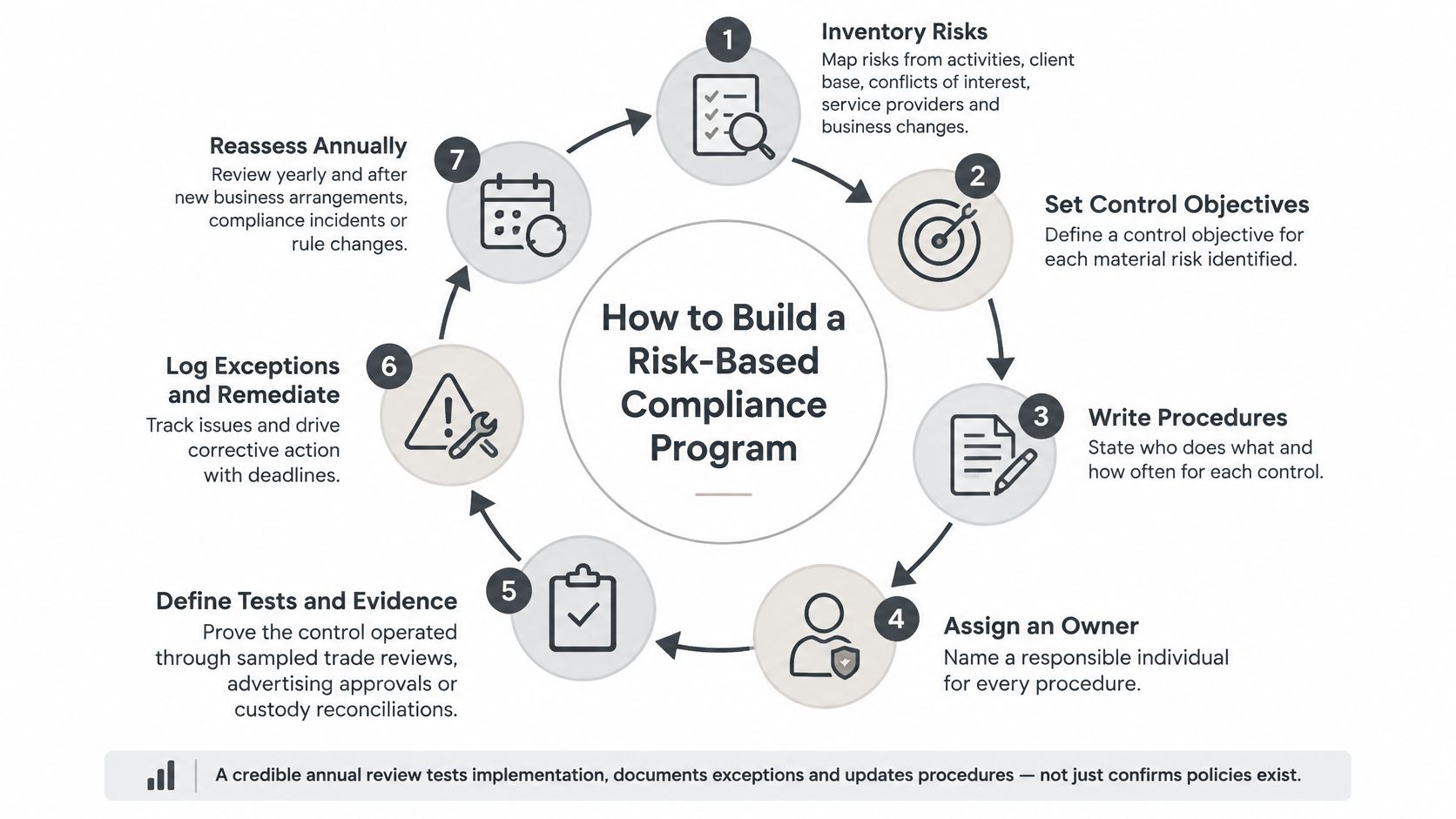
Turn risks into observable actions
Inventory risks. Examine activities, affiliations, client types, conflicts, service providers, and business changes. For example, identify compensation arrangements that could influence recommendations rather than recording a broad entry labeled conflicts.
Set a control objective. State the result the control should achieve. For advertising, the objective might be that employees distribute only reviewed versions containing appropriate disclosures and supportable claims.
Write an executable procedure. Specify who performs the task, what starts it, and how often it occurs. A personal-trading procedure should explain submission, review, exception handling, and where the reviewer records a decision.
Assign a named owner. A department name doesn't tell an examiner who was accountable. For third-party oversight, identify the person who gathers diligence materials, evaluates concerns, and escalates unresolved weaknesses.
Define the test and evidence. Decide how someone independent of the original task can verify performance. Examples include sampled trade reviews, advertising approval histories, custody reconciliations, and records showing that rejected communications weren't distributed.
Log exceptions and remediate. Give each issue an owner, target date, corrective action, and closure evidence. If a recordkeeping test finds missing messages, investigate both the missing records and the channel configuration that allowed the gap.
Reassess when the business changes. Treat a new affiliate, service provider, compliance incident, or business arrangement as a reason to revisit affected controls. Don't leave a procedure unchanged merely because management previously approved it.
Distinguish completion from effectiveness
A reviewer should be able to follow the evidence without relying on the employee's memory. An approval entry should identify the material reviewed, the reviewer, the decision, and any conditions attached to that decision.
The test should also challenge whether employees used the process. Checking an advertising approval folder won't reveal unapproved advertising unless the reviewer compares that folder with material distributed.
A signed policy acknowledgment proves receipt. It doesn't prove the employee followed the policy.
A credible review documents exceptions, management's response, unresolved risk, and procedural changes. Closing an issue should mean someone checked the correction, not that someone marked it complete.
A small-business compliance checklist can help organize the work. The important next step is replacing general checklist entries with firm-specific owners, tests, and retained evidence.
Responding to Regulatory Inquiries and Information Requests
Under FINRA Rule 8210, FINRA can require information, written answers, testimony under oath, and access to records within a firm's or associated person's possession, custody, or control. Failure to comply can itself become a violation, separate from the underlying conduct.
Consider an examiner's finding that a supervisor didn't document message reviews. If the firm leaves that gap unresolved and a customer complaint later raises questions about those messages, an inquiry may require the firm to explain both the communications and its supervisory response. That progression isn't automatic, but it shows why an apparently administrative deficiency deserves attention.

Preserve first and control the response
- Issue a legal hold. Notify relevant custodians and suspend deletion before collection begins.
- Identify people and systems. Include email, messaging, phones, shared drives, and relevant AI tools.
- Build a request-to-records matrix. Map each request to custodians, repositories, date ranges, and responsible reviewers.
- Separate preservation from production. Preserve potentially relevant material, then assess responsiveness and reconcile collection completeness.
- Maintain a production log. Record what was sent, when, by whom, and under which request.
- Document privilege and confidentiality decisions. Counsel should evaluate protection rather than assuming a confidential label resolves the issue.
- Escalate ambiguity in writing. Clarify uncertain scope through counsel instead of narrowing the request on your own.
For a cross-industry explanation of traceable records, VideoLearningAI's discussion of FDA and HIPAA audit trail standards offers useful context. Those standards aren't securities requirements; the practical comparison is how a record identifies an action and its history.
Address departure disclosures separately
The Form U5 materials and interpretive guidance address termination disclosures and the need to amend inaccurate or incomplete information. A later dispute can therefore require a renewed accuracy assessment rather than treating the original filing as permanently settled.
We guide financial advisor clients through regulatory inquiries, on-the-record interviews, and compliance issues. Our discussion of Securities and Exchange Commission investigations provides additional context for counsel-led responses.
A clean response file contains the request, hold notices, collection records, reconciliations, review decisions, correspondence, and final production index. Another reviewer should be able to reconstruct the response without guessing.
Signs You Need a Consultant Now
The right time to obtain help is usually an operational trigger, not a date on the calendar. Warning signs include no designated compliance leader where required, no documented program review, procedures describing a business the firm no longer operates, and recurring findings on the same subject.
Unapproved technology is another signal. If employees use an AI meeting assistant without anyone checking where recordings go or how outputs are retained, the firm has an unresolved workflow question, not merely a software question.
Compliance triggers, urgency and first steps
| Trigger | How urgent | First step |
|---|---|---|
| New SEC or state registration | Before the firm begins client activity | Gap review against applicable rules |
| Deficiency letter or exam finding | Within the response deadline stated in the letter | Root-cause review and written remediation plan |
| Regulatory inquiry or Rule 8210 request | Immediately | Legal hold and preservation of records |
| New product, AI tool or outside business activity | Before launch or first use | Risk assessment and approval workflow |
| Rule change or rule modernization | Begin assessment when finalized; implement by the applicable effective or compliance date | Gap analysis against updated obligations |
| Advisor departure or breakup dispute | Before the departure is finalized, where feasible | Records review and Form U5 accuracy check |
| Acquisition or merger | Before signing | Diligence on the target's supervisory and compliance program |
Decide whether the team can fix it internally
An internal team can handle routine updates when it understands the obligation, has enough capacity, and can verify the correction objectively. Updating a contact list is different from deciding whether past supervisory failures require broader investigation.
Outside assistance becomes more valuable when:
- The issue may become adversarial, including a regulatory investigation or contested termination.
- Management needs independent testing, rather than assurance from the person responsible for the control.
- Several functions must coordinate, such as compliance, information technology, human resources, and legal.
- The same weakness keeps returning, suggesting that reminders haven't addressed its cause.
For a small firm, the useful output isn't a lengthy summary of regulatory language. It's a practical assignment of owners, required evidence, approval conditions, and escalation thresholds.
Before authorizing an engagement, identify who can implement the recommendations. Even a sound outside assessment won't solve a problem if management leaves responsibility unassigned.
Realistic Scenarios and What Good Outcomes Look Like
The following scenarios are hypothetical illustrations, not client results. They show how the scope of compliance work changes with the underlying problem.
A growing adviser outgrows its procedures
Suppose an investment adviser grows from 40 to 150 clients, but its policies still assume the founder personally reviews every communication. Employees now publish marketing material, and compensation arrangements have become more complicated.
The consultant rebuilds the risk inventory, revises conflicts and advertising procedures, assigns reviewers, and establishes quarterly testing as part of this hypothetical engagement. Management also identifies a backup approver so employee absences don't result in informal exceptions.
The adviser ends with a current risk map and tested controls, not a larger manual.
A departing broker has client texts on a personal phone
A broker preparing to leave discovers that personal messages and client discussions are mixed together. The firm's records process doesn't clearly explain how to collect business communications without unnecessarily exposing unrelated personal material.
Counsel directs preservation, and the team uses a documented review protocol to distinguish potentially responsive business records from personal content. Nobody deletes messages merely because the device is personally owned, and nobody assumes every personal message must be produced.
The deliverable is a defensible response file containing collection details, review decisions, and a production log. If termination disclosures become disputed, the preserved record supports an informed accuracy review.
An advisory firm introduces AI meeting notes
A firm wants an AI tool to summarize advisor meetings. Before approval, the team checks recording settings, access permissions, vendor terms, retention options, and how advisors will correct inaccurate summaries.
The consultant maps the workflow to applicable approval, supervision, and recordkeeping obligations. A pilot review compares sample outputs with the underlying meeting record and checks whether employees can distinguish draft notes from approved client records.
The firm ends with an approved use policy, defined restrictions, and a testing record. Approval applies to the reviewed configuration and workflow, not every future feature the vendor releases.
Good outcome: Employees can perform the task correctly, supervisors can verify it, and the firm can retrieve the evidence.
A binder that nobody tests doesn't meet that standard.
How to Choose a Compliance Consultant or Counsel
Compare providers by the work you'll receive, not the length of their regulatory vocabulary. A useful engagement should make responsibilities and evidence easier to understand.
Use a deliverable-focused checklist
Match the expertise to your status. An SEC adviser, FINRA member, state-registered lender, and business processing Connecticut residents' personal data face different questions. Confirm that the proposed team understands your activities and applicable frameworks.
Inspect a sample work product. A risk map, testing workpaper, or request-to-records matrix should connect an issue to a control, owner, and evidence source. Generic policy language doesn't establish implementation.
Understand the testing method. Establish how reviewers select records, investigate exceptions, repeat testing, and obtain management sign-off. Ask what happens when evidence is missing.
Address privilege before work begins. Communications with counsel for legal advice may be protected, but protection depends on the circumstances. A consultant's involvement doesn't automatically make documents privileged, and copying an attorney doesn't solve that problem.
Define scope and fees. Specify deliverables, exclusions, access needs, and responsibility for implementation. A defined gap review followed by separately scoped testing can make the assignment easier to manage.
Consultant-led implementation may suit routine operational work. Counsel-led engagement deserves consideration when facts may become contested, employees face individual exposure, or termination disclosures are disputed.
A fractional general counsel arrangement may also help coordinate legal decisions with ongoing business operations. Whichever structure you choose, the participants should work from a shared owner list and controlled evidence file, rather than creating conflicting instructions.
Confirm Your Compliance Gap With Counsel
You don't need to rebuild the entire program before seeking advice. Start by making the unresolved questions visible and preserving the records needed to answer them.
Gather the current record. Pull the latest program review, examination correspondence, deficiency letters, and open regulatory requests. Identify response dates and any preservation instructions already issued.
Compare obligations with actual activities. Mark each applicable framework as open, partly addressed, or closed with evidence. Treat closed as a conclusion supported by records, not a synonym for having a written policy.
Identify the immediate trigger. Note any departure, product launch, inquiry, or transaction that changes urgency. State who currently owns the issue and what decision that person needs help making.
Bring the uncertainty into focus
A concise issue summary is more useful than an undifferentiated document dump. Explain what changed, which employees or systems are involved, what management has already done, and where the evidence stops.
Our Securities Regulation practice defends financial advisers facing regulatory inquiries, investigations, and disciplinary actions. Our Corporate & Business Law practice helps clients form and structure businesses, draft and negotiate contracts, manage mergers and acquisitions, and maintain ongoing compliance with complex regulations.
The value of regulatory compliance consulting is clearest when it produces a specific correction that someone owns and another person can verify. Prospective clients can schedule a confidential consultation by calling the firm or completing its online form.
Kons Law helps businesses address compliance obligations and financial professionals respond to regulatory scrutiny. Visit Kons Law to learn about the firm and request a confidential consultation. If you want to discuss your business law matter, contact Kons Law at (860) 920-5181.
