
A buy-sell agreement attorney is the legal expert who drafts what many business partners call a "business prenup." This vital contract establishes clear rules for what happens if a co-owner exits the business—whether due to death, disability, retirement, or another triggering event. It’s all about ensuring a smooth ownership transition and heading off disputes before they start.

Why a Buy-Sell Agreement Attorney Is an Essential Partner
Imagine the business you built with your partners is a finely tuned vehicle. A buy-sell agreement is your emergency plan and insurance policy, designed to prevent a total crash if one of the drivers unexpectedly has to exit. Without one, a sudden departure can throw the entire company into chaos.
This legal document isn't just a simple contract; it’s a survival guide. It provides a clear, legally sound roadmap for navigating one of the most disruptive events a business can face. This isn't a luxury for big corporations—it's a foundational need for any company with more than one owner.
Protecting Your Company’s Future Before a Crisis Hits
Hiring an attorney to draft this agreement is one of the smartest proactive steps you can take. It’s about tackling the tough "what-if" scenarios now, while everyone is on good terms, rather than scrambling for answers during a crisis when emotions are high.
A well-written agreement protects your business from very real threats:
- Ownership Chaos: It stops an owner's shares from falling into the hands of an unprepared heir, an ex-spouse after a divorce, or a stranger who has no connection to your vision.
- Damaging Disputes: It sets a pre-agreed formula for valuing a departing owner's stake, preventing ugly and expensive fights over what the business is worth.
- Financial Instability: The agreement can ensure a funding source—often life or disability insurance—is ready so the company or remaining owners can afford the buyout without gutting operational cash.
A little foresight with an expert today prevents a disaster tomorrow. The cost of drafting a buy-sell agreement is tiny compared to the staggering expense of litigation, business disruption, and potentially losing the company you've worked so hard to build.
Ultimately, a buy-sell agreement attorney helps you protect your partners, your family, and your legacy. They ensure your business has the structure it needs to survive the unexpected and continue to thrive. This kind of stability is a core part of what a business lawyer does. If you want to discuss your business law matter, contact Kons Law at (860) 920-5181.
What a Buy-Sell Agreement Actually Does for Your Business
People often call a buy-sell agreement a “business prenup,” but it’s so much more than that. At its core, this is a legally binding contract that lays out exactly what happens to a business owner's shares if they leave the company—whether due to death, disability, retirement, or dispute.
Its real power is in answering the toughest questions before they become a crisis. The agreement’s main job is to control who can own a piece of your company. It prevents shares from falling into the hands of an ex-spouse after a divorce, an heir with no business sense, or worse, a competitor. This control is absolutely fundamental to protecting the business you've built.
The Tale of Two Businesses
To see why this matters, imagine two identical businesses. Both are successful, and both suddenly lose one of their two founding partners.
Business A (No Agreement): Chaos erupts. The deceased partner’s shares go to their spouse, who knows nothing about the industry and has a completely different vision. They can't agree on valuation, operations, or strategy. The dispute ends up in court, draining the company's money and morale until the business itself is at risk.
Business B (With an Agreement): The buy-sell agreement kicks in immediately. It clearly states the company will buy back the deceased partner’s shares using a life insurance policy set up for this exact scenario. The valuation method was already agreed upon, so the price is fair. The partner's family gets a prompt cash payout, and the surviving partner takes full control, ensuring the business continues without missing a beat.
This isn't just a hypothetical; it’s a reality we see play out all the time. A buy-sell agreement is a crisis management plan that preserves the company’s value. Many of its key components are often tied into a shareholders' agreement, another critical document for protecting ownership.
The Connelly Case and Why It Matters
The legal ground for these agreements shifted dramatically after the U.S. Supreme Court's recent decision in Connelly v. United States. This ruling has major tax implications for how your business is valued.
The Connelly decision makes it clear: life insurance proceeds meant to fund a buyout must now be included when calculating the company's total value for estate tax purposes. If your agreement isn't structured correctly, this can lead to a much higher valuation and a bigger tax bill.
This is a critical update for every business owner in Connecticut. An outdated or poorly drafted buy-sell agreement could leave a deceased owner's family with a massive, unexpected tax liability, undermining the financial security the agreement was supposed to provide.
The old way of doing things—using a simple fixed-price formula in your agreement—is now incredibly risky and may not stand up to IRS scrutiny. Working with an attorney who understands the nuances of the Connelly case isn't just a good idea; it's essential. For more on the fundamentals of owner contracts, you can also explore our guide on shareholder agreements.
The need for these forward-thinking legal tools is growing. The global legal services market, which includes corporate governance planning, was valued at $1,052.90 billion in 2024 and is expected to climb as more business owners recognize these risks. If you want to discuss your business law matter, contact Kons Law at (860) 920-5181.
Choosing the Right Buy-Sell Agreement Structure
Once you’ve decided to create a buy-sell agreement, the next critical step is picking the right structure. This isn't just a technical detail; the framework you choose will have major consequences for taxes, funding, and how smoothly the whole process works when it's needed most.
Think of it less like a legal form and more like a strategic plan. There are three primary structures—Cross-Purchase, Redemption, and Hybrid—and each one serves the same goal in a fundamentally different way. The right one for you depends entirely on your company's unique setup.
The Cross-Purchase Agreement
A Cross-Purchase agreement is the most direct approach: the remaining business owners personally agree to buy the departing owner’s shares. It's a "partner-buys-partner" model. For businesses with just two or three owners, this is often the cleanest and most effective route.
Its main draw is a significant tax advantage. The owners get a “stepped-up basis” on the shares they buy, meaning their new cost basis is the price they just paid. This can dramatically lower their capital gains tax bill if they sell those shares down the road. The downside? It gets messy fast with more owners, as you’d need to manage multiple insurance policies and agreements.
The Redemption Agreement
With a Redemption agreement, the business entity itself buys back the departing owner's shares. This is a "company-buys-back" model. Because the company handles the transaction, this structure is far simpler to administer, especially in businesses with many owners.
The company usually holds one life insurance policy on each owner to fund the buyout, which keeps things streamlined. The trade-off, however, can be the tax treatment. The remaining owners don't get a stepped-up basis, which could lead to a bigger tax hit for them later. You have to weigh the administrative simplicity against these potential tax implications.
The Hybrid Agreement
A Hybrid agreement combines elements of both, offering the most flexibility. Often called a "wait-and-see" plan, it creates a sequence of options.
Typically, the company gets the first opportunity to buy the shares. If it can't or chooses not to, the option then passes to the individual owners. This adaptability makes it a great choice for businesses that want to keep their options open or have complex partner dynamics.
To help you choose the best fit, here's a simple breakdown of how these three structures compare.
Comparing Buy-Sell Agreement Structures
| Agreement Type | Who Is The Buyer | Primary Funding Method | Key Tax Consideration |
|---|---|---|---|
| Cross-Purchase | The individual owners | Owners buy life insurance on each other | Remaining owners get a "stepped-up" cost basis |
| Redemption | The business entity | The company buys life insurance on each owner | Remaining owners do not get a stepped-up basis |
| Hybrid | Company first, then owners | A mix of company and individual insurance | Varies depending on who executes the purchase |
This table lays out the core mechanics, but the real-world impact depends on your specific financial situation and long-term goals.
This decision tree shows the two paths a business can take when a partner leaves—one with a plan, and one without.
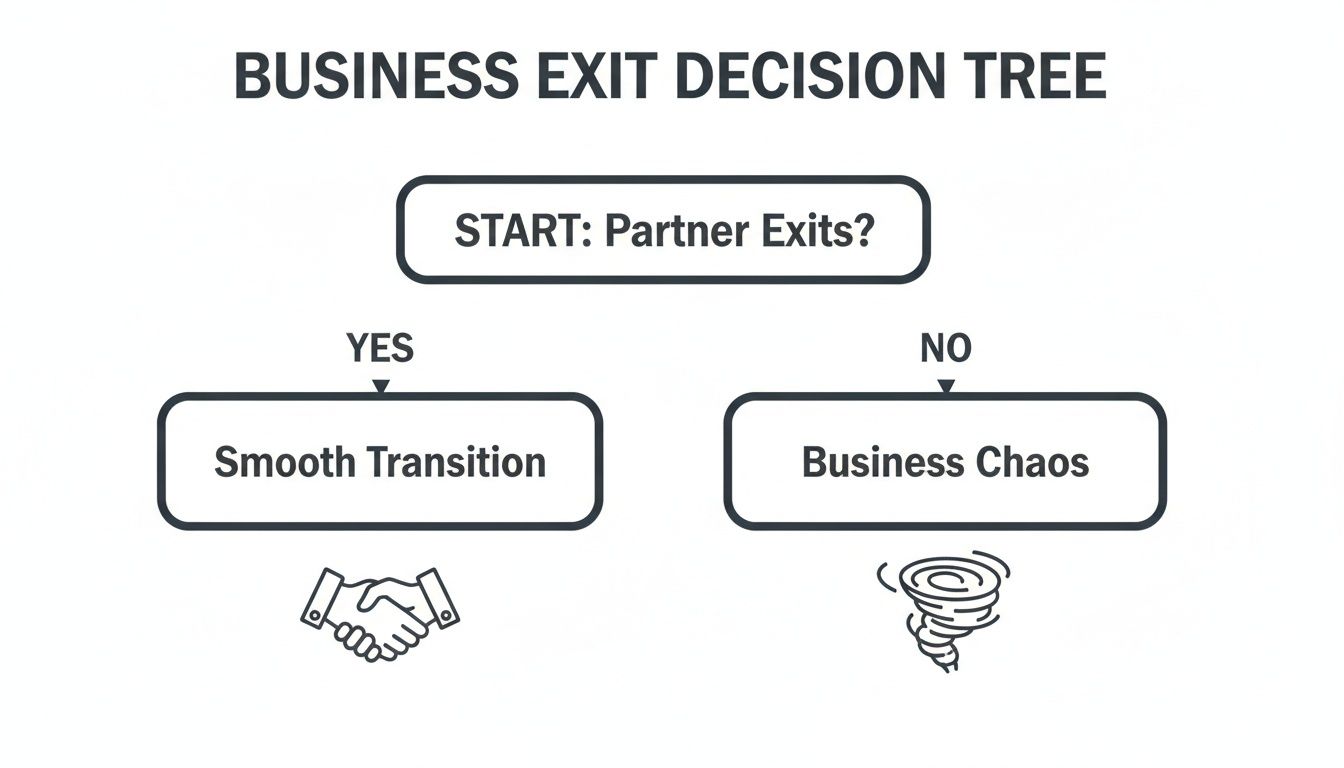
The takeaway is simple. A partner's exit is inevitable. Proactive planning ensures it's a controlled transition, not a crisis that derails your business.
The choice of structure is not just a legal formality; it's a strategic business decision. It directly impacts your company's financial health, the tax burden on remaining owners, and the ease of executing the agreement when a triggering event occurs.
The right choice is deeply connected to other foundational decisions, including your business entity type. If you need more background, you can read about how to choose a business structure to understand how all these pieces fit together.
If you want to discuss your business law matter, contact Kons Law at (860) 920-5181.
How an Attorney Crafts Your Ironclad Agreement
A skilled buy-sell agreement attorney provides far more than a standard legal document. They bring crucial strategic guidance to the table, helping you build a framework that protects your company from the disruption of an owner's departure.
This isn’t about filling in a template. It's a detailed process tailored to your specific business, your partners, and your long-term goals. The attorney’s first step is to align the agreement’s structure—whether cross-purchase, redemption, or hybrid—with your company's operational and tax objectives.

Defining Every Possible Trigger Event
A good attorney looks beyond the obvious triggers like death and retirement. They help you anticipate and plan for a wide range of other potential exit scenarios, leaving nothing to chance.
A truly comprehensive agreement will clearly outline the procedure for:
- Disability: Defining what qualifies as a long-term disability and how the buyout process begins.
- Divorce: Shielding an owner’s shares from being treated as a divisible asset in a divorce proceeding.
- Bankruptcy: Protecting the company from the claims of an individual owner’s creditors.
- Ethical Breaches: Creating an exit ramp for situations where an owner’s conduct, like losing a professional license or committing a crime, puts the business at risk.
By defining these events in clear, unambiguous terms, your attorney removes guesswork. This proactive planning ensures a clear path forward is already in place if a difficult situation ever arises.
Establishing a Bulletproof Valuation Method
One of the most critical functions an attorney performs is creating a valuation mechanism that is both fair and defensible. In the past, many business owners relied on a simple fixed price or a basic formula, but this approach is no longer safe.
The recent Connelly v. United States decision has dramatically increased IRS scrutiny on how private businesses are valued for estate tax purposes. An experienced attorney ensures your valuation method can withstand this review, often by requiring periodic third-party appraisals or using a dynamic formula that reflects true fair market value.
A vague or outdated valuation clause is an invitation for a lawsuit. Your attorney's job is to craft a method so clear and defensible that it minimizes the risk of disputes, protecting both the departing owner's interests and the remaining partners.
Coordinating and Integrating Key Components
A buy-sell agreement doesn't operate in isolation. A knowledgeable attorney ensures all the moving parts of your succession plan work together seamlessly, often coordinating with your other professional advisors.
This integrated approach includes:
- Funding Strategy: Working with your financial advisor and insurance professional to ensure the funding mechanisms—like life or disability insurance policies—are properly structured to cover a buyout.
- Tax Minimization: Collaborating with your CPA to structure the buyout in a way that minimizes the tax consequences for the company, the departing owner, and the remaining partners.
- Document Management: Ensuring all corporate formalities are followed and that essential records, such as the company’s Minute Book, are properly maintained to support the agreement’s validity.
This coordination closes potential loopholes and turns the agreement into a functional plan ready to be executed when needed. Well-drafted agreements are proven to prevent up to 70% of ownership disputes, and with IRS challenges to buy-sell valuations spiking 40% post-Connelly, expert legal drafting is more critical than ever.
If you want to discuss your business law matter, contact Kons Law at (860) 920-5181.
Navigating Connecticut Business and Tax Laws
A buy-sell agreement isn't just a private handshake between partners. It’s a legal document that has to function within the strict framework of Connecticut state law. For business owners here in the Nutmeg State, that means any agreement you create must be perfectly aligned with our state’s unique corporate, partnership, and tax statutes. Using a generic, one-size-fits-all template is a recipe for disaster, often failing to account for these local nuances and leaving your business wide open to legal and financial risk.
This is precisely where a buy-sell agreement attorney with deep Connecticut expertise becomes essential. They do more than just draft a plan; they build a legally enforceable contract that fully complies with state requirements. Think of local knowledge not as a bonus, but as a core necessity for creating a document that actually protects you.

Connecticut Corporate and LLC Statutes
Connecticut law has specific rules that govern how ownership can be transferred, and they differ based on your business structure. For instance, the Connecticut Business Corporation Act lays out clear shareholder rights and restrictions on stock transfers. A buy-sell agreement for any C-Corp or S-Corp must be drafted to work in harmony with these statutes, not against them.
It's a similar story for Limited Liability Companies (LLCs), where the buy-sell provisions are typically built right into the operating agreement. Connecticut’s LLC Act dictates how membership interests can be bought and sold. If you fail to properly integrate your buy-sell terms into a compliant operating agreement, they could be deemed ineffective, leaving your business completely exposed when you need protection the most.
The Impact of Connecticut Estate Tax
One of the most critical—and often overlooked—local factors is Connecticut's estate tax. Unlike the federal system, our state has a much lower exemption threshold. This means a greater number of estates end up facing state-level taxation, a fact that has direct and serious implications for your buy-sell agreement.
The valuation method you define in your agreement will be closely scrutinized not just by the IRS, but also by the Connecticut Department of Revenue Services. An agreement that undervalues the business could trigger a significant and unexpected state estate tax bill for a deceased owner's heirs, defeating one of the primary goals of the plan.
An attorney who practices here understands this landscape. They will ensure the valuation and funding mechanisms are structured to account for both federal and state tax laws, shielding your partners and their families from avoidable financial pain.
An experienced local attorney will manage these key Connecticut-specific considerations for you:
- Statutory Compliance: Ensuring all transfer restrictions in the agreement are valid and enforceable under Connecticut’s corporate and LLC laws.
- Operating Agreement Integration: Properly embedding the buy-sell provisions within your LLC’s operating agreement to make them legally binding.
- Estate Tax Planning: Structuring the valuation and funding of the agreement to minimize exposure to Connecticut's specific estate tax.
Figuring out how all these state-specific rules interact is a complex job. You can get a broader sense of the legal environment by reading our overview of Connecticut business laws.
Ultimately, navigating the state's legal environment is not a DIY project. If you want to discuss your business law matter, contact Kons Law at (860) 920-5181.
Secure Your Business Legacy with an Expert Partner
We've covered why a professionally drafted buy-sell agreement is essential for intelligent business planning. Without one, you leave your company exposed to bitter disputes, costly tax burdens, and the potential collapse of everything you and your partners have worked to build.
A well-crafted agreement provides stability, fairness, and continuity when ownership changes. It turns a potentially catastrophic event into a manageable business process. Now is the time to move from understanding the "why" to taking decisive action.
From Knowledge to Action
The risks of inaction are clear. A vague or nonexistent plan doesn't just create problems down the road—it can dismantle a successful business from the inside out. The goal is to fortify your company’s future, securing it against unexpected departures and ensuring the legacy you've built can endure.
For business owners in Connecticut, this means finding a legal partner who understands both corporate law and the specific requirements of our state. This is where professional guidance becomes critical.
Your Partner in Building a Secure Future
Kons Law provides focused guidance in corporate and commercial law for business owners across Connecticut. We know a buy-sell agreement is more than a legal formality; it’s a strategic tool designed to protect your most valuable asset.
Our approach is direct and protective. We craft clear, enforceable agreements that stand up to legal scrutiny and close the loopholes that often lead to disputes. Our priority is to safeguard your legacy and ensure the long-term continuity of your business.
Your business deserves a secure future. Don’t leave its fate to chance or rely on generic templates that fail to account for Connecticut’s complex tax laws and legal precedents. Formalizing your partnership's future is one of the most important investments you can make.
To discuss your business law matter, contact the attorneys at Kons Law at (860) 920-5181 to secure your business's future.
Common Questions About Buy-Sell Agreements
Even with a solid grasp of the basics, business owners we meet always have practical questions about how a buy-sell agreement works in the real world. Let’s tackle some of the most common concerns we hear from entrepreneurs here in Connecticut.
What’s the Real Cost of Hiring a Buy-Sell Agreement Attorney?
Business owners are right to watch the bottom line, so questions about legal costs are always top of mind. The expense of hiring a buy-sell agreement attorney really depends on how complex your business is and how many owners are involved.
Some lawyers charge by the hour, while others might offer a flat fee to draft the entire document. It's easy to see this as just another business expense, but it’s truly an investment in your company’s future. The cost of getting a solid agreement drafted now is just a fraction of what you’d spend on litigation if a partnership dispute blows up later.
How Often Should We Update Our Buy-Sell Agreement?
A buy-sell agreement is a living document, not something you can just file away and forget. As your business grows and changes, your agreement needs to keep pace. Think of it like a regular check-up.
You should plan to sit down with your attorney to review the agreement whenever these events occur:
- Major Business Changes: This could be anything from taking on significant new debt to acquiring another company or seeing a major shift in profitability.
- Changes in Ownership: Any time a new partner comes on board or an existing one leaves.
- Significant Life Events: A marriage, divorce, or serious health issue for any owner can have a huge impact on the agreement.
- Every 3-5 Years: As a general rule, a review every few years is smart. It ensures your valuation methods and terms still make sense for where the business is today.
An outdated agreement can become completely useless when you need it most. For instance, an old valuation formula could force an unfair buyout price, causing the exact kind of conflict the agreement was supposed to prevent.
What Happens If We Just Don’t Have One?
Running a business with multiple owners but no buy-sell agreement is like driving without a steering wheel. If an owner dies, retires, or just wants out, the situation defaults to state law—and those default rules almost never align with what the partners actually want.
Without a plan, you’re exposing the business to huge risks:
- Ownership Gridlock: An owner’s shares could suddenly belong to an heir or an ex-spouse who knows nothing about the business but now has a say in everything.
- Costly Litigation: When there's no agreed-upon process or price, disputes over the value of a departing owner's stake almost always end up in expensive, draining court battles.
- Forced Dissolution: In a worst-case scenario, a judge could order the entire business to be dissolved and its assets sold off just to pay out one owner’s share.
Skipping this step creates a power vacuum filled with uncertainty and conflict, which can easily threaten the survival of the business you've worked so hard to build.
Can’t I Just Use an Online Template?
It’s tempting to grab a cheap template online, but this is an incredibly risky shortcut. These one-size-fits-all documents aren't built for Connecticut's specific laws and usually end up creating more problems than they solve.
Generic templates cannot account for the intricate legal and financial nuances of your specific business. They often contain vague language, outdated valuation methods, and fail to address critical state-specific compliance issues, leaving your business vulnerable.
This risk is bigger now than ever before. Following the landmark U.S. Supreme Court decision in Connelly v. United States, the IRS is scrutinizing buy-sell agreements with a fine-toothed comb. In fact, it's estimated that up to 70% of existing agreements may need to be updated because they use fixed formulas that the IRS now views as undervaluing a business for tax purposes. You can find more detail on the post-Connelly landscape for buy-sell agreements on hklaw.com. Using a generic template that ignores this critical new precedent is practically an invitation for an IRS challenge.
If you want to discuss your business law matter, contact Kons Law at (860) 920-5181.
