Non-solicitation agreements are generally void and unenforceable in California under Business and Professions Code § 16600, and that position was reinforced by laws effective January 1, 2024. But the easy answer, "no, they aren't enforceable," misses two narrow but important exceptions that can create real exposure for financial advisors, firms, and practice owners.
A lot of online commentary stops at the headline. That's risky. In real disputes, the outcome often turns on how the agreement was drafted, whether the employer is really protecting a trade secret, and whether the restriction sits inside an employment contract or inside a deal involving the sale of a business. For advisors moving between firms, teams unwinding, or owners selling a book of business, those distinctions matter.
If you're asking are non-solicitation agreements enforceable in California, the practical answer is this: usually no, sometimes maybe, and occasionally very much yes if the facts fit a narrow exception. The hardest cases usually involve client relationships, transition protocols, promissory note disputes, Form U5 pressure, and arguments that an advisor's move was tied to confidential information or a prior equity transaction.
The Complicated Truth About Non-Solicitation in California
California starts from a strongly mobility-focused rule. The state generally doesn't let employers use private contracts to keep someone from earning a living in the profession they know. For financial professionals, that means a standard non-solicitation clause in an employment agreement often looks stronger on paper than it is in court.
That said, knowledgeable readers should resist overcorrection. "Void" doesn't mean "ignore everything and move fast." A bad transition can still trigger claims over trade secrets, confidentiality, unfair competition, document retention, client communications, and regulatory fallout. In the brokerage and advisory space, those side issues are often where the primary contention occurs.
Why advisors get tripped up
Financial advisors often work inside a structure that mixes employment obligations with client ownership narratives, data access rules, and payout incentives. A firm may call a client list proprietary. An advisor may view those same households as relationships developed over years of personal effort. The conflict isn't theoretical. It's usually about who can contact whom, using what information, and under which deal documents.
The legal label on the clause matters, but the surrounding facts usually matter more.
A clean legal analysis starts with three questions:
- What document contains the restriction: an offer letter, an employment agreement, a confidentiality agreement, or a purchase agreement.
- What interest is being protected: general goodwill, confidential data, or a specific trade secret.
- What transaction occurred: a straightforward departure, an equity buy-in, or a sale involving business goodwill.
The two nuances most people miss
Most generic articles don't spend enough time on two issues that matter a lot in this industry.
First, a non-solicit tied to a sale of a business can be enforceable in circumstances where the same language would fail in a plain employment contract. Second, the 2024 California amendments gave the statute a broader reach, which matters for advisors who signed agreements outside California and later move into the state or work for a California-based operation.
Those two points can completely change the risk analysis.
The General Rule B&P Code 16600 and Its Broad Prohibitions
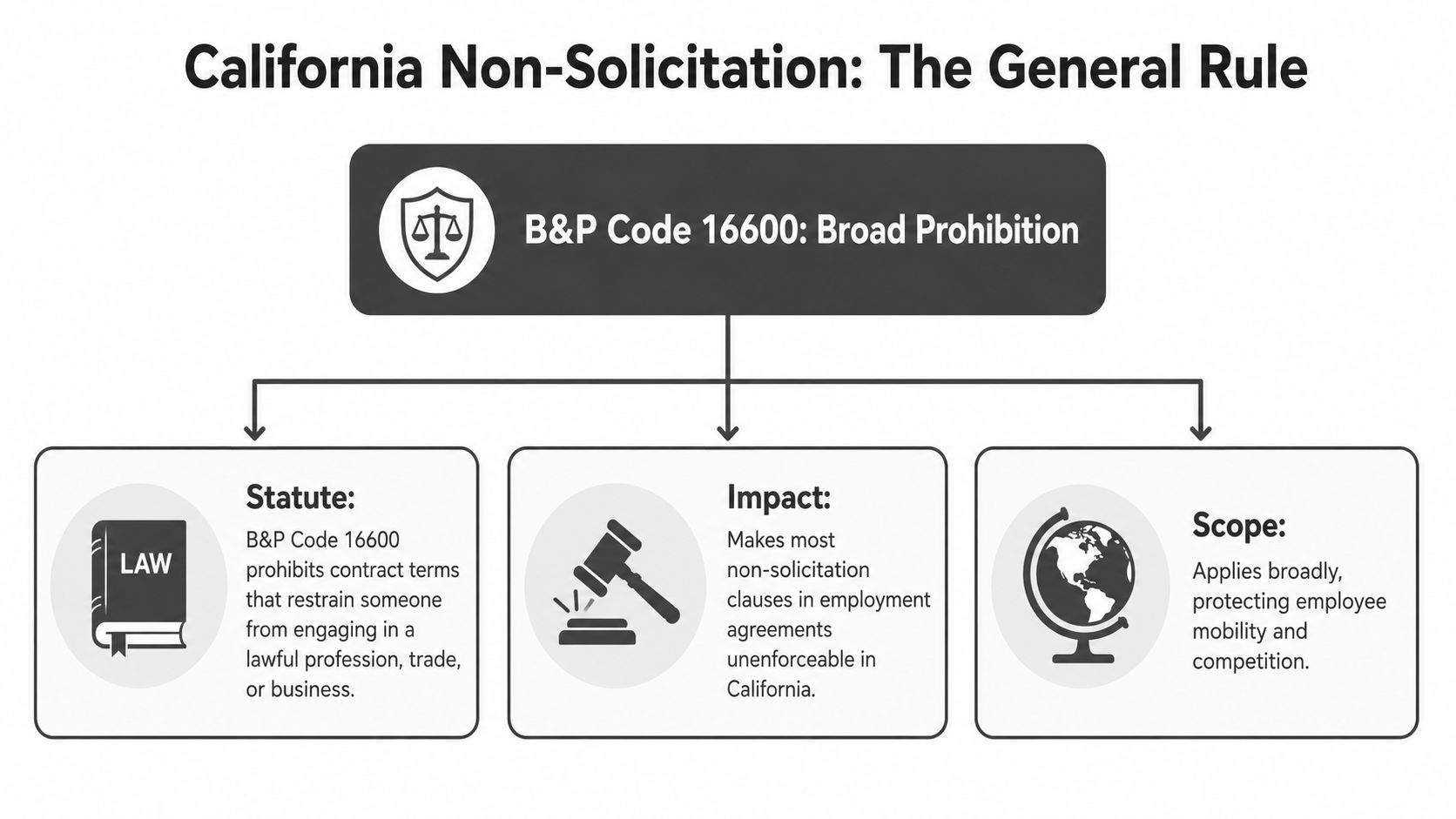
California's baseline rule is unusually broad. Under Business and Professions Code § 16600, a contract that restrains someone from engaging in a lawful profession, trade, or business is void. In the employment setting, that broad language is why non-solicitation clauses are usually on shaky ground.
"Every contract by which anyone is restrained from engaging in a lawful profession, trade, or business of any kind is to that extent void."
That statutory policy isn't narrow or technical. It reflects a larger judgment that California favors employee mobility and open competition over private restraints in ordinary employment relationships. If you want a broader overview of restrictive covenant concepts generally, this discussion of restrictive covenant agreements is a helpful companion.
What changed in 2024
The default rule became harder to evade after SB 699 and AB 1076, both effective January 1, 2024. As summarized in this review of California non-solicitation enforceability and the 2024 amendments, the law now expressly states through Section 16600.5 that contracts void under Section 16600 are unenforceable regardless of where they were signed, and employers were required to notify current and former employees, if employed after January 1, 2022, by February 14, 2024 that unlawful non-compete or non-solicitation clauses are void.
That matters because older employer arguments often depended on geography, drafting finesse, or the assumption that a clause signed elsewhere would remain viable. California narrowed that room considerably.
What this means in practice
For most employee non-solicitation provisions, the practical presumption is unenforceability. A clause saying a departing advisor can't contact clients, can't recruit colleagues, or can't compete for a defined period after leaving is usually the kind of restraint California disfavors.
A few practical consequences follow:
- Standard employment language is vulnerable: If the clause restrains the former employee's ability to compete, it likely faces a serious Section 16600 problem.
- Out-of-state drafting isn't a cure: A firm can't assume a different signing location saves the restriction.
- Enforcement efforts carry risk: The issue isn't only whether the clause fails. The attempt to enforce it may create additional exposure.
Practical rule: Start with the assumption that a stand-alone employee non-solicitation clause in California won't hold unless the employer can tie it to a recognized exception.
The public policy behind the rule
California's framework pushes employers toward lawful alternatives. Firms can still protect confidential information, client data that qualifies as a trade secret, and goodwill acquired in a true sale transaction. What they generally can't do is use a broad post-employment restraint as a substitute for those narrower protections.
That's why the right question usually isn't just "Is there a non-solicit?" It's "What lawful interest, if any, is this clause protecting?"
The Trade Secret Exception A Narrowly Defined Path to Enforcement
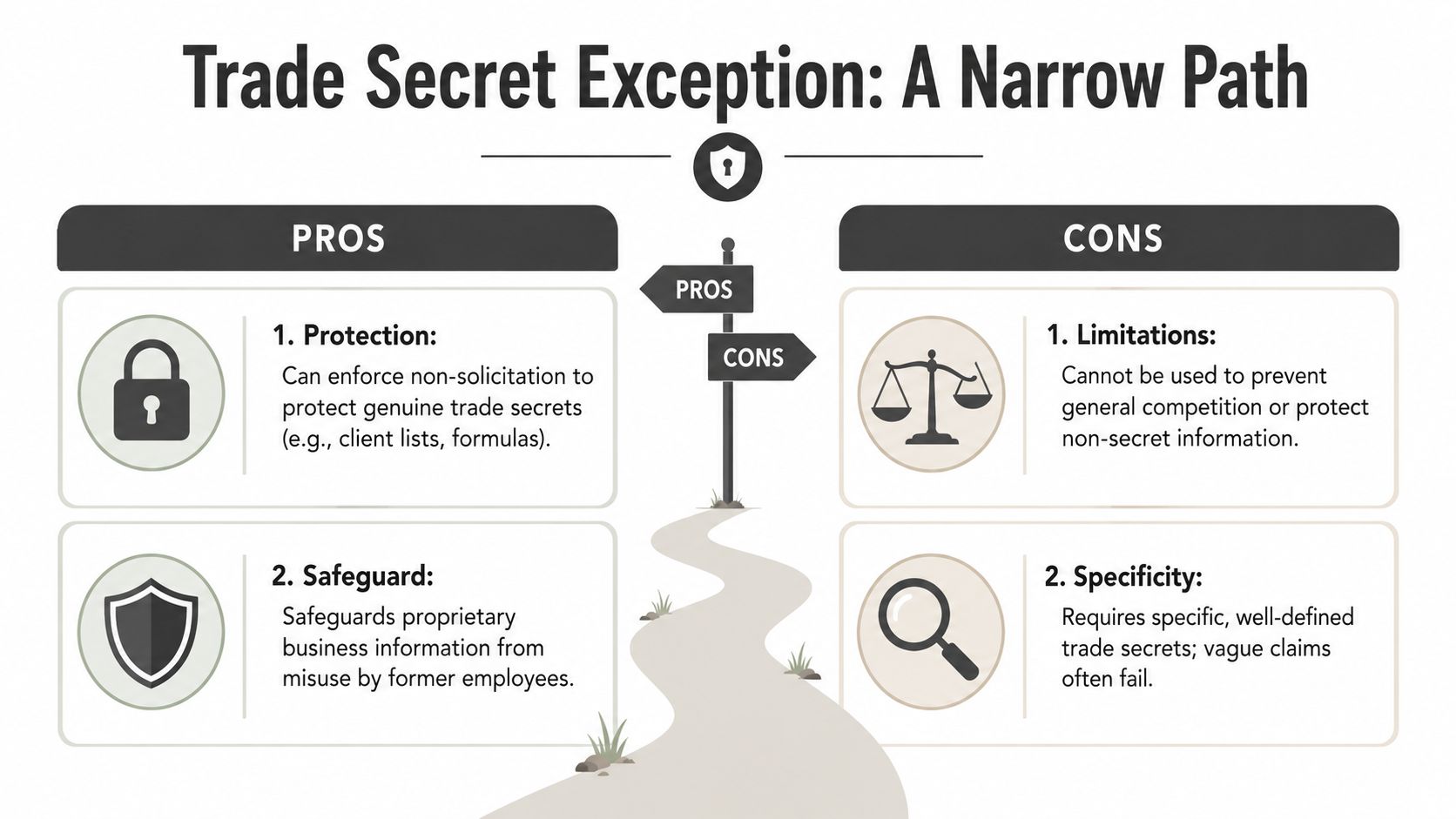
The most commonly cited exception involves trade secrets, but employers often overread it. California doesn't allow a company to relabel ordinary competition as trade secret protection. The restriction has to be tied to something proprietary, and the fit must be narrow.
The clearest way to think about it is this: a firm may have a legitimate complaint if a former advisor uses protected information such as an employer-created customer list built through significant investment of time and money, or proprietary formulas used to identify customers. That's different from an advisor using memory, experience, public information, or general professional relationships.
What Loral Corp. v. Moyes still means
As discussed in this analysis of when non-solicitation and non-competition agreements are enforceable in California, employee non-solicitation agreements may be enforceable if narrowly drafted to protect trade secrets, and Loral Corp. v. Moyes remains an important reference point. The same analysis notes that federal courts have increasingly interpreted recent authority to prohibit employee nonsolicitation provisions broadly, even though Loral remains technically good law.
That combination creates uncertainty. A lawyer who tells you "trade secret exception" without examining the actual information at issue is skipping the hard part.
If you want to understand how businesses should protect sensitive information without overreaching, this piece on protecting trade secrets is useful background.
What counts and what usually doesn't
Here's the practical divide for advisory businesses:
| Scenario | Likely view |
|---|---|
| A curated internal client list developed through firm investment and not publicly available | Potential trade secret argument |
| Proprietary segmentation methods, internal formulas, or confidential prospecting systems | Potential trade secret argument |
| An advisor's memory of relationships, preferences, and service history | Usually not enough by itself |
| Publicly available contact information or clients known throughout the market | Weak basis for enforcement |
A court is much more likely to scrutinize the information than the employer's label for it.
Where employers often lose
Employers usually run into trouble when they draft a broad non-solicit and then try to defend it by saying, after the fact, that everything is confidential. Courts tend to look for specifics. What exact information was secret? How was it protected? Why isn't this just a client relationship the advisor personally developed while working at the firm?
For financial advisors, this distinction is especially important because client relationships sit at the intersection of firm resources and personal trust. A broker-dealer may fund marketing, CRM systems, and segmentation. The advisor may be the person the client knows. That overlap doesn't automatically create a trade secret.
A stronger employer position usually includes precise confidentiality provisions, access controls, internal policies, and evidence that the information wasn't generally known. A weaker one relies on broad post-employment restrictions and slogans about ownership.
The Sale of a Business Exception A Trap for Unwary Advisors
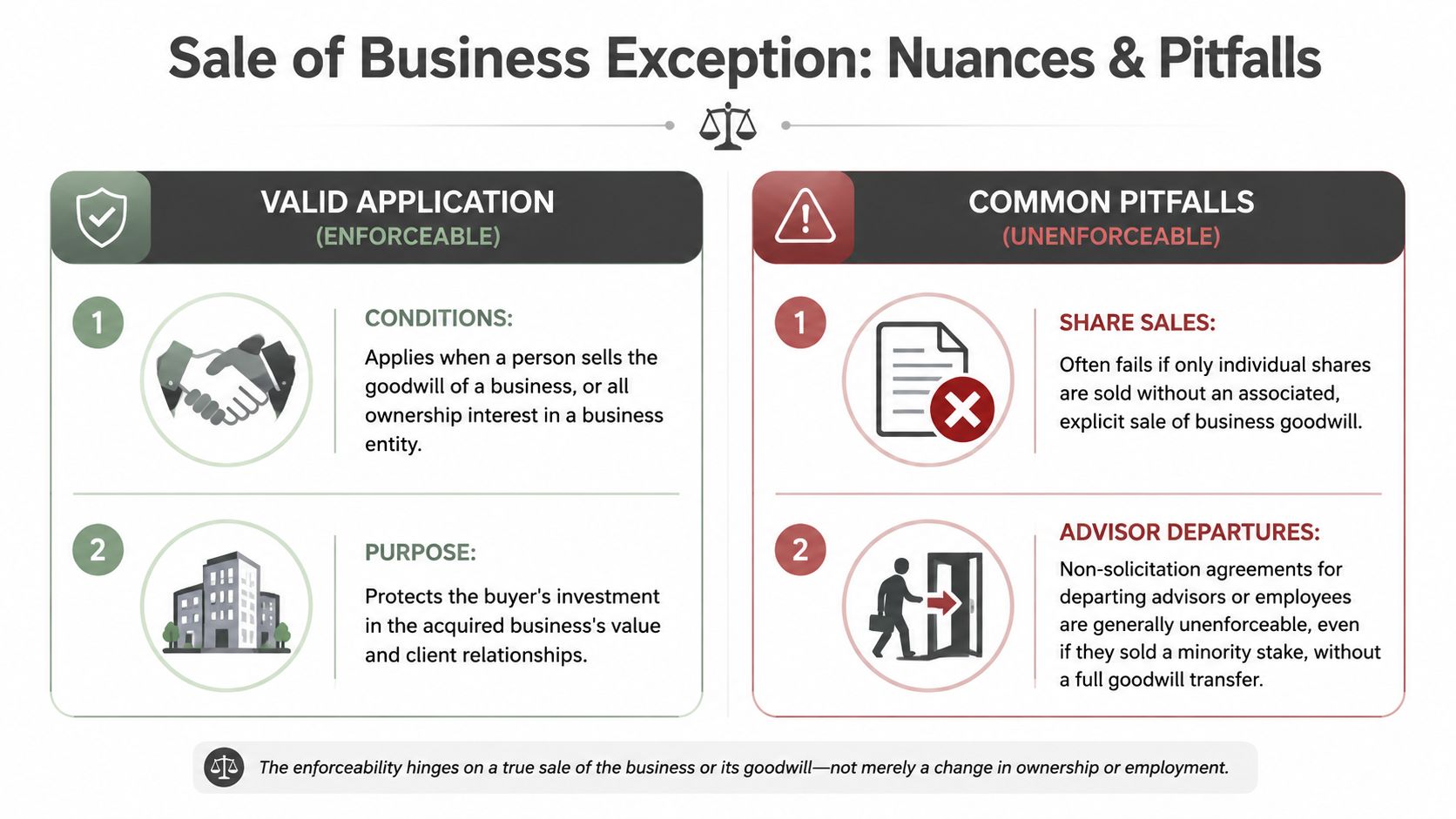
The sale of a business exception is where many breakup disputes become more dangerous than expected. Advisors often assume that because California disfavors non-solicitation clauses in employment agreements, the same rule applies when ownership interests, goodwill, or practice sales are involved. That's not always true.
In the financial services world, this comes up in team separations, succession deals, tuck-in acquisitions, and "buy-in" arrangements that were casually documented when everyone was getting along. Once the relationship breaks down, one side argues the clause is just employment restraint. The other argues it was part of the sale of a business and protection of goodwill.
Blue Mountain and the structure of the transaction
That issue sharpened in Blue Mountain Enterprises v. Owen (2023). As explained in this discussion of the California sale-of-business nonsolicitation exception, the court upheld a non-solicitation clause because it was part of a global transaction involving the sale of a business, not a standard employment agreement.
The practical lesson is significant. Courts may examine the entirety of the transaction, not just the title of the document that contains the restriction.
If you're evaluating a transaction before signing, this overview of letters of intent is worth reviewing because many enforceability problems start with loose deal structure at the preliminary stage.
Why this hits advisors differently
A pure employee departure usually fits the general California rule. But a departing advisor who sold equity, transferred goodwill, or participated in a broader purchase transaction may not be able to rely on that rule so easily. In practice, the legal structure can decide the case.
Consider the contrast:
- Employment agreement only: non-solicitation language is generally vulnerable.
- Purchase agreement tied to goodwill: the same type of restriction may be treated very differently.
- Mixed deal documents: the dispute often turns on whether the advisor was functioning as an employee, a seller, or both.
If the agreement was part of buying or selling a practice, don't assume California's general employee rule answers the question.
Common traps in practice sales
The danger isn't limited to large acquisitions. Smaller advisory transitions can create the same issue.
A few recurring problems:
- Minority interest confusion: An advisor sells or buys a stake and assumes it was too small to matter. Later, the other side characterizes the transaction as a goodwill transfer.
- Layered documents: The restrictive covenant appears in an employment agreement, but the surrounding transaction documents tell a broader story.
- Post-deal role changes: The seller stays on as an employee, which blurs whether the covenant belongs to the sale or to later employment.
For owners selling a book of business, careful drafting matters because the buyer wants protection for the value being acquired. For advisors leaving after a buy-in or partial sale, the same drafting can become a trap if they later try to compete freely.
The 2024 Laws and Their Nationwide Impact on Agreements
One of the most important changes in this area is the end of a common employer assumption: that an agreement signed outside California stays outside California's reach. That assumption is much less reliable now.

The new global void
As explained in this summary of important changes to California non-compete laws taking effect in January 2024, SB 699 created Section 16600.5, which states that any contract void under Section 16600 is unenforceable regardless of where or when it was signed.
For financial professionals, that is the part many old-school transition strategies miss. An advisor may have signed a restrictive covenant while working in Connecticut, New York, or another state. If that advisor later works in California, the old agreement doesn't get a free pass because it originated elsewhere.
Why this matters in cross-border moves
This issue comes up in several real-world patterns:
| Situation | Why the 2024 law matters |
|---|---|
| Advisor relocates to California after signing elsewhere | The signing state may no longer control enforceability if the contract is void under California law |
| National firm uses one template across many states | A California-facing employment relationship can create new problems for old forms |
| Team lift-out involves advisors with mixed state histories | Different documents may collapse into the same California analysis once the dispute lands there |
A lot of firms still operate from a multi-state playbook that assumes restrictive covenants are mainly a drafting exercise. California isn't playing that game.
The strongest practical takeaway from the 2024 amendments is that geography alone won't rescue a void restraint.
Enforcement risk changed too
The consequence isn't merely that the clause may fail. Under the statutory framework discussed earlier, employees can pursue injunctive relief, damages, and attorneys' fees if an employer attempts to enforce a void contract. That changes the power dynamic in pre-litigation letters, emergency motion practice, and negotiated exits.
For advisors and firms, this reshapes strategy in at least three ways:
- Demand letters need more discipline: Threats based on stale forms can backfire.
- Choice-of-law confidence is weaker: Contractual language selecting another state's law may not carry the day.
- Early case assessment matters more: The old instinct to "send the letter and see what happens" is more dangerous.
In short, the 2024 amendments didn't just restate California policy. They expanded the consequences of getting this wrong.
Defensive and Offensive Strategies for Your Next Move
Legal doctrine is useful. Transition planning wins cases. If you're a financial advisor facing a non-solicitation clause, the goal isn't to recite Section 16600 in a vacuum. It's to move carefully enough that you don't hand the other side a trade secret claim, a document retention claim, or a narrative that your transition was dishonest.
If you're a firm, broad non-solicits are no longer a dependable shield in California. The better approach is to protect what the law allows you to protect and stop relying on provisions that may create more litigation risk than practical value.
For advisors and departing professionals
Start by reading every related document, not just the paragraph labeled "non-solicitation." The answer may depend on whether the restriction appears in an employment agreement, an equity document, a redemption agreement, or a purchase-related contract.
Then pressure-test the facts:
- Check the transaction history: If there was any sale, buy-in, redemption, or goodwill transfer, the analysis may be different from a standard employment departure.
- Separate memory from data: Don't take client lists, exported CRM records, pipeline reports, or internal notes unless counsel has cleared the issue.
- Review notice issues: Under AB 1076, effective January 1, 2024, employers had to notify current and former employees employed after January 1, 2022 that unlawful non-compete or non-solicitation clauses are void. That requirement can matter in negotiations and disputes, even if the earlier legal analysis already favors the employee.
- Respond strategically to threats: A rushed answer to a demand letter can do damage. This guide on how to respond to a demand letter outlines the kind of disciplined response approach that often matters early.
Don't confuse a likely void clause with a license for sloppy conduct.
For firms and practice owners
Employers still have tools. They just need to be lawful and well-built.
The strongest protections usually include:
- Confidentiality agreements that define protected information clearly.
- Trade secret policies backed by real controls, not just boilerplate.
- Careful deal drafting when goodwill is being sold.
- Documented onboarding and offboarding procedures for CRM access, client files, and return of materials.
What doesn't work well is the old habit of dropping a broad non-solicit into every agreement and hoping the clause itself creates an advantage. In California, that approach often invites a direct challenge.
A practical decision matrix
When clients ask are non-solicitation agreements enforceable in California, the fastest useful answer usually comes from matching the dispute to the right category:
| Situation | Most likely focus |
|---|---|
| Ordinary employee departure | Section 16600 invalidity |
| Client outreach using confidential records | Trade secret and confidentiality issues |
| Practice sale or succession deal | Sale-of-business exception |
| Agreement signed outside California | Section 16600.5 and the global void analysis |
The right strategy depends on facts, timing, and paper trail. Advisors should avoid self-help. Firms should avoid reflexive enforcement.
If you want to discuss your business law matter, contact Kons Law at (860) 920-5181.
