
Form U4 is the Uniform Application for Securities Industry Registration and Transfer, the filing that registers an individual to work in a securities role. It asks for at least five years of residential history, at least ten years of employment history, and answers to a set of disclosure questions that stay on a regulatory record long after the hiring paperwork is filed.
You'll meet this form on one of two days. The first is your first week at a new firm, when someone in operations sends a packet and asks for a signature by Friday. The second is your last week, when you ask for a copy of what the firm filed about you and realize you've never read it.
That gap between signing and understanding is where trouble starts. A U4 isn't a hiring form that disappears into a personnel file. It's a live record that regulators, compliance departments, and future employers can pull up years later, which is why typing "what is a U4 form" into a search bar the night before your first day is a reasonable move. Here's the plain-language version.
What a Form U4 Is and Who Files It
The FINRA registration forms page describes Form U4 as the foundational registration document for individuals seeking approval to work in securities-related roles. A broker-dealer files it with the applicable self-regulatory organization for each associated person who will effect securities transactions. The same form also covers investment adviser representatives and certain issuer-related registrations.
Note who files: the firm, not you. You supply the answers and the signature, while the registration or compliance department submits the filing. That division of labor matters, because the firm controls what gets entered and you control what you confirm before signing.
Filing happens electronically. Broker-dealer registrations run through FINRA's Central Registration Depository (CRD). Adviser registrations run through the Investment Adviser Registration Depository (IARD). Nothing goes in the mail, and none of it is optional.
The document looks like a job application. Treating it like one is the mistake.

A resume reaches a hiring manager and fades into a personnel file. A U4 becomes a regulatory record. It holds prior employment and disciplinary history, regulators use it to evaluate fitness for registration, and it shapes public disclosures and investigations through every job change. The SEC's registration guidance puts the trigger plainly: a broker-dealer must file Form U4 when an associated person is hired or otherwise becomes associated with the firm. Hiring is the event, not a promotion or a review cycle.
It also behaves nothing like a live market tool. A product such as event-driven catalyst feeds for quants updates continuously as conditions change; a U4 changes only when someone files an amendment, and each filed version stays visible. If your filing route is about to change because you are building your own practice, the process for starting an RIA explains how registration shifts from CRD to IARD and what carries over.
The short version: Form U4 is the securities industry's registration filing. Your firm files it, you sign it, it goes to FINRA through CRD or IARD, and it stays on record.
What the Form Records, Section by Section
The form runs long because it functions as an audit trail. Five blocks carry most of the weight.
| Information block | What it covers | Requirement |
|---|---|---|
| Identifying and administrative data | Legal name, other names, contact details | Required on every filing |
| Residential history | Addresses over the past five years | At least five years |
| Employment history | Employers, roles, and dates | At least ten years |
| Outside business activities | Other business roles and interests | Required where applicable |
| Disclosure questions (Section 14) | Criminal matters, civil litigation, regulatory events, financial circumstances | Each yes answer needs a Disclosure Reporting Page |
The depth is deliberate. FINRA's Form U4 filing instructions call for at least five years of residential history and at least ten years of employment history. Ten years of employers, roles, and dates is a longer memory than most professionals carry in their heads, and that's exactly why the form asks for it in writing.
Reading the form like a records audit
Work the table row by row against documents, not recollection. Take an advisor who left a firm two years ago and now sits at a new one. That prior employer belongs on the employment block with a start date, an end date, and a title that matches the firm's records, not the internal title people used around the office. A three-month gap between two entries is the single most common source of follow-up questions, so account for it on the first pass rather than in a compliance email six weeks later.
Dates cause more corrections than any other field. Month and year matter, and a habit of rounding to "sometime in 2016" creates an inconsistency the firm has to chase.
The documents to gather before you start
- Five years of addresses. Pull them from tax returns, lease agreements, or utility bills. Memory drifts on move-in months.
- Ten years of employers. Offer letters, W-2s, and any Form U5 you kept from a prior exit give you exact start and end dates.
- Exam and license history. Your CRD record and exam confirmations settle which registrations you held and when.
- Disclosure paperwork. Court dockets, settlement agreements, regulatory orders, and lien releases, where any of those exist.
Lay the documents out before you open the form. Checking a completed block against a lease is fast. Reconstructing a 2017 address from memory under a filing deadline is not.
Disclosure Questions That Create a Permanent Record
A yes to a Section 14 question doesn't finish the form. It opens a second document. The FINRA registration guidance is direct about the mechanics: every affirmative response to Section 14 requires a corresponding Disclosure Reporting Page (DRP) carrying event-specific details. The same guidance notes that an initial filing for someone never previously registered, or not registered with a FINRA member for at least 30 calendar days, must address all applicable sections.
The questions reach further than most new advisors expect. Criminal matters, civil litigation, regulatory events, and financial circumstances all sit inside that block.
What a yes answer covers
The events that generate DRPs are ordinary career events for a lot of people. A customer complaint that went to arbitration. A regulatory action resolved with a fine. A civil lawsuit from a business dispute. A tax lien. A bankruptcy. A pending criminal charge. None of these require a finding of wrongdoing to be reportable, and each one needs dates, case numbers, jurisdictions, and the disposition in the terms the deciding body used.
Why it matters is simple. The disclosures become part of the record used to evaluate registration eligibility, to shape supervision, and to drive public reporting. BrokerCheck is where clients and prospective employers read them. An incomplete answer can trigger regulatory follow-up or an amendment obligation that follows you into your next role.
Write what the document says. Not what you remember, not a summary that softens the outcome, and not a phrase borrowed from another advisor's filing.
A four-step check for any disclosure question
- Pull the source document. The court docket, regulator's order, firm settlement agreement, or lien release.
- Match the identifiers. Dates, entity names, case numbers, and the jurisdiction where the matter was decided.
- Confirm the disposition. "Dismissed," "settled," and "resolved without admission" mean different things and shouldn't be blended.
- Copy the language. Write the answer in the words the source document uses, then check it against the DRP text before signing.
A disclosure isn't automatically disqualifying. Regulators see settled customer complaints regularly. What draws attention is a disclosure nobody can explain, or one that contradicts the paper sitting in the regulator's file. Outside business activities sit in a different part of the form and cause a surprising share of amendments, and the FINRA outside business activity rules explained cover when a side role has to be reported.
How Amendments and Signatures Work
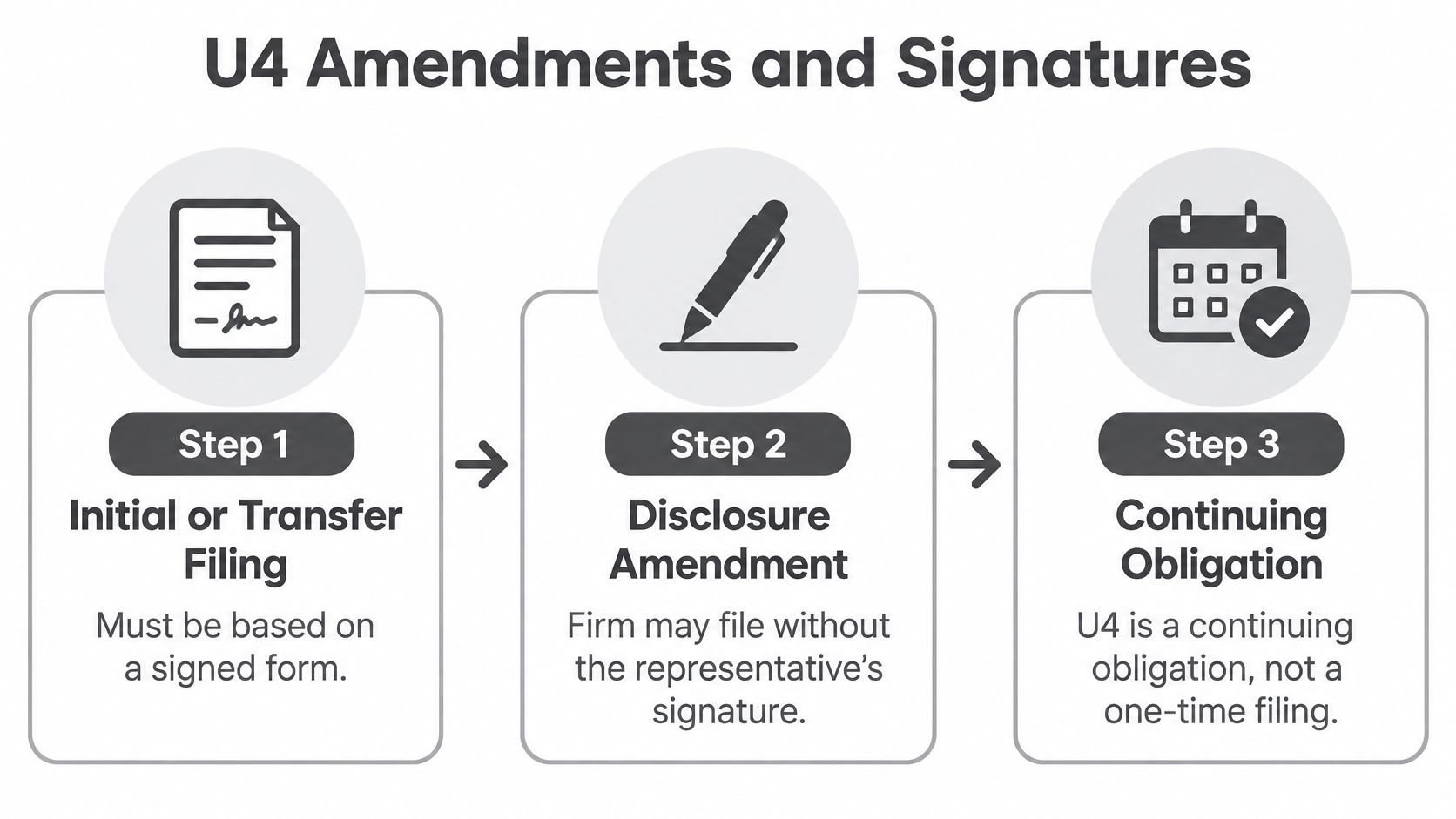
The U4 isn't a one-time filing. After registration, the associated person and the firm must keep the information current by filing amendments under FINRA By-Laws Article V, Section 2. That duty is shared, which surprises advisors who assume compliance handles everything once the initial form is approved.
An initial or transfer filing generally has to be based on a signed form. A disclosure amendment is different. FINRA Rule 1010 permits a member firm to amend disclosure information without the individual's signature if it makes reasonable efforts to provide the amendment beforehand and obtain written acknowledgment. If those efforts fail, the firm still must file the disclosure information it knows, and it should give the individual a copy afterward.
Acknowledgment is not consent
This is the distinction that gets lost. A firm asking you to acknowledge an amendment is not asking for permission. It's documenting that you saw the language. The filing can proceed either way, which is why silence is the worst response available to you.
Say an advisor learns about a new customer complaint from a colleague, not from her firm. The amendment already went in. She never saw the wording, and the entry now describes the complaint with a date that doesn't match the client's own letter. The record is wrong and it's public.
Five steps when an amendment lands
- Request the proposed language in writing. Ask for the DRP text and the disclosure block as filed.
- Compare it against your own records. Statements, settlement documents, correspondence, and calendar entries.
- Respond in writing with any disagreement. Email creates a timestamp that a phone call doesn't.
- Keep every version. Drafts, final filings, and the emails that produced them.
- Correct material errors promptly. A wrong date is easy to fix now and much harder to explain after a regulator asks about it.
Firms must retain signed U4 forms and amendments and produce them promptly when a regulator asks, so version control isn't housekeeping. It's the difference between a corrected record and a disputed one.
There's a second clock running. Fingerprint information must be submitted promptly after an electronic filing, and if FINRA doesn't receive it within 30 days, the person's registration is deemed inactive, per FINRA's guide to completing Form U4. An advisor who ignores the operations emails about prints can find the registration lapsed while everything else looked fine.
Form U4 Versus Form U5 at a Glance
The U4 opens a registration. The U5 closes it. The closing document does more than end the relationship, though: it records how the relationship ended, and that description becomes part of the permanent file.
| Aspect | Form U4 | Form U5 |
|---|---|---|
| Purpose | Establishes registration | Ends registration |
| When filed | When a person is hired or transfers to a new firm | When the association with the firm ends |
| Who files | The member firm | The member firm |
| Core content | Identifying, residential, employment, and disclosure information | Reason for termination and any investigation or allegation |
| Ongoing duty | Amendments keep the record current | Amendments and corrections can follow the termination |
The U5 carries something the U4 doesn't: the firm's own characterization of why you left and whether you were the subject of an investigation or allegation at the time. That characterization reaches the next employer before your first conversation with them.
It helps to compare voluntary and involuntary separations before you resign, because a firm choosing between "voluntary" and "permitted to resign" is writing a sentence that will outlast the employment relationship. A U5 that describes your departure in terms your records don't support can become the basis of a defamation claim. If the wording is wrong, raise the discrepancy in writing promptly after the termination. Amendments and corrections can still be filed once the association ends, but a challenge raised right away is far easier to resolve than one surfaced after the next firm has already read the record.
Practical rule: The week you leave a firm, request a copy of the U5. Read the termination explanation and the investigation language line by line. If either conflicts with your records, dispute it in writing while the firm still has the file open.
What to compare during any transition
- Employment dates. They should match your U4 employment block exactly.
- Reason for leaving. The stated reason should describe what happened, not a category chosen for internal convenience.
- Reported events. Any investigation, complaint, or allegation the U5 mentions should match the underlying documents.
- Pending amendments. Confirm whether a disclosure amendment is still in flight as you exit.
Our guide to the Form U5 filing and what it records walks through the rest of the form. Read the two documents as one record, because a mismatch between them is visible to anyone who pulls the file.
How a U4 Follows an Advisor to the Next Firm
Maria spent six years as a registered representative at Firm A. Two years before she left, a client complaint went to arbitration and Firm A settled it. She signed the settlement, the client moved on, and she assumed the matter ended there.
It didn't. Firm B's Form U4 for Maria has to report that settled complaint, along with the amount stated in the settlement agreement, the parties, and the disposition. The disclosure follows her because it happened, not because anyone at Firm B went looking for it.

Before signing, Maria does the one thing that prevents most problems. She asks for the draft Disclosure Reporting Page and lays it next to the settlement papers. Parties, filing date, arbitration forum, the dollar figure, and the language describing how the matter resolved. Everything matches except the arbitration number, which is off by a digit. She flags it in an email and it gets corrected before the filing goes in.
Three months into the new role, a different client files a complaint. Firm B decides it's reportable and submits a disclosure amendment. It first tries to get Maria's written acknowledgment and doesn't get one, so it files anyway, which the rules allow.
Where the record bites
This is the part advisors underestimate. Maria's response decides whether the next five years are calm or expensive.
- The settled complaint stays on the CRD record. It can surface on BrokerCheck at every firm she joins from here. A clean explanation in the disclosure narrative does real work; an empty one leaves the client and the recruiter to guess.
- An inaccurate Section 14 answer invites a document request. A regulator comparing the stated date to the client's letter will ask for the source file, and now the question is about the accuracy of the filing, not the complaint.
- A U5 that conflicts with the U4 starts a new dispute. If Firm A's U5 characterizes her departure differently than the dates and description on her U4, the mismatch needs a written explanation. Where the exit followed a complaint about a supervisor's conduct, the same facts can support a wrongful termination theory alongside the U5 correction.
- A missed amendment becomes a supervision issue. The record has to stay current, and a firm that files late or incompletely answers for it. Advisors usually feel that pressure through tightened supervision, delayed registrations, or a stalled move.
In Maria's case, she requests the proposed wording on the new complaint, replies in writing that one date is wrong, and keeps every version and email in a folder. When the compliance officer asks her a year later why the amendment reads the way it does, she forwards two messages and the matter closes.
Transitions concentrate the risk. Advisors moving between broker-dealers often discover that an old disclosure was described differently at each firm, and our guide to the broker-dealer change process covers what to reconcile before the next U4 goes in.
Kons Law's Securities Arbitration practice handles securities industry employment disputes, Form U5 defamation matters, and securities industry rule violations. Get help before a regulatory inquiry, a disputed amendment, or a U5 that conflicts with your records turns into a registration problem.
Kons Law represents financial advisors and brokerage professionals in regulatory inquiries, disputed Form U4 amendments, and Form U5 defamation claims, and we can review a filing before you sign it. If you want to discuss your business law matter, contact Kons Law at (860) 920-5181, or request a consultation by filling out the form on our contact page and someone from the firm will get back in touch. Start at Kons Law to see how we handle these matters.
